New Honda Super N review – tiny hatchback is one of the most fun electric cars yet
Honda's small electric car is a charmer with genuine talent to give it appeal beyond its quirky design

Automotive history time. In the late 1940s, Japan’s rapid post-war industrialisation and mobilisation of its people had to be done economically. The upshot was that in 1949 the government created a special class of car, the kei-jidōsha, or ‘light automobile’, with restrictions on its size and engine capacity, plus favourable rates of tax, exemption from parking space ownership requirements, and other financial benefits.
Kei cars still exist today and make up a huge proportion of Japan’s domestic car sales, but very occasionally one breaks free and makes it to the UK. You’ll remember the Suzuki Cappuccino and Daihatsu Copen; you might be less familiar with the Subaru Vivio and Mitsubishi ‘i’. And now, sort of, there’s another: the Honda Super‑N.
> Honda Civic Type R (FL5, 2022 - 2026) review – the hot hatch that may never be beaten
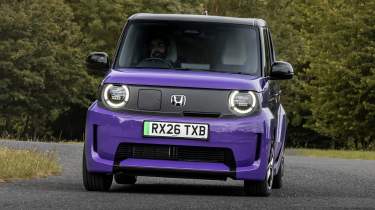
Under the skin, the Super‑N is heavily based on the Honda N‑One E, the electric version of a charming pseudo-retro kei car sold in Japan over a few generations since 2012. That said, the Super‑N doesn’t technically meet kei regs, due to its enlarged dimensions and extra power. At 1573mm it’s still amusingly narrow, but that’s still 100mm wider than the N-One, and it’s 204mm longer too. Most of the width is filled out by 185/55 tyres on 15-inch wheels (the true kei car gets 155s) and a wider track.
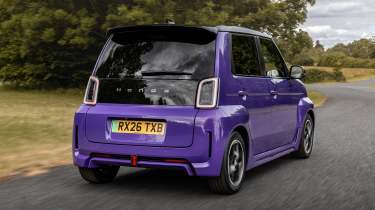
The overall effect is reminiscent of the old Honda City Turbo II, Honda’s bulldog-like hot hatch from 1983. The new car replicates the Turbo II’s wide-eyed face, with a functional vent in the grille to help cool the electrics, and a flat rump with upright tail-lights. The colour you see here though, Boost Violet Pearl, is brand new, and it’s echoed throughout the Super‑N. You’ll find it in the usual stuff like the touchscreen graphics and ambient lighting, but the most prominent reference is the BOOST button on the steering wheel.

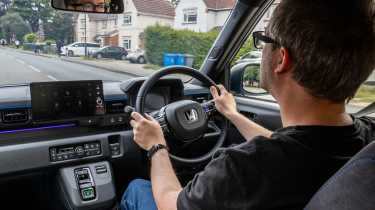
Unlike the slightly redundant OV ‘overtake’ button in an Alpine A290, the BOOST button here is something you’ll end up using frequently, if not permanently. For a start, it raises power from a kei-car-friendly 63bhp to the full 94bhp, reducing the 0-62mph time from a distinctly tepid 14.5 seconds to a livelier ten-flat. It also turns on Active Sound Control, a piped-in combustion-engine facsimile that Honda says is a cross between what you’ll hear in the City Turbo and an Integra Type R. More intriguingly still, it activates a simulated ‘gearshift’ mode.
The idea is similar to the S+ Shift in the new Prelude, but given that this is a full EV, the similarly all-electric Hyundai Ioniq 5 N’s N Grin Shift is a better basis for comparison. Acceleration and ‘engine braking’ are gear-dependent, the system briefly interrupts power while you shift up and down, and if you so choose, you can bang into the virtual rev-limiter by not shifting up. Conversely, you can also leave it in auto, where it’ll shuffle up and down just as an ICE vehicle with a regular auto or DCT would.
In some ways it’s even more convincing here than in the 5 N, since in the Hyundai you’re always partly aware that the fake gearshifts mean slower progress than just letting an EV be an EV, but as they come part and parcel here with a boost in power and sharper accelerator response, this feels like the only way to drive the Super‑N.
Performance is still modest, and the growly low-frequency engine sounds certainly aren’t very Integra Type R to my ears (nor is the virtual rev limit, which feels a bit diesely), but neither is it unpleasant, and the feel of the gearshifts and the behaviour in each ratio is impressively authentic. As braking regen is gear-dependent, you’re encouraged to use the regular friction brakes too (discs front, drums rear), which have pretty decent pedal feel.
It’d all be for nought if the rest of the package wasn’t up to scratch, but it’s hard not to like how the Honda goes about things. The ride is the first thing to impress: it’s firm, and the short wheelbase makes it energetic over bigger bumps, but it also rounds off the edges of sharp intrusions beautifully, and the structure feels stiff too. The steering is light and glassy but precise and loads up naturally, while the light-for-an-EV 1097kg kerb weight and reasonable grip from those 185s (Yokohama Advan Flevas, for sporty handling over ultimate range) give it a chuckable character.
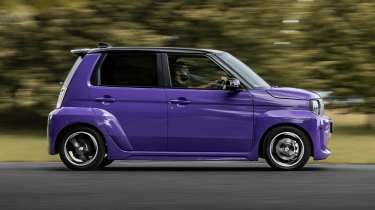
Honda gets all the detail stuff right too, and economises only where it doesn’t really matter. The supportive City Turbo-inspired front seats are fabulous, but the surprisingly spacious rear bench is about as basic as they come, and, unlike the sound, really does bring the old Integra to mind. The two-spoke wheel feels good and the triple-gauge display in BOOST mode is funky, while the car’s tiny dimensions (and effective one-pedal City driving mode) mean urban mooching feels like playing on Easy mode.
Price and rivals
More history: back in 2020, Honda launched the E. It was a funky B-segment city car but sold poorly due to a high price (£29,660) and low range (136 miles). The Super‑N’s official range is only 128 miles (though Honda quotes 199 city miles, and our mixed drive suggested at least 150), but at £18,995 it’s among the cheapest EVs, and indeed enthusiast cars, on the road. Not bad considering it’s also one of the most fun.
In terms of rivals the Super N can probably count the new Renault Twingo as its closest. There's no official pricing for the Renault yet but estimations have it very close to the Honda, in the £19,000 range. You might also consider Fiat's electric Grande Panda, which beats it for official range but is a little more expensive.