Best electric cars – from BMW i3 to the Rimac Nevera
There's a huge variety of electric cars on sale in 2026, and we've picked the best of the breed for those looking for performance
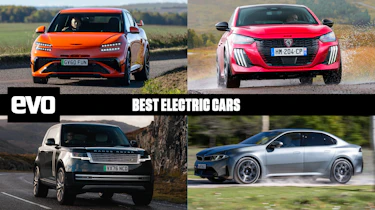
The electric car market, in spite of the challenges it’s faced over the last couple of years, is really picking up steam, even where driving enthusiast options are concerned. The best electric cars now offer long ranges and driving experiences that go just as far towards hiding the weight of those batteries.
Hyundai’s N-badged Ioniq models (plus the new Genesis Magma) have proven performance EVs can be a riot, while the new BMW i3, Porsche Cayenne Electric and Range Rover electric are worthy EV inclusions in the ranks of evo-sanctioned daily drivers.
The hot hatch breed that died a bit of a death in the last couple of years is being reborn in the EV space, with Alpine’s A290 and Peugeot’s E-208 GTI proving to be worthy showings. And soon, Jaguar’s Type 01, AMG’s GT 4-door and CLA 45, BMW’s electric M3 and Ferrari’s Luce will give us further cause for optimism. The premium and performance end of the market can do a lot with motors and a battery rather than hydrocarbons and pistons.
Which are evo’s current favourite EVs? From sports saloons to crossovers and hypercars, we’ve listed the best electric cars we’ve driven below, with a ‘best of the rest’ entry to round it off.
The best electric cars to buy in 2026
- BMW i3
- Peugeot e-208 GTI
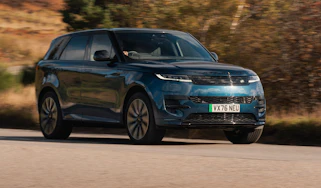
- Range Rover Electric
- Genesis GV60 Magma
- Renault Twingo
- Honda Super N
- Lucid Air Sapphire
- Polestar 5
- Porsche Taycan
- Porsche Cayenne Electric
- Hyundai Ioniq 6 N
- Renault 5
- Rimac Nevera R
BMW i3
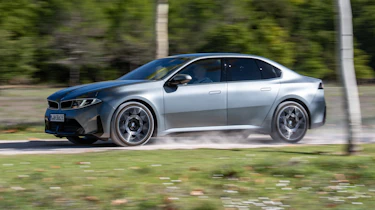
- Pros – Superb refinement, performance, handling and range
- Cons – HMI is a challenge initially, seats
- evo rating: 4.5
Arguably it’s the one we’ve all been waiting for. When BMW announced its upcoming Neue Klasse era, with double-figure percentage-point jumps in efficiency, response and range, the message was clear: this will be the EV to sway the sceptics. The iX3 proved BMW’s tech claims to be credible but isn’t really our sort of EV. The i3 is much more like it – a handsome, slippery saloon that’s intelligently packaged, efficient and crucially, impressively resolved in terms of dynamics and refinement. In other words, it’s what you’d hope to get from an electric version of the world’s best, longest-serving driver’s saloon.
While BMW’s WLTP-verified range claim of 559 miles for the 50 xDrive isn’t exactly what you’ll get in the real world and comes with the catch of an enormous battery to deliver it, this is still a seriously impressive electric car in terms of range. Being able to charge at 400kW to get juice enough for 250 miles in as little as ten minutes is another big plus.
Peugeot E-208 GTI
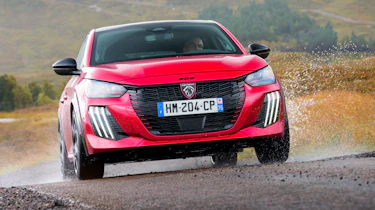
- Pros – Great design, strong power, responsive chassis
- Cons – Uninspiring sound, ageing cabin, range
- Evo rating: 4 stars
The weight of expectation has hung over the E-208 GTI since its reveal at Le Mans last year. Was it worth the long wait? In a way, yes.
It’s certainly the most driver-focused product of the many from Stellantis that use its mechanical limited-slip diff and 271bhp electric motor. It looks and feels the part outside and in, with properly punchy seats and aggressive highlighting.
It feels the most like a proper hot hatch, with a responsive chassis, well-resolved brakes and impressive, class-leading performance that sees it hit 62mph from rest in just 5.5sec. But it’s also slightly compromised in terms of its day-to-day amenability, with a ride that’s not for the faint of heart. That’s not to mention that it’s quite porky for a small hot hatch too, at 1546kg – a BMW M3 figure not so many years ago. Nonetheless, a commendable effort.
Range Rover electric
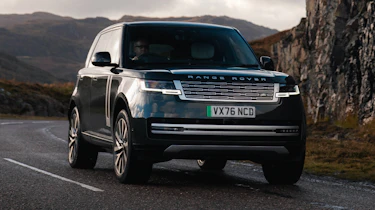
- Pros – Effortless comfort, silent, emissions-free driving
- Cons – Most people will still hate you for driving one
- evo rating: 4 stars
Another long-standing automotive institution has gained electrification. Thankfully, the long wait for the Range Rover electric has been worth it. It’s one of those cars, like a Rolls-Royce, that entirely suits being electric. The instant, silent performance is an improvement in every way in terms of what you expect from a Range Rover powertrain.
The Range Rover doesn’t go for headline-grabbing figures either. 542bhp and 627lb ft doesn’t sound huge in today’s world of excessively performant EVs but actually, it’s a perfectly measured amount for ample performance – again, just what you expect of a Range Rover.
This restraint means that there’s reasonable range, with a bold claim of 330 miles in the real world from its 118kWh battery. New twin-chamber air suspension that’s been recalibrated for the lower centre of gravity and changed weight distribution is still controlled and cushioned as you’d expect of a Range Rover, better even thanks to that lower centre of gravity.
If you don’t live and die by the top trumps, this is a seriously impressive option, if an expensive one at £154,070 for the EV550 - though ‘lesser’ models are coming. You can also count the Range Rover Sport electric here, which offers much the same competence and appeal as the full-size Range Rover.
Genesis GV60 Magma
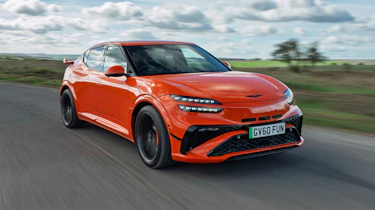
- Pros – A dynamically equal and better sounding Ioniq 5 N
- Cons – A more expensive one too
- evo rating: 4.5 stars
The Genesis GV60 Magma has been a long-time coming, which is strange to say of a car that essentially is a reclothed Hyundai Ioniq 5 N that’s £10k more expensive. There is appeal here in comparison to the Hyundai, however. The synthetic sound is a bit more palatable, emulating a high-revving V6 rather than a four-cylinder. If the Hyundai’s blocky retro-futuristic looks aren’t for you, the Genesis could also appeal. Likewise, inside it’s a much more upmarket, luxurious product, with its own UI and an expensive use of materials.
Otherwise, it appeals in all the ways the Ioniq Ns do. Its power distribution makes it extraordinarily agile and adjustable. Its damping is really serious, in terms of its control and composure. Plus, there’s how it can emulate the gears and rev bands of an ICE performance car, to give the driver more to interact with. A gimmick, yes. But one that elevates your experience for sure. Just remember that enthusiastic driving on the road will mean charging every 150-200 miles.
Renault Twingo
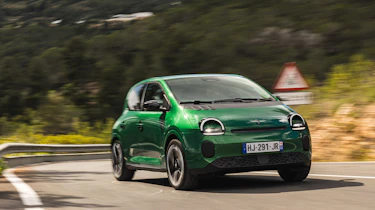
- Pros – Affordable; roomy; characterful; thoughtfully designed; built to a price but doesn’t feel cheap
- Cons – Range best suited to urban mileage than longer trips
- evo rating: 4.5 stars
Many wondered if the Renault 5 was a fluke from the French manufacturer. Time in its new baby sibling, the Twingo, has put that speculation to rest. If anything, it’s an even more appealing small car.
Somehow Renault has managed to create a high-quality, desirable product and offer it at what will seemingly be a bargain price of around £20,000 when it lands. It looks great inside, mitigating its use of some cheap materials with a variety of textures and design details so as to not feel basic. The user interface is commonsense and there are physical HVAC controls.
On the road the Twingo operates above its station too, feeling agile and pointy like a city car should but with some welcome composure on rougher roads. It’s far from perfect, its torsion beam rear end making it feel a little less sophisticated than the multi-link R5, but for its intended use, it’s a boon. And that’s the key. This is a car that knows exactly what it wants to be and has been developed with commendable focus to that end. The flip side of that is the range is far from extraordinary. Just 163 miles on the WLTP cycle won’t be remarkable in mixed driving but will be perfectly sufficient for a true city car.
Lucid Air Sapphire
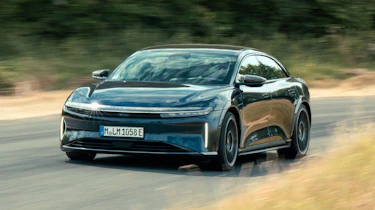
- Pros – Ambitious, innovative, embraces true torque-vectoring
- Cons – Heavy, brake feel, will probably make your family vomit
- evo rating: 4.5 stars
We all know power isn't everything, but that's often the sole metric by which performance EVs excel over their combustion-powered counterparts. You'd be forgiven for thinking the 1200bhp Lucid Air Sapphire was more of the same story, but thankfully, there's much more depth to its offering.
Having used models such as the excellent BMW M5 CS as a benchmark during development, the range-topping Lucid saloon doesn't only have hypercar power, but excellent dynamics too. Jethro Bovingdon said: '...a focus on a fluid, easy-going balance with an unfashionable amount of pitch, roll and dive goes some way towards recreating an enthusiast’s imagined past.'
Given the extreme adjustability a triple-motor setup allows for, it has full torque vectoring capabilities which shrink its vast dimensions around you. Bovingdon added: 'In slower turns it quickly chases understeer away with aggressive over-speeding of the rear axle; through quick turns you can feel it tweaking and cajoling the balance and holding the car in the perfect yaw angle.' It's one of the best quick saloons on the market as a result, if you can get your hands on one in the UK, that is.
Honda Super N
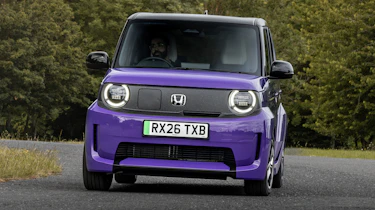
- Pros – Fun looks, fun drive, virtual shifts, well priced
- Cons – Definitely not quick, range will be a hard sell
- evo rating: 4 stars
The Japanese Kei car has always been a fascination of those from the west, with ultra-compact dimensions, subsequent low kerb weight and charming styling all part of the package. The Kei-derived Suzuki Jimny was sold out for almost the entirety of its time on sale in the UK, and while we haven't seen another model like it since, the new Honda Super N brings some of the magic back.
Its fun, boxy design makes it immediately clear that this is derived from a Kei car, with dimensions only marginally increased to allow for an increased track width. The reason for that change is that the Super N is a driver-focused model, but not in the same sense as a Type R.
Power stands at a very modest 94bhp for an even more modest 10sec 0-62mph time, but the use of virtual gears and a piped-in combustion engine sounds makes it feel much less dull than it sounds. It handles well too, with a firm but well-rounded ride and responsive steering making it just as chuckable as its looks would suggest. Better still, it's available from just £18,995 in the UK to make it one of the most accessible driver's cars on sale today, EV or not.
Polestar 5
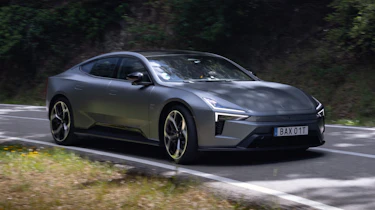
- Pros – Great looks; superb steering and damping; not as frenetic as a Taycan
- Cons – Lacks a Taycan’s precision; a whole lot heavier; cabin falls a little short for £100k; questions over range
- evo rating: 4 stars
The Polestar 5 is finally here, going on sale a full six years on from the debut of the Precept concept that previewed it. Happily, its crisp Scandinavian design hasn’t aged a day. What has is the market the 5 now joins, with premium electric cars not proving to be the sales successes many expected when its chief rival, the Porsche Taycan, went on sale.
Polestar persisted undeterred with the 5, with the focus on creating a worthy halo model; a flagbearer for the brand and a flex of its engineering muscles. To that end, it uses a bespoke bonded aluminium platform, electric motors, steering and damping systems – MagnerRide on the flagship and passive on the Dual Motor.
The result is a genuinely entertaining performance car, with good feel to its steering and fidelity in its damping. It wears the endless hours spent on its development on its sleeve. Conversely, it’s also more practical than the Taycan, less frenetic at a cruise and priced incredibly competitively. Though fewer are now cross-shopping this segment than perhaps Polestar would like, the 5 is nonetheless a genuine competitor worthy of consideration.
Porsche Taycan
- Pros – Fast, 421 miles is good range, drives as a Porsche should
- Cons – Expensive, touch-heavy UI, practicality
- evo rating: 4.5 stars
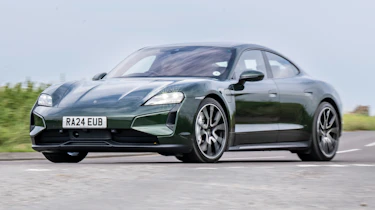
The Porsche Taycan has had a while to mature into the marketplace since it launched in 2019, and in the process it's become one of the very best electric cars on sale. Having received comprehensive updates to its powertrain, battery tech and chassis in 2024, the Taycan is now almost without weakness (ignoring question marks over residual values, that is...).
Every Taycan is quick – even the base rear-drive version hits 62mph in 4.8sec – but more important is that the driving experience feels distinctly Porsche-like. It steers with supreme accuracy and precision, and despite weighing 2090kg in its lightest form, it corners with the sure-footed poise of a genuine sports saloon. Porsche's Active Ride suspension technology comes to the fore here, giving the Taycan a freakish ability to resist roll and working all four tyres evenly through corners. It's one of the very best handling EVs you can buy, and the Taycan now has the range and efficiency to back this up, achieving up to 421 miles from a charge in single-motor guise.
Renault 5
- Pros – High quality engineering, premium feel
- Cons – Battery doesn’t like the cold weather
- evo rating: 4 stars
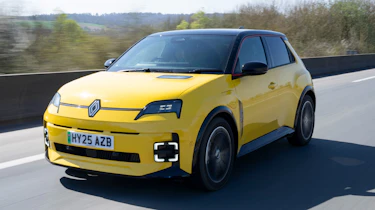
Since we first set eyes on Renault’s reborn 5 hatch in concept form in 2021, we had high hopes for what appeared to be exactly what the market needed: a small, desirable, affordable EV designed around the right priorities, hopefully for the right price. Now, having driven the final production version, the R5 has met all of our expectations.
The R5 has the kind of feel-good factor not found in this sector since the likes of the original BMW Mini, but that goes beyond its charming retro design. It's slick and satisfying to drive too, and though it was never going to be an intensely engaging hot hatch (Alpine was given that task with the technically-related A290), there is some fun to be had and enough zip for an 8sec 0-62mph time. Combine that with a respectable real-world range of 200-miles and an affordable £23k asking price (before you've lopped off £3500 with the electric car grant), and you have the makings of a mass-market EV success.
Rimac Nevera R
- Pros – A mesmerising, freakishly fast and totally absorbing hypercar
- Cons – We haven't driven it on the road
- evo rating: 5 stars
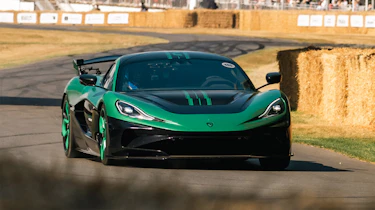
The spectacular Rimac Nevera uses some of the most advanced hardware and calibration ever seen on a road car to conjure an intuitive, organic and simply mesmerising driving experience. That it’s able to do so without the character and noise of a combustion engine has ignited our hopes for the future of performance cars – it’s that good. But as electric car technology continually progresses, Rimac hasn’t rested, the Nevera evolving into the even faster, more track focussed R version.
Compared to the ‘standard’ car it gets even more power – 2078bhp compared to 1887bhp – more aggressive aero and revised chassis tuning. The results are sublime. It’s not just the ludicrous manner in which the R deploys its power to the road, nor the enormous cornering forces it can generate. The Rimac achieves so much more than this, clearly communicating to the driver through every touch point and opening up a world of different driving behaviours via its torque vectoring quad-motor setup. Fully unleashing it is one of the most intense experiences you can have in a car.
Hyundai Ioniq 6 N
- Pros – Class-leading powertrain; engaging chassis; premium ride
- Cons – Weight; awkward design
- evo rating: 4.5 stars
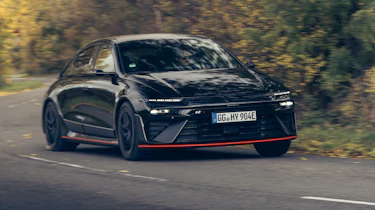
Hyundai hit it out of the park with its first performance EV, the Ioniq 5 N. It launched in 2023 as one of the most bold mainstream electric cars yet, with a huge array of software features and chassis configurability – including everything from a switchable torque-split to a simulated internal combustion engine mode, complete with virtual gearshifts, engine braking and a rev limiter. The result was the most interactive and fun EV we’ve driven this side of £100k, and the Ioniq 6 N saloon takes the same ingredients and applies them to a lower, sleeker saloon – to great effect.
With a 601bhp dual-motor setup (or 641bhp on overboost) it’s rapid, of course, and it has the same sense of deeply ingrained engineering quality as the 5 N. There’s a stiffer body structure than the standard Ioniq 6, revised suspension with different geometry, an e-LSD and again, a high level of configurability. The result is an electric supersaloon that’s more polished and rounded than the 5 N in some respects, but equally as much of a laugh. The driving experience pulls you in with accurate steering, controlled damping and handling that can be as expressive and adjustable as you’d want from a supersaloon. It’s another hit from the N division.
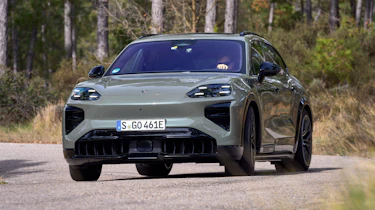
Porsche Cayenne Electric
- Pros – Astonishing performance; dynamic ability; refinement
- Cons – It needs expensive options to be at its best; excessive price and performance; middling range
- evo rating: 4 stars
Porsche’s Cayenne strategy has changed dramatically in the years since the Electric model was approved for development. Initially intended as a wholesale replacement, the Cayenne Electric will now be sold alongside its combustion and hybrid badge-mates.
Don’t mistake Porsche’s flagging confidence in the market for a lack of confidence in its own product, however. This is a highly impressive, technically advanced, well-engineered and resolved electric SUV. In the high-performance Turbo model, Porsche uses Formula E-inspired direct oil cooling. With almost 900bhp in standard mode, or over 1100bhp (yes really) in launch mode, it can trouble a Bugatti Veyron for acceleration performance.
However, being a Porsche, it’s also responsive, steers crisply and is comfortable yet controlled. With Porsche’s hydraulic active ride suspension system, it drives more like a fast estate than a higher-riding SUV.
The only thing you need to be aware of when looking at a Cayenne, is getting the right version, with the right options. The Turbo model’s extra performance is almost pointless compared to the S, so our recommendation is the S, with active ride, rear steering and Porsche’s PTV-Plus limited-slip diff. Watch how much of the power you use too. It’s claimed the Cayenne S Electric can go over 410 miles on a charge. That halves if you dig into its performance.
> Porsche Cayenne Electric review
Best of the rest
Such is the proliferation of offerings in the electric car market, that we can’t list them all in an efficient page. So here’s a roundup of the best of the rest.
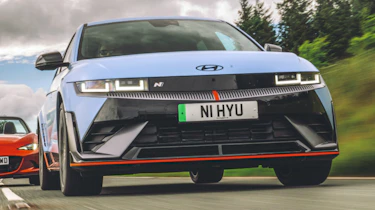
Hyundai's Ioniq 5 N is obviously an excellent choice, but it’s not as good as the 6 N and sounds worse than the Genesis GV60 Magma. If you’re into its more cartoonish looks, it’s a great shout. If you don’t want the intensity or expense of these models, Kia's EV6 GT is a toned-down but still extraordinarily capable and entertaining experience. Porsche Macan GTS Electric is also an option, albeit an expensive one. Likewise Alpine's A390, albeit a flawed one in terms of range. In fact, it was tough to exclude the A290, a commendable hot hatch, but the reality that it doesn’t offer enough over the already excellent Renault 5 bites a bit too hard.
Audi's e-tron GT is a stylish sibling to Porsche’s Taycan that, in the real world, is no less car than the Porsche and no less worthy of commendation. Lotus’s Emeya is a commendable super electric saloon too, if not the Taycan toppler some hoped.
The Peugeot E-208 GTI may be the best product of that particular box of Stellantis bits but the other options – the Alfa Romeo Junior Veloce, Abarth 600e, Vauxhall Corsa and Mokka GSE – are also well-resolved, if they take your preference.
Frequently Asked Questions
Most electric cars don’t have gears at all, with only forward, neutral and reverse. Some EVs, like Porsche’s Taycan and Mercedes’ CLA, have two forward gears, the second engaging at higher speeds for efficiency. An increasing number of performance EVs are also adopting fake ‘gears’ created with software to mimic the sound and feel of a gearbox in a petrol car and increase driver involvement.