McLaren MSO HS: the secret 205mph special born to save the brand
This could just be the best McLaren you’ve never heard of. We get the inside story on the ultra-exclusive, 675LT-based MSO HS

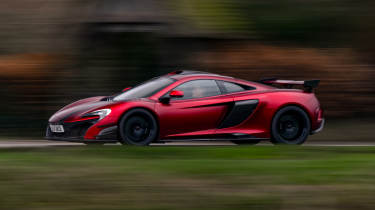
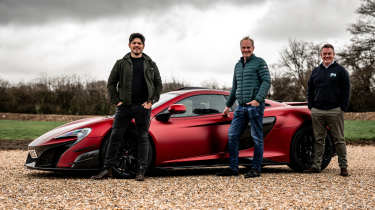
'An acquaintance of mine has a collection that includes one of just about every car McLaren has made, and of all of them, the HS is among his absolute favourites.’ I’m standing with James Banks, formerly head of Bespoke Cars at McLaren Special Operations (MSO), and we’re surveying one of the most exclusive projects the division ever worked on – and, by more than one account, one of the best cars ever to wear a McLaren badge, despite few people knowing it even exists.
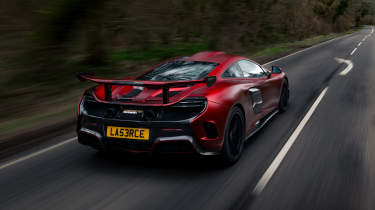
Should an MSO HS ever pass you in traffic, you certainly wouldn’t miss it, but you probably wouldn’t realise you’d seen anything out of the ordinary; perhaps a well-specified 650S or maybe a 675LT whose owner ticked the box for the carbon pack. There’s little on a quick glance to suggest it’s one of only 25 cars, each built on the same line as the P1 hypercar rather than the standard Super Series production line, and each a little different, tailored to the tastes of 25 hand-picked MSO clients. Never publicised, never wafted under the noses of the press, a real ‘in the know’ kind of car.
> McLaren 675LT (2015 - 2017) review – McLaren’s answer to the Ferrari 458 Speciale
The HS (it stands for High Sport) shows a different side to MSO than the one you’re probably familiar with. Search the internet for MSO commissions and you’ll mostly be presented with strikingly coloured versions of McLaren’s mainline cars, or one-off builds like the 12C-based X-1. The HS demonstrates MSO’s capacity for tackling engineering challenges as well as visual ones; many of the parts were designed, tested and manufactured solely for this car, with quality levels equal to or better than those on mainstream McLarens.
While the aim with the HS was to build something spectacular, it was also a necessity. McLaren Automotive has had its fair share of tumult in its relatively short history, much of it a natural side-effect of being a small-volume manufacturer that designs, engineers and builds almost everything in-house. As Banks relates, in 2015 things were going pretty well: ‘We launched the new car business in 2010, and did a pretty damn good job. There was the odd bump in the road, but starting from literally zero – no dealer network, no electrical architecture, no chassis, no nothing – we’d created the 12C, the P1 and the 650S.’
But with those cars making their way to customers and plans for further expansion, the company was rapidly outgrowing its dedicated production system, dubbed MAXIM, inherited from the Mercedes-Benz SLR McLaren and the F1 before it. There was a plan in place for this, thanks to technology partner SAP, but whereas a larger car maker might be able to migrate systems little by little, with multiple model lines to take up the slack, the transition at McLaren meant completely shutting down production for several weeks. As Banks puts it, ‘No cars, no output, no cashflow – for a company where cars spend six to seven weeks on the line and parts are ordered months in advance, the transition was a real threat to survival.’
The company turned to MSO, essentially with the task of creating something to fill that gap. And, as it happened, the timing was just about perfect for something truly special. The MSO team already had an idea rattling around for a special project, combining some elements of the then-new 650S GT3 car with the road car. Not only that, but there were P1 owners knocking on the door asking for a P1 without the hybrid elements, signalling demand for a lighter, more focused and more tactile model.
And while a stripped-down P1 wasn’t possible, a more specialised version of the 650S certainly was. The 675LT was just around the corner, itself inheriting lessons learned from the P1, but as designer Esteban Palazzo explains, a few of his ideas for the LT turned out to be a little too much for then-CEO Mike Flewitt. ‘The briefing for the 675LT was a track car for the road, so we created a proposal. We unveiled it to Mike Flewitt, and he essentially went, “What the hell is this?” because it was too much!
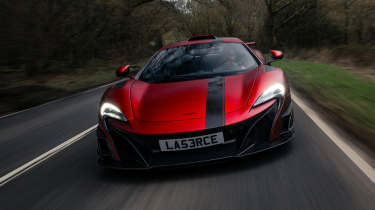
‘It’s quite common that when the idea of doing a new car arrives in the studio, the studio tends to be overly ambitious. The beauty of MSO is that you could green-light these more ambitious ideas, such as combining a GT3 car and a road car. On every project you generate an archive of ideas, dozens of proposals, and at some point this becomes the DNA of the next vehicle. With the HS, that meant incorporating the dive planes, the louvres, the roof scoop, the high-mounted wing…’
Up close, it’s easier to appreciate the differences between the HS and the 675LT to which it’s closely related. In part that’s thanks to spotting the carbon weave down the unpainted stripe on Banks’s personal car – a clue to the fact that the HS’s entire body is now formed from carbonfibre, like the P1’s. The roof scoop, such a notable part of the look, was actually already available from MSO – but rarely ordered – and feeds the V8 through two carbon channels that run behind the seats and into the engine bay, conveniently bringing a little more induction roar into the cabin.
‘There’s quite a lot of engineering, down to aperture size, so you get exactly the right airflow, exactly the right turbo noise coming back to the driver,’ explains former MSO lead engineer Paul Arkesden. The standard intake ports used on the 650 were blocked with special carbonfibre panels. ‘These pieces were super-expensive,’ Palazzo adds.
The wing was a custom part, inspired by the one on the GT3 car (which Palazzo had also designed). Arkesden shows me a sketch on his phone that depicts an early LT proposal that included the wing; as soon as the opportunity to build the HS came up, it was one of the first parts back on the drawing board. Unlike on the GT3 car, it still incorporates active aero, as used in the LT, but a bespoke actuation mechanism allows it to flip up more aggressively under braking, revealing a cross-section that wouldn’t look out of place on a Monaco-spec Formula 1 car. Dive planes, another feature not green-lit for the LT, also make an appearance.
Changes within the cabin are more subtle; the 675LT didn’t need improving ergonomically, but Alcantara is widely used to minimise reflections in the HS, while an integrated shift-light array was custom-designed and incorporated into the carbon hood for the instrument cluster.
Mechanically, Arkesden wryly sums up the differences between 675LT and HS as ‘all of the really boring limits that the main business had to put on that car, we could take off…’ That meant being able to run the engine at a higher temperature, being able to take away some of the torque limits imposed on the 675 (the LT’s electronics curb torque in third to prevent wheelspin; the HS has no such limit), and even better, being able to select the best engines from the line, these being identified by the BIPO or ‘Break In, Pass Off’ process.
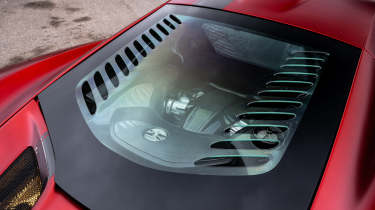
‘Every engine is dyno’d,’ explains Arkesden, ‘so for the HS project we just asked the team to keep an eye out over a four- or five-month period, and every time they saw a particularly powerful engine [due to the natural variations in production tolerances] to set it aside. So we started off with a better base engine.’ From that carefully selected base, every Ricardo-built V8 was then blueprinted, and heads were sent off to Cosworth, where the ports were enlarged within tolerances and hand-finished. While the HS was never given a power-based designation like the 650S or 675LT, Banks confirms that officially the car made 688 PS (679bhp) – a small increase over the 675LT, but a great example of the kind of optimisation MSO was able to achieve.
Perhaps wisely, the car retains its traction and stability control systems – ‘boring limits’ have their place, though Banks remarks that Dynamic mode is the base level for the stability control – but the car still has a much more aggressive feel than the LT. ‘We wanted the car to have a different character,’ says Arkesden. ‘Gareth Howell [the former touring car driver] was our test driver and did a lot of recalibration work at MIRA. We gave it a different shift map, different torque curves in each gear, and we had Gareth there to really exploit the changes.’
Spring rates were left as per the 675LT but, much as with the engines, suspension components were carefully selected to be as close to the ideal as possible, while geometry was standard but again tuned to the most precise calibrations. For wheels and tyres, the HS benefited from small changes that Palazzo had been able to make with the 675LT and its wider track: ‘We were really looking at what Porsche was doing with its wheel-to-wheelarch relationship. We got to the point where the fenders don’t have a lip – we were working with tolerances of 3mm, 7mm, to reduce the gap.’
Two questions then remained: how to build it, and how to sell it. For the former, Banks recalls that Dave Davies, a manufacturing engineer at McLaren, trained his team to build the car on the P1 technical assembly line, already well set up for such a specialised product. ‘It was ideal,’ says Banks. ‘In the end, McLaren didn’t end up having to go to zero production when it moved to SAP, but the P1 line was meticulous. They were more used to working in grey space – sometimes parts would just turn up, others were complete one-offs – rather than the ones and zeros of a standard production line.’
There was no brochure for the HS, no configurator on McLaren’s website. To sell the car, Banks already had a number of clients in mind who he knew would be interested, and he and his team ended up making 27 phone calls to sell the 25 cars, many of which would end up alongside an F1 and P1 in collections. Each buyer was able to personally configure their vehicle, though a few needed disclaimers writing up. ‘You had to acknowledge that your choice of dashboard colour was going to affect visibility, or the 24-carat gold in the engine bay might need restoration at some point down the line,’ says Palazzo.
Beautiful though the South Downs are, and despite attracting petrolheads like moths to a flame thanks to venues like Goodwood and Caffeine & Machine, they are not over-encumbered with great driving roads. Throw in a mixture of heavy traffic, speed cameras and poor weather, and today will not be the day to uncover the differences between 675LT and HS; badger the editor if you’d like to see a Greatest McLarens feature, of which the HS would undoubtedly be a part.
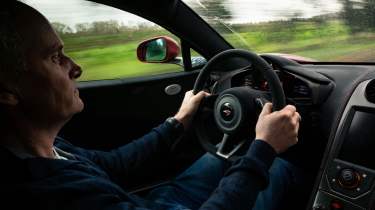
Even on what amounts to a potter around the nearby lanes, though, the HS displays a subtly different character from even that of Long Tail models, proportionally a similar step from LT to HS as the LT is over a standard 650S. It’s nuanced, but it’s there – a dash more weight and texture to the steering, an extra fizz of vibration through the carbon tub (not quite to A110 Ultime extremes, but more than you’d expect from a volume production car), and a touch more grit to the way the V8’s revs rise and fall with each squeeze of the pedal.
It’s also no more demanding to drive than any other McLaren, such that as an owner it’d be easy to forget you’re piloting something considerably more valuable than most other McLarens, or indeed every other car – and a few houses – in the immediate vicinity. The driving position remains perfect, noise levels aren’t significantly elevated at regular road speeds, and it still rides pliantly. A brief taste like this definitely doesn’t do the car justice, but Banks leaves me in no doubt as to how profound the differences are when driving it harder.
How much extra money? MSO has never disclosed what the HS sold for originally, though Banks notes that some have changed hands recently for around the £600,000 mark, while others have touched seven figures. Even the lower figure is two or three times the current price of a 675LT (and six or seven times that of a 650S), though compared with the £1m-1.6m of a P1, a car that across all its variants outnumbers the HS by fifteen to one, the HS seems like a bargain.
And if the rapid churn of models from Woking has taken the shine off the exclusivity of some McLarens, the HS at least remains truly special, to those who know about it. It’s a car that shows what MSO is capable of, conceived by a small team with clear goals, and it got McLaren out of a bit of a financial bind to boot. But most appropriately of all, it’s a driver’s car among driver’s cars; one that 25 fortunate owners consider to be right up there alongside the F1 and P1.
McLaren MSO HS specs
| Engine | V8, 3799cc, twin-turbo |
| Power | 679bhp @ 7100rpm |
| Torque | 516lb ft @ 5500-6500rpm |
| Weight | 1328kg |
| Power-to-weight | 520bhp/ton |
| Tyres | Pirelli P-Zero Trofeo R |
| 0-62mph | <3.0sec |
| Top speed | 205mph |
This story was first featured in evo issue 345.