Fiat Grande Panda review – as cool as a Renault 5 but with petrol power
Fiat’s take on the retro-modern small car has substance and talent to match its style

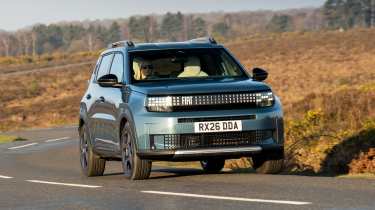
The Grande Panda couldn’t have come at a better time for Fiat. It feels like this cute, quirky little car is here to save the day in the same way the 500 did almost 20 years ago. It leverages retro-modern design and cute details to rail against the idea that small affordable cars need to be austere or lack desirability. But then behind the style, there’s substance. There’s real thought that’s been put into this car’s powertrain, user experience and market positioning.
It might be riding the coattails of the Renault 5 in this arena but the Panda has one key trump card: it isn’t an electric-only proposition, opening it up as an option to that huge subset of buyers who love the look of the 5 but can’t contort their lives around the (im)practicalities of EV ownership. Here’s how we got on after a week behind the wheel.
Engine, gearbox and performance
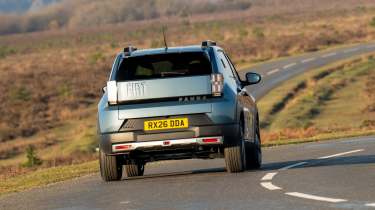
- EV or petrol hybrid powertrain options
- EV has 44kWh battery and 111bhp electric motor
- 1.2-litre Puretech three-cylinder hybrid produces 109bhp
The Panda’s secret weapon is choice. Specifically, a choice of powertrains. If you are a buyer with only a need for a small local run car and can charge an EV at home, the 111bhp electric version with its 44kWh battery should do just fine. If you’ll be depending on this car as your more regular transport with a varied range of use, the option of the 1.2-litre three-cylinder mild hybrid means the Panda’s still in the game.
Peak power of 109bhp doesn’t sound like much (nor the 0-62mph time of 11.2sec) and indeed it isn’t. It's only 9bhp up on the Panda 100hp of over two decades ago, which was itself not considered overburdened with potency when new. Nonetheless I never found myself asking for performance from the Panda hybrid and not receiving at least enough. It’s not fast, but the way the 1.2-litre Puretech engine coalesces with the 48-volt mild hybrid system and its electric motor means there’s a sense of pep and keen response to the Panda. This makes sense when you consider the modest-but-chunky-enough torque figure of 151lb ft, the same as a Volkswagen Up GTI.
More reviews
Group tests
Long term tests
Reviews
The six-speed dual-clutch transmission is an important part of this equation too. While you can’t change gear manually, the ‘box has been calibrated to work with the powertrain efficiently and smoothly, always being in the right gear at the right time and responding promptly to throttle inputs. Happily, for those who want a bit of extra involvement, a non MHEV manual is on the way as an entry-level model.
There’s no lust to this powertrain. I’d say it’s actually harsh with pervasive three-cylinder thrash when you’re asking it for everything it has. For most of the time however, you simply don’t think about what it’s doing. Nothing sticks out and that’s very much meant as a compliment.
MPG and running costs
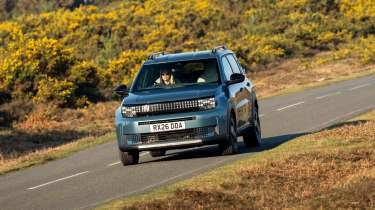
- Hybrid has claimed combined efficiency of 55.4mpg
- Reality is more like 45-50mpg
- Claimed electric range is 199 miles from a 44kWh battery
Fiat’s claim is that the Grande Pande mild hybrid should be good for a combined 55mpg. In our experience, we saw more like 45-50mpg, although a great deal of our time in the Panda was spent at motorway speeds, which aren’t where this powertrain is at its most efficient. In reality, when you’re trundling around at between 20 and 50mph, it’ll sip fuel at a rate closer to Fiat’s claim.

At very low speeds, in stop/start traffic, the Panda is even happy to run on electric alone, though you’ll need a feather foot to stay electric-only for any meaningful amount of time. The battery is, according to Fiat’s spec sheet, just 0.876kWh.
We haven’t tested the EV but the claimed range is 199 miles from its 44kWh battery. In reality, accounting for the c/20 per cent you lose in the real world compared to WLTP, you’ll probably see more like 160 miles, depending on the nature of your journeys and your driving style. In cold conditions, possibly even less…
Ride and handling
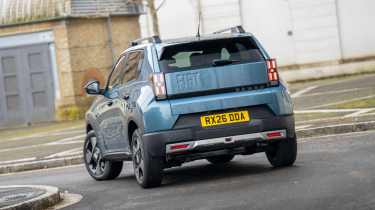
- Soft ride but also soft handling
- Fundamentally neutral enough handling balance
- Amusing (or terrifying) body roll
Let’s make this clear. The Panda is not a hot hatch. Truthfully, it’s actually a bit of a crossover (hence the Grande bit in the name); its cool cute styling cleverly distracting you from its jacked-up stature. You should temper your expectations of its dynamics accordingly.
On a nice sweeping country road, you can build up to a seven-tenths, flowing pace, without the Panda falling over itself. There’s prominent body roll and it takes a damper stroke and a half to settle over major disturbances but if you keep your speed appropriate, it does what it does with dignity. You learn what the appropriate speed is pretty quickly too. Push beyond what the Panda wants to do and the roll makes you feel like a post-deployment jack-in-a-box. The Renault 5 is a more sophisticated and capable car to drive; its independent rear axle, lower centre of gravity and more effective mitigation of body roll afford it greater composure.
The upside of floaty dynamics is the ride is generally good, the Panda cushioning you nicely from large, long-wavelength impacts. It’s no magic carpet mind, with high-frequency impacts – expansion joints in motorways, potholes and other such road blemishes – thunking through the frame.
The brakes are effective and inoffensive in feel and the steering is linear, with a rack and weighting appropriate for this sort of car. Unlike some small Fiats of the past, it’s not steering you need to micromanage at motorway speeds either, without sacrificing low-speed urban manoeuvrability.
Interior and tech
- Cabin is joyously designed, full of fun details
- Quality is better than you’d expect too
- Some material choices are curious nonetheless
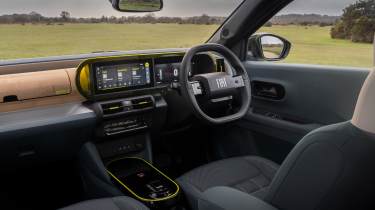
The inside of the Panda is as quirky and detail-laden as the outside, if not more so. Even the steering wheel, which is a slightly strange squircle shape, has a fun boxy airbag with the Fiat badge quad-hatch extruded at the bottom. Look to the infotainment screen and you’ll see a little original Panda within the clear yellow acrylic surround.
The yellow see-through plastic is an interesting material choice, as is the strange speckled plastic lining the scalloped-out dash (the shape inspired by Fiat’s Longotto rooftop test track), bringing to mind those horrendous mobile portaloos you see at music festivals and village fetes. All the same, most of the material choices in here are at least high quality, with sharp edges, squeaks and rattles few and far between. The cabin of a Renault 5 feels more premium and solid but this is a good effort nonetheless.
The 10.25-inch infotainment and digital driver’s display do feel a little last-generation, especially graphically. Its responses aren’t the best either but the user interface is at least intuitive. What is commendable is the retention of plenty of physical controls, for the climate and to switch off nannying assistance bongs. The seats are good, the view out is decent and there’s room to adjust your seating position without impeding rear passengers. Even the boot is a proper size.
Price and rivals
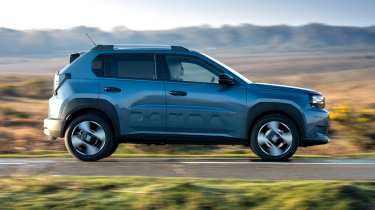
The Grande Panda is very competitively priced, starting from £18,995 in Hybrid ‘Pop’ trim, which comes with air conditioning, a multi-function wheel, USB-C charge ports, cruise control and more. Icon trim (probably the pick of the bunch) adds the Pixel LED headlamps, the Uconnect 10.25-inch infotainment system with smartphone connectivity and a few other extras for £19,995. Then La Prima jumps to £21,995, adding automatic climate control, 17-inch diamond cut alloy wheels, a heated steering wheel and heated front seats (courtesy of the winter pack). Electric models command a premium, priced from £21,000, £22,000 and £24,000 for the respective specs.
Being a Stellantis product, the Fiat Grande Panda can count a group mate or two as rivals, namely Citroen’s C3, which starts from £21,995, somewhat highlighting the Panda as the value proposition. Likewise the Renault 5, which is the only other car to rival the Panda for style and retro appeal. It too is pricey, starting from £21,495, and that’s for the lower-range model.