Driving the greatest ’70s supercars, from BMW M1 to Countach – car pictures of the week
In the latest issue of evo, we revisit 1970s supercar icons from Ferrari, Porsche, Lamborghini, BMW and more. These are our favourite shots

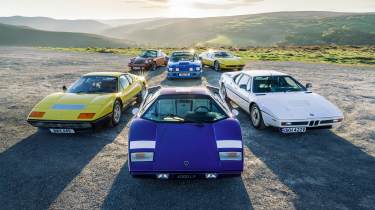
When did the first supercar appear? The answer is up for debate, with the likes of the Bentley Blower, Mercedes-Benz 300SL, Ford GT40 and Lamborghini Miura having solid claim to being the first, and launching in different decades. However, if you were to ask when the supercar really hit its stride, the answer is no doubt the 1970s. Manufacturers from all corners pushed the boundaries with wild shapes, technical innovation and startling (for the time) performance to compete in this elite sector, producing some of the most distinctive and desirable supercars of all.
In the current issue of evo, we gather the six '70s icons from the major players – Lamborghini, Ferrari, Aston Martin, Porsche, BMW and Maserati – to revisit this golden era of supercars, and discover what they’re like to drive today. To read the full feature, pick up a copy of evo issue 347 in-store or online via the evo shop.

Half a century old this group may be, their performance levels aren't to be underestimated. The least powerful car in the group, the Porsche 930 Turbo, has enough power to trouble a modern hot hatch (260bhp), while the Ferrari 512 BB, Lamborghini Countach and Aston Martin V8 Vantage produce in excess of 350bhp. Meanwhile the BMW M1 reaches 60mph as quickly as the latest Civic Type R, and the Maserati Bora’s 168mph top speed also matches Honda’s hot hatch.
These cars come from a time well before assists like traction control, anti-lock brakes and power steering, so using their performance takes more muscle and bravery than modern equivalents. The Countach – star of the test and the era in general – is a case in point.
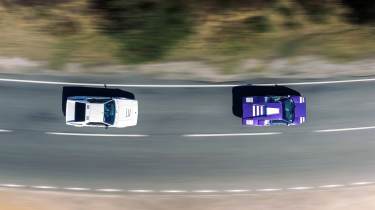
‘The unassisted steering starts uncomfortably heavy but proves quite manageable on a flowing road, hence the small steering wheel, while the car beneath you feels nicely biddable, its mass well damped,’ said evo’s John Barker. ‘There’s an inescapable pleasure versus pain ratio with the Countach, though. When it’s good, it’s very, very good, and when it’s not it all feels like a bit too much effort.’
To read the full feature, pick up a copy of evo 347 in-store or online.