Yangwang’s U9X breaks the 500km/h barrier, but SSC’s record still stands
The Yangwang U9 Xtreme is now the world’s first car to go faster than 500km/h, though not over a two-way run average

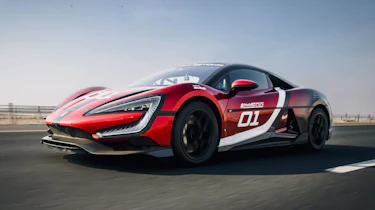
Not Bugatti, nor Koenigsegg, nor Hennessey, nor any other pretender to highest road car top speed throne has gone to or beyond the 500km/h barrier. The Yangwang U9 Xtreme that’s beaten them all to the punch has done so with battery rather than petrol power.
The 2978bhp Chinese hypercar made its high-speed run on the E11, in Abu Dhabi’s Al Dhafra region, on 1 November, with endurance racer Marc Basseng at the wheel. He hit a maximum FIA-recognised speed of 503.17kph, or 312.65mph, surpassing the U9 Xtreme’s former top speed of 496.22kph. Yangwang has declined however to set two-way averages, which mitigate the effects of a road's angle of attack and wind direction, meaning that specific record stays with the SSC Tuatara, which set a 282.9mph two-way average in 2021.

Four Guinness World Records did fall in the process of Yangwang’s runs: fastest production car in a single direction, fastest EV in a single direction, fastest EV tyre and fastest road car tyre for the Giti tyres the U9 Xtreme was wearing at the time.
The U9 Xtreme managed this feat by being well over twice as powerful as the standard U9 hypercar, which is already extremely potent with 1269bhp. Each of the car’s four motors was enhanced to allow speeds of up to 30,000rpm, thanks to use of the 0.1mm super-silicon steel for the stator and high-strength silicon-steel in the rotor. Higher-grade aluminium was also used for the motor housing. The car underwent some adjustments in between test runs, optimising tyre pressures, suspension settings and aerodynamics. Notably missing from this top-speed car is the swan-neck wing of the car that set the 6:59.157 Nürburgring lap time.
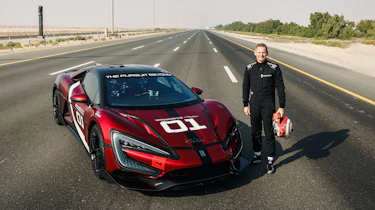
The U9X uses BYD’s proprietary lithium iron phosphate Blade battery tech, wired up with a 1200-volt electric architecture – thrice the potency of, say, a Volkswagen ID.3. That means more discharge capability, better thermal performance and therefore, more usable power. It’s not 3000bhp all the time though, with output dropping to 2400bhp when charge is at 20 per cent.

Nevermind its power and speed, though. The U9X’s Instagram gold party trick is of course the fact it can jump. That’s thanks to its DiSus-X body control system, with dual-valve electronic dampers, capable of delivering up to 50kN of active force in 120 milliseconds. In terms of handling, that means anti-roll bars are redundant, with the car even able to tip into corners, support its nose or tail to reduce dive or squat and, yes, jump into the air.
The first production-spec U9X has been built, with some of the 30 customers now configuring their cars ahead of production beginning properly. Maybe the U9 Xtreme will be another world-first for electric hypercars: one that actually sells…