Renault 5 Turbo 3E: Why the French firm is confident about its £140k hatchback
£140k for a Renault 5 is a huge ask. Here’s why the firm is confident in its unconventional supercar’s appeal and purpose
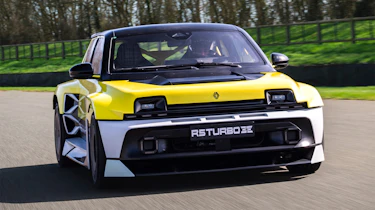
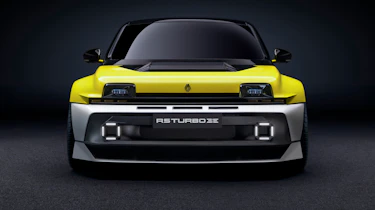
It’s no secret that high-end electric performance cars are a tough sell at the moment, ordinarily at least. But the Renault R5 Turbo 3E is anything but ordinary. Being a 547bhp rear-drive hatch built for track driving (and drifting), it promises a heavy dose of nostalgia, supercar levels of performance, customisability and exclusivity, not to mention and a huge dose of fun to go with it, albeit for a very punchy £140k asking price. There’s almost no way to rationalise a six-figure hot hatch, but that’s potentially part of its appeal. Having ridden in the Turbo 3E around Goodwood Circuit and had its rationale explained to us by its creators, its appeal is clear as day.
Despite looking like a concept car the Turbo 3E is far from a fantasy creation, being road legal and available to reserve, with a limited production run of 1980 units. As of October 2026, half of that 1980-car run is sold out, with the process of customer specification set to begin in mid-2027. Renault names everything from the Lotus Emira to the Nissan GT-R as the Turbo 3E’s potential competitors, although there’s currently nothing like it on the market.
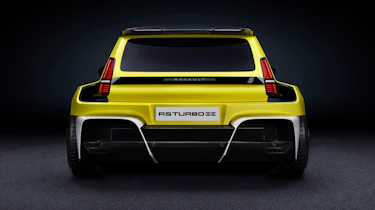
‘With this car, we have no real direct rival. This car is really unique,’ the car’s product lead, Florent Ingargiola, told evo. That’s because the Turbo 3E is a highly bespoke electric hot hatch that shares almost nothing with the base Renault 5. The exterior mirrors, door handles, tail lights, windscreen (albeit cut down) and the infotainment system are the only major shared components, with the Turbo 3E getting significantly widened, redesigned carbon bodywork and a unique aluminium EV platform developed by but not shared with Alpine Engineering. At 4.08 metres long and 2.03 metres wide, it’s as short as a supermini but the width of a supercar.
Renault 5 Turbo 3E: Innovative in-wheel electric motors
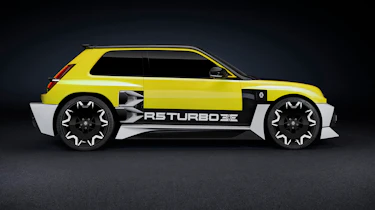
Like the original 5 Turbo, the 3E is rear-drive, but its source of propulsion couldn’t be more different. Being an EV it swaps the classic’s midship turbocharged four-pot for batteries and motors, with a 70kWh pack mounted in the floor powering a pair of rear e-motors with a combined 547bhp.
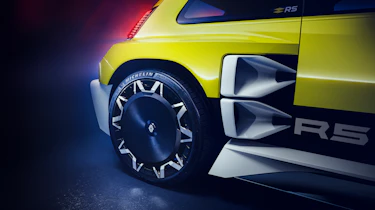
In a first for a production EV, these are in-wheel items mounted within 20-inch rims and forming part of the unsprung mass of the car, with the suspension pick up points and arms (double wishbones all round) reinforced and the dampers tuned accordingly. They supposedly provide even more instantaneous response than a conventional EV drivetrain and no transmission losses, and allow for torque vectoring across the rear axle. Alpine CEO Philippe Krief explained the benefits of the in-wheel tech to us:
‘Putting the motor in the wheel, there are three benefits. First, you free up the back for aerodynamics. Second, without the transmission it cuts response time. Normally, you press the throttle, that goes to the inverters, then to the motor, then through the transmission. Here, there’s no time delay because there’s no transmission. I can assure you that the results are just incredible. You have the sensation that you have another steering wheel. Third, globally, you also save weight, partly because you can downsize all the brakes.’
Ingargiola articulated the challenge of developing the powertrain to us: ‘The in-wheel motors have been the biggest challenge, non-suspended [unsprung] weight. Tuning the motors, which are really different to what we’ve had before, and tuning the tyres with Michelin specifically for the car. Other than that, it’s an 800-volt electric platform. We know this. The carbon body is unique, but not unique to the industry or Alpine.
‘But the in-wheel motors are the innovation. This was the only way we could enjoy the power that we put through the motors. Otherwise we’d have to do a different weight distribution. We wanted to keep the car agile, with rear-wheel drive, with this size and weight distribution. It would have been impossible any other way.’
Reducing weight has been key in its development, with the 3E tipping the scales at 1450kg – about the same as an FL5-generation Honda Civic Type R – with a 47:53 front-to-rear split. That helps it achieve a 3.5sec 0-62mph time and a 167mph top speed, with ‘over 248 miles’ available from a full charge.
Part of the Turbo 3E’s brief is to perform several hot laps on track between charges, with 20 minute sessions followed by 20 minute recharges. Thanks to an 800-volt architecture, the peak charging rate is 350kW which tops up the battery from 15 to 80 per cent in 15 minutes, with vehicle-to-grid and external device charging available too. As well as being capable of fast laps on track, the Turbo 3E has a wilder side, accessed via a drift mode and hydraulic handbrake.
Justifying a £140k Renault 5: Heritage, and future tech
Krief even admitted that the in-wheel technology has strong potential for future use by Alpine: ‘For a sporty car, the in-wheel motor is really quite promising. Today we are the first to do it, we need to industrialise it, make it efficient and reduce cost, but for us it makes a lot of sense.’
Likewise Renault CEO François Provost, sees the R5 Turbo 3E as a proof of concept for the technology, as well as a halo supercar to elevate the brand’s status and emotional appeal: ‘If you want to differentiate yourself, you need ambition, vision and emotion’ Provost told evo.
‘We have the chance to use our heritage, and the R5 Turbo does this. It’s also about technology. I want the in-wheel motor proof of concept, that we intend to consider for the future.’
Provost continued, explaining why Renault is uniquely positioned to be able to produce such a car: ‘A brand like Renault with its history can sell a kind of supercar. We can create a kind of halo of emotion that’s consistent with our brand and on top of this we can sell some cars.’
Product lead Ingargiola echoed these sentiments: ‘It fits the brand – we allow ourselves to do this kind of project. We are trying to show the industry and our customers that we are a brand of passion and immersion. We build your daily driver but we can also do this.’
Renault 5 Turbo 3E: hypercar-level customisation
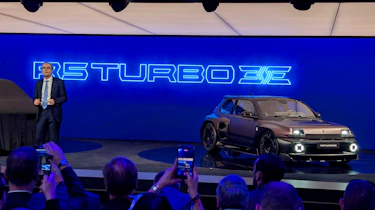
Provost proclaims the Turbo 3E is Renault’s supercar. It certainly has a supercar price and so, for all its unconventionality, it needs to appeal to supercar customers. The retro-Tonka toy aesthetic helps, as does the promise of extraordinary performance and fun.
But supercar buyers expect quality and customisation, too. To that end, Renault will have you covered, with new ateliers being built outside Paris and just off the Champs-Élysées. Colour and trim designer Éléonore Lebec explained to us the challenge of punching up with Renault’s artisanal scope and how programme’s like Aston Martin’s Q are the benchmark:
‘Today we are finessing the Taylor Made program that will require endless possibilities in terms of colour and trim design. It’s going to be massive. We have five people working on this, usually you have only two. The experience and customisation, we’ve benchmarked other customisation programmes.
‘The level of creativity we will allow customers, this is the most crazy part. This area requires that we have quite a lot in development right now. The customer must not be frustrated that there is any option they cannot take. We are fine-tuning, we are taking customer feedback.’
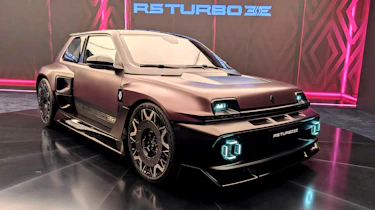
‘To validate one colour takes so much time,’ Ingargiola added. ‘There’s body colour, the colour of parts, and personalised items – from the centre console to the roll cage. There are so many items, where do we stop? What’s the minimum the customer will expect?
‘Customers asked for areas of visible carbon fibre and we’re trying to put it in the customisation program. The car’s already been revealed for some time, so we can talk to customers and adjust the program as we go through.’
What kind of customer is buying a Renault 5 Turbo 3E? Ingagiola says half of the 1980 cars are spoken for and there are all kinds of buyers:
‘We talked to our customers and they’re all so different. Some of them are huge collectors, some are giving their everything to get the Turbo. One has every Twingo, and is ordering a Turbo 3E. Some are coming for the design, some are coming or the Turbo heritage, some are coming for the unique engineering. For Turbo it was never about how many we booked. Even if we booked 10 per cent, we would still build the car and sell them after.'
On track in the Renault 5 Turbo 3E
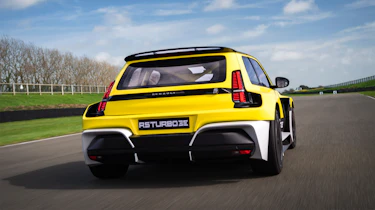
It’s some time before we can experience it from the driver’s seat, but a few laps around Goodwood Motor Circuit in the passenger seat of a Turbo 3E has given us an idea of what to expect. In short? It’s as mad and extreme as it looks, and quite unlike any EV we’ve experienced.
This Turbo 3E is a development prototype, driven by Alpine vehicle dynamics engineer David Praschl. The setup and dynamics aren’t fully signed off yet, and certain elements such as the launch control system aren’t usable. Neither, unfortunately, is the enormous fluorescent yellow hydraulic handbrake separating us in the cabin.
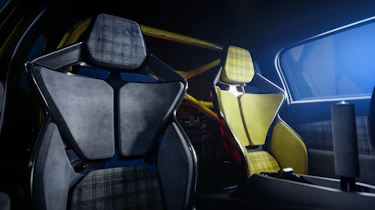
Inside there are elements from existing Renault Group cars (a steering wheel borrowed from the Alpine A290 and the R5’s dual display panel, for example) baked into a redesigned cabin architecture. There’s a new dashboard, door cards with fabric pulls and a high central tunnel, while the seats are carbon buckets with six-point harnesses. Behind you there’s netting and a half cage, and a surprisingly generous luggage area (made possible by the compact in-wheel motors).
The driver is presented with a digital dash display that mimics the original 5 Turbo’s square dial pack. There’s also a boost button marked OV (for overtake) on the wheel, as well as a switch to cycle between four regen modes and a button to change from Snow, Regular, Sport, Race and the aforementioned drift mode.
We only have a couple of laps so there’s no time to play with the modes, but the Turbo 3E makes a big impression straight away. It takes off with that smooth, instant hit we’re used to from electric motors, but more of a surprise is that from the first few metres, it feels genuinely raw and racy. You’re not isolated from your surroundings as in most fast EVs – the Turbo 3E connects you to the road surface and relays plenty of noise, through the whine of the motors and the rush of its Michelin Cup 2 tyres against the tarmac. Pings and rattles from stones in the wheel arches add to the motorsport vibe.
It’s rapid, too. The relatively modest mass (for an EV) means it punts out of corners with real snap and energy. Down Goodwood’s back straight acceleration does tail off, but we still hit an indicated 220kph (137mph) before braking into Woodcote corner. The stopping power is violent, harness belts squeezing my chest as we tip into the long right hander.
Most importantly, the Turbo 3E doesn’t feel like an EV that’s dominated by its performance. Just as striking is how short, agile and playful it is in the hands of Praschl. It doesn’t feel like a conventional hot hatch, or a sports car in fact. It generates huge lateral grip but there’s a sense of it sitting square on the road, ready to change direction, or occasionally bite back when getting hard on the throttle out of slower turns. It doesn’t look easy to catch and hold slides, which Praschl puts down to the unfinished calibration of the chassis systems.
For all our hesitation around performance EVs, the Turbo 3E so far seems every bit as wild and intriguing as the original 5 Turbo – we can’t wait to drive it ourselves.
Price
The £140,000 figure is described by Renault as an ‘introductory price’, and doesn’t include the extensive customisation options that will be available to buyers. Indeed, Renault CEO François Provost confirmed to us that some buyers are speccing theirs up to €350,000. The so-called ‘dedicated reservation system’ is currently live and allows buyers to begin their R5 Turbo 3E ownership journey, and involves completing a form and selecting a preferred dealer. That dealer will then contact them to make an appointment at their nearest showroom, where they’ll sign a reservation form and place a deposit.