Audi RS4 (B9, 2018-2024) review – why the last RS4 lacked C63 AMG-beating magic
The B9 RS4 will be the last RS4 for now, as well as the last Audi of its type to utilise a combustion engine alone.
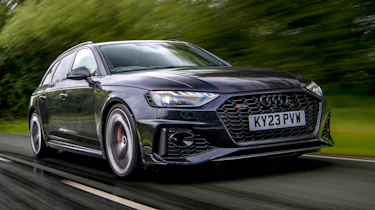
The Audi RS4 has long been the less hardcore, more sensible alternative to BMW’s M3 and Mercedes-AMG’s C63. Through the boosty and brilliant B6, the fabulous V8-powered B7, its unimpressive B8 update and back to turbocharged V6 power in the recently departed B9, the RS4 has rarely been able to match its closest rivals for outright thrills. As a package, though, there’s rarely been reason for the RS4 faithful to be disappointed with the dependable, straight-laced capability and performance the model has always offered.
The B9 RS4 first arrived in 2018 and served for six years, through to 2024, before being replaced by the new plug-in hybrid RS5. In that time it underwent a subtle update in 2020, but didn't change much mechanically; instead the changes focused on aesthetics inside and out. In 2022, however, the very limited edition RS4 Competition brought significant changes to the suspension and drivetrain, plus a small reduction in weight that came in part thanks to carbonfibre bucket seats. These upgrades carried over to the RS4 25 Years Edition that saw out the B9, with just 50 coming to the UK.
Engine, gearbox and performance
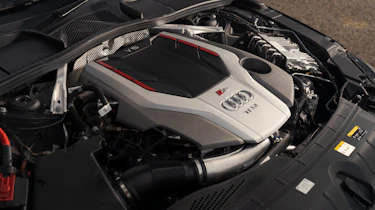
- 2.9-litre twin-turbo V6 is an effective engine, shared with Porsche
- The RS4 was outclassed by the M3 performance-wise in its later days
- This engine isn’t the most exciting in the class
More reviews
Group tests
In-depth reviews
Reviews
- Audi RS4 (B7, 2006 - 2008): V8 executive gives the BMW M3 a run for its money
- Audi RS4 Edition 25 years (2024 - 2025) review – a fitting farewell to the BMW M3 fighter?
- Audi RS4 Competition (2022 - 2023) review – sharpened estate eyes the M3 Touring
- Audi RS4 Avant B8 review (2012-2015) - price, specs and 0-60 time
The B9 RS4 came with a 2.9-litre twin-turbocharged V6 engine, co-developed with Porsche. Alongside its implementation in the RS4 and RS5 coupe and Sportback, this specific V6 was also found in Porsche’s Cayenne S and Panamera S, as well as the updated Macan Turbo, and lives on in hybridised form in the new plug-in hybrid Audi RS5 and RS5 Avant. Whereas the V8 of the B8 RS4 was connected to a dual-clutch transmission, the B9 made do with an eight-speed torque-converter automatic.

Aside from the obvious benefit of improved wet-weather traction, all-wheel drive also meant the RS4 was quick from a standstill, reaching 62mph in 4.1sec – on a par with the old Mercedes-AMG C63 S Estate and Alfa Romeo Giulia Quadrifoglio, which both pack at least 50bhp more than the 444bhp B9.
Unfortunately this parity doesn’t last, as the Audi will quickly lose ground to almost all of its direct rivals in the mid-range. In-gear response isn’t prohibitively worse, but compared with the hypersonic responses that both the AMG and Alfa are able to muster, the Audi can feel a tad more cumbersome. When on boost, the V6’s willingness to rev right through to its red line was also less apparent than in its rivals.
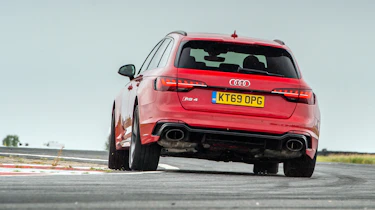
There’s an industrial feel to the powertrain of the B9 RS4, like it’s an extremely well-executed executive car that has been given some aggressive mapping rather than being an inherently performance-biased package. This is unsurprising when you remember this engine’s shared parentage and the role it played in two Porsche SUVs and a mid-level Panamera.
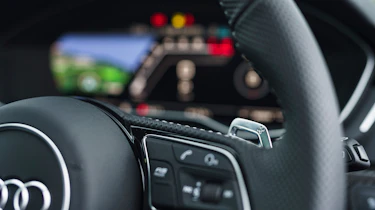
The transmission was always well-mannered when just pootling around, yet capable of impressively quick changes when the correct mode was selected. Gears change cleanly and smoothly, but select manual mode from the transmission’s Sport setting (the selected gear will turn red on the virtual cockpit) and the aggression rises, with ignition cuts, fuel dumps into the exhaust and short, sharp downshifts.
The engine noise in the cabin was always underwhelming, but drive with the windows down and the turbochargers make themselves known with plenty of wooshy noises and pops coming from both in front of and behind you. At least some induction noise would’ve been nice, though.
Driver’s note
‘Compared with its rivals over at AMG, the RS4’s outputs can appear a little undernourished, but the RS4’s immediate punch makes it every bit as fast as a C63 or C63 S out on the road. The 2.9-litre biturbo V6 boosts impossibly early and hits very hard, making the RS4 an absurdly effective overtaker.’ – Adam Towler.
Ride and handling
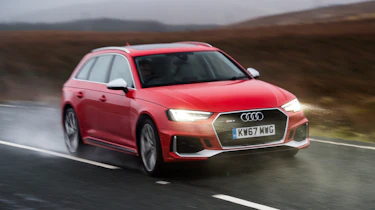
- Audi’s clever AWD system breeds capability but hasn’t much of a sense of humour
- The steering isn’t as direct as that of some rivals
- However, it’s supremely compliant on the road – it’s a super GT estate in character
As you’d expect, all four wheels in the B9 RS4 receive power via the usual quattro all-wheel-drive system, split mechanically 40:60 front-to-rear, although either axle can receive more depending on the available grip levels. All UK cars were fitted with the Sport Differential, which is able to mechanically manage torque across the rear axle. Suspension was by coil springs with adaptive dampers as standard, although Vorsprung models also featured Audi Sport’s Dynamic Ride Control system, which utilises a set of four hydraulically cross-linked dampers for increased support under hard cornering.

Audi’s dynamic steering was also included in the top-spec Vorsprung models, swapping the standard progressive EPAS rack for a speed-variable item that varies the amount of turns lock-to-lock depending on the road speed.
Of course, the big technical difference between the RS4 and other A4 models of its era is the bespoke body that’s 24mm wider. To achieve this, the entire body-in-white is unique to the RS4, with only the bonnet, roof, front doors and tailgate shared with lesser models. That’s a huge investment for a model with relatively low-volume production, but it has become a trademark of Audi’s RS4 since the first B5-generation car in 1999.
Filling those arches are wider tracks front and rear, along with an enlarged wheel and tyre package, plus larger cost-iron brakes or an optional carbon-ceramic set.
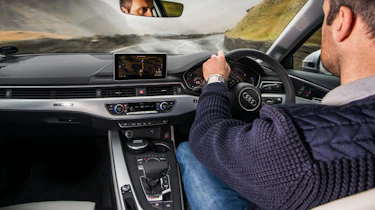
If you’re getting the sense that the B9 RS4 Avant is more of a high-speed GT than an M3-style track weapon, it’s because Audi Sport’s engineers designed it that way. Drive the B9 RS4 in maximum attack mode and it’ll struggle to contain its outright body movements. Get on the throttle and the nose will broadly push without nuance; go into bends on the brakes and the body feels a tad loose and lacks composure. Any sense of adjustability on or off the throttle is off the menu at road speeds; the body control dissolves before you have the chance to really start throwing it around.
Calm things down, though, and the RS4 makes more sense. Audi has significantly improved the chassis’ balance through the generations by a combination of inching its engine further back in the chassis and ditching the heavy V8. As a result, the B9 RS4 feels pretty well balanced, giving engineers a better baseline to develop from.
While the optional Dynamic Ride Control doesn’t feel set up for ultimate lateral support, it did give Audi the ability to dig deep into the dampers’ range of movement, giving the RS4’s suspension a wonderfully long-legged feel, as if the bump-stops are a foot above where you expect.
Hit severe undulations in the road and the B9 RS4’s wheels feel vacuum-sealed to the road surface, with excellent wheel control and the ability to breathe with the road even on rough and broken surfaces. The dynamic steering is predictable and accurate, its weighting varying between well-considered extremes depending on the mode, but each is well calibrated to the body control. It’s more measured and relaxed than the Mercedes and Alfa’s steering, and despite the variable ratio it rarely feels out of step with the body when pushing on.
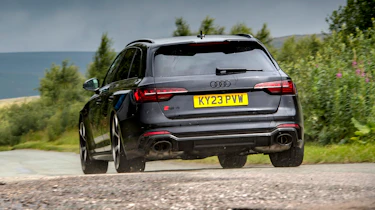
Much more serious in feel than the regular RS4 are the RS4 Competition and 25 Years models, which feature manually adjustable coilover suspension. In every way they are more controlled and more expensive in how they carry themselves down a road. The only downside? Manual adjustment means a setting that works on one road might come unstuck on another. Find the sweet spot, however, and these are dark horse driver’s cars.

Braking performance on the standard cast-iron items is up to the job on the road, with a nice bite at the top of the pedal and transparency through the travel. For track work, the carbon-ceramics would be a desirable option to seek out, but then we’d probably suggest an RS4 isn’t the car for that job anyway.
As predicted, the strength of the V6 is its incredible pick-up, regardless of revs, and so keen is it in a low gear that a pre-emptive tug of the upshift lever is required in manual mode if you’re not to snag the limiter. Combine that pace with the security of four-wheel drive and you have a very quick way of getting you – and four passengers and their luggage – from A to B.
Driver’s note
‘Out on the public road the RS4’s ride is smoother and its dynamic personality is more sophisticated than an AMG C63, undoubtedly feeling far more suited to the road than it does the track. You could argue that the RS4 is the better car for the real world, the world in which the ability to pull gigantic powerslides and to lap circuits faster has no great relevance to anyone.’ – Steve Sutcliffe, evo 282.
Interior and tech
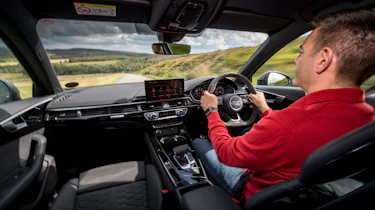
- Cabin feels a little old-fashioned now, but is high-quality and satisfyingly tactile
- It’s also relatively compact – the RS4 is a decade out-of-date space-wise
- Overall though, it’s comfortable and a very nice place to be
The RS4’s interior is less of a leap from that of standard A4 models than its exterior would suggest, which in many ways isn’t a bad thing. The basic interior layout is one of Audi’s older designs, with a high-mounted screen and physical controls for the air conditioning below. It’s a less contemporary look to that seen in Audi's newer models, but that will be a plus to some.
Compared with the original B9 RS4, the 2020 facelift model featured a larger touch-only infotainment screen, losing the lovely rotary dial on the centre console. Though quick and crisp when new, these systems were less intuitive than those of earlier cars with the rotary control. Both have aged visually; they feel like last-gen cabins, especially compared with the new Audi RS5’s.
Build quality is broadly excellent though, so too the materials, which eschewed wrapping every surface in faux leather and pointless stitching. The leather used on the seats, door trims and console was Audi’s wonderfully waxy nappa stuff. Truthfully, this generation of RS4 is a high point of Audi cabin quality, along with the third-gen TT. The touch points are also reassuringly solid, while the thin, firm perforated leather steering wheel is neither too big nor too small, although some might still find the flat bottom a tad irritating.
Unless you get an Audi Exclusive-spec example, interior colours and finishes are somewhat limited to black on black with a bit of coloured stitching here and there, but the overall aesthetic is sound. Space inside is good if not overly generous, while the standard pneumatically adjustable seats are superbly comfortable.
MPG & running costs
An advantage of the RS4’s relatively small body, V6 engine and low (relative) power figure is that its quoted 30-ish MPG should be entirely achievable on a daily mix of driving, even with a few heavy throttle applications thrown in.
The RS4’s footprint is rather chunky with 275-section tyres all-round, and it’s got some aggressive geometry too, so combined with a pretty even spread of power delivery you can expect tyre bills to be more substantial than with a normal A4. The all-wheel-drive systems also necessitate that you’re disciplined with your tyre replacements, with imbalances famed for causing issues.
From all accounts, the RS4's Porsche-developed V6 engine is a resilient and somewhat understressed unit, meaning that general reliability is pretty good. The engine saw service – and is still in use – across a lot of Porsche’s passenger car range, in many cases paired to a hybrid drive module, as well as in the new RS5 hybrids.
Long-term test – 8320 miles in the last Audi RS4
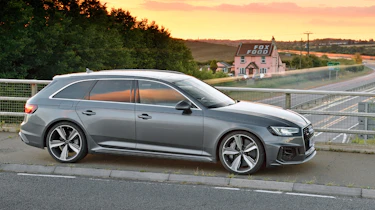
‘The RS4 made extreme yet everyday-usable performance so ludicrously accessible, and therein lay so much of its appeal, and also most of what, in my eyes, constituted its downfall.
‘Our RS4 arrived box fresh, and was so rippling with overt muscle and intent that it appeared almost a caricature of what the sporting German estate represents. I thought it seemed like a good idea to opt for the special milled 20-inch alloy wheels, only offered on the Carbon Edition launch model, as their quoted reduction in unsprung mass promised good things. Opinion was certainly divided, but the majority thought they were a bit “try hard”.
‘Did they help the ride? Well, apart from some low-speed fussiness, our RS4 rode very comfortably, although I think much of this was due to the adaptive dampers we’d also specified – a crucial box to tick in my view.
‘The nature of its performance lacked the ultimate satisfaction of a V8 AMG’s deep-chested torque, or the sheer bombast of an M3’s blown straight-six at higher rpm. And in spite of the optional sports exhaust fitted to our car, the distant woofles and the oddly grating soundtrack of the V6 were a disappointment.
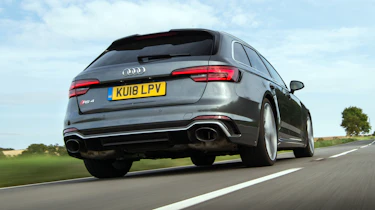
‘That was in keeping with the RS4’s overall demeanour: cool, calm effectiveness, complete control, unruffled traction, and that glossy, remote sort of accuracy characteristic of its maker’s cars. Driven flat out it was certainly exciting, but the velocities involved were so anti-social that this wasn’t practical most of the time.
‘At anything less than nine-tenths its personality shrank into the background, leaving little to reward the driver. I would have loved more breadth to its dynamic tuning: the Auto chassis setting was the only one I ever used, as Dynamic was too stiff for the road, yet the option of a slightly firmer setup would at times have been desirable.
‘Comfortable seats, a decent sound system, a head-up display – the RS4 offered all the usual luxury items, and, of course, having the estate body made it unerringly practical. It drank about a litre of oil early on, but none thereafter, and the only real snags were our bad fortune with punctures.
‘Around 24mpg was the norm with a mix of generally rapid driving. In the end, I never did quite come to terms with our Audi’s near 90-thousand-pounds price tag (up from £62k basic) given the actual experience it offered. Too often I’d wonder if a standard-spec S4 wagon at half the price wouldn’t have provided much of the RS4’s offering, most of the time, leaving change for something really interesting for the weekend.’ – Adam Towler
Prices and buying guide
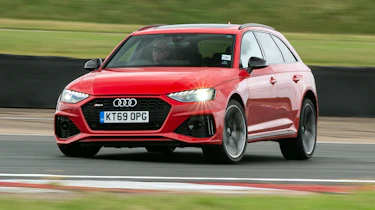
UK-specification RS4s were available in four distinct trim levels: basic, Carbon Sport and Vorsprung, with the hardcore Competition variant limited to just 75 units on our shores. These models collated different equipment combinations into individual models that do away with most single-option choices or option packages.
All B9 RS4s were well equipped, with things such as a sports exhaust, sports suspension, Audi’s Sport rear differential and 19-inch wheels. On top of this were a host of convenience features such as Matrix LED headlights, nappa leather sports seats, full navigation and a virtual cockpit.
You could specify carbon-ceramic brakes at £6150, a more vocal RS Sports Exhaust system for £1250, and the excellent DRC suspension upgrade – an essential – for £2000. The latter two were standard on the top-spec Vorsprung. If red brake calipers on the standard steel brakes were your thing, they were also available for £460.
Used B9 Audi RS4s are coming up for nine years old now and can be had for as low as £26k for the highest-mileage, lowest-spec examples. Vorsprungs are more expensive, being a newer spec that came with the facelift, and start from £40k, though they’ll have the desirable exhaust and damper options.
Be sure your chosen RS4 has a healthy set of brakes and branded tyres, a full service history and a clean MOT history. If you’re looking at a DRC-equipped car, listen for clunks on your test drive that could be a sign of failed actuators. The V6 engine can also have thermostat issues, similar to those on VW Group’s EA888 four-cylinder.
Specs
| Audi RS4 Avant (B9) | Audi RS4 Competition | |
|---|---|---|
| Engine | V6, 2894cc, twin-turbo | V6, 2894cc, twin-turbo |
| Power | 444bhp @ 5700rpm | 444bhp @ 5700rpm |
| Torque | 442lb ft @ 1900-5000rpm | 442lb ft @ 1900-5000rpm |
| Weight | 1745kg (259bhp/ton) | 1745kg (259bhp/ton) |
| 0-62mph | 4.1sec | 3.9sec |
| Top speed | 155mph | 180mph |
| Price new | £65,700 (2021) | £84,600 (2024) |
| Value now | From £26,000 | From £50,000 |