Best estate cars 2026 – family cars with space and pace
Haven’t got the space for your own sports car and a family hack? None do it better as a do-it-all performance car than a fast estate
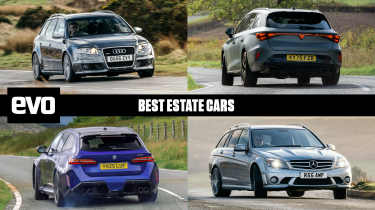
A good fast estate is the fun family car cheat code, rolling the sports car you’re not allowed and the load-lugging people hauler you were avoiding into one desirable do-it-all package. They’re cars that thrill and engage, then surprise you as you look in the rearview mirror and remember they’ve got as much space for passengers and tat as a dull SUV. Such is the cult status of the fast estate among die-hard car enthusiasts, that fast estates that never came to be are being created, with companies now making their own E46 BMW M3 Touring, a car BMW itself only made one of.

It's a genre that extends to numerous performance levels too – the cars we mention here have power figures ranging from under 280bhp to over 700bhp. Yet they all mix a level of discretion and practicality with genuine driver involvement that should be enough to tempt anyone away from a crossover or SUV.
Fast estates are evolving with the times too, with Audi’s latest RS5 Avant (taking the place of the time-honoured RS4), BMW’s M5 and Mercedes-AMG’s E53 bringing long-range plug-in hybridity to the party, albeit with the obvious weight penalty… Either way, most tastes and budgets can be catered to with a proper fast estate.
Best estate cars 2026
- BMW M3 CS Touring
- Audi RS5 Avant
- Mercedes-AMG E53
- Porsche Taycan Sport Turismo
- BMW M5 Touring
- Skoda Octavia VRS estate
- Audi S5
- BMW M340i xDrive Touring
- Cupra Leon 333 Estate
Used options
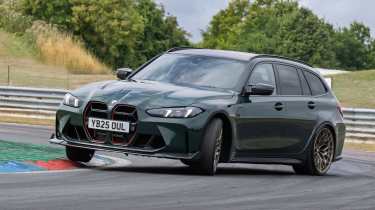
BMW M3 CS Touring
- Prices from: £126,275
- Pros: A hugely impressive road, track and family car
- Cons: For an equally huge price
- evo rating: 4.5 stars
There had been fears that the BMW M3 CS Touring would follow in the footsteps of its closer relations, rather than those of the old M5 CS, in never quite being the car to live up to that badge. On recent first impressions, we were wrong to be presumptuous. Of the three (M3 CS saloon, M4 CS and M3 CS Touring) it’s easily the most appealing. Changes compared to the standard M3 Touring include a bump to 543bhp, a CS-specific strut-brace and Michelin Pilot Sport Cup 2 tyres. It’s also been nominally lightened compared to the standard car, by 15kg, thanks to the carbon bonnet, aero addenda, interior trimmings and bucket seats. The M3 Touring already featured too new stiffening structures based on those found on the M4 Cabriolet to compensate for the lack of the coupe and saloon’s rear bulkhead.
Like in the standard car, the xDrive system is a defining factor, as few all-wheel-drive systems are more deftly calibrated. The M3 seems to magic traction from nowhere without compromising its balance, and the various stages of its engagement from 4WD, 4WD Sport and 2WD make it possible to set it up exactly how you want it.
‘In fact it’s hard to think of something the CS can’t do. Throw a set of Pilot Sport 4 Ss on it and it’d be a joy to use on the road all year round, and with Cup 2s on a dry track it can do frankly absurd things for a car with four doors and a 1510-litre carrying capacity. It is painfully expensive – you could buy a standard M3 Touring and a used Caterham 360R for the same money – but no other modern performance car combines so many talents at once.’ – Yousuf Ashraf, evo senior staff writer, who tested the M3 CS Touring on the road and on track in the UK.
Alternatives to the M3 CS Touring
In truth, the only downside to the M3 CS Touring is that it’s not a cheap car, starting at £126,000. You could quite happily get a used standard M3 Touring and a lovely modern classic Porsche 911 for that. But then that’s not a great one car solution. For £10k less as standard, you could have the 717bhp BMW M5 Touring but then, it’s vastly less involving and has a weight figure tantamount to the CS Touring with an old Elan on its roof. The Audi RS6 GT could be worth a look, though it is a lot more expensive, with used prices in the region of £200k. There’s also our next entrant to consider…
Audi RS5 Avant
- Basic price: £91,300
- Pros: More balanced than ever
- Cons: Doesn’t sound as good as the pipes promise
- evo rating: 4 stars
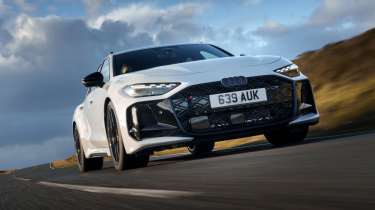
Think of a fast estate and the first to come to mind will likely be some form of RS Audi, in all likelihood the RS4. Unfortunately, the RS4 is now longer, though a new model has arrived in its stead. The new RS5 then, is not a coupe, but a saloon and an estate. By way of its plug-in hybrid system, it’s by far the most versatile RS Audi yet. And with that system supporting a 2.9-litre twin-turbo V6, it’s the most powerful of this junior RS estate lineage, with some 630bhp to call upon.
It’s a PHEV with significant range too, good for over 54 miles of electric-only running according to Audi. It’s also the heaviest, at 2370kg. But what about thrills? Happily, the new Audi RS5 is probably the best balanced of its lineage yet, even with a 25.7kW battery stuffed in its rump. That’s thanks to Audi’s Dynamic Torque Control rear axle, with a new electromechanical torque-vectoring rear differential, powered by a 10bhp, 30lb ft electric motor that can shift torque powerfully between the rear wheels in either direction.
The new two-valve dampers and five-link suspension also affords it the kind of comfort and control you’d neither expect of a car so heavy, or of a traditional fast Audi. It seems the new RS5 really isn’t a traditional fast Audi, for a number of reasons. It might not turn out to be an M3 Touring beater, but it could well be the best of its kind yet.
‘Some of the same sensations that were in the surprising RS6 GT are present in the RS5, particularly that connection to a back axle that feels alert and ready as soon as you turn into a corner, willing to be adjusted with more or less throttle as necessary. I wouldn’t say the big Audi feels delicately fleet of foot, but rather the B10 with its new tech doesn’t give you the sense that it’s carrying around 30 per cent more weight than the B9.’ – Henry Catchpole, evo contributing editor.
Alternatives to the Audi RS5 Avant
The most obvious alternative to the RS5 is the BMW M3 Touring. The Beemer is a good bit lighter and with M’s adaptive dampers, differential and xDrive, it’s likely the sharper steer, though back-to-back comparison is needed to know for sure. If you need a full-fat German and hybrid power, BMW’s M5 could be worth a look, or for more similar money to the RS5, Mercedes-AMG’s E53.
Mercedes-AMG E53 Estate
- Basic price: £94,540
- Pros: Well calibrated powertrain, refinement, long-distance comfort
- Cons: High weight, high price, dull powertrain, brake feel
- evo rating: 4 stars
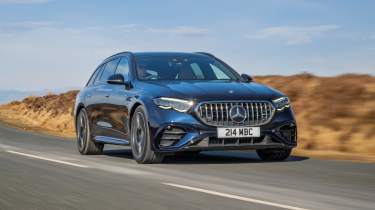
The Mercedes-AMG E53 is a bit of an awkward one, if you have fond memories of E63s of old. It’s important to know that this is not a successor to those cars, either in its positioning, in terms of performance or as an experience. Rather it is a flagship estate with an incredibly generous and impressive technical accompaniment. The powertrain combines Mercedes’ M256 3-litre turbocharged straight-six good for 443bhp with a 120kW electric motor sandwiched between the engine and transmission. The resulting 577bhp isn’t delivered with any of the old-school AMG hot rod brutality, rather togetherness, decorum and subtlety.
The E53 is blisteringly quick but is so with subtlety, never exchanging too much refinement for uncouth theatrics. For many of us that’s disappointing but in practice, the E53 is just a really good, effective fast road car. The way its adaptive dampers manage the mass, the way the 4matic AWD system distributes the power, works with steering that’s weighted and set up to be intuitive and a similarly well-balanced rear limited-slip differential. It puts you in mind of a car BMW no longer makes, the BMW M550i – again, not a full-on M car rival but a mighty machine to tackle most jobs. It’s a useful £20k cheaper than the M5 too. It’s not an all-time great thriller but in the real world, far from an evo comparison test, this is a car that should appeal to many.
‘The Mercedes-AMG E53 has much of the perceived performance of the bygone 63-badged cars and if anything, greater capability, without much of the character or drama.’ – Ethan Jupp, evo web editor, who tested the Mercedes-AMG E53 on the road in the UK
Alternatives to the Mercedes-AMG E53
The interesting thing about the E53 is it’s cannily positioned. The BMW M5 isn’t a direct rival – it’s much faster, more focused and more expensive, though we’d say given the funds it’s a worthy alternative. Likewise the E53 is of a higher station than, say, the M550e, which lacks a bit of M edge (and more than a little performance) compared to the Merc. Look at Porsche and the Panamera is worth a look, though for the same money you’ll only get the Panamera 4 E-Hybrid. The 4S E-Hybrid is a better match but is much more expensive and of course, the Sport Turismo no longer exists.
Porsche Taycan Sport Turismo
- Prices from: £89,400
- Pros: Exceptional performance, range and dynamic ability
- Cons: Comes at a hefty price; not as roomy as it should be; inconsistent brake feel
- evo rating: 4 stars
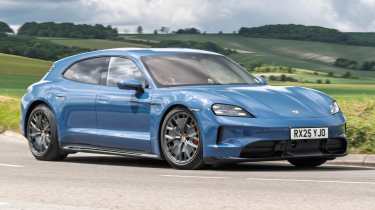
An all-electric estate on this list? Surely not. But the Porsche Taycan Sport Turismo really is an automotive Frankenstein of the best possible type. Sharing its J1 platform with the Taycan saloon and Audi e-tron GT, the Sport Turismo provides a distinctly Porsche feel in a versatile, zero-emissions package.
Following a comprehensive 2024 update, the Taycan can now go further and even faster than before, with added composure and comfort courtesy of Porsche’s clever Active Ride suspension tech. As of now, the 537bhp 4S feels like the sweet spot in the range, offering a sledgehammer hit of acceleration but remaining manageable and exploitable on the road.
With a kerb weight well beyond two tons, the Taycan doesn't quite move like a traditional sports car, but its precision and poise are almost unmatched in the EV space. The interior is quite cramped despite the generous exterior dimensions, but that aside, the Sport Turismo is one of the most broadly talented estates on sale – electric or otherwise.
‘The Taycan doesn’t feel light per se – you’re still conscious of the enormous forces the tyres are dealing with – but Active Ride makes use of all four contact patches by distributing the loads evenly across them, no matter what you throw at it. The (now standard) air suspension setup is impressively poised and flat to begin with, and Active Ride accentuates these qualities.’ – Yousuf Ashraf, evo senior staff writer, who tested the Taycan on the road in the UK.
Alternatives to the Taycan Sport Turismo
We’re supposedly in the era of electrification but the number of full EV estates on the market is vanishingly slim. The BMW i5 Touring and Audi S6 e-tron Avant are available but these really aren’t comparable options dynamically, even to the most basic Taycan, even if they are very fast in their own right. Instead if you’re powertrain agnostic, an Audi RS6 Performance or BMW M5 Touring would be worth investigating.
BMW M5 Touring
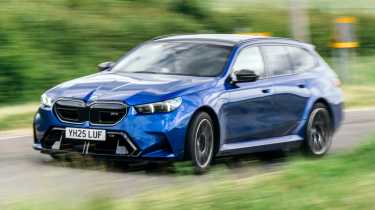
- Prices from £116,160
- Pros: Incredible levels of performance, no loss in agility
- Cons: Lacks the draw of its predecessors
- evo rating: 4 stars
With the latest-generation M5, BMW has given us the first M5 Touring since the E61, but also a very different interpretation of its flagship fast four door. A twin-turbo V8 remains at its heart, but it's mated with a plug-in hybrid system for the first time, the combined effect of which is a thumping 717bhp. And an even more colossal 2.5-ton kerb weight…yikes.
Yet somehow, despite the complexity and the enormous mass contained within the G99 M5 Touring’s swollen wide-track bodywork, BMW M has managed to make it go, stop and steer like an M car. The precision and agility is impressive for a car of this size, and there's monumental shove from the electrified V8 when you ask for it. You can also drive up to 41 miles on silent electric power, making the G99 one of the most versatile M5’s yet.
The flip side is that the M5 seems to have lost some of the endearing qualities that mark out the very best of the breed, such as the outgoing M5 CS. It has a very wide footprint on the road and feels more clean cut, less instantly lovable than its predecessors. Having said that, we can think of few better cars to live with on a daily basis, good for tip runs on some days and hassling 911s on others.
‘This is a car you have to get in the right modes and drive hard on the right road, to bring out the M personality - one that’s hungry for pace and eager to engage. To this end the M5 is at its best and most natural-feeling in the 4WD Sport drivetrain setting with traction control off, allowing you to fully exploit its agility and balance and get into an almost Nissan GT-R-like neutral flow.’ – Ethan Jupp, evo web editor, who tested the M5 Touring on the road in the UK
Alternatives to the BMW M5 Touring
For now the M5 Touring is the only proper performance estate to use hybrid drive. An RS6 with an electrified element will be along before too long but for now, it’s the outgoing all-V8 model you can have instead. That’s no bad thing, it’s the best RS6 yet, which against what is charitably a divisive M5 among fans, a very compelling option indeed.
Skoda Octavia vRS
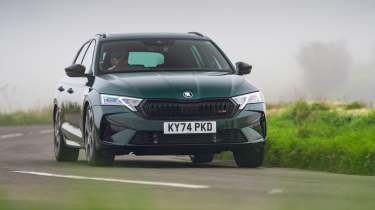
- Prices from: £41,765
- Pros: Everyday performance, practicality, price
- Cons: Interior materials, steering feel
- evo rating: 4 stars
Since the latest generation launched in 2020, the Octavia vRS has offered an unbeatable blend of space, performance and quality in its price bracket. A 2024 facelift has made it even better, with more power (261bhp), revised tech and sharp-suited but subtle styling.
Inside, Skoda's sensible side shines through with a brilliantly designed dash that is both clean and elegant (so much so as to have put a few VW boss's noses out of joint). The new model gets an upgraded 13-inch infotainment screen, along with a perforated leather steering wheel and sports seats to separate it from ordinary Octavias.
We’ve run several Octavia vRSs on our long-term Fast Fleet and they’re fantastic all-rounders. Unique suspension tuning and hot hatch levels of acceleration make them punch much harder than the sedate looks would have you believe, and there’s always a slight pang of disappointment when it’s time to hand the keys back. And at a smidgen over £40,000 the vRS estate looks like good value for money, too.
‘Body control is strong and despite a size (and weight) disadvantage over an equivalent hatchback, it doesn’t feel much bigger on the road. Steering is as linear as it was before, with the front end positive to provide the confidence you need on roads like this.’ – Sam Jenkins, evo senior staff writer, who tested the Octavia vRS on the road in the UK.
Alternatives to the Skoda Octavia vRS
The VW Group produces a strangely broad range of fast estates with all being worthy alternatives to the Skoda. The Golf R Estate remains a balanced and capable alternative, while the Cupra Leon 333 Estate adds a bit more aggressive and a flash of Spanish flare in the styling.
Audi S5 Avant
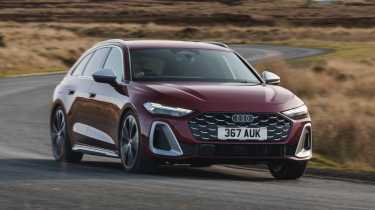
- Prices from £67,805
- Pros: Quick, refined, balanced, well-equipped
- Cons: Expensive, not the most thrilling
- evo rating: 4 stars
The Audi RS4 is no longer on sale and until the RS5 Avant arrives, the S5 Avant is your only option for a small fast Audi estate. For what will in the grand scheme of things be a middling warm model, this car is worth considering – it’s a very impressive device. With over 360bhp it has plenty of poke to be getting on with, if not so much to take your breath away. That motor now features Audi’s MHEV Plus 48-volt mild hybrid system, which means at low speeds for very short distances it can be electric-only.
What matters to us of course is that the power is delivered with a bit of charisma too, the twin-turbo V6 being possessed of more multi-layered vocals than we’re used to from many cars nowadays. There’s balance and nuance to the way it drives too. It’s well-damped and the car moves the power between the axles willingly. It’s not a drift machine but there’s balance and real cross country pace.
‘It’s very impressive and enormously capable. The ride and body control are great. But it’s just not engaging and compelling in the way you want a proper performance car to be. It’s no RS6 but a strong base for the forthcoming hybrid RS5.’ – Stuart Gallagher, evo editor-in-chief, who drove the new Audi S5 on the road in the UK.
Alternatives to the Audi S5
The strongest alternative to the S5 is from BMW in the form of the M340i xDrive (more on which in a moment). It’s less tied down, less uptight, more willing to work with you, while also having an uncanny ability to tour and breathe with the road. Look across to Mercedes and the C43 estate is worth a look too, though we’d rank the Audi in the middle between the Merc and the BMW.
BMW M340i xDrive Touring
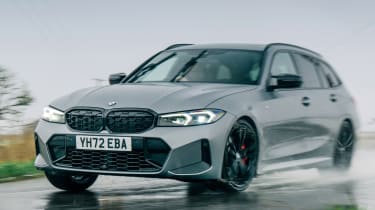
- £64,315
- Pros: Expressive chassis, seriously quick, beautifully made
- Cons: Brake pedal lacks bite
- evo rating: 4 stars
The M3 Touring is the benchmark fast estate and Alpina’s B3 Touring has already proved a compelling alternative, so where does BMW’s own M340i Touring sit? Somewhere beneath these two admittedly, but that’s no bad thing, and neither is the £25k saving that comes with the M-lite machine. Like many of the estates on this list, the M340i is one of the most capable and multi-talented cars on sale right now.
It’s fast, superbly built, well equipped, big enough for the family clobber, but without the egregious dimensions that larger executive estates have now established as the norm. The all-wheel-drive system also makes it weatherproof like few fast BMWs have ever been, yet not to the detriment of adjustability – it will still wag its tail if you try hard enough.
To top it off, BMW has also figured out how to make a petrol straight-six engine capable of sending a 1.8-ton estate to 62mph in under five seconds also return nearly 40mpg in normal driving. What’s not to like?
> BMW M340i xDrive Touring review
‘Truth be told, the impression of mass is well hidden and much of it can be dialled out with the dampers set to Sport+, where they manage to find breadth and control even through the most brutal dips and undulations.’ – Yousuf Ashraf, evo senior staff writer, who tested the M340i Touring on the road in the UK.
Alternatives to the BMW M340i xDrive Touring
As above, the BMW’s closest rival is the Audi S5 Avant. Even if it’s not as rewarding a driver’s car, it has a certain solidity and cross country determination that’s awfully appealing. There’s also the C43 for if you want your small executive car to more resemble a plush, glitzy luxury car.
Cupra Leon 333 estate
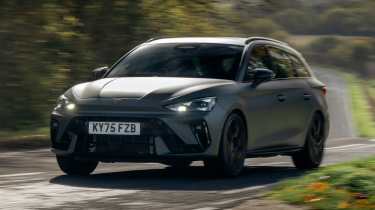
- Basic price £45,195
- Pros: Point-to-point pace, chassis balance, interior materials
- Cons: Steering feel, price
- evo rating: 4 stars
Skoda Octavia vRS a little staid? It’s worth looking to the Spanish and their take on the MQB Evo, EA888-powered estate. The Cupra Leon 333 Estate features the 326bhp version of the ubiquitous four-cylinder, feeding all four wheels via the venerable torque-splitter rear differential we enjoy in Audi’s RS3. It’s also suspended on DCC 15-way adjustable dampers and steers with greater clarity than the Volkswagen Golf R with which it shares its engine.
If you get to experience all that from the comfort, support and excellent driving position provided by the optional Sabelt carbon-backed bucket seats, the package proves unexpectedly compelling. Its responsive to turn in, capable in terms of outright grip but not so tied-down and dull that you don’t have options. There’s adjustability in the chassis, if not under power. Is it a pure driver’s car like a Civic Type R? No. But it’s the finest showing from this platform this side of VW’s Golf Edition 50.
> Cupra Leon 333 Estate review
‘Everything about the Leon just feels a bit keener, a bit more eager and more intuitive than the People’s Car equivalent. It’s more expressive and offers a clearer dialogue at speed, with more clarity on how it wants to move around under braking or with agitated steering inputs. – Ethan Jupp, evo web editor.
Alternatives to the Cupra Leon 333 Estate
There’s no escaping that this is an expensive car, at over £51,000 in VZ3 form (with the make-or-break seats). The alternatives however, are a step up again – Audi’s S5, BMW’s M340i and Mercedes-AMG’s CLA 45 Shooting Brake, which all start from well over £60,000.
Five used options
Audi RS4 Avant (B7)
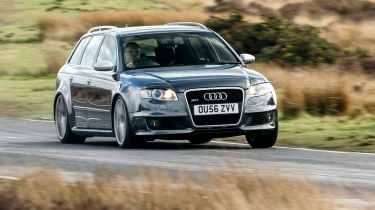
A recent test in which we reassembled a cohort of V8-engined small saloons from the 2000s golden era of natural aspiration revealed a surprising winner. Not the E90 BMW M3 with its screaming V8, not the monster C63, but the B7 RS4 Avant. The car that arguably opened the V8 floodgates in 2005 revealed itself to be the sweetest, most satisfying road driving device. It was a great car when new, but with the high-revving 4.2-litre V8 heart of an R8, its small size and beautifully judged damping and steering, its appeal has only intensified with two decades under its wheels. As is reflected in strong values, which at the time of writing, see a half decent car costing at least £20,000.
Mercedes C63 AMG estate (S204)
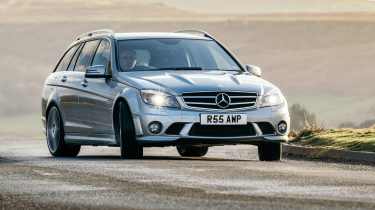
What that test also revealed is that the S204 Mercedes C63 AMG is a more multi-dimensional device than some may expect. With its monster 6.2-litre M156 V8 and rapturous exhaust note many think of the C63 as a bit of a one-dimensional tyre-shredding hot rod. In reality, it’s a proper, pucker, multi-talented driver’s car. It’s just as satisfying stroking along a country road as it is immolating a set of rears in a rolling burnout. It does lack a certain degree of the M3 and RS4’s sophistication, but it puts in a fine shift.
BMW M5 Touring (E61)
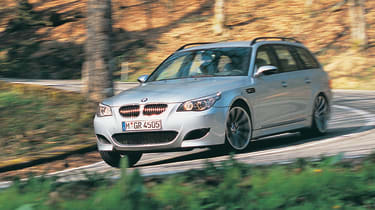
It’ll never take the title of best M5 (there’s no dethroning the M5 CS for that title) but the V10 M5 will always be front-runner for most distinctive M5. With a 5-litre 500bhp V10 wedged under the bonnet of this saloon/estate, it’s perhaps the most absurd expression of the slightly mad era of natural aspiration that spawned the two cars above. Strictly speaking, it needed more torque, a bigger fuel tank and a better gearbox (we only got the single-clutch SMG in the UK). But as ever, time and the mundane march of cars getting faster but more boring, highlights and emphasises the V10 M5 Touring’s esoteric appeal.
Audi RS6 (C5)
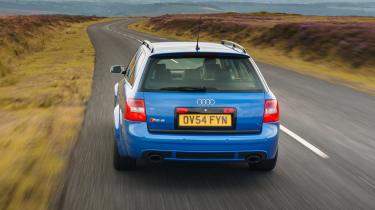
Quite unlike the beloved RS4, the C5 RS6 is a bit of a dark horse. In fact, that’s overstating it. It’s downright forgotten about. Everyone remembers the wild twin-turbo V10 RS6 that succeeded it in 2008 but it’s the original of 2003 that’s actually the better car. It was a monster performer, as all RS6s have always been, with 444bhp. But it was also sweet to drive – not the most involving in terms of steering, but nicely balanced if you weren’t ham-fisted. It’s also the master of that delicate art of clothing subtlety with a thin veil of extroversion. The RS6 is good-looking, with musculature that’s noticeable but not in your face.
Mercedes-AMG E63 S Estate (S213)
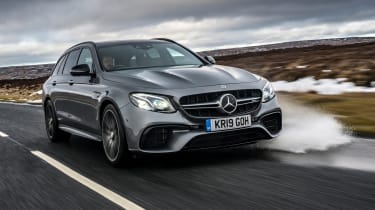
Returning to a much more modern used alternative and one that doesn’t yet have a true successor, the E63 S Estate. This car is Mercedes-AMG at the peak of its powers. All the muscle (over 600bhp and over 620lb ft), with some serious dynamic capability and polish to meet it. It features a rear-biased all-wheel-drive system that (in)famously is able to be switched to rear-wheel drive when certain controls inside the cabin are pressed in the right order. The updated version mercifully polished off the previous model’s edgy ride, but the E63 S was the most exuberant estate of its type at the time of its discontinuation.