Toyota GR Corolla 2026 review – the GR Yaris’s big brother will be worth the wait
Could the UK get Toyota's four-wheel drive Golf R rival, and should we be excited?

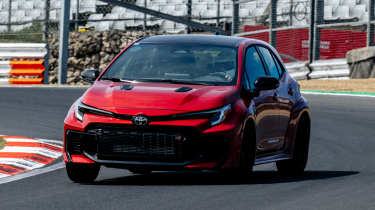
Only one thing really matters here, and, officially at least, the answer is no. Toyota has no plans, at least none it’s willing to share publicly, to offer the GR Corolla in the UK alongside its smaller GR Yaris counterpart.
If you weren’t expecting it to – after all, the model has been available since 2022 in the United States with no rumours of it making it over the Atlantic – then you might not feel like you’re missing out. What brings the question back to mind, however, is that Toyota is now manufacturing the GR Corolla in the UK, at its Burnaston plant in Derbyshire, the first factory outside of Japan to build cars bearing the Gazoo Racing badge. All of North America’s GR Corollas will now be made here, but there are, as yet, no plans to skim a few off to the side for UK enthusiasts like us.

Frustratingly, Toyota knows there’s demand; the UK remains a key hot hatchback market for any manufacturer, and the GR Yaris has been very well received. But much like France’s ‘malus’ tax has lain waste to that country’s combustion-powered hot hatches, the UK’s Zero Emission Vehicle (ZEV) mandate means a potentially popular car like the GR Corolla needs to be balanced by flogging even more electric SUVs. ZEV’s ever-increasing targets (33 per cent of a brand’s sales in 2026) mean there’s a £15,000 fine waiting for every single non-EV sold over the allowance, either pushing up the price in search of a sliver of profit, or taking away the incentive to offer the car at all. If Toyota is to sell the GR Corolla here – and in truth it’s still not completely off the table – it needs to find a way to make the sums work.
More reviews
Reviews
For now, then, this is just a taste of the forbidden fruit, rather than having access to the whole tree. We get a tour of the impressive production line at Burnaston, where the GR Corolla is hand-built, and a day at Brands Hatch comparing the Corolla with the smaller Yaris. It’s an opportunity to spread the word, and perhaps if enough readers twist Toyota’s arm, it might reconsider its position.
Visiting the factory certainly whets the appetite. While Burnaston had to meet Toyota’s tough quality metrics and demonstrate constant improvement (the latter going by the Japanese word kaizen, which someone seems to mention every six seconds or so) and while the UK was chosen for its long motorsport history, there’s no doubt that building the GR version there required relatively little extra capital investment for Toyota, given that five-door Corolla shells already go down the line to be filled with hybrid gubbins.
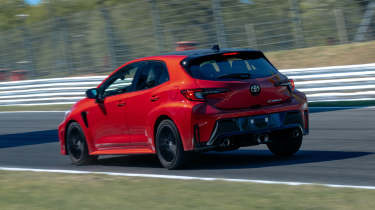
Each GR starts effectively as a body-in-white to be built up by hand rather than assembled in-line with more conventional models. Even before the GR team gets its hands on the car, though, automated processes on the main line have stiffened the shell with extra spot-welds, and the body is checked for dimensional accuracy before paint – one of several steps Toyota takes to ensure the geometry is as close to perfect as possible to hit the car’s performance goals.
The running gear of each GR is effectively blueprinted. Parts are plucked from elsewhere in the Toyota line-up wherever possible, reducing costs compared to creating bespoke components, but all GR items are selected for tighter tolerances and less deviation from the optimum for each item. Toyota’s conventional quality standards allow for tolerances of plus or minus 45 degrees; for GR the target is plus or minus 15, and in reality the factory is averaging nearer plus or minus 3 degrees.
Toyota takes care to avoid building the car in such a way that nudges components out of square, too – the shells are lowered onto the engine and transmission from a datum point on the floor, rather than the drivetrain being mechanically attached from below, so that geometry doesn’t change during the process. Likewise, bolts in the suspension system are only tightened to torque at the very end, when the car is at its final weight and correct weight distribution, to avoid changes as more parts are added. Finally, every single GR Corolla is sent for two laps of Burnaston’s test track for validation; the rate for conventional Corollas is a batch of five cars from every 200 off the line.
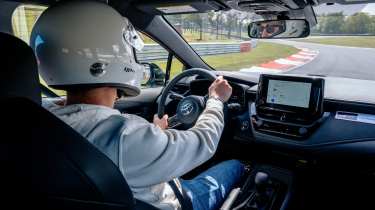
It’s all quite satisfying if you get a kick from the little details in a car’s design and engineering, and impressive too given that, unlike the GR Yaris, the GR Corolla has neither a purpose-designed body, nor any homologation requirements. It’s simply a hot hatch with an additional layer of engineering polish over and above your common-or-garden GTI; closer conceptually to the way rival Honda has always built its Type Rs, or Renault Sport sending its wide-arched Clios down a dedicated line.
Mechanically you’ll recognise the basic components from the Yaris. There’s the same 1618cc, transversely mounted three-cylinder turbocharged petrol engine, a permanent four-wheel-drive system with an electronic coupling to send torque to each end, and a Torsen limited-slip differential on each axle to figure out what to do with that torque at individual wheels. The Corolla gets the same choice of gearboxes too, with a six-speed manual and an eight-speed automatic.
The actual outputs narrowly eclipse those of the GR Yaris: the Corolla makes 300bhp at 6500rpm (against 276bhp in the current Yaris), and 295lb ft of torque from 3250rpm (versus 288lb ft). It needs this extra punch as the Corolla unavoidably carries a little extra flab – a minimum of 1495kg compared with an entry point of only 1280kg for the GR Yaris. The pair are closely matched on outright performance; Toyota USA claims 4.9 seconds to 60mph for the family hatch with the manual ’box, to the supermini’s 5.2 to 62, while both butt up against a 143mph limiter. Nothing in it, really.
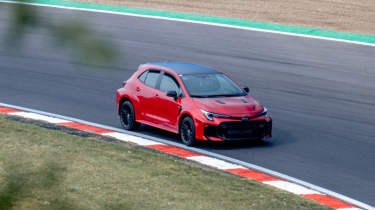
My only meaningful experience with Brands Hatch has been in pixellated form, so I hop into a manual GR Yaris for some familiarisation laps. Like many all-wheel-drive performance cars, at least those with their engines up front, the Yaris wouldn’t necessarily be your first choice for a trackday, but as plenty of owners have experienced, it acquits itself impressively well. It’s instantly reassuring thanks to measured steering responses, plenty of grip, powerful brakes and unflappable traction, and in just a couple of laps I set the GR-Four dial to Track mode (for a 30:70 power split in favour of the rear wheels) and the driving mode to Sport (quicker throttle response, more noise), while a prolonged press of a button nixes the traction and stability systems.
Doing so doesn’t suddenly unearth Caterham-style adjustability or poise, but loosening the leash does allow the car to rotate more at every stage of the corner, and the effects of the 30:70 torque split are more profound. It turns in smartly and feels usefully neutral – at least until the front tyres get a little too hot and begin to muddy the GR’s precision.
The brakes show no signs of wilting though, and while circuits always knock perceived performance a few notches back from how a car feels on the road, 276bhp is still a useful amount to be getting on with, and on track you never catch it off-boost as you occasionally can on the road. The manual gearshift is snappy too and the no-nonsense dash (and lower seating position of these post-facelift cars) sets the right tone. I’m still more fond of the GR Yaris’s feel on a twisty, bumpy, damp road than on a bone-dry track, but it’s set a bar for the Corolla to aim for.
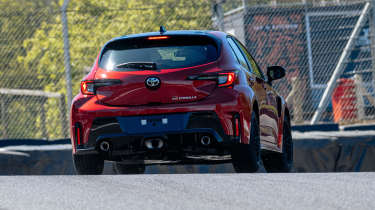
Aesthetically I can take or leave the GR Corolla. The pumped-up body additions, gaping grille, bonnet vents and broad stance give it purpose, but it lacks the homologation-special swagger of the Yaris with its three-door body. The same goes for the cabin: you get a set of sports seats, GR-spec graphics for the driver display and some shiny metal pedals, but it definitely feels more closely related to conventional Corollas than the updated GR Yaris is to your nan’s hybrid.
My first taste is of the automatic, and if Toyota does change its mind, I’d not be too disappointed if it left this option off the list. Perhaps road driving would show it in a better light (I’ve not yet driven the automatic GR Yaris, though some evo staffers rate its transmission) but on track it doesn’t have the instantaneous, gear-when-you-need-it responses of a dual-clutch or the ubiquitous ZF eight-speed. Throttle response is mushy, and even in full manual mode it’s too easy to activate kickdown, forcing the engine to roar away in a lower gear rather than use the torque in those corners where ideally you’d want a ratio in between. The gearshift paddles don’t offer much joy for the fingertips, either.
The manual, thankfully, is much better suited, and indeed feels much like the ’box in the Yaris – not Honda or Mazda-precise, but robust, mechanical, and with well-chosen ratios. The iMT auto rev-matching function is more useful here than in the Yaris, though, as at least in this left-hand-drive car the pedal spacing isn’t quite ideal for heel-and-toe downshifts. Also not ideal, given the car’s cornering abilities, is a seat that seems designed for… er, broader frames, so I end up having to brace myself through most corners – not an issue in the more figure-hugging Yaris seats.
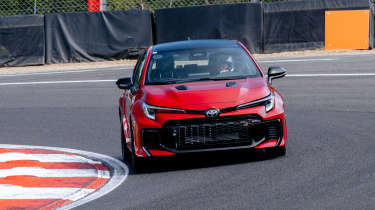
Otherwise, differences between the Corolla and the Yaris are, perhaps not surprisingly, only minor. The extra weight carried by the Corolla means it doesn’t stand on its nose into braking zones quite so readily, and turn-in isn’t quite as keen, but the trade-off of the longer wheelbase (2640mm versus 2560mm) and wider track (1590mm and 1620mm front and rear, to the 1535mm and 1565mm of the Yaris) is a little extra stability under braking and when transitioning on and off the throttle. It encourages you to drive it on the nose a little more, using the extra mass to help the car rotate and giving you more time to address any slides. It’s more neutral mid-corner too, as if the front and rear outside tyres are sharing the responsibility better than the equivalent contact patches in the GR Yaris.
Drive out of the corners seems pretty similar, taking on the same near-neutral stance when you get hard on the power and force the rear diff to do a bit of work, but the long corners at Brands mean that, just as in the smaller car, the front tyres begin to lose their bite before the brakes get a chance to fade. Incidentally, the Corolla takes to BTCC-style kerb-hopping more naturally than the Yaris, presumably another benefit of its greater dimensions. It’d be interesting to see whether this translates to extra pliancy on the road, though the Yaris has never been bad at dealing with poor surfaces.
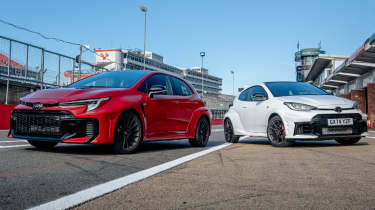
Maybe it feels a bit underwhelming to learn that the GR Corolla is so very close to the GR Yaris in character, but just remember that the Yaris remains one of our favourite hot hatches, so that’s certainly no bad thing. And being so similar under the skin, it was inevitable that the pair would share dynamic DNA, despite their different bodies. Cherry-pick the best bits of each – the Yaris’s fancy homologated shell, sharper initial turn-in, better seats, more purposeful interior; the Corolla’s better balance and body control and its smidgen of extra power and torque – and while the end result would undoubtedly be very special, it also wouldn’t be transformatively different from either car in isolation.
Interestingly, in Japan, where customers get the choice of both, the smaller size and rallying cred of the Yaris mean it’s still the more popular of the pair, while the Corolla finds favour among enthusiasts who need the extra space and practicality. And that’s kind of the crux here: each GR hot hatch stands on its own merit, and the only perfect solution would be to have access to both. Hopefully that’s something Toyota UK is actively considering, even in small numbers, before regulations make it impossible.