How to heel and toe: the motorsport technique for smooth manual downshifts
Learning this bit of fancy footwork will make your road and track driving more fluid. Here’s how to do it
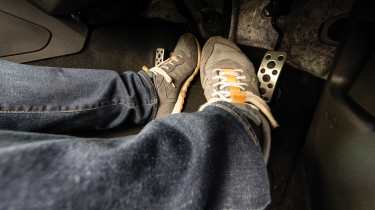
Heel and toe is a long-established motor-racing method for refining the process of braking and gearchanging at the same time. It’s also a technique that many driving enthusiasts choose to use on the road because, if it’s employed correctly and with expertise, it adds a rewarding smoothness to the gearchanging process.
The benefit of heel and toe is that it allows you to raise the engine’s revs when downshifting during continuous braking, therefore preventing you from engaging your clutch onto a ‘dead’ engine (i.e. at tickover speed) when making progress. You probably won’t find this technique in most advanced driving books, but that doesn’t mean it has no place in high-performance driving for those among us who possess a boundless appetite for developing new skills to add to our armoury.
> How to steer a car properly – The evo standard part 3
‘Heel and toe’ is actually something of a misnomer, because the heel of your foot plays no part in the technique. However, you do need to use more of your right foot than usual, as you must ‘teach’ it to work both the brake and throttle pedal simultaneously.
You’ll need to position your right foot so it’s mainly on the brake pedal, generally at a slight angle, then the right-hand part of the same foot rolls over to ‘blip’ the throttle at the precise time required to raise the revs for when you re-engage the clutch after selecting the lower gear.
Precise placement of your foot on the pedals is vital, as you must never risk your foot slipping off the brake because it is too far over the accelerator. It’s also important to recognise that not all pedal set-ups are appropriate for using this skill: sometimes the pedal spacing can make it too difficult.
Once you’ve found a comfortable and safe position for your right foot, the trick – and the part that takes the most practice – is combining your throttle blip with the continued application of braking pressure, which must always remain unaffected by the dual role your right foot plays.
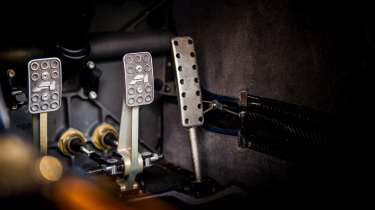
Smoothness when re-engaging the clutch is the other piece of nifty footwork that can make or mar successful heel-and-toe gearchanging. But when everything is timed to perfection, the result is flowing, seamless shifts, as your engine and gearbox mate in exquisite symmetry.
A related technique you may wish to explore is the ‘sustained revs’ method of gearchanging. Here, rather than blipping the accelerator, the objective is to hold it to produce the appropriate amount of engine revolutions to match the gear you are about to engage. To find the right level of revs you’ll need to not only take into account the speed you’re driving at, but also the gears you are changing between. For example, you’ll need more revs when changing down from fifth to second than when shifting from fifth to fourth.
Once perfected, this great skill has a profound effect on smoothness and developing a flowing driving style, and is easier to apply consistently than the heel-and-toe technique. And you don’t always have to combine it with braking at the same time – you can ‘sustain’ your way down the gears without touching the brake pedal at all.
Again, extensive practice is the key, but always do this well away from other traffic and somewhere where a mistake won’t have implications. Your efforts will be rewarded, because once perfected, these techniques will add an extra layer of polish to your driving, and will bring you another step closer to reaching the evo Standard.
This story was first featured in evo issue 339.