Aston Martin DBX S review – beating the Ferrari Purosangue to the top of the class
Lots of tweaks and upgrades inside and out keep Aston Martin's SUV at the top of its game in DBX S-form

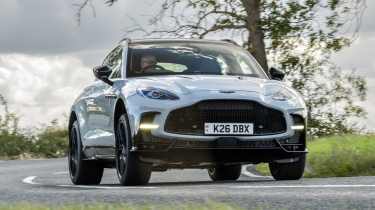
There is more choice when it comes to high-performance SUVs in the new car market than there are hot hatches and sports cars combined, which tells you all you need to know about the habits of car buyers and the desire by car manufacturers to cash in. From Alfa Romeo to Range Rover your choice of 2+ton/500+bhp four-wheel drive behemoths makes deciphering a mid-2010s Renault Sport Megane line-up look easy. In 2026 Aston Martin added another into the mix: the DBX S, all £210,000, 717bhp of it.
When it first arrived, the S joined the existing 707 in the line-up as part of CEO Adrian Hallmark’s strategy to broaden the offerings within the current line-up with more tailored derivatives. The 707 has since been dropped from the line-up replaced by the new GT, which was launched this month and will drive in January 2027.
> Aston Martin DBX GT - the ultra-high performance SUV for those wanting to blend in
The DBX S follows a similar route as the Vantage S and DB12 S with more power, alternations to the aerodynamic elements and revisions to the chassis, transmission and drive mode software to extract more from the cars.
Hallmark wants to offer Aston Martin’s customers more choice, providing a line-up on a par with those of its rivals. Therefore, just as Bentley and Porsche customers have the choice between various flavours of Cayenne and Bentayga, Aston Martin has joined the party by creating a more powerful, more focused, and yes, more expensive model to sit alongside the new GT model, which shares the S’s underpinning but not its performance orientated aero additions.
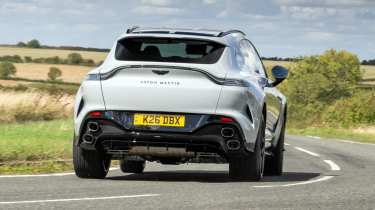
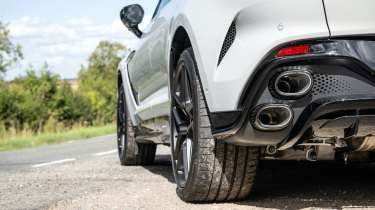
Six years on and there’s still a presence to the DBX that few rivals this side of Ferrari’s Purosangue can match. Changes to the S are light, including a new front splitter and rear diffuser, with the exhausts now stacked vertically within the latter. The side sills are more expressive, but when finished in gloss black they look a little cheap, drawing your eye to the sizable gaps between each individual piece of the bodykit.
Engine, gearbox and technical highlights
- 717bhp 4-litre twin-turbocharged V8 from AMG
- Increased output makes itself known at higher revs
- Nuanced mechanical changes from DBX707
More reviews
The DBX707’s ‘upgraded’ body was always its weak point to me and the S does little to change that, it’s still closer to being OTT than under the radar discrete as per the visual updates to the Vantage and DB12 S models. Which is partly why the GT now exists, because there are markets that feel the S is a little shouty for their tastes.
Little has changed inside beside some ‘S’ badges across the trim, which now includes some Alcantara, plus the addition of the underwhelming Apple CarPlay Ultra. It remains a cleanly designed cockpit and still provides the welcome blend of an elevated driving position but with a sense of sitting in the car rather than on it. In fact, it feels like a large estate car rather than an SUV. Remove some ride height and Aston Martin would have an RS6 rival on its hands. Now there’s a thought.
The cosmetic changes are only the side orders to the S’s upgrades, however, because while these are on the light side – literally when you consider the 18kg saved by choosing the carbonfibre roof (it does away with the roof rails) and the further 19kg lost if you opt for the extra-cost 23-inch magnesium wheels – the mechanical revisions are more detailed and nuanced. And they come together to subtly enhance what is already one of the sharpest and most engaging performance SUVs you can buy.
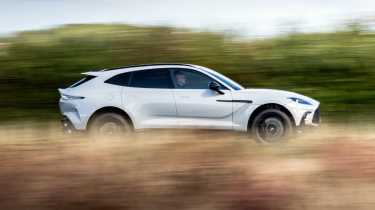
The engine upgrades aren’t the focal point, despite the AMG-sourced 4-litre hot-vee V8 ditching the 707’s turbos for those fitted to the Valhalla. This means larger-diameter compressor wheels and associated upgrades to the ’charger's internals, providing the DBX S with its 20bhp uplift to 717bhp, while torque remains the same at 664lb ft.
Both now arrive later with peak torque delivered between 3000 and 5250rpm, peak power at 6250rpm, and you don’t notice the increase in output until you reach the higher echelons of the rev range. Here the S retains an urgency where the regular 707, no slouch itself, starts to soften its thumping shove.
Performance, ride and handling
- Strong performance with precise body control
- Comfortable and spacious as a daily driver
- Mechanical upgrades keep it class leading
You need to go looking for the performance gains, which live in Sport and Sport+ modes, where the nine-speed multi-clutch gearbox has had its shift points massaged to reflect the engine’s higher rev range. Each shift lands with more aggression when you pull on the paddles, and if you leave it in auto the downshifts in both Sport modes are quicker and more intuitive, everything feeling ramped up by half again.
It’s a similar feeling with the chassis tune. Immediate impressions are of a low-speed ride quality that’s overstepped the threshold into harshness, but this initial perceived firmness is down to tighter body control rather than an overly stiff set-up. The air-springs are a development of those first installed for the 707’s 2024MY update, and the Bilstein DTX dampers first used on the DB12 are further tuned here.
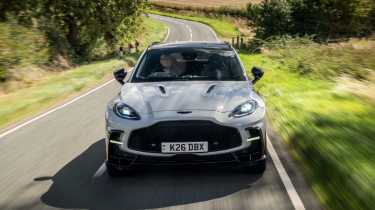
A DBX strong point has always been its lack of body pitch and roll, eradicating that feeling that you’re driving something very top-heavy. The 707 improved this and the S takes it a step further once more. There’s just enough roll – no more than 1.5 degrees – to gauge the car’s reaction when you add load into the chassis, but it settles with an uncanny immediacy, giving you that unexpected confidence the DBX has always generated.
A four per cent quicker steering ratio takes a few corners to tune into, but then you find a front end that hunts grip and provides a precision few, if any in the sector can match. With a four-wheel drive system that’s rear-wheel drive until it thinks you need a helping hand with the torque, the S remains a fluid, linear machine that’s unexpectedly capable and engaging even on roads that look tight for its upsized footprint. It makes an M5 Touring feel one-dimensional.
Standard carbon-ceramic brakes with 420mm discs for the front, 390mm at the rear are on the numb side during their first cold application but work better if you can get some heat into them, while the standard Pirelli P Zero tyre rarely protest unless you decide to drive like an idiot and take on physics with the S’s mass (2198kg in its lightest spec, according to Aston Martin).
However, despite the quicker steering ratio, the damper changes that tighten body control, a chassis reset that improves turn in further, makes the DBX S more adjustable on the limit and that power and torque tweak that maintains the surging step-off acceleration but now adds a friskier tip-end the majority of DBX S owners will use theirs as a daily. Most probably replacing a fast estate car or a less performance orientated rival. So what’s it actually like to use a DBX S as how it will be used rather than its intended use?
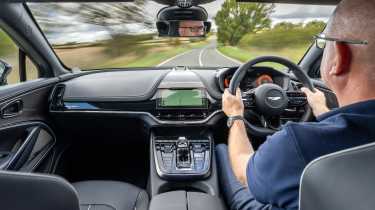
As you’d expect of a car that gets so many of the fundamentals right the DBX S makes light work of mundane duties. On a day that included a 500-mile round trip to the north east of England from the south east, I forgot it had been created to be a more powerful rival to the Ferrari Purosangue and let it carry me effortlessly to my destination.
Fears that the S’s more vocal exhaust would be a drain proved unfounded, its powertrain so unstressed the AMG sourced V8 is barely ticking over. The stiffer ride that comes with a high state of damper tune didn’t rock the coffee from its cup or irritate me to the point of contemplating getting the train home; Golf GTI 50th Edition with the Performance Pack has a more jarring and unsettled ride. Combined with a cruising fuel range comfortably north of 300 miles you’ll need to stop first before it does.
And when loaded with three additional passengers for the return leg its comfort makes for a silent journey with nodding heads catching flies as passengers doze. The DBX’s interior design has always benefitted by the approach taken during the platform’s design stage to maximise interior comfort and space without compromising the car’s dynamic ability. With a number of interior measurements putting the DBX ahead of a Range Rover, and it’s as impressive, if not more so, to use as a GT than it is a performance SUV.
Visually, the DBX S may lack the uplift from the 707 many were perhaps expecting, but Aston Martin will argue the detail has gone into the bits you can’t see to create a performance SUV that’s still top of its class. Which it very much is.
Price and rivals
It remains slightly obscene that there is so much choice at this end of the market, then again human beings are an odd bunch at times. Alfa Romeo’s Stelvio Quadrifoglio props up the sector with 513bhp and a £96,190 RRP, much less if you take advantage of the £9000 discounts currently in the market. The Alfa is the standout in its sector, not least because, raised ride height aside, it cares very little for being an SUV.
BMW has plenty to offer, from the grotesque X6 M £140,095 (currently offered with £20,000 discounts, which is still not enough for us to recommend it) or £154,815 for whatever is worse than grotesque for the XM Red Label, which also have £20,000 discounts. Bentley Bentayga Speed? £219,000 please. Lamborghini Urus SE? That starts at £208,000 before mandatory options. Mercedes-AMG G63? Germany’s answer to the Land Rover Defender starts at £185,595.
Talking of Land Rovers, a Defender OCTA starts at £145,300 which is an awful lot for a car, but then it has had an awful lot of work done to it to make it a Defender with ideas of being a Porsche 911 GT3. Sticking with JLR, the Range Rover Sport SV now starts at £139,995 and has its dynamic sight set on the £210,000 DBX S. The top of the pile is where you’ll find Ferrari’s £313,000 V12-engined Purosangue.