Ferrari Enzo v LaFerrari – analogue hypercar meets its digital successor
When Ferrari launched its first hybrid hypercar, the LaFerrari, Henry Catchpole pitted it against the Enzo, its iconic analogue predecessor

Pretenders come and pretenders go, but only Ferrari has remained a constant force on the supercar scene. Like gravity, the weight of Ferrari’s unparalleled catalogue of exquisite road cars and a matchless motorsport pedigree keeps the others firmly in their place. So, while it’s true there have been a few lame nags along with the prancing horses, and the Scuderia has endured some seasons to forget, it’s also true that when it comes to pulling out all the stops and building genre-defining flagships, Ferrari never fails to deliver.
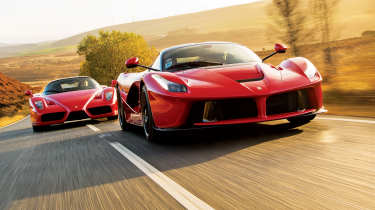
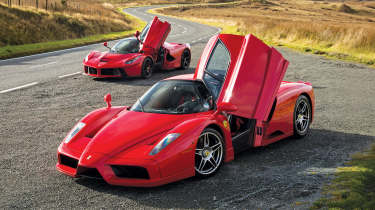
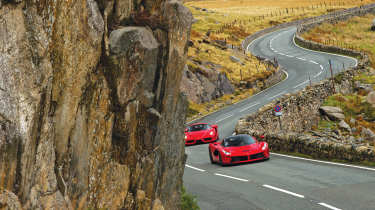
In early 21st century terms, this meant the Enzo and LaFerrari. It’s an obvious pairing, but no less compelling for that. Besides, it’s not simply getting these two mythical beasts together, but the challenge of getting them together for a meaningful amount of time, in a location that does them justice, that takes blood, sweat and tears. Not to mention the trust and generosity of two owners. As moments go, arriving at our chosen meeting point high on the Denbighshire moors to find the Enzo and LaFerrari already disgorged from their transporters and silhouetted against an azure sky is something akin to a religious vision.
> Ferrari F80 review – hybrid V6 hypercar is a worthy successor to the LaFerrari
Nearly a quarter of a century on from its launch, the Enzo’s shock value remains undiminished. If anything the intervening years have intensified its visual impact, a little familiarity somehow allowing us to interpret the quality and purity of its shape, rather than just stare in slack-jawed wonder. The boldness of its profile, the extravagance of its endless front overhang, the quirkiness of that upswept side window and the brutality of its squared-off tail conspire to create something wondrous. Still not beautiful in the conventional sense, but utterly magnificent.
So you approach the Enzo with a certain reverence, as befits a car named in memory of the Old Man himself. Reach into the neat recess in the trailing edge of the door, pinch the release handle and swing the door up and open before stepping down into the cockpit and settling into the supportive driver’s seat. It’s wall-to-wall carbonfibre in here. No frills or fripperies. In fact it’s like sitting in an unfurnished room, empty and a bit echoey. Ahead of you are only the essential tools of a driver’s trade: steering wheel, two pedals, two paddles and some dials that come to life when you twist the ignition key.
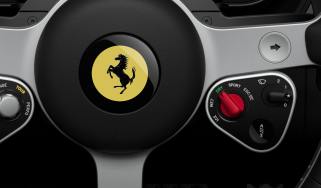
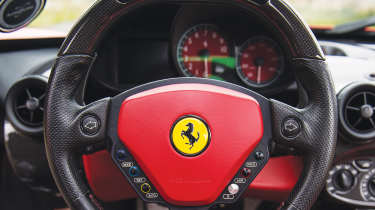
Enzo predates the manettino, so instead of that deliciously tactile red anodised lozenge you get a row of small round buttons on the steering-wheel boss. I can remember thinking that this, combined with the shift lights embedded into the top of the wheel’s arc, was impossibly cool when I first drove an Enzo (the first to come to the UK). Now it looks a bit quaint. I’m wondering if the driving experience will mirror that in the face of the LaFerrari.
Dab the brake, press the scarlet engine start button, and momentarily register the shrill spin of the starter motor before all twelve combustion chambers ignite in a barrage of furious sound and rich super-unleaded fumes. This particular Enzo has a somewhat liberal attitude to silencing. In fact it’s deafening. Still, out of courtesy to the cold V12 you have to sit for a few minutes, eardrums rattling in your skull, as hundreds of metal components thrash up and down in cold, viscous lubricants. Slowly the gauges begin to register some temperature, the cold-start revs settle into a less frantic tickover and the four stubby tailpipes spew rising serpents of vapour. Finally the oil pressure drops a little, acknowledging the hard-working oil pump’s burden is beginning to ease as the oil thins. The Enzo is ready. But are you?
Dab the brake, pull back on the right-hand paddle and gently squeeze the throttle. The clutch begins to bite and the Enzo gets moving, slowly at first, then more insistently as clutch plates finally clamp to the flywheel. The sparse cockpit offers little isolation from the commotion going on just behind the firewall, and the carbon tub transmits all manner of tingles, vibrations and resonances into your body. You really do feel like one of the car’s components.
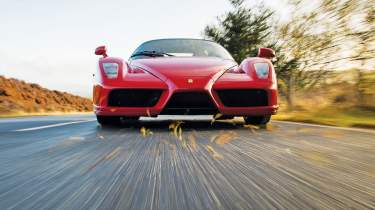
Stray chippings and other bits of road detritus clatter round the wheelarch liners, picked up and flung like roulette balls by the big Pirellis. You’ve only explored a small fraction of the throttle’s travel, but still the magnificent 6-litre V12 dominates the experience. Few cars offer such a direct, precise and immediate connection between throttle and response, with seemingly every additional micron of pedal movement yielding a commensurate rise in revs, noise and acceleration. This is not a car you get into and stamp on the gas, not least because 651bhp and 485lb ft in three million quid’s worth of all-carbon Ferrari icon deserves and demands healthy respect. Especially when the road is slick with overnight rain and strewn with the first leaves of autumn.
The skies are blue and the sun is out, so the grip will come, but for now the Enzo is playing the part of short-tempered supercar to a tee, fighting for traction in a straight line on part-throttle and generally showing me who’s boss. It’s now you’re presented with a major dilemma. Leave the ASR in its tighter settings and it’s difficult to get the Enzo to make clean, uninterrupted progress, but disabling it altogether feels like the ultimate hubris. Despite its label, Race mode seems like the best compromise, for it relaxes the electronic reins sufficiently for the rear wheels to spin, but still offers some support, both literal and psychological.
As the Enzo winds through the intermediate gears, revs flaring and tail shimmying as the meat of the torque arrives at 4500rpm, there’s the sense that even a stage as grand and sprawling as this has been found wanting by the demands and performance envelope of our 217mph projectile. The Enzo is a big, broad car that fills its side of the road and more. You become familiar with the kerdug-kerdug-kerdug of the right-hand tyres slapping across the catseyes, and when you encounter oncoming traffic you instinctively breathe in as a ton-and-a-half of steel flashes by its precious composite flank.
The steering has that unmistakable urgency and pointiness that defines all turn-of-the-century Ferraris. It’s alert and aggressive, enough to require calm hands and measured inputs if you’re to avoid over-agitating the Enzo as you turn in, but the upside is a front end that you know will always change direction and never wash wide of its mark. It takes confidence to lean that hard on the nose, especially as you know that doing so means the tail feels lively. Coupled to the razor-sharp throttle response and a rampant V12, you really need to dance the Enzo through fast corners with small, precise inputs. An unflustered approach pays dividends, for getting the car settled before you ask it to change direction means it stays deliciously flat and four-square on the road. With each tyre working evenly and pressed helpfully into the surface by the steadying hand of downforce it slices through fast sweeping curves like a slot car, punching out onto the next straight as you push the throttle through the last of its travel and ride the torque as it goes to work on one of the six-speed transmission’s taller ratios.
It’s an intoxicating feeling, and one surpassed by the savagery of the Enzo’s delivery in the first three gears. With dry tarmac beneath its tyres the whole car comes alive and you can access a whole new dimension of excitement. It’ll still break traction, but only under full throttle, and it remains stable and free from that edginess that makes it so spiky in the wet. Even in the dry there are only so many opportunities to stoke the Enzo’s race-bred V12 through successive gears, but when you do it’s absolutely sensational. The sound builds from a deep, roiling bellow to a raw and jagged howl, each upshift punctuating the aria with a short, phlegmy stammer.
There’s plenty of go at any revs or throttle opening, but as each gear is devoured there’s a definite sense of building to an aural and accelerative crescendo. You have to work the Enzo to get the best from it, and you have to form an intimate bond with it to know how to do so. The automated single-clutch transmission, once a source of wonder and synaptic shift speeds, is one of the Enzo’s weaker links, but you do learn to finesse the upshifts, not so much by lifting off the throttle, but by relaxing your pressure on it by a fraction. No need to worry on downshifts, though, so you squeeze the brilliantly powerful and satisfyingly feelsome carbon brakes and bang down through the gears, revelling in the massive stopping power, brapp-brapp blips and crackling report of the exhausts on a closed throttle. It might have been an early product of the digital age, but its thrills are very much of the visceral kind.
If the gearbox dates the Enzo then so too does the damping and driver aids. Actually it’s probably more accurate to say it’s the electronics that date the Enzo, rather than just the hardware. Don’t forget these were the days when the firmness of suspension was ramped up in line with everything else, so as you go from Sport to Race the car gets stiffer. But while the chances are you’ll want the increased immediacy, aggression and freedom offered by Race, it doesn’t always figure that you’ll want the firmest suspension to go with it. On a smoother, more manicured road like the Route Napoleon, that’s not a major compromise, but up here where the surface is more lumpen you want a little more pliancy than the Enzo is prepared to give you. Yet run in Sport and you run the risk of grazing the car’s flat belly on the road through the numerous high-speed compressions that lie in wait. Ultimately it's a combination of common sense and limited body control that tempers your speed, even when the road opens out and invites you to go for it. But when those moments come, the Enzo is absolutely mighty.
There’s something slightly surreal about climbing out of an Enzo and immediately walking up to a LaFerrari, as though I’ve been sucked into the pixellated fantasy world of Forza or Gran Turismo. The first thing that strikes you is how much fussier the Enzo successor’s styling looks. Compared to the broad, slab-surfaced Enzo, the LaFerrari is a complex collision of curves, scoops and moveable aerodynamic devices. Where the Enzo has the look of a Cold War MiG fighter jet, all square shoulders and jutting air intakes, the LaFerrari’s shape is more intelligent, bending the slipstream to its will, rather than taking big bites out of it.
From the moment you climb inside you know you’re in a different world. Where the Enzo’s cockpit feels hollow and brittle, the LaFerrari’s exudes a sense of quality. There’s a reassuring density to the thunk with which the door closes and a level of finish to the interior that highlights the exposed fixings and visible wiring that has always made the Enzo feel unfinished.
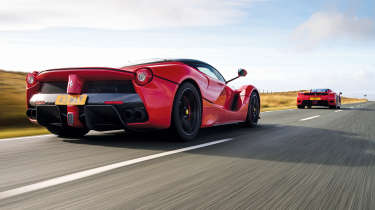
The fixed seat forces a different ritual to getting comfortable, so you bring the oddly shaped (but perfectly comfortable) steering ‘wheel’ and pedals towards you, rather than shuffle yourself around on runners. Start the engine and there’s little of the Enzo’s bombast, but you’re in no doubt of the potency of the powerhouse that sits just behind your shoulders.
Like with the Enzo, there’s little effort involved in getting the LaFerrari underway; the same dab-tug-squeeze of pedals and paddle is all you need to do. The double-clutch transmission is smoother and more decisive, the propulsion creamier and more elastic. There’s more weight to the controls, especially the steering, which has a calmer and more intuitive rate of response that has subsequently informed the 458 Speciale’s dynamic stamp. As a result it’s easier to settle into the LaFerrari, for it feels like a more relaxed, less edgy machine.
The suspension has the same polish. There’s sweeter control and greater depth to the damping, and you can feel this increased sophistication from the moment you start moving. The whole structure has greater rigidity and integrity, which combined with much-improved levels of noise, vibration and harshness creates an impressive, all-pervading impression of solidity. It might seem anathema to what a supercar stands for to praise comfort and isolation from the action, but the really clever thing about the LaFerrari is that it only seems to filter out the unwanted bits. Those parts that matter – your understanding of what each wheel is doing, how much grip it has available and how hard the suspension is working – are more clearly gauged and understood. What’s more, thanks to the supremely honed electronics you have complete faith – and zero frustration – in the driver aids.
In the LaFerrari it’s clear we have now reached a point where traction and stability control systems are another tool at the driver’s disposal, for they never get in the way and allow useful slip angles. It de-risks the process, yet when you work your way to the most lenient settings it’s still your skill and judgement that will make the difference. Maybe I’m getting old, but I never make that final twist of the manettino to disable the ASR. On the road there’s simply no need.
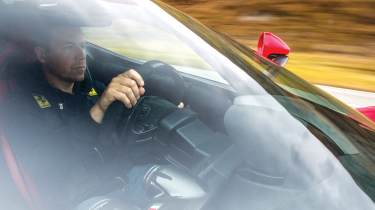
Retracing the route I followed earlier in the Enzo is a bizarre experience, for it literally feels like the road has been resurfaced. Not with baize from a billiard table, but with a smoother covering of fine asphalt that’s had the sharpest edges and most savage compressions rounded and filled to present less of a challenge to passing hypercars. In the LaFerrari, mid-corner bumps barely deflect you from your chosen course and crests do little to shake the rear tyres’ ability to channel all that torque into the tarmac. It’s a graphic lesson in the advances in suspension technology and one that makes the Enzo feel its age.
If there’s a defining type of corner up here on the moors it’s the long, fast sweeper. In a car like the Enzo or LaFerrari they require minimal steering lock, but because of the speed at which you can commit to the turn, you’re chasing maximum confidence and feel for what the front and rear ends are doing. The Enzo’s responsive nose, light steering and slightly edgy tail never quite feel completely connected to one another, so although you learn to trust it, you rarely feel totally relaxed. Thanks to its slightly calmer steering and a much closer bond between front and rear ends, the LaFerrari feels much the more composed of the two. There’s a fleeting phase after the perfectly measured initial turn-in where the steering seems to deliver a slightly increased rate of response, but then almost as soon as you’ve noticed, a fraction more lock restores the linear response. Every now and again you find a curve that has you sitting in this awkward transitional stage, but it’s a very minor flaw.
Interestingly, the brakes don’t feel quite as linear as they did during our first drive of the LaFerrari. The nature of those Italian roads – short tangles of straights and hairpins – meant you’d hit the brakes late and hard, much like we did at Fiorano, but up on the moors that fringe Snowdonia the greater variation of corners demands more subtlety, and therefore tests whether the brake feel and response is black and white, or offers some shades of grey. The answer is a bit of both, actually. When you’re making lighter brake applications there’s a fraction of dead travel, then the pads seem to pinch the discs rather than squeeze. Like that split-second of non-linear response in the steering it’s soon gone, replaced by consistent, organic and intuitive feel, not to mention immense power, but for outright feel they don’t quite match the Enzo’s stoppers.
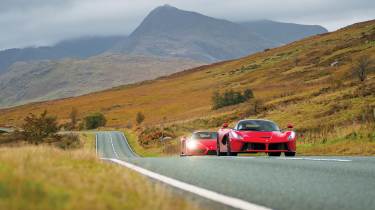
The funny thing is you don’t get the sense it’s related to regenerative retardation for the hybrid system, as it feels more of a temperature-related issue. You simply don’t need to brake that often, or that hard, on these roads, so it could be that they just crave more heat. On the positive side there’s no hint of the regen ‘grab’ we felt at Fiorano during the final phase of hard braking, so that’s clearly something that only manifests itself when you’re right on the limit of the brakes.
The magnitude of performance at the command of your right foot is, frankly, crazy. We’ve covered how the technology of the 950bhp hybrid system works, but suffice to say the way the V12 and battery power combine is like nothing else, P1 and 918 Spyder included. Of course, if you work it hard from a standstill, the way you’re catapulted down the road is genuinely shocking, but it’s even more impressive to settle at a steady speed (not three-figures fast, but not far off) in a high gear, let’s say fifth, and then floor the throttle. Without any hesitation or pause for breath it punches – and I mean punches – forwards, as if you’ve just dropped two gears. The way it accelerates from three penalty points through six, to nine and, ultimately, to a velocity where you’re risking your licence and liberty is quite shocking and, in truth, laughably easy. The only consolation is you can dip in and out of this twilight zone so readily that you and the LaFerrari barely break sweat.
Such epic in-gear performance is a new sensation brought to us by this new breed that is the hybrid hypercar, but it’s one that does come with a downside, and that’s the fact it all but negates the need to explore much beyond the foothills of this extraordinary V12’s rev range. Of course you don’t have to rely on the massive low- and mid-range shove, but invariably you find yourself working within that generous band of propulsion, rather than using the gears. At least that’s how it seems on the road, where even going as fast as the most liberal conscience thinks is prudent you’re still so far within the all-out capabilities of both these cars that to believe otherwise is totally delusional.
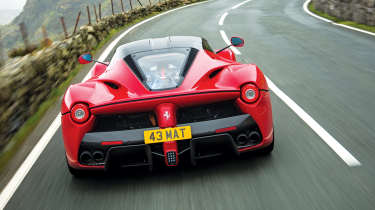
By every objective – and most subjective – measures the Enzo is outclassed by the LaFerrari. It trails in pace, grip and poise, yet its performance is less accessible and harder to manage. How a car that was once the benchmark for advanced technology can now seem so comparatively crude is testament to the increasing pace of change in automotive engineering rather than any slight on the old warhorse. And yes, despite the compromises and relative shortcomings, the Enzo remains a spectacular experience. There’s something intoxicating about the rawness of its delivery and the fact there isn’t an instant seamless slug of battery power to iron out the kinks in the torque curve. It’s a more binary character, less patient of those who can’t or won’t commit, less adaptable to road surface and weather conditions. But when the road is smooth enough and dry enough, and you feel bold enough to seize the day, the moments it delivers are incredibly special.
Like the Enzo, the LaFerrari has too much performance to deploy on these roads, despite the huge steps in suspension and electronics, but you always have to remind yourself that you’re unleashing 950bhp and 664lb ft, some 300bhp and 180lb ft more than the Enzo sometimes struggles to control. That’s absurd firepower. What’s truly remarkable is the level of refinement, quality and measured tactility that’s been engineered into a car that relies so heavily on electronics. Its chassis is far more supple and malleable, yet you feel more connected to the process. And, though it perhaps sounds irrelevant in a car so wholly dedicated to speed, it feels just as satisfying at low speed, so you get more from the experience more of the time. I’m not sure there’s ever been a more complete supercar, at least when measured against my own emotional and rational yardsticks.
No question, the LaFerrari is a majestic machine. One that embraces dazzling technology, but ruthlessly exploits it to intensify its performance in a manner Enzo Ferrari would surely condone. The F40 was the last flagship to receive his blessing, but in the wake of his death in 1988 the F50, Enzo and LaFerrari remained true to his memory. When asked which was his favourite car, Ferrari responded: ‘That which is yet to be built. The car which I have not yet created.’ He could surely not have imagined a car like the LaFerrari, just as we couldn’t conceive of how its eventual successor, the almighty F80 could possibly have moved the game on further than this. But it very much did.
With thanks to Matthew Munson and Chris Green for the loan of their fabulous cars.