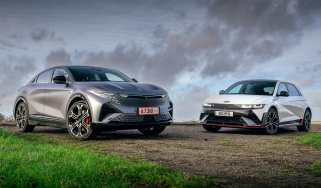
Alpine A390 review – France's flawed rival to the Porsche Macan
Alpine's applied its engineering nous to create an EV SUV with real driving appeal, but it has its flaws too
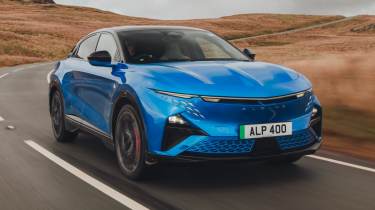
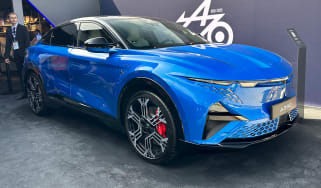
The Alpine A390 is a pivotal car for the French premium brand, tasked with appealing to a broader audience and spreading awareness of the brand. It’s a car that’s designed to be your everyday driver and perform the kinds of roles an A110 never could, without dispensing with the ultimate essence of Alpine, with deft dynamics and striking design. It’s not intended to be a cash cow and has no unrealistic volume expectation looming over it. Nonetheless, it needs to perform, critically and in terms of broadening Alpine’s reach.
Alpine claims it has no rivals (in spite of its £61,390 starting price and positioning being suspiciously close to Porsche’s Macan) and that it is not an SUV, rather a sport fastback, which sounds gimmicky until you read that it’s only a centimetre taller than the A290 hot hatch.
We’ve been along for the ride for a while with the A390, from prototype drives, through the launch, comparison tests and now some extensive road miles in the UK. You definitely feel the work that’s gone into giving it that sharp, agile Alpine feel, but there are sticking points that reduce its appeal when you’re not exploring its sporting character, which for most drivers, will be most of the time. Here’s what we found.
Motors, battery and performance
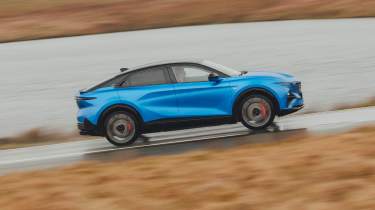
- 395bhp in GT form, 463bhp in GTS form
- Three electric motors with rear-axle torque vectoring
- 463bhp A390 GTS feels the ‘right’ amount of performance
More reviews
Even though it falls into Alpine’s ‘Lifestyle’ range of cars, rather than its ‘Icon’ range (see next A110) or its new 'special projects' line (Ultime and the rumoured hypercar), Alpine claims the A390 is still shot through with the kind of technical detail and delivers the performance and dynamic agility to be deserving of the badge. It even claims it’s as fast and agile as the A110.
Fed by a new 89kWh battery are three electric motors (the only tri-motor example in its segment, which includes Porsche’s new Macan electric) with one on the front and two on the back axle, collectively producing 395bhp in GT trim (that we’re driving) and 463bhp and a stonking 596lb ft in the range-topping GTS. The GTS hits 62mph in 3.9sec on the way to a 137mph top speed, the GT taking 4.8sec and maxing out at 124mph.
The rear motors are of a permanent magnet synchronous design that’s lighter than that of the front motor, aiding in the A390’s 49:51 weight distribution. The rear motors are also set within their own unique, lighter aluminium cradle.
Alpine A390 v rivals
| Alpine A390 GTS | Porsche Macan 4 Electric | Hyundai Ioniq 5 N | |
|---|---|---|---|
| Motors | Twin rear, single front | Single rear, single front | Single front, single rear |
| Power | 464bhp | 402bhp | 641bhp (with overboost) |
| Torque | 608lb ft | 479lb ft (launch control) | 546lb ft |
| Weight | 2121kg (222bhp/ton) | 2330kg (175bhp/ton) | 2235kg (291bhp/ton) |
| 0-62mph | 3.9sec | 5.2sec | 2.3sec |
| Top speed | 137mph | 137mph | 161mph |
| Basic price | £69,390 | £71,900 | £65,800 |
Each of the rear motors has the same power and each delivers it equally for the most part, while Alpine Active Torque Vectoring is the system that then varies the output depending on demand. Power on hard with a lot of lock on and it’ll bias the outside rear wheel to improve the sense of agility, mimicking (and bettering in theory) the feel of a limited-slip diff.
Five drive modes include Normal and Sport returning as well as Save and Perso. What’s new for the A390 is a dedicated ‘Track’ mode, almost entirely releasing the ESC constraints and allowing for near full control of power, though full ESC off requires a switch. The drive modes affect three dynamic parameters (independently changeable in Perso): Engine for adjusting throttle response, Steering Effort for adjusting steering weight (but not ratio) and new for the A390 with its twin rear motors, Agility Control, managing the aggression of the torque vectoring. The augmented sounds also vary through the modes.
The more powerful GTS feels livelier and pulls harder from most speeds as you’d expect – it’s the right amount of performance compared to the GT, that feels fast enough most of the time, if a little out-of-breath sometimes when punching it uphill from say, 50-60mph. Perhaps a second high-speed ratio on the rear axle would've helped here. Either way, the extra power and punch of the GTS is for our tastes worth the price premium.
Ride and Handling
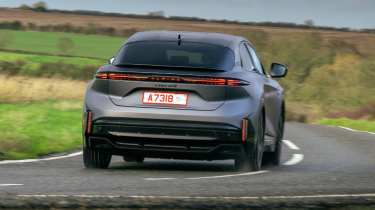
- Passive dampers with hydraulic bumpstops and quick steering
- Steering light and sharp, almost too sharp
- Damping is excellent - feelsome and detailed but occasionally busy
The platform the A390 rides on is a development within the AmpR medium family, making it a relation of Renault’s Megane E-Tech and Scenic, as well as Nissan’s Arya and Leaf, the Arya already having received the Nismo treatment. Don’t be spooked however. Alpine has majored on engineering detail here – across the steering, suspension and measures to reduce weight, for a c2120kg result.
Boldly for an ostensibly heavy electric SUV, the A390 features passive damping with no changeable modes. Adaptive dampers were considered but what wasn't a worthwhile trade for the added complexity and weight. What it does have are hydraulic bumpstops, serving alongside long-stroke dampers as a body control and ride comfort failsafe.
Likewise, the A390 gets its own lightweight aluminium suspension components to reduce unsprung mass. There’s a quicker steering ratio 12:1 and 365mm brake discs clamped by six-piston calipers, housed within 20 or 21-inch wheels, the latter shod in bespoke A39-marked 245-section Michelin Pilot Sport 4S tyres. The A390 is distinct from its platform-mates too, at 6cm wider than the Mégane E-Tech, with just a 1cm longer wheelbase, for a more foursquare stance
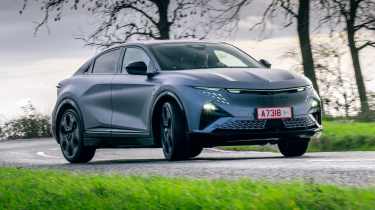
Two things become immediately apparent as you get underway. First, the steering is light and quite sharp, with a rate of response for a high-rider that takes some getting used to, requiring micro management and fine adjustment at speed. It’s a trait known to those familiar with the A290 hot hatch, one we noted immediately on the launch and that is persistent in being enjoyable when you’re on the right road, and annoying when just trying to get on.
The A390 never really settles into a direction of travel at high speed. It's just a bit too easily distractable by all but perfect roads for its own good. You do find yourself wondering if, while heavier, use of a rear-steering system that could relax the car at a fast cruise as much as it aids agility in dynamic driving, might have been the right move.
Second, the passive suspension gamble has largely paid off, depending on your tastes. If you want a Range Rover-esque magic carpet ride, the A390 does not deliver. If you want a feeling of detail and control - an Alpine feel - then it works well.
The A390's suspension is constantly communicating, with an expensive, sophisticated feel. The tradeoff is that there is a busyness to it at lower speeds, when trundling through small villages, dodging divots and potholes. The hydraulic bumpstops absorb the really jarring impacts but there’s a consistent activity to the A390’s low-speed damping that won’t be to all tastes.
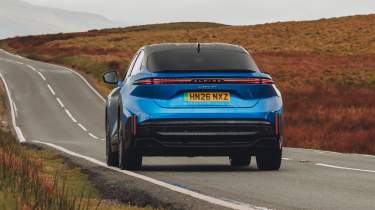
Throw it down a proper road and all of these elements that irritated at times during civilian driving come into their own. The throttle and brakes are well-judged in terms of modulation, the steering is responsive, delicate and intuitive and that plush suspension exhibits real control. Well-judged body roll serves as a reliable barometer for what is and isn’t sensible pace and aggression.
You quickly trust the A390, which leads you to start looking for magic from the Alpine Active Torque Vectoring. Bring up the Car menu, then Live Data and under the Agility sub menu, a diagram showing the rear of the A390 appears and exactly how much power is going through which motor. It’s 50:50 at the straight ahead and we saw as much as 73 per cent going to the outside wheel through sharp hairpins with a glug of throttle.
The A390 is keen to neutralise, the rear axle almost spitting you straight from mid-corner to exit, having helped tuck the nose in entry in concert with the sharp steering. The Hyundai Ioniq 5 N is keener on the road, though being more extreme with more power helps.
Interior and tech
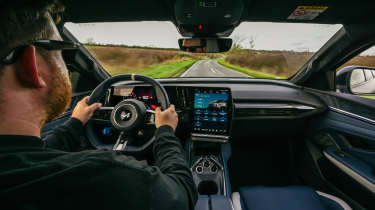
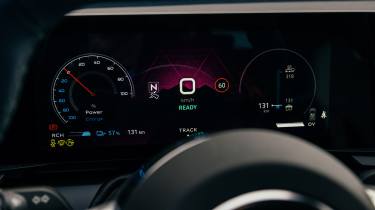
Inside the A390 and there’s a lot to take in, some good and some so-so. The seats hug and support where you want them to and the steering wheel is immediately familiar: carried across from the Renault 5-based A290 hatch, including the ‘OV’ overtake boost button and ‘RCH’ four-way regen’ adjustment dial.
Behind the wheel is a 12.3-inch display with clean-looking design and software. In the centre of the car, canted towards the driver, a portrait 12-inch infotainment screen. The UI is all Alpine – crisp and intuitive with plenty of blues, whites and reds in typically French fashion.
There’s plenty of Renault in here too, such as the media controls behind the wheel that in layout date back to the early 2000s. Some of the materials are a familiar scratchy matte plastic, though they’re offset with real Alcantara, aluminium, carbonfibre and Nappa leather trim elsewhere.
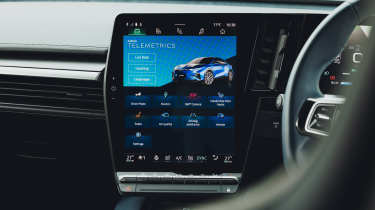
There’s also an annoying protruding trim element on the central tunnel that hurts your knee if the rear passenger needs too much legroom; room in the rear itself isn’t great - leg or head. The UI features too many pop-up windows too, like every time you adjust your seats.
The quite chunky mirrors get the wind roaring at motorway speeds, noticeable more so for the relative lack of tyre roar. The view out of the back is very A110-inspired which is to say, it’s slim by sports car standards, more so by family crossover standards.
We did experience a few glitches and eyebrow-raising moments during our latest 500-mile jaunt in the A390. The adaptive cruise control has an unnerving habit of hugging the inside white line a little too closely when on sweeping motorway corners. It also at one point stopped recognising the (ancient Renault-based) key and wouldn’t start, requiring us to Google where to leave the key so the car could pick it up. It’s in a well-hidden central cubby under the infotainment screen.
Range and efficiency
The 89kWh battery can charge at 190kW in the GTS and 150kW for the GT. The difference comes from the confusing fact that the GT and GTS batteries use different chemistries. GTS range is a 314 miles, while GT range is 345 miles. Not class-leading by any means. yielded a projected range of less than 300 miles, that reduced to a real world result of around 210 miles, albeit across a full journey of high-speed motorway driving. We saw average efficiency in the region of 2.5mi/kWh.
The GTS managed a day of back-and-forth brisk countryside driving for photography without setting range anxiety alarm bells off. Nonetheless, don’t expect it to reliably deliver over 250 miles from a charge in normal varied driving or in chillier conditions.
Our experiences charging the A390 GT were interesting. Some disclaimers: We tried two chargers, a 150kW MFG station and a 350kW Ionity station. Neither were particularly busy, with a maximum of maybe two or three other cars charging across several available points. We also plugged in at the right battery level for high-speed charging, around 20 per cent. On the other hand, we also didn't navigate to said chargers using the car's native system, which would have prompted it to precondition the batteries.
We saw highs of 100kW that quickly fell away to a c75kW average. When you plan your day around the charge speeds you’re told to expect (though not well enough to prompt the car to precondition, admittedly) that puts a spanner in the works.
Price and rivals
Alpine claims there are no direct rivals for the A390 but the aforementioned Porsche Macan and Hyundai Ioniq 5 N are obvious alternatives, on price and performance. The A390 GT is priced from £61,390 and the GTS from £69,390. In addition to the extra performance, the 21-inch ‘snowflake’ wheels and Sabelt sports seats are notable, worthy spec upgrades for the GTS over the GT.
That makes it appear good value on performance alone (if range isn't a priority) compared to the 355bhp £68,600 Porsche Macan, and 400bhp £71,900 Macan 4. Though a bit bland inside, the Macan even in its basic forms is better on average for interior fit, finish and materials. The Polestar 4 is the value proposition, available in 536bhp, 367-mile-range dual-motor form from £62,750 (discounted from £67,000). Audi’s Q6 e-tron and SQ6 are pricier than the Polestar and less dynamically satisfying than the Porsche.
And then, of course, there’s the Hyundai Ioniq 5 N, that has set the dynamic benchmark for performance SUVs - and the fun, too - and at £65,800 (before generous discounts) offers 641bhp, ‘gearshifts’ and endless configurability and Hyundai’s generous warranty. It means the A390 is going to need all of its Gallic charm to convince the business owners who are the majority buyers of such cars it's what they want to spend the benefit-in-kind savings on.
Specs
| Alpine A390 GT | Alpine A390 GTS | |
|---|---|---|
| Motors | Twin rear, single front | Twin rear, single front |
| Power | 395bhp | 464bhp |
| Torque | 479lb ft | 608lb ft |
| Weight | 2124kg (189bhp/ton) | 2121kg (222bhp/ton) |
| 0-62mph | 4.8sec | 3.9sec |
| Top speed | 124mph | 137mph |
| Basic price | £61,390 | £69,390 |