Polestar 5 review – cheaper and faster than a Porsche Taycan but not quite as sharp
Polestar’s flagship finally arrives, with a bespoke aluminium structure, electric powertrain and suspension. But will anyone actually buy it?

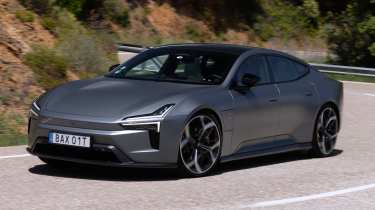
The Polestar 5 has finally arrived as the Swedish brand’s flagship Porsche-rivalling four-door GT, after a five-year gestation. In that time, expensive electric cars of this kind have suffered a fall from grace where market and customer sentiments are concerned. One has to wonder if, like the new Mercedes-AMG GT 4 Door and Jaguar Type 01, it isn’t late to the party Porsche’s Taycan started. We travelled to Barcelona to take on a leg of Polestar’s Grand Tour launch programme, from Gothenburg to the Sahara, to find out if it’s any good.
With the 5, Polestar is saying strong volumes are a ‘would-be-nice’ outcome and is managing expectations. Much like its spiritual predecessor, the Polestar 1 coupe, a car with which it shares its halo billing, the Polestar 5 is a distillation of the brand’s core values and the fullest expression of its engineering and design might.
If the market it’s wading into has aged like milk over the last half-decade, the 5’s design is still minty fresh, as if sent back from a more optimistic future. It’s long, low, sharply sculpted and its bespoke bonded aluminium architecture allows an almost supercar-like front wheel-arch-wing ratio.
Motors and performance
- Dual Motor and Performance models available at launch…
- … with 737bhp and 871bhp respectively
- Motors are bespoke to Polestar, powered by a 112kW battery
The Polestar 5 will launch with two versions initially. The Dual Motor is the most affordable for now, with an electric motor on each axle and a total system output of 737bhp and 599lb ft, while the Performance has a faintly dizzying 871bhp and 749lb ft. The rear motor is an in-house developed unit, wound up in the Performance model, while the front motor is a bespoke unit from ZF. There are Performance and Range modes for the powertrain. In the Dual Motor, you start in Range as a default. In the Performance, you start in Performance mode.

Even starting out in Performance mode the powertrain’s responses are still well measured to your inputs. The straights on the T700 snaking across Muntanyes de Pradas may as well not exist, such is the Performance version of the Polestar 5’s ability to inhale them. Officially, 0-62mph takes 3.2sec and it feels every bit as quick as that. Truthfully, the Dual Motor is plenty quick enough, able to hit 62mph in 3.8sec, or in other words, at pace with hypercars from a couple of generations ago.
An important distinction too between the Dual Motor and the Performance is the split of power between the front and rear axles, with the Performance much more rear-biased. In the Performance the rear motor is good for over 600bhp, with the front motor contributing around 268bhp. By contrast, the Dual Motor has a higher maximum power figure at the front axle, over 300bhp. The rear axle meanwhile is good for 436bhp.
Ride and handling
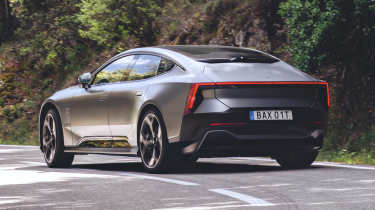
- Magneride dampers with three modes on the Performance
- Passive dampers on the ‘Dual Motor’, but they’re no poor relation
- Steering is good, if not as sharp as a Taycan off-centre
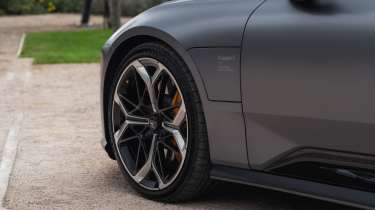
That Polestar was given freedom to develop the Polestar Performance Architecture just for the 5 speaks if not of a blank cheque, then a very generous one. So too the bespoke Michelin Pilot Sport S 5 POL tyres and the custom MagneRide adaptive damper system developed for the 871bhp(!) Performance flagship.
It’s been a long process of iteration, yet the joyfully obsessive Joakim Rydholm, Head of Driving Dynamics, was still tweaking the steering software just weeks ago. It sounds like they had to slap the laptop shut on his fingers.
Trundling around at modest speeds, the fruits of the 5’s protracted gestation are appreciable. There’s texture to the steering (which doesn’t use a variable-ratio rack), fluidity to the damping and nary a creak or shimmy in the frame. That’s a benefit of the platform’s 50 per cent increased torsional stiffness compared to more conventional steel or hybrid construction. There are three steering modes – Light, Standard and Firm. Firm adds the most off-centre weight but Standard sometimes feels the most natural.
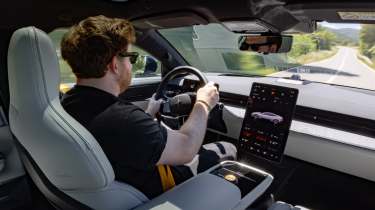
The dampers in their Firm setting control the Polestar 5’s body movements nicely. The middle setting is Nimble, while Standard offers the most low-speed compliance. Joachim chose Magneride dampers, having been convinced by their use on Honda’s NSX, saying they offer the widest calibration bandwidth.
The ride is actually perfectly acceptable most of the time in Firm, the car only feeling overly taut over low-frequency, high-speed impacts. In all modes, there’s a bit of high-frequency chatter at low speeds. The 737bhp Dual Motor model’s passive dampers are also bespoke, with hydraulic bump stops. Bar the last two tenths of vertical control, they don’t render the ‘lesser’ model the poor relation. Between the ride and the cabin refinement, it’s an almighty mile-muncher.

The brakes instil confidence and the balance feels good. The steering isn’t as responsive as a Taycan’s off-centre, but it’s nicely weighted, granular in feel and less frenetic at a fast cruise. The lack of a limited-slip diff is noticeable. The torque vectoring by braking system (plus the Performance’s 30/70 front/rear bias) does afford throttle adjustability, but it lacks the polish of a ‘proper’ diff. It, along with the weight, could explain the pungent brake smell after an enthusiastic run.
In all but the most aggressive weight transfers, the 5 feels like a 2000kg car. In actuality, kerb weight is a stout 2500kg. Whether you blame its broader proportions, larger 112kW battery, or more luxurious, grand tourer positioning, that’s a lot.
Range and efficiency
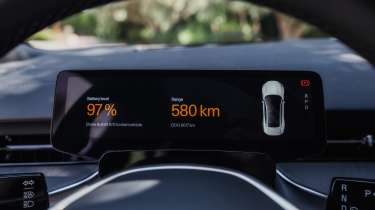
- Respective claimed range of 346 and 421 miles for the Performance and Dual Motor
- Claimed efficiency does not match the likes of Mercedes’ CLA or BMW’s i3
- Claimed charging speed up to 350kW
Stated range is 346 miles in the Performance, 421 miles in the Dual Motor; figures we got nowhere near when hopping between demanding mountain roads and high-speed cruising. Claimed efficiency is a high of 3.4m/kWh for the Dual Motor and 2.9m/kWh for the Performance.
Our testing on the initial first drive – scrabbling up and down mountains and using as much of the Polestar 5’s performance as was sensible – was likely not representative of what owners will see in the real world. Nonetheless, it’s safe to say, if you plumb the Polestar 5 for its performance you’ll be charging a lot more frequently. We saw consumption of 1.98m/kWh, which would put expected range between 200 and 250 miles. And that was in the Dual Motor. The Performance was even juicier. It’s worth noting, we switched between regeneration being fully off and the first of two settings, which simulates engine braking nicely.
Happily, as the Polestar 5 uses an 800V architecture, it will charge briskly, at up to 350kW, allowing a jump from 10 to 80 per cent charge in 22 minutes. The 113kWh battery in the Polestar 5 uses nickel manganese cobalt chemistry, with eight modules carrying a total of 192 cells.
Interior and tech
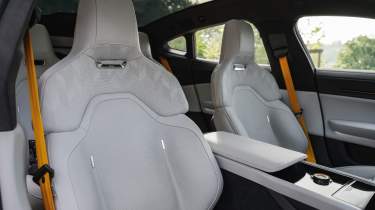
- Tight to get into, thanks to the chunky pillars of the aluminium chassis
- Quirky but eventually intuitive cabin interfaces
- Recaro seats are the newest part of Polestar’s well-known cabin set-up
Aluminium isn’t as strong, so you need more of it. A fact you remember when contorting yourself through a surprisingly slim aperture, past the substantial B-pillar. Once in, you appreciate the well-judged driving position in the new Bridge of Weir leather-shod Recaro seats, which feature natural fibre composite, made of woven flax. It’s not just trim, rather part of the structure of the seat.
It’s airier and you feel higher up than in a Taycan initially, but soon adjust to the larger glasshouse and the windscreen that reaches lower into the nose. It’s much more spacious in the back too, Polestar namechecking the Panamera LWB as comparable for rear legroom.
The back seats aren’t the short straw unlike in some four-door coupes, with massage, heating, ventilation and good leg and kneeroom. It’s not dark or dingy in the back either, even without a rear window, thanks to the panoramic roof. Seating is described as ‘4+1’, meaning that there are two full-sized rear seats with a foldable centre armrest section, that can reveal a central seat. The back seats can fold too to extend storage from the boot.
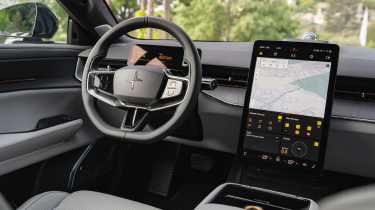
If the seats are new, not much else is inside. The steering wheel is Polestar 3, tricky label-less buttons and all. Likewise the 14.5-inch portrait touch screen and quirky (occasionally glitchy) but quickly learnable Google-based UI.
The materials are nice and crisp, but lack that last tenth of truly satisfying premium density. You can tell the Performance and the Dual-Motor apart inside by the seatbelts. They’re fully Swedish Gold in the Performance, with a Swedish Gold stripe in the Dual-Motor. The excellent Bowers & Wilkins stereo that comes with the Performance is optional on the Dual-Motor.
There’s a 62-litre frunk, designed to accommodate carry-on luggage. Lift the lid and you’ll notice there’s no sound deadening material. This is because the frunk itself is made of a new sound-reducing material, that’s recyclable and 60 per cent lighter than plastic.
Price and rivals
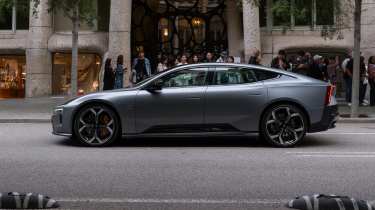
The Polestar 5 is as intended, its own car. A good one, and not a Taycan clone. It’s longer-legged and less frenetic, devastatingly fast while swapping the last tenth of outright driving focus for a calmer GT vibe. But it does offer more performance for your money and more space inside. To my mind it equals the Taycan’s four stars, but the actionable points for upping driver satisfaction are more obvious – slightly tighter steering, a limited-slip diff and a bit of trimmed fat. Whether anyone would buy that car, or will buy it as is? That’s the billion-dollar question.
The Polestar 5 Dual Motor starts from £89,500, while the Performance carries a premium, starting from £104,900. All things being relative, they represent a value proposition compared to the likes of Mercedes-AMG’s new electric GT 4-door, which will start from around £150,000 and even the Porsche Taycan.
The Dual-Motor matches a base Taycan (and a base Audi e-tron GT for that matter) on price more or less, but offers more power than the £118,200 GTS and performance to match the £96,200 4S. The Polestar 5 Performance meanwhile, is priced almost £15,000 less than the Taycan GTS, but offers near-Turbo (£135,200) power and performance.