Best saloon cars 2026 – four-door cars that are fast and fun
Great sports saloons are as performant and engaging as supercars, but with the practicality to suit almost all day-to-day jobs. These are our favourites
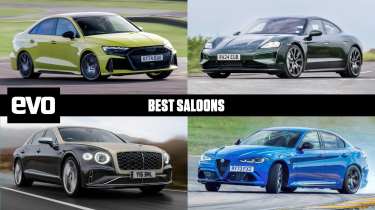
The best sports and super saloons are still cars for all occasions, able to lunge across long distances with the best GTs and deliver near-sports and supercar thrills on the very best roads. In between, they are faithful family expresses, with decent boot space, four doors and Isofix. They’re attractive, even a little aggressive to look at, enough to catch glances of admiration from those who know. But they should also be unassuming and unpretentious to most others, almost blending in with the traffic around them, while doing all the same jobs without compromise.
This is an arena that has in the past been largely defined and dominated by the trifecta of German giants, Audi, BMW and Mercedes. They built their core lineups and reputations with a beloved bloodline of three-box machines but contenders and pretenders have always stepped up.

Despite the challenges facing traditional high-performance cars, the sports saloon and super saloon still have an immediate future thanks to electrification. This means that this list will likely look very different in 12 months' time as hybrid and electric powertrains change the performance saloon landscape. Surely the new 630bhp hybridised Audi RS5 is in with a shot of an addition, while the new BMW M5, Alfa Romeo Giulia Quadrifoglio, new Porsche Taycan Turbo and Audi e-tron GT, already feature.
Best sports saloons 2026
- Mercedes-AMG E53
- Alfa Romeo Giulia Quadrifoglio
- Audi RS3
- BMW M3 Competition
- Audi S5
- Porsche Panamera GTS
- BMW M5
- Audi e-tron GT
- Mercedes-AMG C43
- Lotus Emeya
- Bentley Flying Spur
- Porsche Taycan Turbo
Mercedes-AMG E53
Prices from £92,140
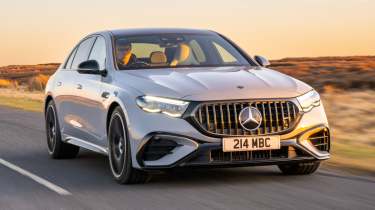
Pros – Looks like an AMG, goes like an AMG, drives like an AMG…
Cons – Doesn’t sound like one
We were worried when the Mercedes-AMG E53 first arrived. Dispensing with a proper, bombastic V8 in exchange for a straight-six with a hybrid system was a punchy choice. For sure, the new powertrain delivers the numbers - it’s good for 577bhp and 553lb ft - but it’s not quite the emotional fulcrum like AMG motors bygone.
Nonetheless, to dismiss the E53 on this basis is to ignore its other talents, of which there is a broader range than any AMG E-class before it. Rear-wheel steering makes what is the largest and heaviest AMG E-class there’s ever been, the most wieldy and agile. Meanwhile the adaptive twin-valve dampers exhibit impressive vertical control of that mass. Then there’s the AWD system which far from shackling the E53 with utter numbness and neutrality, the rear LSD and balance of power distribution partner the rear-steering in aiding agility, capability and even showing shades of flamboyance. A hair-raising hot road in the lineage of the old Hammers? Not quite. An enormously talented super saloon? Certainly. Don’t count the grown-up AMG out.
Alternatives to the Mercedes-AMG E53
The E53's divergent, less aggressive nature by comparison to its predecessors also means it's without direct rival. This is no straight answer to BMW's M5, especially given the BMW is over £20,000 more. Nonetheless it is M's super saloon that you must turn to (and stump up the extra cash for) if you want all that the E53 offers but more. In exchange for more performance though, you'll lose some of the polish of the Mercedes-AMG. Look carefully and you might find a pre-registered RS7 or two at Audi dealers that have still yet to find a home, should you want to ditch the batteries and motor and stick with a big petrol V8.
"Wound up into its most aggressive settings and the E53 will respond in kind to the levels of aggression you present it with. You can build a satisfying flow or throw it around, at which point it’ll start to dance with shades of the E63’s flamboyance still present, it just requires a little more digging to unleash it." – Stuart Gallagher, evo editor-in-chief.
Alfa Romeo Giulia Quadrifoglio
Prices from £86,885
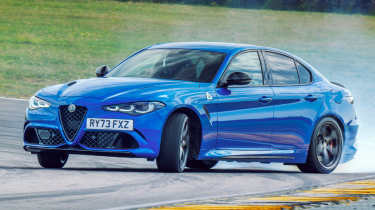
Pros – Awesomely fast, amazingly approachable, full of charisma
Cons – Interior not a match for its rivals, reputation for flaky reliability
The Alfa Romeo Giulia Quadrifoglio has long been a firm evo favourite, with continuous developments since its 2016 launch keeping it dynamically sharp in the face of constant opposition. The latest tinkered-with Giulia QV brings extra power, a recalibrated chassis and a new mechanical limited-slip differential, elevating its talents still further. The Giulia Quadrifoglio is as a result is more approachable, tractable and alacritous than ever, still with the adjustability and sinewy twin turbo V6 muscle we’ve always adored it for.
At the heart of the Quadrifoglio lies a superb 90-degree twin-turbo 2.9-litre V6 that now kicks out 513bhp. It’s mated to an eight-speed auto that’s controlled by a pair of flamboyantly large aluminium paddles, driving the rear wheels via a carbonfibre prop shaft. The body is equally exotic, featuring a lightweight mix of carbon and aluminium panels wrapped around telephone-dial wheels, sophisticated double wishbone suspension and multi-way adaptive dampers. Oh, and did we mention its development was led by the same man who brought us the Ferrari 458 Speciale?
On the move the Alfa’s Ferrari DNA isn’t hard to spot. The big giveaways are the wrist-flick quick steering and surprisingly supple ride. Yet it’s the car’s poise, balance and grip when really pushing on that leaves the deepest impression – this is a tremendously fast and accomplished machine that’s more engaging than almost anything else with four doors. Sure, the optional carbon-ceramic brakes lack manners at low speed and the engine doesn't sound particularly musical (although it endows the Quadrifoglio with a brutal turn of speed), but these niggles don’t detract from what is a sublime saloon.
Alternatives to the Giulia Quadrifoglio
The small super saloon crop feels a bit thin at the moment, with the latest Mercedes-AMG C63 a non-option. Happily the BMW M3 is still around and on thoroughly fine form, even though it’s more like an M5 of 20 years ago than an M3. Until the recently revealed new RS5 arrives, you could go smaller (and more affordable) and get the warbling five-cylinder RS3 saloon (while you still can).
"The traction the new diff enables is very impressive, in dry conditions at least. Even in Race mode, which as before disables the traction and stability control systems, you can get on the power remarkably early without wheelspin or the rear becoming unstable. And when you do deliberately wish to slide the car, it’s very progressive and intuitive. In cold, damp or greasy conditions it broadens the spectrum in which to control the car beyond the limit, with a clearer dialogue between car and driver. In short, the Giulia is now an easier car to control when traction is at a premium" – James Taylor evo deputy editor
Audi RS3
Prices from £63,450
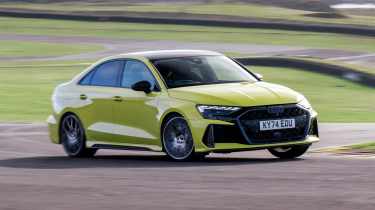
Pros – Fabulous engine; exciting, playful chassis
Cons – Lacks the feedback and precision of the very best
The Audi RS3 clings on in 2026 in a familiar form: sharp of snout and making an entrance on a potent wave of five-cylinder warbling. Its days are surely numbered but they aren’t up yet, and arguably, a model that started life with a stumble is now on its finest form.
With adjustments and tuning to an already competent package, the RS3 in its updated form distances itself further from Audi Sport archetypes. It's keener to turn in, it’s more power-adjustable thanks to its torque-splitter rear differential, and its chassis breathes with a road or circuit better than it ever has. It’s a car in which you eventually realise, the instinct to scrub off speed to mitigate nose-heavy understeer can be unlearned. Even the non-ceramic brakes are up to the task of heaving the 1565kg RS3 to a stop with repeatable proficiency.
Of course, the engine remains the RS3’s star turn, it’s defining feature. Still bristling with muscle at 394bhp and 369lb-ft and still sounding like nothing else, the barrel-chested urgency with which it forces the RS3 up a straight stretch is irreplicable by rivals with fewer cylinders and less cubic capacity. It’s a joyous dinosaur.
Alternatives to the Audi RS3 Saloon
The RS3 Saloon is a curious device in the marketplace. It’s not a full-on BMW M2 rival, it’s an altogether different beast to that. BMW also doesn’t make a hotter version of the 2-series Gran Coupe beyond the M235 xDrive that meets the S3 saloon head on. Mercedes-AMG’s CLA 45 S runs it close. Otherwise, used Alfa Romeo Giulia Quadrifoglios and BMW M3s are worth a look, too.
"Ultimately, the RS3 isn’t as tactile or immediate as a Civic Type R, or as cohesive and confidence inspiring as a GR Yaris. But exploring its peculiar dynamic makeup is a rewarding process, and the awesome presence and sound of the five-pot motor can’t be denied." – Stuart Gallagher, evo editor-in-chief
BMW M3 Competition
Prices from £91,315
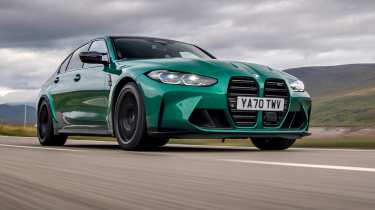
Pros – As quick and capable as you could possibly want
Cons – Bigger and heavier than you’d possibly like
If you were to tell a die-hard BMW M fan 20 years ago that the BMW M3 was now a turbocharged, all-wheel-drive saloon with a weight figure close to that of the E39 M5, they might not have believed you. But as BMW M has proven time and time again, its ability to create brilliant performance cars through new generations of powertrain and chassis technology means the latest M3 is one of its finest.
While the CS version was one of the best saloons on the planet, it was a short-lived special, with the facelifted M3 Competition now taking the reins. The standard M3 Competition that came before was already an eCoty contender in 2021. The updated car wades into battle with a boost to 523bhp from its twin-turbocharged straight six. The headline figures aren’t changed especially for the new M3 Competition, though the extra power does shave 0.6sec off its 0-124mph time, now down to 11.8sec for the saloon.
Though the rear-driven car is now no longer available, it’s no great loss. The xDrive was always the version that made this generation of M3. We can’t see a small boost in power, an updated steering wheel, new infotainment software and revised front lights ruining what is one of the most potent and desirable saloons of the last few years.
Alternatives to the BMW M3 Competition
The reality of buying a super saloon other than the BMW M3 Competition is that it’s a slight exercise in contrarianism. There are things the Alfa Romeo Giulia Quadrifoglio does better even than the latest M3 but now especially, its advancing years make it an esoteric choice. An excellent one, but esoteric all the same.
"Perhaps the biggest compliment that can be paid to the new M3 is that while it may have proportions more suited to an M5 from a couple of generations ago, it manages to drive, steer and thrill in as close a fashion to an M2 Competition as is possible to get from a car that’s both bigger and heavier." – Stuart Gallagher, evo editor-in-chief
Audi S5
Prices from £66,575
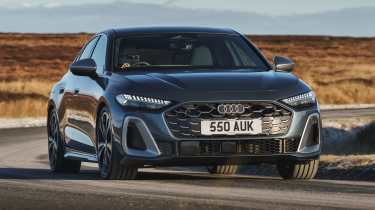
Pros – Quick, refined, balanced, well-equipped
Cons – Expensive, not the most thrilling
Audi’s recent flip-flopping over its naming convention where ICE models were to have odd number designations with EVs taking the even-numbers might have been ditched but the new Audi A5 and S5 were caught in the transition. These traditional coupe models have transitioned to the saloon and estate class previously occupied by the A4. It’s not just a badge with a bigger digit though, with the S5 bringing mild-hybrid technology, deftly-tuned adaptive dampers and a quattro sport limited-slip differential to the party.
We start with the engine, which is a derivative of the old 3-litre turbocharged V6, only it now features mild hybridity with a power generator and a variable geometry turbocharger for a healthy 362bhp and 269lb-ft. The result is improved response low down and better efficiency and emissions everywhere else, with 62mph arriving in 4.5sec on the way to a 155mph top speed. It may not be as powerful as the 400bhp-plus Mercedes C43 but the Audi S5 matches it in terms of acceleration.
It’s a surprisingly tuneful mill that’s enjoyable to play with up and down the rev range with the seven speed dual-clutch transmission. It’s also surprisingly composed at speed down a road, the adaptive dampers admirably controlling its not inconsiderable mass. No, it doesn’t steer with the utmost tactility, but it has sharp responses and together with the diff, gets the S5 turned in with a keenness alien to some hot Audis.
The S5 is a fine car in and of itself, surprisingly so. What’s exciting, is the bandwidth left over for the upcoming RS5. For now, Audi’s small warmed-over saloon is the freshest and one of the best of its type.
Alternatives to the Audi S5
There are plenty of warm saloons to choose from that stand comparison to the S5. BMW’s M340i is the default choice if a dynamic feel is a priority. If you want a bit more of a plush, luxurious aesthetic inside (if not feel) then the Mercedes-AMG C43 is worth a look.
"Turn-in on power is keen, while the amount the S5 is happy to send power to the outside rear wheel and spit itself sideways seems to directly correlate with how much steering angle is on. You won’t hold it for long in a balletic graceful drift, though. This simply isn’t in the S5’s nature. It’s happiest cultivating positive neutrality with the occasional flourish of rear-driven personality, without the natural, always rear-lead feel of a longitudinally-engined xDrive BMW." – Ethan Jupp, evo web editor
Porsche Panamera
Prices from: £89,400
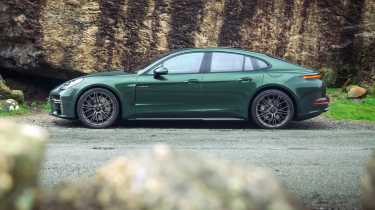
Pros – A fast, satisfying and usable supersaloon
Cons – Needs more aggression to take on the BMW M5
Is the Porsche Panamera a high-performance four-door coupe, a super saloon, or a luxurious limousine with an outrageous turn of speed? Regardless of how you view it, there’s no denying that it’s a deeply impressive piece of kit, especially in GTS spec and above. Despite its size and weight it still goes and handles with the alacrity you’d expect from a car bearing the Porsche badge.
The big Porker was updated in 2024 and is resolute in GTS form, in sticking to pure combustion power, courtesy of a twin-turbo V8. While power is up from before, 493bhp isn’t exactly going to make the new 717bhp BMW M5 blush. That said, it does undercut the M5’s weight by over 300kg.
It’s not got the all-out intensity of some of the very best super saloons but there is a duality to its personality and truly unshakable capability. The chassis doesn’t use the new Active Ride suspension the Turbo S E-Hybrid gets but it’s 10mm lower than standard, riding on adaptive dampers and two-chamber air springs. It also gets stiffer anti-roll bars and a torque vectoring rear diff, adding agility.
The GTS could have been edgier to try and tempt BMW M5 CS owners away from their unicorn super saloons but there are subtleties to the GTS’s dynamic manners that are there to enjoy. Whatever way you look at it, it’s a compellingly capable machine.
Alternatives to the Porsche Panamera
The Panamera as a model is positioned above conventional executive saloons such as the BMW 5-series and Mercedes-Benz E-Class, so it’s difficult to attribute direct rivals. For GTS money, however, it’s difficult to ignore that a well-optioned BMW M5 is very much within budget.
So too were the Audi RS7 Sportback Performance and Mercedes-AMG GT four-door, though both are now off-sale. If for some reason you’re not interested in internal combustion, Porsche’s own Taycan and the Audi e-tron GT are compelling options.
"It stays composed and keyed in under high braking and cornering forces (particularly in the Sport damper setting – Sport Plus is too tense for the road), and breakaway at both axles is progressive and easy to read. It always feels like a big, substantial car, but the clean and accurate steering response means you can pick precise lines and build confidence for corner after corner. You need to work the paddles of the eight-speed PDK ‘box to punch away from them, but it’s easy to settle into a fast, satisfying flow in the GTS." – Yousuf Ashraf, evo senior staff writer
BMW M5
Prices from £114,095
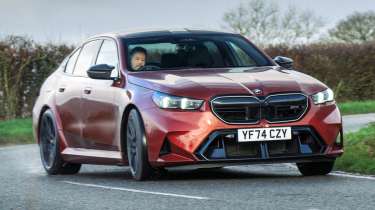
Pros – Still does everything you’d expect of an M5
Cons – Plus some stuff you don’t
The new BMW M5 has very big boots to fill, with the memory of the sublime BMW M5 CS still vivid in all our minds. The odds were against it, as its controversial kerb weight of over 2400kg had many doubting BMW M could possibly tie it down as an enjoyable and effective super saloon.
We needn’t have worried too much, as BMW has managed it. The new M5 is a masterclass in disguising mass, deploying its 717bhp (coming courtesy of the old 4.4-litre twin-turbo V8 with new hybrid tech) to devastating effect. It stops, goes, turns and controls itself with the decorum of a car hundreds of kilos lighter.
As infinitely adjustable as you may expect, the goldilocks zone is far from buried within the M5’s sprawling configurability. The do-everything ‘Comfort’ setting is excellent in its own right. Sport damping and steering aren’t really necessary for hustling on the road. The sport setting for the brakes does improve feel and obviously, Sport and Sport Plus settings for the powertrain allows you to call up the full 717bhp at will. The dynamic balance of the car is topped off by switching the 4wd to MDM mode, which adds a rear bias without switching the front axle off completely.
It still doesn’t flow with anything like the interactivity and life of the eCoty-winning M5 CS. Rather, it’s an M5 designed to expand the bandwidth of the badge, combining the ability to run on electric power for up to 43 miles, with an easily reached 190mph top speed (when the M Driver pack is added). It’s comfortable, cosseting, and almost infinitely capable.
Alternatives to the BMW M5
Unless you’re going for the slower, more expensive Panamera GTS, the M5 is a car without a direct rival at the moment, unless you’re looking at the Touring. Mercedes-AMG's E53 is a subtler, less aggressive alternative – what a strange parallel universe to be saying that of an AMG. Nonetheless it's a well-sored, nicely damped, agile and capable sports saloon.
"It feels like M engineers have given the car all the agility it should ever need but for everyday road driving has created a zone of calm around the steering’s centre, a place where you can work in a relaxed way. It feels wieldy with well-judged efforts, lovely linearity and a decent sense of what the front is doing, which is mostly going exactly where it’s pointed." – John Barker, evo editor-at-large
Audi e-tron GT
Prices from: £89,555
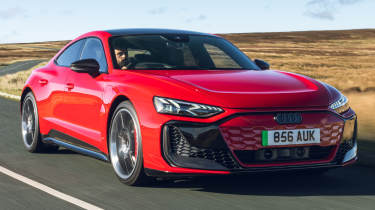
Pros – A comfortable, satisfying and impossibly fast electric GT
Cons – Inconsistent brake feel, Taycan has better steering and damping
The Audi e-tron GT has always been the unlikely sibling of the Porsche Taycan and indeed, an unlikely feather in the Audi Sport cap. For while electric cars and brutally fast cars are very much in Audi’s wheelhouse, there have been fewer dynamic, interactive, and adjustable saloons wearing the four rings. The e-tron GT is an exception, in spite of its weight, in spite of its size, in spite of being an EV – and in spite of its badge.
Updated in 2024, the e-tron GT range is now split into three, with the S e-tron GT that opens the range sporting power to match the old flagship, at 671bhp. The RS e-tron GT has a full-bodied 844bhp and if that’s not enough, the 912bhp RS e-Tron GT Performance should suffice. It’s not just a series of power bumps, either. It now has an active chassis system that uses air springs and hydraulically-connected active dampers, removing the need for anti-roll bars. There’s also a quicker steering rack and rear steering, all working together to make the e-tron GT more dynamic and agile, as well as faster. They also have a serious range boost, with the S e-tron GT claimed to be good for 370+ miles on a charge.
The results? Well, it was never going to trouble anything for the eCoty crown but it’s a thoroughly impressive, oddly engaging, distinctly un-Audi-like device, that’s as pleasant to drive as it is to look at. On the inside, a steering wheel that now features haptic controls is thankfully the only real move away from real buttons, as the e-tron GT keeps the physical controls that always gave it serious appeal over the Porsche Taycan.
Alternatives to the Audi e-tron GT
There are plenty of fast electric four-door coupes/rakish saloons kicking about at the moment if you have around £100k to spend. The most obvious e-tron GT alternative is the Porsche Taycan, its platform mate, though the Lotus Emeya offers more exoticism inside and out and sound dynamics to boot. Coming soon will be the Polestar 5.
"The updated e-tron GT even in base quattro form is still an incredibly fast, capable and strangely balanced (for Audi) super GT/saloon. It’s also fantastic looking – a car all bystanders look at as if it’s the R8-adjacent flagship Audi has positioned it as, even if in our eyes it’s a V10 short." – Ethan Jupp, evo web editor
Mercedes-AMG C43
Prices from £69,960
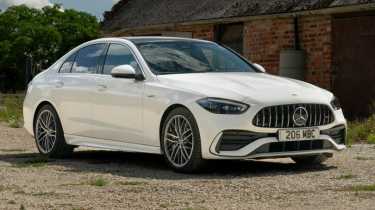
Pros – Clever turbo tech, accessible performance, capable chassis
Cons – Sterile steering, some transmission jerkiness
The days of barrel-chested V8 saloons in Mercedes-AMG’s lineup are behind us – that hurts just to type. But while the weighty plug-in hybrid C63 misses the mark, the Mercedes-AMG C43, that utilises a version of the same bombastic four-cylinder engine but without the heavy electric bits, proves to be oddly compelling. If you look to the past, Mercedes has form with enjoyable performance saloons with four cylinders. The C43 is no 190E Cosworth replacement but it has its charms.
Firstly, the engine. Short on cylinders and cubic capacity it may be but it’s a stout performer with some very impressive technology. 402bhp and 369lb ft is plenty to get the C43 going down the road, especially given the response of the electric turbocharger with a small motor that can spin up to 175,000rpm. If you’re in search of such things, F1 derived tech in a sporty road car is always good to see.
Happily, this motor finds itself housed in a competent, high-tech chassis, with 4Matic four-wheel drive delivering a sensible 31:69 front/rear torque split, for some AMG-typical power adjustability. The C43 is suspended on active dampers and has rear-steer, to really sharpen up responses on turn in, while helping high speed stability. The only real blot in the C43’s dynamic copybook is the inert, synthetic-feeling steering. Nevertheless, the junior performance C-Class is a bit of a dark horse that shouldn’t be overlooked for the sins of its big brother.
Alternatives to the Mercedes-AMG C43
There are plenty of warm saloons to choose from instead of the C43. BMW’s M340i majors on dynamic feel though isn’t as plush inside as the Mercedes. The Audi S5 being the most recent is the most high-tech inside, though like the BMW is slightly staid and clinical in terms of cabin design. The Audi is similarly restrained in terms of its chassis too.
"Mercedes-AMG isn’t alone in having to reinvent itself. Times are changing. But the once presumed conflict between saving the planet and going fast has simply failed to materialise. Performance, far from being the sacrificial lamb, has got its second coming. If the new, greener C43 isn’t as emotionally rewarding as its twin-turbo predecessor, in matters of motion, there is no sacrifice." – David Vivian, evo contributor
Lotus Emeya
Prices from £84,990
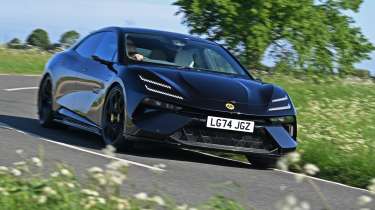
Pros – Fluidity of the standard car’s dynamics
Cons – Active chassis never settles; 900’s performance is too much
Strange times at Lotus at the moment. The ship is struggling to stay afloat, as a thoroughly modernised lineup that’s the least ‘Lotus’ it’s ever been fails to resonate with buyers in the volumes the Hethal marque had hoped for. But that’s not the fault of the cars themselves. Save for some inconsistent performance in terms of range, the Emeya is a brilliant super saloon/coupe – as appealing to drive if not more so than the Audi e-tron GT, nicer to be inside than both the Porsche Taycan and the Audi and needless to say, properly rapid in whatever form you buy it.
In fact, that’s the key to getting the best out of the Emeya, is to not go overboard with the one you plump for. Do you need the fancy anti-roll system? Probably not. Do you need the almost 900bhp headline power figure of the very highest spec Emeyas? Absolutely not a chance. You can therefore look further down the range and spend under £100k on your chosen Emeya – a basic Emeya 600 on the smaller 20-inch wheels (for a better ride) is competitive at £84,990 but still good for 0-62mph in 4.2sec.
Alternatives to the Lotus Emeya
The Emeya is aimed squarely at the Porsche Taycan and Audi e-tron GT and so those are your most obvious alternatives if you’re in this market, which given how much it’s struggling, chances are you’re not. Soon the Polestar 5 will join them in the fight for a shrinking crowd of prospective buyers. Want hydrocarbons? The Porsche Panamera and BMW M5 are worth a look.
"You still have little adjustability via the throttle, but there’s a natural balance to how it behaves, the way it rolls into a corner, transfers and manages its weight and conveys an attitude and character missing in so many electric cars, including Porsche’s generally impressive Taycan." – Stuart Gallagher, evo editor-in-chief
Bentley Flying Spur
Prices from – c£200k
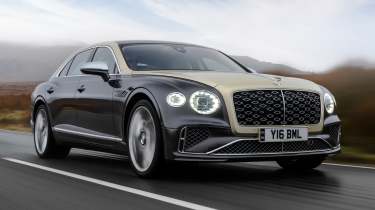
Pros – Shocking performance; duality; class-leading luxury
Cons – Brake feel; invasive assistance systems
It might feel a bit odd to describe the Bentley Flying Spur as a sports saloon, but it does have four doors and it certainly has more than enough performance to nail the sports part of the brief. It might be masquerading as an opulent luxury continent crusher but the Flying Spur disguises its size and weight with a physics-defying performance.
It might look very much like the previous generation machine, but there have been a host of changes under the skin, not least the ditching of the venerable W12 in favour of an electrified V8 which is shared with the new Porsche Panamera Turbo, Lamborghini Urus SE and Bentley Continental. Bentley refers to it as an ‘Ultra Performance Hybrid V8’ powertrain and with a combined figure of 771bhp and 738lb ft it’s the most powerful Bentley powertrain ever developed. A 3.5sec 0-62mph time for a 2646kg leviathan tells you most of what you need to know.
But there’s far more to the Flying Spur than outright performance. It’ll do around 40 miles (Bentley says 50) on battery power alone yet engage the V8 and Sport mode and the chassis lowers and perceptively stiffens, maintaining a luxurious ride quality while retaining impeccable body control and minimising roll. If you’re after the ultimate in luxury while retaining plenty of driver involvement then the Flying Spur has few, if any, peers.
Alternatives to the Bentley Flying Spur
Large luxury barges aren’t often up to the lofty standards of the prim, proper and plush Bentley. Though for folding money less than the £200k it costs to get into a Flying Spur there’s everything from BMW’s 7-series, to Mercedes’ S-Class and Audi’s A8. For a proper rival to the Bentley in terms of luxury, only the Rolls-Royce Ghost foots the bill, albeit it’s not quite as dynamic to drive.
"In Sport mode the chassis lowers and stiffens noticeably, minimising roll and maintaining a level of body control that doesn’t feel possible given the luxurious ride. On more than one occasion I spotted a dip ahead, prepared for a jolt and momentary upset, and it simply never came. The way in which the Flying Spur manages its 2646kg mass makes you reassess your understanding of physics." – Sam Jenkins, evo senior staff writer
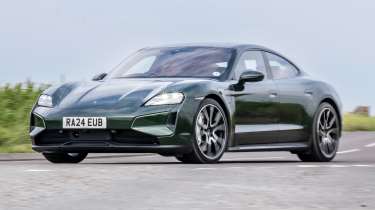
Porsche Taycan Turbo
Prices from: £135,200
Pros – Exceptional performance, range and dynamic ability
Cons – Comes at a hefty price; not as roomy as it should be; inconsistent brake feel
Porsche’s take on what a performance orientated electric saloon should be like has always been the template for what we like about performance EVs but in its second-generation guise it’s even better. We summed it up as being ‘the most complete electric car on sale’ Give it’s got four doors it was a shoo-in for inclusion in our best saloons category.
It might look familiar but the Porsche Taycan has taken considerable steps forward in its performance, the distance it can cover and the speed that it can accept a charge. If that wasn’t enough its dynamic abilities have been enhanced as has its long-distance ability. The Turbo sits in the middle of the range which starts with the 402bhp Taycan and tops out with the track-focused 1020bhp Turbo GT. The Turbo makes do with just 872bhp. That it can sprint from 0-62mph in just 2.7sec tells you just how unhinged the Turbo GT must be.
The rear-drive entry-level Taycan will manage 421 miles on a charge officially and despite having over twice the power the Turbo will still cover 391 miles between charges. However, it’s the Taycan’s Porsche genetics that grab the headlines with crisp responses and wonderful steering precision. The optional Porsche Active Ride does away with the need for anti-roll bars (just like its Audi e-tron GT relation) and results in a car that’s impressively poised despite its 2290kg weight. Despite the extra edge to its handling the ride remains excellent endowing the Taycan with a duality of purpose that’s unmatched in the EV field.
Alternatives to the Porsche Taycan Turbo
Audi’s e-tron GT is the Porsche’s platform mate and therefore its closest rival. For £8k less than the Taycan Turbo is RS e-tron GT, which has very nearly as much power (near enough 850bhp) and is available with the same active ride system as an option, also not standard on the Porsche. Want something that’s a little more attractive inside but a little more shaky in terms of the stability of the company that builds it? Step towards the Lotus Emeya.
"Porsche’s Active Ride tech that first appeared on the Panamera enables precise control of suspension forces at each corner of the car. As a result, the body is extremely well supported and you don’t need to slow down your inputs to allow the weight to settle, which feels a bit alien in such a heavy car. The Taycan doesn’t feel light per se – you’re still conscious of the enormous forces the tyres are dealing with – but Active Ride makes use of all four contact patches by distributing the loads evenly across them, no matter what you throw at it." – Yousuf Ashraf, evo senior staff writer
Best used saloon cars
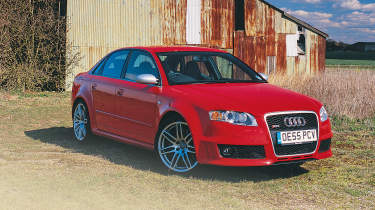
Audi RS4 (B7)
Prices from £20,000
Pros – Addictive, linear NA V8 power
Cons – Costly DRC suspension repairs
The B7 RS4 remains a high watermark for Audi Sport, swapping its typical clinical character for real soul. Its centerpiece is a 4.2-litre naturally aspirated V8 that revs all the way to 8250rpm in a way that not many cars of its kind could. It’s a car defined by its dual nature, pairing the tractability of quattro all-wheel drive with a sharp chassis that finally shrugged that Audi stereotype, offering a level of approachability and throttle-adjustability that its predecessors lacked.
Driving it in 2026, the mechanical purity of the six-speed manual and hydraulic steering are refreshing. The Dynamic Ride Control provides a level of composure and compliance that makes it a formidable cross-country tool, even decades since its launch. It’s far from a numbers car, but the way the RS4 breathes with the road and rewards you for pushing on is unlike any other RS4 we’ve seen since.
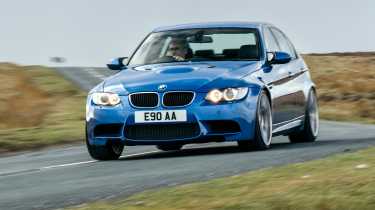
BMW M3 (E90)
Prices from £23,000
Pros – Incredible chassis & throttle response
Cons – Potential for costly maintenance, low on torque
When BMW dropped a V8 into the 3-series, straight-six M3 purists were not pleased. The 4-litre S65, essentially a truncated version of the M5’s V10, is a sensory triumph, delivering F1-inspired ferocity and a ludicrous 8400rpm redline. While the E90 saloon lacked some of the visual muscle of earlier M cars to some, the mechanical substance was undeniable, offering a level of theatre usually reserved for much more exotic machinery.
The chassis balance is neutral and intuitive as an M car should be, though the steering can feel slightly woolly off-centre compared to the razor-sharp E46. The E90's ability to handle daily duties, only to transform into a hugely capable track tool at the push of the MDM button, made it one of the greatest dual-purpose supersaloons ever conceived.
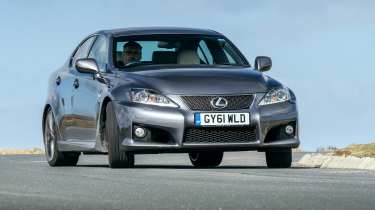
Lexus IS F
Prices from £15,000
Pro – Satisfying V8 engine
Cons – Over-active damping, confusing HMI
Despite the Lexus stereotype, its first serious foray into the supersaloon segment was just as bonkers as the German alternatives. At its heart is a 5-litre V8 that delivers power and torque to sit above the M3 of the time, and beneath the C63, but its ‘two-stage’ intake sound gives it a truly unique character. Early cars did struggle with an open diff, but the addition of a proper Torsen LSD transformed the IS F into a progressive, playful car that finally had the traction we were looking for.
Early electronic steering means it lacks the steering precision of an M3 or C63 of the time, but the Lexus compensates with charisma and class-leading refinement. It rewards commitment on the right roads, finding a rhythmic flow once you push past its slightly overactive damping. It won’t break the bank, either, with plenty of examples to be found for under £20,000.
Mercedes-Benz C63 (W204)
Prices from £15,000
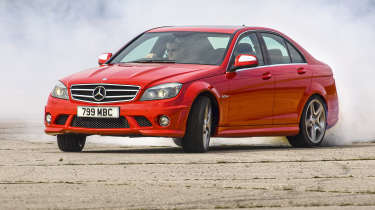
Pros – Potent, soulful 6.2-litre V8; excellent steering
Cons – Appetite for tyres
The W204 C63 is the dictionary definition of AMG, applying a huge, 6.2-litre naturally aspirated V8 to a saloon of not-so huge dimensions. Its M156 engine was AMG’s very first bespoke unit – it didn’t do things by halves. Power output of up to 500bhp in 507 form put it in an entirely different league in terms of straight-line performance next to rivals of the time, with a huge 442lb ft of torque right from the bottom of the rev range making performance accessible at all times. It’s an honest, analogue machine with excellent hydraulically assisted steering that offers surprising clarity for a car so often associated with tyre smoke.
While it can feel a touch more ragged at the limit than an M3, the C63’s linear power delivery makes it predictable, providing you’ve found an example with the optional limited-slip differential. It’s a car of immense personality and surprisingly robust mechanicals, though its appetite for fuel and tyres is certainly worth considering. The saloon is the cheapest C63 variant of all, too, with higher mileage examples starting from around £15,000.
BMW M5 (E28 - G90)
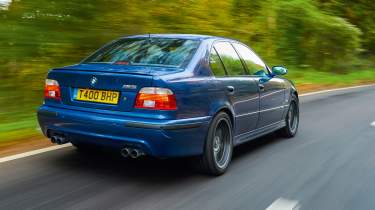
Pros – Defining executive performance benchmark
Cons – Weight and complexity in its current form
The M5 lineage established the template for the supersaloon, evolving from the delicate E28 of the ‘80s to the high-tech, 717bhp G90 of today. Throughout its history, the M5 has consistently pushed boundaries, from the high-revving straight-sixes of early cars, to the exotic S85 V10 of the E60 and the endless torque of the modern turbocharged V8s. It quickly became the benchmark against which all other supersaloons were measured.
While the M5’s character shifted from lightweight agility to the outright pace of today’s cars, the core ethos of effortless progress remains. Whether it’s the mechanical purity of the E34 or the all-wheel-drive dominance of the modern F90 and G90, the M5 continues to prove that you can have supercar-slaying performance without sacrificing practicality.
Lotus Carlton
Prices from c£60,000
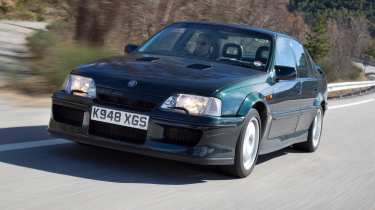
Pros – Supercar-slaying straight-line pace
Cons – Alarming body roll today
It’s fair to say that the Lotus Carlton was a shock to the system in the early '90s, a 176mph Vauxhall that made Ferraris look a little lethargic. Born in Hethel and featuring a 3.6-litre twin-turbo straight-six, it delivered 377bhp, a figure that completely overshadowed the M5 of the time. It was a hand-built specialist machine, a humble saloon ripped apart and reconstructed with supercar-grade suspension, brakes, and a Corvette-sourced six-speed gearbox.
On the road in 2026, the Carlton feels alive, riding a massive wave of torque that still feels fast by modern standards. While the steering is heavy and the body roll pronounced, the chassis provides a level of finesse and character that belies its ordinary silhouette. It remains a hero car, an industrial-strength legend that still holds its own against contemporary alternatives.
Mitsubishi Evo
Prices from £13,000
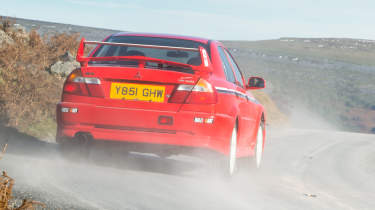
Pros – Unmatched, laser-like precision
Cons – Basic, plastic-heavy interiors
The Mitsubishi Evo series represents a line of rally-bred specials that prioritise lateral grip and mechanical immediacy above all else. From the early narrow-body cars to the widened Evo VI and beyond, they offered a level of precision that not much else could.
The Tommi Mäkinen Edition, for example, is a sensory assault. The steering is ultra-responsive and the chassis seems to float effortlessly over bumps that would upset lesser cars. It is a car free of compromise, demanding total focus from the driver but rewarding with a level of engagement and agility that remains almost unmatched.
Subaru Impreza Turbo
Prices from £5000
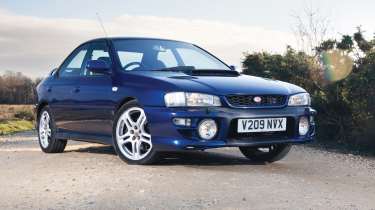
Pros – Iconic, characterful flat-four
Cons – Basic interior
The Impreza Turbo was a car that brought huge levels of performance to the masses, combining the thrumming soul of the EJ20 flat-four with a lightweight, agile chassis. It was the era of the giant-killer, where a relatively affordable saloon could outrun exotica on a rain-soaked northern B-road. Its brilliance lies in its transparency, with the Turbo offering a raw, immediate sensation of precisely how the tyres are working with the tarmac.
Despite the hard plastics inside, just like the Evo, the driving experience is hypnotic. The mechanical whines, whooshes, and that trademark boxer throb create a truly unique character. It’s a car that feels energized the moment it hits boost, digging its claws into the road in a way that modern all-wheel-drive systems struggle to replicate.
Subaru Impreza RB5
Prices from £15,000
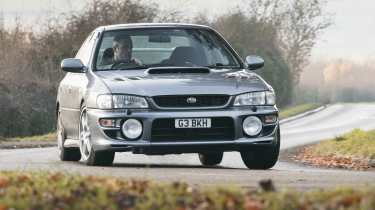
Pros – Excellent, malleable chassis balance
Cons – There aren’t many around
The RB5 was a celebration of Richard Burns’ arrival at the WRC team, a slightly more grown-up take on the Impreza formula. While it shared the raw performance of its siblings, it was often distinguished by its Steel Blue paint and a focus on more polished dynamics.
Like the P1, the RB5 thrives on being worked hard, its EJ20 engine passing 6000rpm with a smoothness that places it among the great internal combustion engines. It remains a benchmark for body control and feedback, proving that a well-tuned rally-special doesn't need to be rock hard to be effective. Yours from £15,000.