Jaguar Project 8 (2018-2019) review – how to make a BMW M5 CS look tame
The XE SV Project 8 is the wildest creation to come out of Jaguar’s 5-litre V8 era and a unicorn of a type that will not be repeated
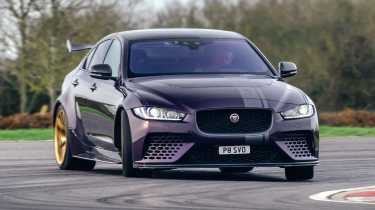
Back in 2018, the Jaguar XE SV Project 8 was a wild proposition: the most powerful Jaguar production car ever; the fastest four-door car around the Nürburgring Nordschleife (eventually recording a 7min 18sec); 200mph top speed; hand-built with three-quarters of the exterior surfaces bespoke and some made from carbonfibre; intended for a production run of ‘no more than 300’.
All exciting stuff, but a few people wondered whether this was a wise use of the company’s time and resources. Today, with Jaguar on the brink of a bold, electrified future, that’s a compelling list of attributes which, it seems, the used market is waking up to. The slightly torrid time it had selling them didn’t put off others from developing similarly extreme machines, namely Alfa Romeo and the Giulia GTAm. Needless to say, the bombastic character of the Project 8 is what we'll most miss in the Jaguar GT and this new electric era.
Engine, gearbox and performance
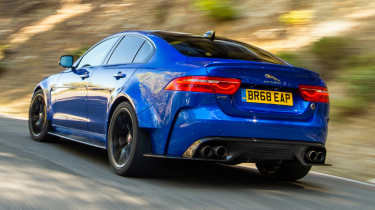
- Ferocious 5-litre supercharged V8, ZF eight-speed automatic ‘box
- Powertrain doesn’t match handling and chassis precision
- 0-62mph 3.3sec, 186mph (Touring) and 200mph (Track) top speed
Putting the company’s biggest engine – the supercharged 5-litre V8 – in its smallest saloon and tweaking it to a headline 600 PS (592bhp) sounds ambitious and it was, to the point that it couldn’t be produced in right-hand drive, for packaging reasons. It also sounds ambitious in terms of traction management, but the wide-bodied XE also got the four-wheel-drive system developed for the F-type, so it wasn’t going to sit there smoking its tyres.
More reviews
> The new Jaguar GT is lovely to drive, but that’s not enough for people to buy it
The supercharger ensures it’s got plenty of torque from the get-go, but torque is capped by the eight-speed ZF auto, so the Project 8 has no more than the slightly less powerful F-type SVR and Project 7 (both 567bhp). While the ZF is a great ’box, all-out its shift speed doesn’t quite match the crispness of the dynamics.
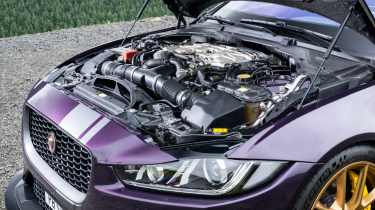
It does the numbers though. The Project 8 posts a 3.3-second 0-62mph time and, in Track spec, a 200mph top speed. Touring models are equally capable off the line, but without the downforce provided by that rear wing, top speed has been limited to 186mph – still rapid, obviously, but not quite so headline-grabbing.
Jaguar’s V8 never sounded better, either. Supercharger whine has largely been consigned to the history books – it’s still there, but no longer so audible – but the Jag’s exhaust note hits with the consistency, volume and heart-stopping power of artillery fire. Throttle response is keen right from the off, and acceleration doesn’t abate, from the first few revs above tickover, all the way to the red line.
Driver’s note
‘The pure theatre and knock-out punch of the supercharged V8 is tough to beat. The eight-speed automatic gearbox is solid but a slight disappointment in the context of the motor, delivering decisive changes but lacking the fully lit feel of the rest of the car.’ – Jethro Bovingdon, evo 316
Ride and handling
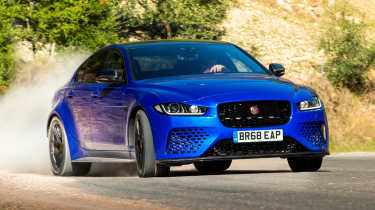
- Wider with bespoke bodywork and suspension
- Feels sharp and precise yet fluid
- Adjustability to ‘track spec’ makes it even sharper
It only takes a glance to notice the visual changes between the XE and the Project 8: only the roof and front door skins are shared between the two variants. Like the XE there’s an aluminium substructure, while the aforementioned panels are also aluminium, but everything else – bonnet, bootlid, front and rear wings, bumpers – is carbonfibre, in an effort to shed weight.
At 1745kg at its very lightest, it’s lighter than, say, a BMW M5, but far from the 1620kg of the less exotically constructed Alfa Romeo Giulia Quadrifoglio. The body kit does at least reduce aerodynamic lift – to the tune of 206 per cent compared to the standard XE – and a wider track (by 24mm up front and 73mm behind) improves stability further.
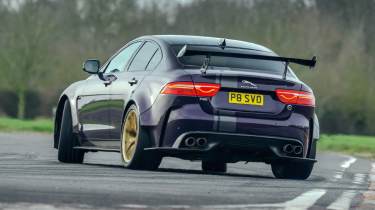
Suspension is radically overhauled, with bespoke billet knuckles, split front wishbones with camber shims, a bespoke rear upper arm assembly with rose joints and upgraded anti-roll bars. The spring platforms are adjustable for the aforementioned Road and Track settings – the latter drops it by 15mm – with helper springs at each corner. It retains the Continuously Variable Damper system, with Comfort, Sport and Track settings.

It wasn’t going to be a blunt instrument. A key competitor car referenced for the project was the Porsche 911 GT3 RS, the hardcore 911’s steering and remarkably controlled yet compliant ride and handling used as benchmarks. Indeed it’s not the pace or thunderous soundtrack that blow you away, it’s the dynamics. Despite the weight, chassis control and fidelity are off the scale, and as a result its mass never feels like a liability.
The composure of the Project 8 is instantly impressive and doesn’t waver even as pace increases and the challenges come harder and faster. On the limit it feels calm, confident, as if time was slowed down, a rare sensation in a big saloon and one known also from the BMW M5 CS.
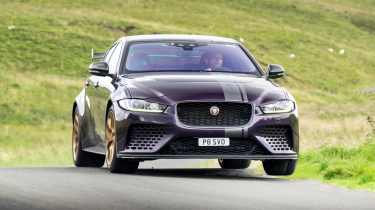
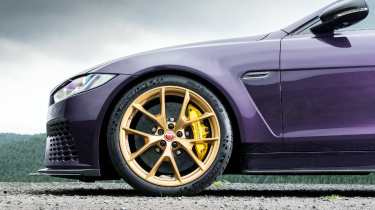
Just a couple of minutes in on track, Harry Metcalfe’s Merlin Purple car shows that there’s even more control to be had by setting the fully adjustable suspension to track spec, which lowers it 15mm. There’s even more feedback, enhanced directness and loads of grip from the bespoke Michelin Cup 2s and AWD system. Project 8’s setups owe a lot to David Pook, who was at SVO and has since built a fine reputation for getting the best out of the Alpine A110 chassis through his tuning company, Life110.
The Project 8’s brakes are more than up to the task of dragging circa 1.8 tons back down to sensible velocities, but a little more pedal feel wouldn’t go amiss, just for some extra reassurance.
Driver’s note:
‘The accuracy afforded by bespoke suspension components is tangible every time it carves cleanly towards an apex. There’s no questioning its agility and the appetite it shows for sustained g loads as it steers sweetly from one corner to the next without requiring a moment’s pause to settle and control its mass.’ – Jethro Bovingdon, evo 316
evo Car of the Year 2019 result:
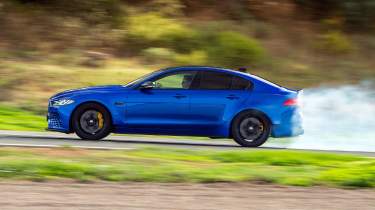
‘One short drive in the Project 8 delivered more thrills than the 20,000 miles I covered in evo’s long-term BMW M5. Its presence and performance might suggest a thuggish approach but, as many commented, the Project 8 has the finesse in its chassis to reward and excite in equal measure. Yes, it has the power and torque to disguise its weight, but the way it could latch on to the tail of the Mercedes-AMG A45 S or Porsche 718 Cayman GT4 and keep them honest no matter how technical the road became won it admiration on the hills around Ronda and a lap of Ascari.
‘Downsides? For all its brawn, the 5-litre supercharged V8 feels its age, and with a sharper-responding engine and gearbox the Project 8 Touring would be better still. That it finished just a single point behind the third-placed car demonstrates the high regard in which we hold the Jaguar.’ – Stuart Gallagher, evo editor-in-chief
Interior and tech
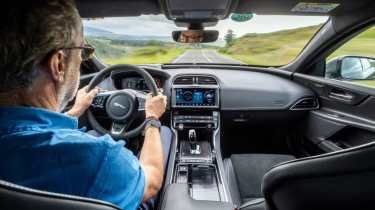
Perhaps another reason Project 8 didn’t fly out of the showrooms was that the interior wasn’t nearly as bespoke as the exterior (or the suspension for that matter). The cabin is clean and simple, a subtle mix of smooth black leather and Alcantara with some carbon highlights, but it’s still very like the stock XE’s because making bespoke interior parts in small batches simply didn’t make economic sense. Frustrating when the cabin of a BMW M3/4 is wildly different to a regular 3-series, but that’s economies of scale for you.
You do get superb Sabelt seats and a suede-rimmed wheel. You could opt for the Track Pack and have just the two seats, a pair of even more sculpted, manually shifted Sabelts with harness belts, plus a half cage instead of two seats in the rear. Out of the production run, 62 customers opted for the Track Pack.
MPG and running costs
Project 8 is thirsty. Oh boy, it’s thirsty. Officially, it’s capable of 25.7mpg combined, but at anything other than a steady, low-revs cruise this seems somewhat optimistic. On a recent drive we saw just shy of 13mpg, and while the normal owner’s experience will probably end up somewhere between those two numbers, potential figures in the low teens are within easy reach. The Cup 2s won’t be cheap to replace either once you’ve burned through a set, though in our experience the Michelin rubber puts up a pretty good fight even on track, so as a car unlikely to be used daily, changes shouldn’t be too regular.
Prices and checkpoints
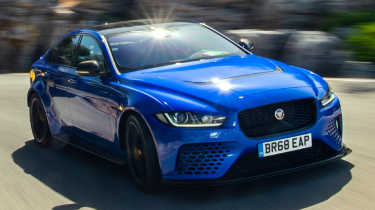
For a number of years, used prices have languished below the original list price, but in the last 12 months, interest has grown. As with the Renault Mégane R26.R, another similarly focused car, it seems that the market took its time to wake up to just how special Project 8 is. Out of the 200, just 35 were sold in the UK, though the choice is wider because it was only built in left-hand drive.
Prices for examples currently offered for sale range from around £130k up to just shy of £200k, and many of them have covered very low mileage, suggesting they were bought for collections or as an investment. Harry’s car is approaching 20,000 miles and he says he’s stopped driving it in the winter for the sake of the bespoke suspension, especially the threads of the adjustable platform struts.
Tom Lenthall, a JLR specialist based in Reading, has had ten examples through his workshop and owns a Project 8 himself. There are only a couple of things potential owners should be aware of, he reckons. ‘If they’re used on track, they go through brake pads quite quickly, and they’re quite expensive: about £2k for a full set.’
The second is an odd one; the bodyshells can be noisy. ‘It often sounds like clonking suspension,’ he says, ‘but it’s the body flexing.’ He reckons the much stiffer suspension puts higher loads into the shell. ‘It’s strong enough and the fix is simple – silicon spray into the seams, much as you would do to quieten twittering trim.’
‘I can’t ever see me selling mine,’ says Lenthall. ‘Best and fastest road car I’ve ever driven on track.’
Specs
| Engine | V8, 5000cc, supercharged |
|---|---|
| Power | 592bhp @ 6500rpm |
| Torque | 516lb ft @ 3500-5000rpm |
| Weight | 1745kg (345bhp/ton) |
| 0-62mph | 3.7sec |
| Top speed | 200mph (Track pack) |
| Price new | £149,995 |
| Value now | From £130k |