How the Ariel Atom went from 'Motorcycle Replacement Therapy' to Britain's wildest sports car
The man behind the Ariel Atom had quite an exciting journey through the car design industry to find his destiny building the world's

‘My first memorable car experience, at three years old, was falling out of a 1920s 3 Litre Bentley belonging to my godfather, which sounds quite posh. The door opened and I ended up on the road. But you tend to bounce at that age, so I was put back in and we carried on. Possibly this planted the seed to my later aversion to doors on the Atom…’
Following that initial brush with luxury (and tarmac), Simon Saunders’ passion for cars was forged amidst more everyday machines. ‘I only had a mum, and our first car, when I was about six, was a pre-war, battered Morris 8 Tourer, so the poshness does evaporate there,’ he explains. ‘My childhood mission was trying to convince her to buy interesting cars, possibly the daftest being a 1928 Buick hearse. She managed to resist.
‘As a boy, being good at art and having a passion for cars, I put the two together at a fairly early age and decided I should draw cars for a living. I never changed from this goal, although the careers adviser disagreed, saying there was no such job, recommending the army instead. But spare time, holidays, were spent drawing cars.
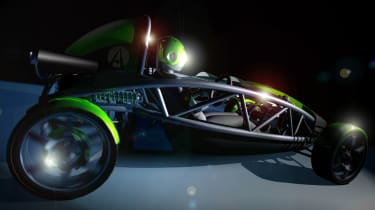
‘A formative book from – amazingly – the local library, and doubtless an influence on the Atom later, was Racing and Sports Car Chassis Design by Mike Costin. Aside from the chassis drawings, a photograph showed an unbodied car with all the mechanics on view. It looked amazing. But turning the page there was the bodied car and it was so disappointing.’

At age 16, motorbikes had an irresistible draw on the young Saunders: ‘Aside from not having to wait until 17 for a car licence, the absorption of riding a motorbike was and remains total. Hopefully a lot of this, the need to concentrate totally and physically drive, is embodied in the Atom.
‘At one time we called the Atom MRT – Motorcycle Replacement Therapy, for those who had to switch to four wheels. But in my teens there was little point in having a car, partly because I lived in London and mostly because for the cost of an average second-hand car I could have a state-of-the-art, nearly new, multi-cylinder bike. No contest really. I bought and sold them; not to make money but simply to try as many as possible.’
After ‘more or less doing art full time at school’, Saunders went to Hornsey College of Art and then on to the Central School of Art, now Central Saint Martins, where he studied Industrial Design. ‘To be honest, car design was a bit of a dirty word then [the early ’70s]. It wasn’t viewed as a terribly serious career, a kind of frippery if you like, seen as tarting up the serious bit underneath.
‘That’s changed now, but it was a bit of a battle then. In reality cars are probably the most difficult and complex product you could design because of the scale, the vast number of considerations and interdependencies, plus the sculptural complexities of car bodywork.’
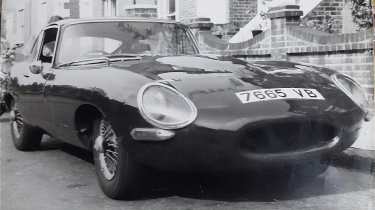
At 21, Saunders got his first car, a 1963 3.8-litre Series 1 E‑type coupe, paid for by working nights and being a dispatch rider during the holidays. ‘I put a synchro 4.2 gearbox in, took off the bumpers, de-seamed it and sprayed it black. I know we’re back to sounding posh but it only cost £395. 150mph for £395! Unfortunately when I came to sell it, I couldn’t. It was the middle of a petrol crisis and I couldn’t give it away.
> Ariel Atom 1 (1999 - 2003) review, history and specs of the bare-bones sports car
‘I ended up swapping it for a Yamaha trail bike, but to underline its worthlessness the guy I swapped with never came to collect it. Eventually the council did and crushed it. A sad end but a time when old sports cars were cheap. Amongst others there was a Mercedes 190SL, also for £395, although a £500 split-window Corvette will remain the one that got away.’
After the Central School of Art, Saunders’ first job was designing motorcycles at a small company in the Netherlands called Van Veen. ‘The development team fitted around one not very big table,’ he recalls, ‘but it showed what can be done with a handful of willing people. The OCR 1000 was an expensive, low-volume, rotary-engined bike, doomed because the “Comotor” engine was dropped by Citroën as the world abandoned the rotary. A fantastic bike, but only 38 were eventually made.’
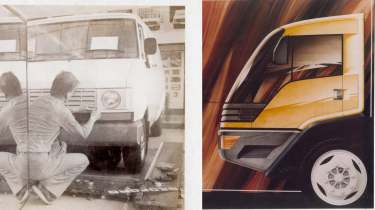
After a stint at Conran Associates, Terence Conran’s design agency (‘too much furniture and not enough wheels for me’), it was off to GM at Vauxhall Bedford Design in Luton to work on cars, vans and trucks. ‘Going from low-volume motorcycles to high-volume cars and commercial vehicles was a very different mindset and a steep learning curve,’ says Saunders.

‘Whilst we did some really interesting concepts, nearly everything ended up in the waste-paper basket. As a designer you’re used to churning out ideas and not being precious about them – it’s your job – but you realise you are just a very small cog in a very large machine. As Vauxhalls became Opels and the writing was on the wall for Bedford, I decided to move on. Turning an Opel into a Vauxhall is not the biggest design challenge.’
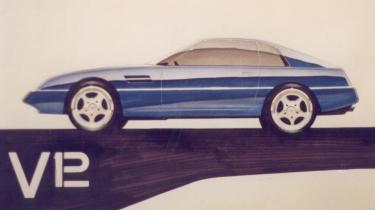
Next came Aston Martin, ‘to design a new V12 car, sharing a small office with the guy employed to design the engine. Coming from the vast studios and resources of GM to leaky buildings in Newport Pagnell was from one extreme to another. The really interesting contrast was again what can be achieved with a tiny number of people.
‘I was the only designer among a small band of mostly equally young engineers, all in our 20s. It was also highly instructive of what you can and can’t do at low volume, particularly with absolutely no money. We were always on the verge of bankruptcy and there were various changes of ownership, with Christmas being a particularly worrying time in case the place didn’t re-open afterwards.’
‘Keeping the wolf from the door in the early ’80s was a turbocharged Ford Capri project, under the Aston Martin Tickford banner. ‘As Aston Martin engineering and design we were a bit sniffy about this,’ Saunders recalls, ‘but it was bluntly explained to us that if we wanted to be paid that month we had better get on and do it, which we did in a matter of weeks. The low-volume nature of making sometimes less than 100 Astons a year certainly informed Ariel later on.
‘I did really enjoy my time, the people and the atmosphere at Newport Pagnell, although the glamour of driving prototype Astons did wear thin sometimes because of reliability issues. Being broken down with an ailing Aston in the Blackwall Tunnel at midnight and being assisted by a Police Special Patrol Group was both memorable and slightly hilarious.’
With interesting work at Aston Martin becoming intermittent, and his bank manager explaining that he couldn’t afford to continue working there, Saunders briefly became a contract designer at Porsche in the 959 studio, which got rid of the overdraft, and at the same time became a freelance designer.
‘One of my hobby horses at the time was trying to get design into the low-volume car business, but that really was an uphill struggle; there was either zero interest or it was just unaffordable. In some ways the Atom came about from the frustration of wanting to see a well-designed, modern, low-volume sports car.’
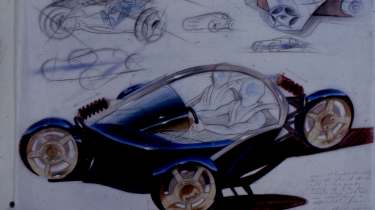
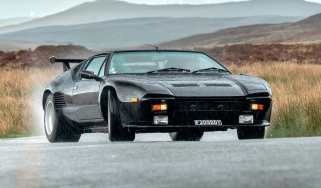
Work on a number of mid-engined supercar projects (‘often overly optimistic, underfunded or both’) and a sideline producing then-fashionable aftermarket bodykits helped smooth out the peaks and troughs of being self-employed. Then came another new challenge: ‘In the early ’90s I started as a senior lecturer in Transport Design at Coventry University, bringing some outside rigour and reality to the course, while continuing as a designer.

‘I enjoyed working with the students, although I found the internal university politics trying at times. I was still hankering to make a low-volume sports car, as well as share a real-life project with the students, so I started what we called the LSC, or Lightweight Sports Car, bringing in outside expertise, friends, funding and physical assistance. It became a bit of a labour of love, with eventually just me and one third-year student, Niki Smart, working on it, with much done outside the university and some very long nights, but we finished the concept car in a year.
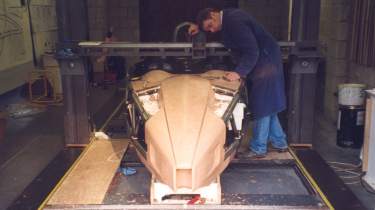
‘We managed to blag a spot at the 1996 NEC motor show and the LSC was really well received. Niki went on to do his final, fourth year and I continued to develop the car into a running prototype in my own studio, putting it through wind tunnel, road and track testing. Driving it, I realised we’d made it a bit too small, so with the learning from the LSC I started again from scratch on what was to become the Atom.
‘Same basic ingredients but designed to be made at an affordable price with low-volume production in mind. With the pressure of developing the car and the tediousness of the M5 commute from Somerset to Coventry, I left the University in ’97. I continued to lecture occasionally at Central Saint Martins but my main focus was on the Atom and bringing in design work to support the cost of its development and production.’
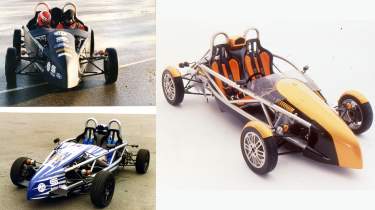
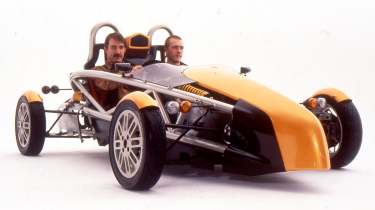
Under a revived Ariel brand name, which dates back to 1871 and has been applied to bicycles, motorcycles, cars and race cars, the Atom was launched in late 1999, with the first cars being built in 2000, ‘probably only 20 or 30 that first year’.
‘It caught people’s imagination and the trackday thing was beginning to happen in a big way, so we were in the right place at the right time. I think it’s a mix of naive optimism and sheer bloody-mindedness that carries low-volume manufacturers through. It’s success against the odds, I suppose, but then we thrive on the David versus Goliath scenario.’
Away from work, what does Saunders drive? ‘I’ve had my share of daft vehicles as well as those I’ve instantly regretted buying on the drive home. Motorcycles aside, I’ve owned several Aston Martins, because they make you feel good, plus a string of 911s because you could get two children in the back and they did a reliable job of reducing the Coventry commute to a record time. I’ve also had a love/hate relationship with the old Land Rover Defender, several fitted with enormous V8s.
‘My day-to-day car is a fairly old Nissan Navara pick-up. I can bash it and I’m not unduly bothered and it just carries on regardless, cheerfully doing its job. Much as I’d like another Aston or something exotic they’re no good for carrying hay bales, fence posts, sheep or much else really.
‘Plus you can end up with what I call Supercar Paranoia – you have a very nice car in the garage but you don’t use it because you’re not going that far, or it’s a faff to get it out, or it’s raining, or you’re worried about the mileage. And then you end up thinking that you don’t use it enough and worry about that too, so it goes full circle. Besides, when I want a fast, fun car for a blast there’s an Atom. Not much is faster and nothing is more fun.
‘I think the interesting thing when you reflect on vehicles you’ve had, be they motorcycles or cars, is that the ones you’d have back, the ones you have love for, are not necessarily the best vehicles. Often the opposite, in fact. I guess the Defender falls into this category, as does my old Harley Electra Glide: fundamentally flawed but somehow their many foibles are forgiven, outweighed by the emotional connection to them.
‘Our Ariel company motto is “Serious fun” and perhaps this is at the heart of it. Be it a 911, a Land Rover or an Atom, a slow vehicle or a fast one, it needs to make you feel good. An Ariel always does that.’