Subaru Impreza Turbo (1994-2000) review – an affordable modern classic rally icon
We knew the Subaru Impreza Turbo was special when it was new. The years haven't dulled this Japanese icon's appeal
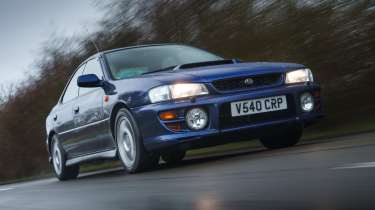
We could all use a time machine right about now. Whatever state the world finds itself in and whatever your own perspective amongst it all I doubt many of us would reject the chance to be whisked to another, more optimistic moment in history. I think I’ve just chosen mine. March 1994, and the UK launch of the Subaru Impreza 2000 Turbo.
I’d love to gauge the contemporary reaction to the car, to witness first hand its vivid reimagining of what a modestly sized, even more modestly priced saloon car can do. I say this because I’ve just leapt out of a well-used (though well-kept) example with 26 years and 170,000 miles of its own history to tell, and it was sensational. Still. What on earth did these things feel like new?
Subaru Impreza Turbo history and performance
The Subaru Impreza nameplate launched in Japan in 1992, fixed to a car using a shortened Legacy platform and shared engines. Available with either front- or all-wheel drive and five-door wagon or four-door saloon bodies, it’s the latter of each that coalesced into the legend we see here. JDM buyers had the option of a turbocharged 237bhp Impreza WRX early doors; it was another two years before we saw a detuned version sold on British shores, albeit officially – and long before its Mitsubishi Lancer Evolution nemesis could claim such things.
More reviews
In-depth reviews
Reviews
- Subaru Impreza WRX STI (Mk1, 1994 - 2000): review, history and specs of the rally icon
- Subaru Impreza 22B STI (1998): a rally-inspired icon
- Best Impreza Colin McRae Edition review – homage to McRae's championship 555 racer
- Subaru WRX STI Final Edition review – end of an era for a rally legend
- Subaru WRX STI (2014-2019) review, specs and prices
- 2013 Revolution Project STI Nurburgring review
The UK-market car got a 208bhp, 201lb ft tune of 2-litre flat-four turbo, driving all four wheels through a centre differential and viscous coupling that would shuffle power to the axle that could use it best while defaulting to a 50:50 split front/rear. A five-speed manual gearbox was standard-fit and its claimed performance at launch was a 6.4-second sprint from 0 to 62mph and a 142mph top speed.
The car evolved gradually following its 1994 introduction, the end-of-decade update you see here responding to the stuff our writers had (only mildly) grumbled about in the years beforehand. It braked a bit harder and its headlights shone brighter, ensuring the car was as fighting fit for a nighttime stage as it had ever been. By now its name had also slightly shortened – to just Impreza Turbo – and outputs had crept up, now peaking at 215bhp and 214lb ft, with slightly stiffer suspension to complement it as well as inch-larger 16-inch alloys and a desirable Momo steering wheel.
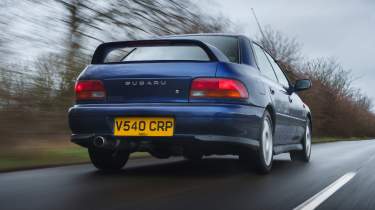
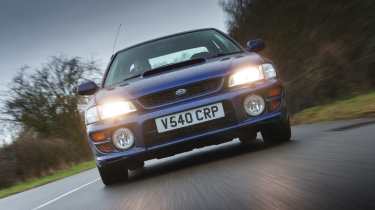
A ’99 model year Turbo starred as a Driven in our launch issue and by evo 011’s 4x4 supertest, another example lapped MIRA’s wet handling circuit quicker than a V-spec R34 Skyline GT‑R and within half a second of the Porsche 996 Carrera 4 – a car that demanded more than three times the Scooby’s £20,950 asking price. A powerful statement of intent even now. Mark Jarvis has owned V540 CRP for most of its life, adoring its origin enough to resist applying a private plate to deflect some of the meaner, less mature derision its original registration can attract. Indeed, the whole car has stayed refreshingly standard.
‘McRae, Burns and Prodrive had done some pretty remarkable things in the World Rally Championship and the price of a used Impreza was in budget,’ he says, rewinding back to the 2005 day he bought it. ‘I appreciated it being just a few steps away from the rally-bred machines. It was never intended as a long-term purchase – three to five years, maximum – but now, after 20 years of ownership, it would be hard to sell it. I haven’t found much that would compare.’
I first drove Mark’s car back in 2017; he valued it so humbly for insurance purposes that I offered to buy it from him there and then. He rightly declined, and over 30,000 miles and nearly a decade later it’s looking better than ever, any of its inevitable rust and niggles taken care of by trusted local hands. Values for stock Turbos like these haven’t yet soared into the stratosphere, making a known, affordable source for fixing them a prize all of its own.
My first miles in CRP were around the underrated twists and turns of Rockingham’s infield circuit, a missed fixture on British trackday calendars. Of all the cars I’ve ever leapt into and felt welcomed with open arms – upping my pace and commitment with rare haste – this Turbo sits right at the top. Car and circuit felt in sweet harmony, a beautifully judged balance of grip and agility bubbling immediately to the surface through the infield’s frequent direction changes.
Today presents more of a reality check. Temperatures are 15 degrees lower and the elements 100 per cent drearier. But it would also be fair to declare these dank February conditions ‘Impreza weather’. It’s upon grimy surfaces like these that the blue ‘n’ yellow blur of L555 BAT galvanised the Subaru legend as Colin took his unforgettable 1995 WRC title.
Approaching an Impreza Turbo still gives me a tingle of anticipation, one which can directly trace itself back to afternoons watching rallying at home or pressing my PlayStation pad’s X button as I selected one in the Gran Turismo menu. This car looks no less shiny and tantalising in the metal rather than TV-screen pixels, too.
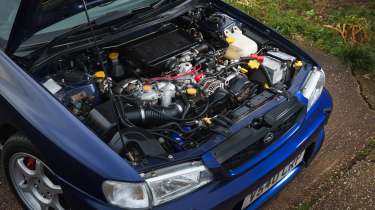
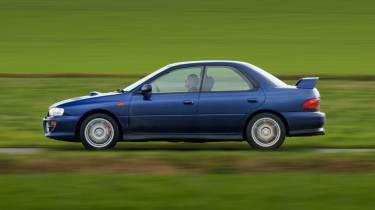
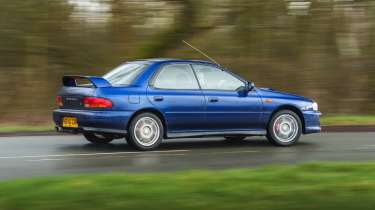
Mark is happy to use it for everyday tasks but maintains it lovingly – even the engine bay is spotless – to help me feel less sore I never got my own shot at its stewardship. While I’m sure the oversize front spotlights and hooped rear wing looked bold at launch, they’re positively tame by the standards of the Impreza timeline that followed, though the whole thing still has strong visual impact and a delicious cohesion in comparison.
Subaru Impreza Turbo interior
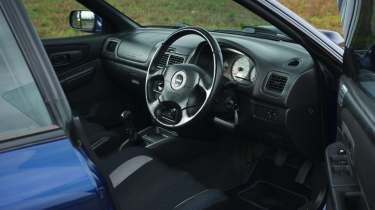
Climbing inside – through frameless doors, as nineties Subaru lore dictates – you drop into a comfy but not overbearing sports seat. Modern performance cars demand increasingly dexterous hurdling over their side bolsters, yet this venerable old icon proves you can still cling onto your front occupants without bending their hips out of shape on entry.

Yet, like the dashboard before them, the seats’ appearance could be considered drab. Flick back to evo or Performance Car issues from the Impreza’s first decade and they lament the interior plastics while acknowledging that most of the car’s skimpy price tag has clearly been siphoned into the mechanicals beneath.
Suffice to say this isn’t an interior that’s suddenly gained charm with hindsight, though the bold clarity of its white dials and the evocative Momo emblem in the middle of its bulky, four-spoke steering wheel definitely lift the ambience. As does the bulging bonnet hump up front and the considerable daylight spilling through the expanse of glass, even on a hopelessly grey day like today. It’s an airy, comfy car to occupy and an easy one to thread around with confidence in your early miles. Perhaps not least because – at 4350mm long and just 1690mm wide – it’s smaller than a Skoda Octavia.
Driving the Subaru Impreza Turbo
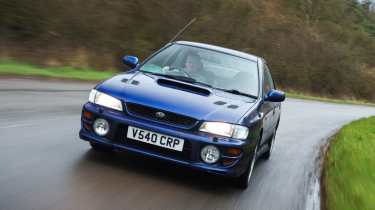
The steering doesn’t brim with feel, and there’s a light, distant moment either side of straight-ahead that could throw your confidence on your way into a corner. And yet you know how hard the axle is biting regardless, so while the rack doesn’t especially weight up or throw much additional information at you with increased lock, it simply doesn’t matter. The front end of this car is so strong, and its grip so reliable, that you have an innate understanding of how much to keep pushing it. The Turbo appears to have a pathological disinterest in understeer, and no matter how much speed you carry into a corner, no matter how greedy you get with the boost spooling out of it, the thing just hooks up and goes. It always seems to be pointing forward, gaining momentum and unfailingly on your side.
There’s an unmitigated thrill to a car that just keeps lapping up its driver’s gumption, and no matter how much you throw at it, you sense the Turbo asking, ‘Is that all you’ve got?’ Though never with a judgemental tone – more a friendly dragging of your hand to goad you into expanding your own enjoyment. It has a contagious appetite for pace.
You simply never feel like you’re fighting its intentions and everything seems to happen in glorious slow motion. While there’s a distinct way to really get the best from this car – to really commit, throwing lots of attitude into a corner before riding the boost on the way out, feeling the torque apportion across all four wheels as the car gently slides – at road speeds that’s often not even bordering on an option.
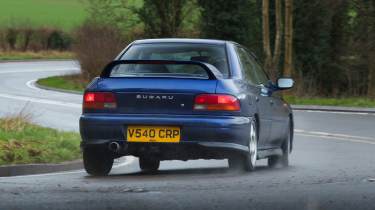
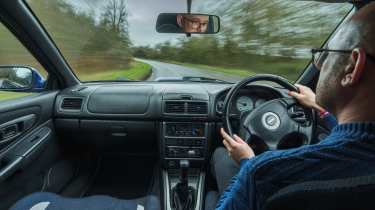
It may be over a quarter of a century old, but its limits are still breached with reasonable velocity. Thankfully, away from such commitment the car has a baseline ability and satisfaction for you to build any driving style you like upon. All without a single diff or drive mode switch to bother you, only its trad, manual handbrake and baseball glove stitch gearlever to wrap your head (or indeed hand) around.

Any perceived lack of communication from the steering is compensated for by the Impreza’s lean. This is hardly a roly-poly thing to drive, but its impression of a heightened driving position – despite those subtle sports seats placing you relatively low – keys you into its pitch and yaw nicely, and makes the whole car feel nicely malleable beneath you. Its grip is hard to breach even in sodden weather like today’s, yet that imposes no limit to the thrill you get from setting the car up into a corner.
Rarely has such dedication to traction felt so enthralling. Credit too for its ride. Contemporary reviews declared it the stiffest Turbo yet, though it’s soft and pillowy in the context of the WRX STI Final Edition that wound up official super Scooby sales in Britain in 2018. Crucially you’re never deflected from your chosen line.
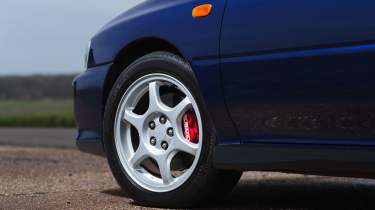
The brakes, despite being uprated for the 1999 Turbo (and looking delectable with their red, Subaru-etched calipers poking through those gorgeously simple six-spoke silver alloys), don’t impress me quite so much. But nor do they need to. This isn’t a car you condescend with a slow-in, fast-out approach. Carrying speed is actively encouraged, and a kerb weight that looks absurdly low now – its claimed 1235kg is little more than half a new Audi RS5, folks – means you hardly need big, meaty discs and pads to make those ‘90 lefts!’ anyway.
What’s aged remarkably well is its performance. That’s despite its power and torque being comfortably outpunched on paper by a modern Mini John Cooper Works, a car whose seven-speed twin-clutch transmission makes mincemeat of acceleration beside the more archaic five-speed manual here. Indeed, inattentive shifting will see you plummet into the Impreza’s well of turbo lag – hold fourth as you accelerate out of a village and you can count the beats before the needle rises past 3500rpm and the boost really kicks in. You sense the turbocharger right on the cusp of spooling up, quietly tugging at its leash like an unexercised greyhound, telling you it’s game to sprint forwards if you are. You’d need a heart of stone not to indulge it.
And it’s a curiously addictive feeling. Anyone who’s had the fortune to stretch out a high gear in a big, naturally aspirated V8 or V12 will enjoy the sensation. The chance to indulge in a car’s multi-suite soundtrack, much like playing your own, mechanical ‘Bohemian Rhapsody’. It begins with a low, bassy boxer burble as your speed climbs oh-so gradually before the hiss and whistle of boost leads into (and overlaps with) a harder, raspier chase of the 7000rpm red line.
Of course, you’ll also delight in shuffling the stubby lever around to keep the EJ20T fully on the boil. You work harder in here than in a modern all-wheel-drive hot hatch, the punishment for dropping out of the revs much greater, but this Impreza continues to keep up with just about anything. Its gearing is also long enough for fifth to drop you below 3000 revs at 70mph, making it a more refined thing on a motorway run than you might fear. Bet it still drinks proficiently, though.
The overriding impression is of a car that’s infallible, whether to criticism or the whims of its driver. You don’t fear its lack of driver assistance or stability control. Its components feel tough. Beneath the cheap but undeniably hard-wearing plastics there’s real substance to it. It’s perhaps little surprise that Dickie Meaden’s Performance Car long-termer did 25,000 miles in six months – and that Mark’s car still feels so fit having covered seven times that distance.
While it’s superb in bone stock form, it’s easy to see how it became the mere jumping off point for all manner of specials and spin-offs, most of which still command a lot more money than the purer, simpler and (whisper it) more satisfying car at the centre of the Impreza universe. Indeed, evo itself opted for the Impreza RB5 to represent the 4WD sports saloon movement as a whole in our Eras series (issue 335), a test which gave senior staff writer Yousuf Ashraf his first stint behind the wheel of an Impreza. He was just a few weeks old when Mark’s example was first registered…
‘The impression I always got from reviews was that the Mitsubishi Evo was the feistier, more exciting car,’ Yousuf tells me. ‘But when I drove the RB5, I absolutely loved it. It had a sense of unshakeable security but somehow managed to feel absorbing and involving, a bit like a GR Yaris. I was really surprised at how hard you could drive it without feeling like you’re abusing the car. It felt surprisingly modern in that sense. Part of me craved a bit more fizz and sharpness – I wonder whether a contemporary Evo would deliver that – though overall it definitely lived up to the legend.’
Apply inflation to its ’90s price tag and it still ends up usefully cheaper than the little Toyota, at a mite over £40,000. And I think the two would be thrilling sparring partners across a challenging road or on a tight, technical circuit. Each chomping at the bit for more commitment from its driver.
‘The Impreza gives so much for so little effort,’ said John Barker in evo 002, when the latest Turbo vanquished the newly launched Honda Accord Type R. ‘It’s wieldy and deploys its ever-ready power with such ease you find yourself making ultra-rapid progress over difficult roads quite naturally. And it never leads you on; over-drive and you discover reserves of composure that raise your respect to a new level.’ Little has changed all these years later, its talents still just as impactful. Perhaps our time machine can be put to more practical use…
Values and buying guide
Today Subaru Impreza Turbos will cost you anything from £8000, to upwards of £20,000, depending on condition, age and mileage. These cars wear their years and miles very much on their sleeves. Look out for rust in the arches and ill-fitting panels and inspect the chassis rails for evidence of accident damage.
The engines too are notoriously difficult to work on, given their flat cylinder arrangement. Look out for exhaust smoke as this could indicate excess oil use or head gasket issues. The cam covers are a known area for oil leaks too. These cars were popular among modifiers and so finding original cars can be difficult, but don’t let tasteful and considered upgrades put you off.
Specs
| Engine | Flat-four, 1994cc, turbocharged |
|---|---|
| Power | 215bhp @ 5600rpm |
| Torque | 214lb ft @ 4000rpm |
| Weight | 1235kg (177bhp/ton) |
| 0-62mph | 5.8sec |
| Top speed | 144mph |
| Price new | £20,950 (1999) |
| Value now | From £8000 |