Toyota GR Yaris rally dominance: What it was like to ride along in Monaco
We join Toyota Gazoo Racing for the most treacherous, record-breaking Monte Carlo Rally in 15 years
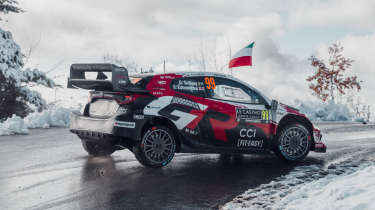
Ask anybody, car enthusiast or not, to name two famous rallies and it’s a safe bet the Monte Carlo will be on the list. Steeped in 124 years of history, the Monte Carlo Rally remains one of the toughest and most dramatic competitions in motorsport, not to mention one of the most famous. Our visit in 2026 was for one of the iciest, wettest Monte Carlo rallies in years that nonetheless revealed a potential rising star for the sport.
‘I’ve seen conditions like this, but 13 years ago,’ Toyota Gazoo Racing World Rally Team (TGR-WRT) principal Jari-Matti Latvala tells me. ‘Maybe once in every 15 years you have conditions like this. This is usually the most difficult rally of the year – and this year extremely difficult.’
> Toyota GR Yaris review – a modern-day hot hatch icon
Monte Carlo is the World Rally Championship season opener, and I’m here as a fly on the wall with the Toyota team. Latvala knows the Monte better than most. He’s racked up more WRC starts than any other driver, before becoming TGR-WRT team principal in 2021. Drivers obviously make good managers at Toyota; Latvala’s predecessor was Tommi Mäkinen and his deputy is Juha Kankkunen, with eight WRC titles between them.
TGR-WRT driver and reigning champ Sébastien Ogier has nine titles on his own, and has won the Monte a record ten times. He’s one of four pilots in the Toyota team, alongside Welshman Elfyn Evans (who finished a narrow second to Ogier last year), Japan’s Takamoto Katsuta and an exciting young talent, 25-year-old Scandinavian Oliver Solberg. A familiar name: his dad is 2003 WRC champion Petter, and Elfyn Evans’ father is former British rally champion Gwyndaf.
Oliver Solberg won last year’s Rally Estonia in a one-off appearance for Toyota in the top Rally1 class – a mid-season break on his way to the WRC2 championship title, for less potent (but still rapid) Rally2 cars that run behind the headline Rally1 competitors. It was a crucial breakthrough after a patchy partial season in Rally1 for Hyundai in 2022 and just missing out on the WRC2 title in ’23.
Solberg’s signing is a crucial one for both Toyota and the WRC: Finnish wunderkind Kalle Rovanperä, who became the youngest ever world champion while winning back-to-back titles for Toyota in 2022 and ’23, announced his retirement from rallying last year, switching to single-seater circuit racing. Fellow frontrunner Ott Tänak has departed too and Ogier isn’t competing in every round. The biggest issue is a dearth of manufacturers: Hyundai is the only official factory team squaring up to Toyota, alongside British squad M-Sport, which has limited backing from Ford.
As a result, headlines featuring the word ‘crisis’ have frequently swirled around the WRC of late. Although Red Bull plays a major role in promoting the series, including free coverage on Red Bull TV (and an energetic presence at the ‘Fanzone’ on the harbour front in Monte Carlo, with breakdancers, BMW stunt riders and DJ sets in typical Red Bull fashion), there have been calls for improved promotion, and meanwhile a tender process is currently underway for a new promoter.
This is the final season with the Rally1 regulations, and something of a bridging year. For ’27, new technical regs will introduce less complex, slower cars closer to Rally2 performance but, crucially, less costly to build and run (Rally1 cars are roughly estimated to cost around $1m each) – with the aim of ushering in more manufacturers. Thus far, only Toyota has committed to the new regs and some are concerned the series could – temporarily – become a ‘Toyota Cup’.
There are parallels with endurance racing, where the outgoing LMP1 and new Hypercar regulations were supported through thick and thin by Toyota and its arch-petrolhead chairman Akio Toyoda. He’s here at Monte Carlo, driving Toyota’s GR Yaris Rally2 H2 Concept – a hydrogen-fuelled IC-engined rally car – in a demo run on a section of the Monaco Grand Prix track to showcase the technology’s potential for rallying in the future.
> Toyota GR Yaris Morizo RR is the 911 GT3 RS of hot hatchbacks
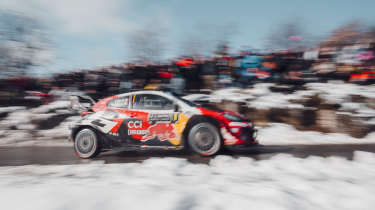
In the meantime, the Rally1 cars have started their swansong in impressive fashion. Stage-side in the mountains, they sound fantastic; their bespoke 1.6-litre turbo engines (with around 370bhp in cars with a minimum weight of 1180kg) emit a flat, buzzy exhaust note, with unique overtones off-throttle: their exhaust gases fill the wake behind the car, increasing downforce and reducing drag, and aggressive anti-lag systems keep the turbos spinning.
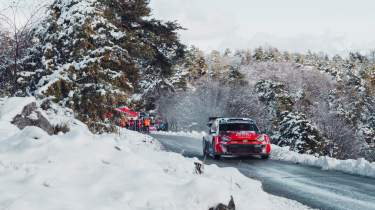
Toyota’s drivers certainly hit the ground running, dominating the rally’s opening days, well ahead of Hyundai, with Solberg setting the pace. It seems the Toyota Cup is already underway. But not without incident. The conditions are treacherous, with snow, sheet-ice and sodden tarmac making every corner an adventure. Just reaching the end of each stage unscathed, let alone posting a quick time, is an achievement. Many of the frontrunning drivers have offs, including leader Solberg, who runs wide on a corner and slides helplessly into a hedgerow. He buries the throttle, j-u-s-t manages to free the car and spins it around in the neighbouring field before dramatically smashing back through the hedge and onto the course. He still wins the stage.
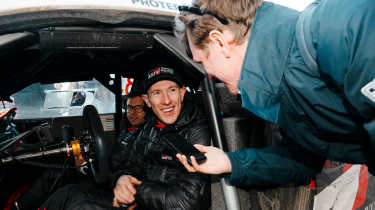
Sébastien Ogier is philosophical about the conditions: ‘Well, it’s been a “proper Monte” like we say, with real winter conditions,’ he tells me. ‘That’s actually the one we want to have. This week was extra challenging because unfortunately at the moment the tyres we are using are not really adapted to these conditions – that’s the main issue of the week.’
Saturday night closes with a ‘super special’ stage on the harbour front, in torrential rain. Nonetheless, a bumper crowd turns out to see the stars and cars in action. It’s the first time WRC cars have competed on part of the F1 track since 2008. ‘I think it was a great move,’ Ogier says. ‘Mother Nature was not really kind to us with the conditions but it shows that rally drivers drive whatever is happening, and F1 will just stay in the pit in this moment… It’s not a stage you can win; you can only lose, basically, if you crash stupidly into the barrier! But I think it’s nice to see rally cars in such an iconic place for motorsport.’
> Living with the Toyota GR Yaris, a homologation hot hatch for £20k
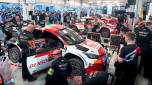
Latvala agrees: ‘Even in the rain, it’s full of people watching. Logistically it’s a little bit more difficult but it’s very worthwhile. For me, definitely something like this needs to be done again. We need to be here.’ Logistically, Monte Carlo is certainly a challenge for the teams. The main service area is in Gap, many hours’ drive north of Monaco. Getting everybody into one hotel is tricky, so the team is scattered. Mechanics’ shifts start at around 4am and finish after midnight. Some have been here for three weeks already, supporting PR events and pre-rally recces.
The drivers put in long hours, too. ‘The nights are short,’ Elfyn Evans explains. ‘Normally we’re up at five, six o’clock, then we get back anywhere between six and 10pm but then we normally have two hours of video analysis to go through with the engineers. The last thing you want to do after a full day’s driving is crack open the laptop – it’s the worst part of the job,’ he smiles. He adds that the Monte’s timetable is not so different from other WRC rounds ‘but the difference here is the stress of the conditions, the tyre choices and all that; the extra mental energy’.
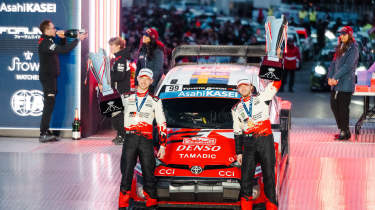
The Welshman has finished on the Monte Carlo podium four times (and second in the driver’s championship five times) and is still seeking a win in Monaco: ‘I wouldn’t say Monte Carlo is one of my favourite rallies because it’s difficult to enjoy in a way, for the reasons we’ve just talked about!’ he continues. ‘But it’s definitely one of the ones that I hold as most prestigious and if I had one more rally on the calendar I’d like to win, it would be this one. And every year I keep trying to finish second…’
In 2026, that’s the case again: Oliver Solberg scoops the win, becoming the youngest Monte Carlo victor since 1937, ahead of Evans. And Ogier rounds out the podium for a Toyota one-two-three. It’s a remarkable performance, achieved in hellish conditions. Toyota’s dominance of 2026 continued too, with Evans later winning in Sweden and Katsuta winning in Kenya.
‘The one year I managed to finally beat Seb, there was another newbie on the block, trying to spoil the party,’ Evans smiles, philosophically. ‘It just means you have to come back next year and try again.’
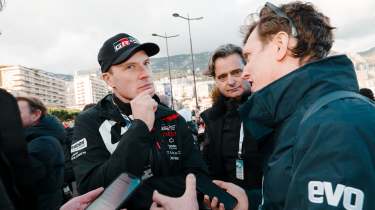
Jari-Matti Latvala is surprised, and delighted to be so. ‘I didn’t expect it, but even Oliver and Elliott (Edmondson, co-driver) said themselves that they didn’t expect it either. It’s a great story because we had a little bit of negative impact for the sport when Kalle informed us he was going to the race circuit. Now we have a new young rising star again, bringing spice – this is exactly what we needed for the sport.’
The new lower-cost Hypercar rules have, after a slow start, created a golden era for endurance racing, thanks in no small part to Toyota keeping the fires burning. The same could, potentially, happen for WRC: Hyundai may yet commit to the new rules, Lancia has entered WRC2 and rumours swirl around Skoda and Subaru, too.
While the perception of WRC from afar may be of a lull right now, the sight, sound and skill of Rally1 cars and their drivers and teams in action up close proves top-level rallying is motorsport at its highest level – and nowhere more so than in the unique challenge of Monte Carlo.