Le Mans 24 Hours: Five race cars that rocked the boat - Page 2
Many cars have pushed the boundaries of what's possible at Le Mans - this selection more than most

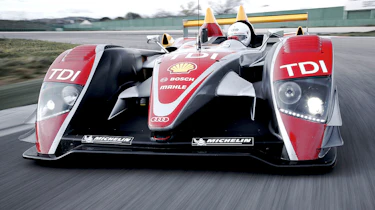
Hybrid technology slipped into Le Mans racing without much consternation, but the story was different when Audi first entered a diesel in the 2006 event. The principle behind the decision was sound – a broad power band and reduced fuel consumption – but for fans on the sidelines Audi’s cars would be drowned out by everything else on the circuit.
Not that Audi had dropped in any old 2-litre TDI, nor even the 3.7-litre V6 of the current R18 e-tron quattro. A 5.5-litre V12 TDI took centre stage, developing around 650bhp and even equipped with a pair of diesel particulate filters to reduce the large clouds of diesel smoke that would otherwise emerge in every acceleration zone.
Audi was no stranger to success at Le Mans, having won five previous times with the petrol-powered R8. But diesel cemented the company’s reputation at the circuit and set a trend unbroken to this day – since 2006, a diesel engine has taken the top spot of the podium at every running of the race.
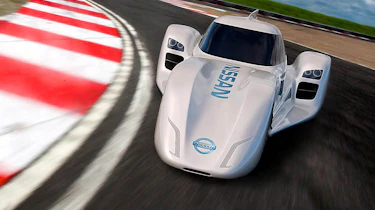
Nissan ZEOD RC – first all-electric Le Mans lap
The Nissan ZEOD RC – for ‘Zero Emission On Demand Racing Car’ – is one of the most unusual creations ever entered at Le Mans, competing as the experimental ‘Garage 56’ entry in 2014. Spawned from the Deltawing racer – itself not exactly conventional – it took the concept further with a closed cockpit layout and, uniquely, a strong focus on electric power.
While not a dedicated electric vehicle, the ZEOD RC’s mission statement was impressive: complete a full lap of Le Mans on electric power alone, and achieve over 300km/h (186mph). It succeeded on both fronts, but unfortunately retired with a gearbox issue early in the race, before its long-term potential could be explored.
In reality, the ZEOD was a hybrid. Behind the cockpit was a 1.6-litre, turbocharged petrol engine. Paired with an electric motor, the car could complete around eleven laps of the 8.47-mile Le Mans circuit, which was enough for regenerative braking energy to replenish the battery pack for an all-electric lap.
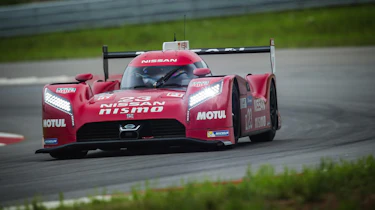
Nissan GT-R LM Nismo – front-wheel drive
There’s nothing new about the concept of a front-wheel-drive vehicle at Le Mans – there were sporadic entries throughout the early years of the sport; one of the best known is the Mini Marcos that finished the race in 1966.
But entering a front-wheel-drive car in the mid-engined-dominated LMP1 class is a different matter. Mid-engined cars are prevalent in top-level motorsport for very good reason: the layout is ideal for the balance needed to go quickly around a race circuit.
The concept behind the GT-R LM, another of Ben Bowlby’s creations (see the ZEOD RC above), is that a car can be equally fast if that balance is proportional to aerodynamics and mechanical grip. The front of the Nismo is, theoretically at least, more optimal than those of the mid-engined cars. The front tyres are wider to assist traction, and clever differentials handle the 1250bhp output available with full flywheel assistance. How will it fare? We’ll have found out in less than a week’s time…