BMW M Concept Neue Klasse previews the electric M3 of the future
BMW M isn't doing electric by half measures, with four motors and 650bhp

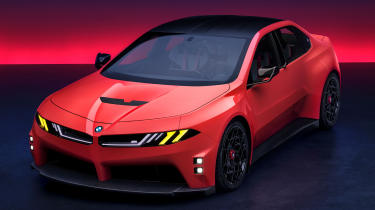
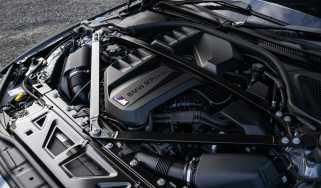
Forty years ago it started with a screaming BMW Motorsport-developed 2.3-litre, 16-valve four-cylinder engine. Less than a decade later it gained nearly a litre in capacity and a pair of cylinders, along with some trick valve timing (for the period). For the new millennium the cylinder count went up to eight and capacity to 4 litres. Then the downsizing began, even if the performance kept climbing. Twin turbochargers and six cylinders have been at the heart of every M3 (and M4) since, but at Le Mans in 2026 BMW M has revealed the next M3's powertrain: 650+bhp, zero cylinders. Meet the BMW M Concept Neue Klasse.
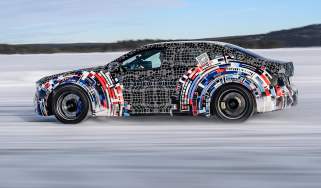
A concept in name, the M Neue Klasse is the new all-electric M3 that requires a handful of production friendly modifications to be fitted ahead of its 2027 debut. Powered by BMW’s M eDrive system, which is built around the brand’s Gen6 electric technology, it features four individual motors powered by an individual electric motor on each axle.
The rear motors are electrically excited synchronous, the fronts asynchronous, while both are paired with silicon-carbide inverters. All are controlled by the BMW M Dynamic Performance Control unit, a specific software controller that manages not only power and torque distribution across all four corners but also every element of the powertrain’s functionality.
This setup allows the electric M3 to run as either a four-wheel-drive car or rear-drive, with the front axle decoupled for optimum efficiency when required. It also means, according to M, that the M Neue Klasse will still feel very M and very rear-wheel drive most of the time. Each individual wheel motor will also manage power and torque loads, traction and stability and recuperation requirements back to the 100+ kWh battery.
In total the new M3 will be able to produce a minimum of 650bhp and 811lb ft torque. Built around an 800-volt architecture, charging speeds are reduced by 30 per cent and the car will be able to support 400kW charging, too. Not that BMW has disclosed a charging speed yet (on a DC fast charger an iX will charge from 10 to 80 per cent in around 30 to 35 minutes). There’s no word on range either, but our M3 CS Touring currently does circa 300 miles on 60 litres of superunleaded when driven in the manner it was designed for, so if the electrified M3 can match that then half the battle is won when it comes to sceptics of such vehicles.
The battery, located between the front and rear axles and forming a structural element of the chassis, utilises BMW’s sixth generation of cylindrical cells, improving energy density by 20 per cent and therefore providing more range without increasing the dimensions of the battery pack. Or, if BMW was so inclined, it could reduce the size of the battery and therefore its weight. BMW M has declared a kerb weight for its first electric car, however. Meanwhile the latest oil-water cooling technology brings thermal efficiencies.
Performance? It’s an electric car with over 800lb ft of torque, so expect to feel sick as it reaches 60mph in under 3 seconds, but don’t expect it to go beyond 155mph.
Details on suspension and brakes fall under the ‘it’s a concept’ banner for now. However, the iX’s adaptive air suspension is unlikely to be used due to packaging and weight; therefore expect an evolution of the current G80 M3’s MacPherson strut front and a five-link rear setup, with the latest M Adaptive dampers linked to the drive modes. 21-inch wheels are fitted to the Concept M KLasse fitted with Michelin Cup 2 tyres. Carbon-ceramics are expected to be the only brake option.
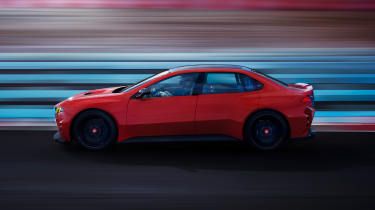
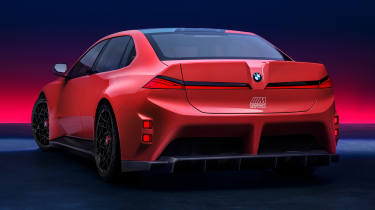
Visually the M Concept Neue Klasse has all the design elements of a current M car, with exaggerated haunches at all four corners and air inlets and outlets around the body to cool the powertrain. If you think you might have seen this shape before, a less aggressive version ran up the hill at Goodwood Festival of Speed in 2025. The headlights and kidney grille are a single unit and the M5 and M3 CS models’ yellow headlights have found their way onto the M Concept.
There’s a trimaran-style front bumper inspired by racing sailboats, with the three-part design underlining the car’s technical appearance. Crucially, it provides structural support for the front splitter. There are also three-dimensional lights within the outer sections of the front bumper.
A similar trimaran design influences the rear of the M Concept Neue Klasse, which ‘floats’ above the rear diffuser. There’s also a ducktail spoiler to increase downforce – or rather reduce lift – across the rear axle. Natural carbon fibres are used across the body and throughout the interior, either unfinished or with a refined finish complete with M branding.
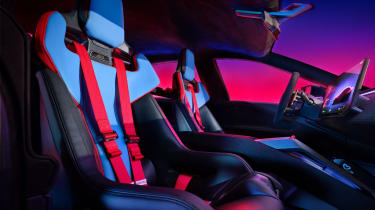
Inside is a much more pared-back interior than you might expect. M5 CS-style individual bucket seats are fitted front and rear, and hopefully the five-point harnesses don’t make production – as anyone who has driven a road car with harnesses will no doubt agree. And we’re not convinced a four-seat car needs a safety bar dissecting the interior. And yes, those are shift paddles on the back of the steering wheel to manage the simulated gearshifts.
Pricing, production and on-sale dates are all to be confirmed, but expect the production car to be revealed when it is finished in early 2027.