Mazda continues testing of carbon capture system – a different way to save internal combustion
Mazda’s continued testing of its new emissions reduction system. It’s showing promising results

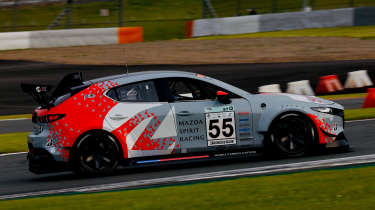
Mazda has been testing a new way of reducing emissions from its internal combustion engines, though it’s not the engines themselves that feature new hardware. Rather, Mazda’s focus is on external hardware, capturing the CO2 that’s emitted by the car.
The system is called Mazda Mobile Carbon Capture and it was revealed at the Japan Mobility Show last year. The car it used was a race-spec Mazda 3 fitted with the system, that it calls the Mazda Spirit Racing 3 Future Concept.
> Best Japanese cars – performance icons from GR Yaris to NSX-R
As with Toyota and the mid-engined Yaris M, Mazda has used Japan’s multi-class Super Taikyu series as the venue for its testing, specifically the Fuji 24 hours. Previously, the system didn’t involve desorption and so, just 84g of CO2 was saved in the original test. With an integrated desorption system added, it managed to capture 804g of CO2, or 9.6-times the previous test.
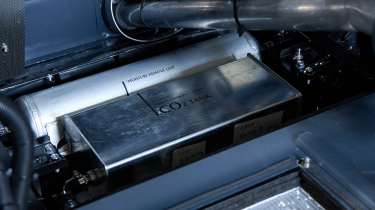
The system features Zeolite with a porous structure to absorb the car’s emissions, which isn’t a million miles away from a traditional catalytic converter set-up. The difference here is that the exhaust heat is then used to desorb the raw CO2 content, which is then compressed by an electric compressor and stored in a tank.
> Mazda’s museum proves it’s one of the most innovative car companies in the world
The Mazda 3 doesn't consume conventional fuel, rather Hydrotreated Vegetable Oil, a fuel that Mazda claims can lower lifecycle CO2 emissions. Indeed, producing less CO2 is handy when you’ve finite absorption and storage capabilities and a 24-hour race to run…
The results during the race temporarily exceeded targets Mazda has set for if the system is used in production cars. The plan going forward is further development and testing in race cars, under the high loads of race conditions. Could such a system make its way into passenger cars? With Mazda, almost anything’s possible and if such a system would allow the next MX-5 to eschew heavy batteries and keep combustion power, or the creation of a true rotary-powered RX-7 successor, more the better. Just a few packaging and weight challenges to overcome…