BMW M3 (E90 & E92, 2007 - 2013) review: £20k family car with an F1-inspired V8
The E90 and E92 BMW M3 are bargains, with an all-time-great V8 and much more besides
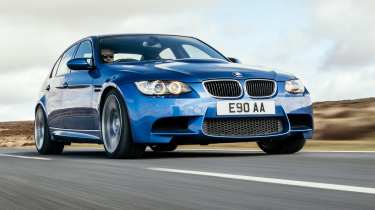
After two generations of straight-six-powered M3s, in 2007 BMW turned to a V8 to enable its new E92 coupe and E90 saloon to join the arms race with Mercedes‑AMG, Audi and Lexus. Taking the E60 M5’s extravagant S85 V10 engine as a base, two cylinders were removed to create the S65, a 4-litre, naturally aspirated V8. This meant that, as with the V10, this V8 wasn’t underpinned by a unit found in BMW’s ordinary line-up, but was instead a pure M creation. And it showed: the result was one of the great naturally aspirated V8s.
Unlike most rival V8s, the S65 utilised individual throttle bodies for class-leading response (and induction noise), while the screaming 8400rpm red line was also the best in its class. Outputs of 414bhp and 295lb ft put it some way behind the likes of Mercedes-AMG’s W204 C63 on paper, but the way it delivered its power ensured it was a force to be reckoned with. A six-speed manual gearbox was standard, while a costly seven-speed dual-clutch auto was a popular option – and a vast improvement over the single-clutch SMG offering on the previous M3.
> Mercedes C63 AMG (W204, 2008 - 2014): absurd in the best possible way
More reviews
Single-piston front brakes and a slight lack of steering feel gave it room for improvement, but the huge jump in outright pace over its E46 predecessor was hard to ignore, while undeniable dynamic polish ensured it was more than a one-trick pony. The Competition version that arrived in 2010 took things one step further with a 10mm drop in ride height, an increase in chassis focus, the fitment of Electronic Damper Control as standard for variable damping rates and a fetching set of CSL-style wheels.
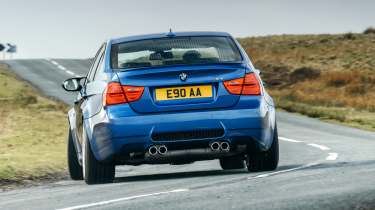
Its design has aged well, but Dickie Meaden wasn't immediately convinced back at its launch in 2007: 'When ‘our’ car appears I have to confess to being mildly underwhelmed, for as we saw from early pictures, the new M3 isn’t as pumped as the car it replaces. There’s still something about it though, a discreet but tangible potency that makes you look twice. And this fitted with standard 18in alloys rather than the optional 19in rims that will doubtless become the default choice with customers, as they were with the E46. Subtle or not, it still has presence.
The most obvious visual identifier is the so-called ‘powerdome’ – required to make room for the new V8 – with its accompanying intakes that help the new engine breathe (although one of the intakes appears to be a dummy). Add the aggressive intakes on the nose, the unpainted carbonfibre roof and the four exhausts jutting from the rear and there’s no mistaking M Division’s latest product for a lesser model.'
Engine, gearbox and performance
- Motorsport-derived V8 is one of a kind
- Light on torque, high on revs
- Manual and DCT transmissions, but the latter is the one to pick
In evo issue 346, we revisited the E90 M3 and its naturally aspirated V8 rivals. John Barker said: 'From the moment the M3’s V8 fires up, it sounds different, not just to the bigger-capacity motors of the C63 and IS F but different from the RS4 too, despite the closeness in capacity and their shared high red lines. The BMW’s S65 V8 has a distinct and appealing motorsport edge, like a hi‑po American V8, and it’s sportier in its delivery too, being lighter on torque and feeling truly in its element from 5000rpm to the red line, delivering its peak power at 8300rpm, 500rpm higher than the Audi.'
The block, which came straight from BMW’s Formula 1 foundry in Landshut, is served by a pair of oil pumps that feed lubricant between the engine’s two sumps – its F1 ties go further still, with the design of its S85 V10 sibling having been heavily influenced by the 3-litre P84/5 V10 of the 2005 Williams FW27. An individual throttle butterfly for each cylinder ensures a fast, precise throttle response, while the Double-VANOS valve-timing system optimises performance across the epic 8400rpm rev-range.
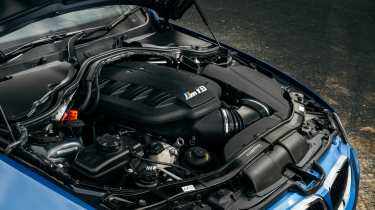
At its 2007 launch, Dickie Meaden said: 'Bizarrely the 3999cc V8 settles into a dry and slightly busy idle that’s spookily reminiscent of the old 3.2-litre straight-six, and it continues to sound like the old six when you’re shuffling through traffic, but the illusion lasts as long as it takes you to depress the throttle a little further, at which point it emits a more guttural rumble and pulls with early, muscular insistence.'
The M3 is very effective regardless of its power disadvantage. When we tested it against the standard, 451bhp AMG C63 (evo 123), despite the E90’s shortfall in power and torque it was only two tenths slower to 60mph, four tenths slower at 100, and around the West Circuit at Bedford Autodrome it was over 2.5sec a lap faster. It is an incisive car. The author of that test, David Vivian, concluded ‘…the M3 saloon is sharper, cuts deeper and will keep you hooked for longer’. I recall being in agreement at the time but, 20 years down the line, does that conclusion still hold true?
Ride and handling
- Direct, tactile steering lacking in its rivals
- Neutral, balanced chassis
- Excellent traction on the limit
The car itself has a directness that’s missing from all of the others. The steering is very connected, very direct and very tactile, and there’s a tautness to the handling that matches the drivetrain. More than matches with this example, because owner Matt has upgraded the suspension with Ohlins dampers, so the chassis responds with an utter lack of slack, snapping to the steered line like a race car and riding with just enough suppleness to deal with the challenges of these roads.
If it’s race car sensations you want, that’s what this M3 delivers. You want playfulness, indulgent oversteer? Not so much. Chucking this one into a second-gear corner was a reminder of the long-termer I ran; there’s so much rear grip that you need to be well up the rev range to have enough torque to unstick the rear tyres, and when you succeed in that, you then have only a couple of thousand revs left to keep it there, so it’s gone in a click of your fingers, snapping back into line. It’s almost as big a challenge in the wet, too.
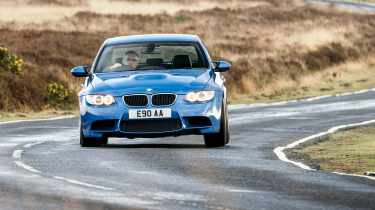
At its launch, Meaden said: 'There’s little body roll and the chassis’ balance is pleasingly neutral, with plenty of front-end grip to lean on as you begin to feed-in the abundant power of the high-revving V8. Fitted with an M differential, the M3 digs hard for traction, although it’s easy to awaken the stability control even in its most relaxed mode.
One big improvement is the eradication of the infamous M3 fidget, which would often have you bouncing gently in your seat as the car seemed to get out of phase with the road surface. The last-and-best M3 CS was largely cured of this problem, but the E92 is more convincing still, although it should be said that all the test cars came with optional EDC (Electronic Damper Control) suspension – a £1295 option. Once again the specific nature of the test route’s roads make a definitive judgement impossible to call, but all indications are that body control is far better without any penalty in ride comfort.'
Interior and tech
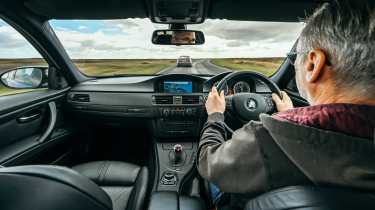
Hop into the driver’s seat of the M3 and it feels like a smaller car than the alternatives of the time, taller and narrower too. Much of the cabin is leather-trimmed, but it betrays its repmobile origins more than its rivals, notably in the single-piece facia with its twin, moulded brows, one for the centre screen and one for the instruments. The latter comprises just a pair of dials that look inexpensive, even with an 8200rpm red line. As ever, the press/turn iDrive controller works brilliantly and the odd-looking DCT shifter works much better than its appearance suggests, though I keep hunting in vain for Park.
What to look out for
Browsing online forums could have you believe the E9X-generation M3 is a ticking time bomb, but the horror stories of failing connecting rod bearings needn’t become reality if the car is well cared for. Tight tolerances in the S65 engine mean proper warming procedures and regular oil changes are a must. However, if you’re unsure of the history of the car and/or the condition of the rod bearings, the only surefire way to avoid problems is to replace them, usually to the tune of £1500-3000 – hence why you’ll see some classified ads proudly proclaiming ‘rod bearings done’. This issue aside, the main concerns with the E92 are the same as you’ll encounter with most M cars of its era, from minor oil leaks to issues with the VANOS and throttle actuators.
What to pay
The E92 and E90’s clean aesthetic have helped them age particularly well, so it’s easy to forget that the earliest examples are now 17 years old. This, and a plentiful supply (you’ll find around five times more E92 coupes than E90 saloons in the classifieds) help explain why you can now pick up an early, non-cat, 100,000-mile car for as little as £16,000. More tempting examples on around 50,000 miles can fetch around twice that figure, while the very best, with BMW Individual paint colours and in Competition spec, will set you back between £30,000 and £40,000. Given its rarity, the E90 typically fetches a premium of a few thousand pounds spec-for-spec.
BMW M3 (E9X) specs
| BMW M3 (E92 coupe) | BMW M3 (E90 saloon) | |
| Engine | V8, 3999cc | V8, 3999cc |
| Power | 414bhp @ 8300rpm | 414bhp @ 8300rpm |
| Torque | 295lb ft @ 3900rpm | 295lb ft @ 3900rpm |
| Weight | 1580kg | 1605kg |
| Power-to-weight | 266bhp/ton | 262bhp/ton |
| 0-62mph | 4.8sec | 4.9sec |
| Top speed | 155mph | 165mph |
| Value today | From £20k | £28,000-35,000 |