Five-star cars: every performance car rated from hot hatch to hypercar
We rate the greatest performance cars ever, so you can have the greatest argument about them
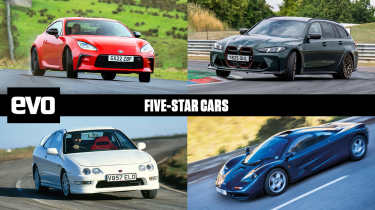
An evo five-star rating is code for a car that you simply can’t ignore, a surefire hit, one that delivers the thrill of driving in everything that it does. It’s not awarded lightly. And it’s often the cause of great debate, not only amongst those of us who decide how many stars a car is worth, but also for those who claim to detect a bias – and those who own a car that falls half or a full star short of top marks and feel we’ve taken leave of our senses and should hand in our evo credentials forthwith.
Over the last three decades, the contents of The Knowledge section published in each edition of evo – where we list the star ratings of the best cars we’ve driven – have created more debate than anything else we’ve written, evo Car of the Year results notwithstanding.
As of now, there are currently 255 cars with five stars in evo’s ratings almanac, from the Mk7 Fiesta ST200 to the Rimac Nevera, and plenty in between, from Alfa Romeo to Mitsubishi, Lotus to Vauxhall, Aston Martin to Nissan, Bugatti to Noble. And yes, Porsche. Hot hatches, saloons, GTs and supercars – there’s a five-star evo car of every flavour, barring SUVs. And while today’s new-car climate is delivering fewer nailed-on five-star heroes, motoring’s back catalogue features a rich seam of modern classics that still wear their five-star ranking proudly and with unblemished credibility.
Therefore, we have compiled a full list of evo's five-star cars from the core sections of The Knowledge, while picking out three highlights from each: a classic, a modern classic and a current/stroke recently off-sale car. If you think we’ve chosen the wrong cars to champion, worry not because we’ll be updating this page regularly so remember to keep coming back.
Hot hatchbacks
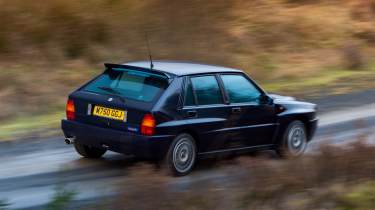
The old one: Lancia Delta HF Integrale Evoluzione II
It might not have the favoured front-wheel drive format of most hot hatchbacks, but the Delta HF Integrale shows there’s more than one way to spin a wheel. Still one of the most successful rally cars of all time, the Delta remains the definitive Group A homologation special – and the Evoluzione II its ultimate incarnation, launched shortly before the Delta went off sale, and splitting its 212bhp among all four wheels. Not as quick as modern all-wheel drive hot hatches (though at sub-6 to 62mph, hardly slow), the Delta offers more feedback than any of them, can still get down a wet B-road at a fair old lick, and looks absolutely fabulous.
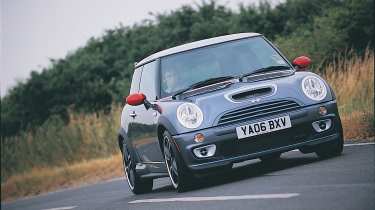
The modern classic: Mini Cooper S Works GP (R53)
The foundations of the Works GP formula were laid with the R53 generation car, which arrived in 2006. A 218bhp version of the Cooper S’s 1.6-litre supercharged four-pot provided the power, but the key factor in the GP’s appeal was the reduced weight, from binning the rear seats (replaced by a brace bar), cutting 15kg with new aluminium rear control arms, unique four-spoke alloys that trimmed 2kg a corner, and tearing out a bunch of sound insulation. It offered a more vivid experience than the Cooper S but one that, like the best hot hatches, seems to gel when you’re tonking on a bit. It’s not as unrefined as you might expect either – the first Works GP still feels great on regular, everyday B-roads.
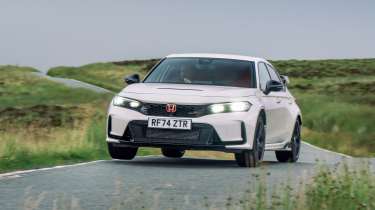
The new one: Honda Civic Type R (FL5)
No beating about the bush: the FL5-generation Civic Type R is nothing less than one of the greatest ever hot hatchbacks. Probably one of the biggest too at nearly 4.6 metres long, though far from being one of the heaviest, at 1437kg the last time we popped one on the scales. An evolution of the FK8 Type R, it’s a great deal more handsome but the handling has also been honed. Initial reports it was too stiff for UK roads were unfounded, we reckon – it’s perfectly adept at absorbing bumps, and body control is impeccable. It’s also got the best seats and the best gearchange in the business, explosive performance, and steering and brakes with genuine feedback. The engine’s a little dull to listen to, but other than that, and a price tag the wrong side of £50k new, it’s damn near perfect.
| Five-star hot hatches | ||
| Ford Fiesta ST200 (Mk7) | Mini Cooper S Works GP (R53) | Renault Sport Mégane 275 Trophy |
| Ford Focus RS (Mk2) | Peugeot 106 Rallye (Series 1) | Renault Sport Mégane 275 Trophy-R |
| Ford Focus RS500 (Mk2) | Peugeot 205 GTI 1.9 | Renault Sport Mégane 230 F1 Team R26 |
| Honda Civic Type R (FL5) | Peugeot 306 GTi 6 | Renault Sport Mégane R26.R |
| Honda Civic Type R (FK8) | Peugeot 306 Rallye | Toyota GR Yaris (Gen 2) |
| Honda Civic Type R Limited Edition (FK8) | Renault Sport Clio 200 Cup | Toyota GR Yaris (Gen 1) |
| Honda Civic Type R Mugen (FN2) | Renault Sport Clio 182 | Volkswagen Golf GTI Clubsport S (Mk7) |
| Honda Civic Type R (EK9) | Renault Sport Clio 182 Cup | Volkswagen Golf R (Mk7) |
| Hyundai i20 N | Renault Sport Clio Trophy (182) | Volkswagen Golf GTI (Mk5) |
| Hyundai i30 N | Renault Clio Williams | Volkswagen Golf GTI 16v (Mk2) |
| Lancia Delta HF Integrale Evoluzione II | Renault 5 GT Turbo | |
| Mini John Cooper Works Challenge (F56) | Renault Sport Mégane 275 Cup-S/Nav 275 | |
| Mini John Cooper Works GP (R56) | Renault Sport Mégane 265 Cup | |
Saloons
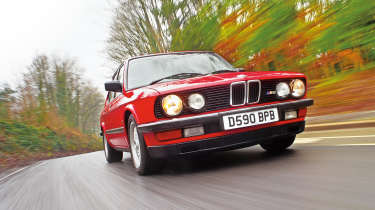
The old one: BMW M5 (E28)
You could point to the E12 BMW M535i as laying the foundations for BMW’s super saloon, but the E28 M5 was the first to wear the now-familiar two-digit alphanumeric. With its 278bhp M88 straight six engine plucked from the M1 supercar it offered truly monstrous shove for the mid-80s, and 0-62mph in 6.2 seconds was up there with some pretty high-performance sports cars. Suspension upgrades meant it could outhandle a few of them too, yet ease off and it retained all the qualities of the base car – a classy cabin, long-legged refinement, and by modern standards, a fluid ride and blissfully compact form. It remains an icon.
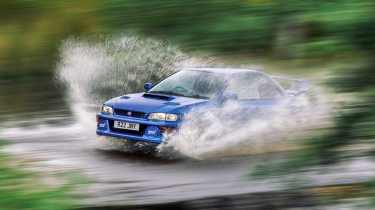
The modern classic: Subaru Impreza 22B STI
An Impreza 22B featured in the very first issue of evo. It actually missed out on that five-star verdict the first time around, but this is one of those cars that has improved with time. It’s impossible not to be charmed by the shape, the closest any road-going Impreza has got to the pumped up WRC cars of 1997-onwards (until the Prodrive P25 arrived). The 22B was 80mm wider than a regular two-door Impreza, and its engine was bigger too, displacing 2.2 litres rather than the usual 2.0 – affording it not just the Japanese gentleman’s agreement 276bhp (in the brochure, anyway – they were thought to produce a fair bit more), but more torque, delivered through a close-ratio gearbox. Quicker steering, wider wheels and firmer suspension gave it a more serious feel on the road, too. All the usual Impreza sensations, but heightened. It’s no affordable hero though, with values now in the six-figure range.
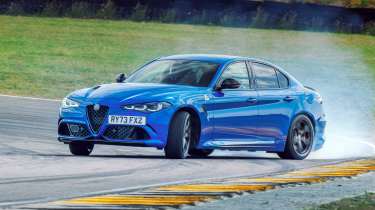
The new one: Alfa Romeo Giulia Quadrifoglio
The Giulia Quadrifoglio’s launch was accompanied by a profound sigh of relief that Alfa had finally nailed the sports saloon formula. It’s not that previous quick Alfas were bad necessarily (we don’t speak of the 4C), but the Giulia was a genuine M3 and C63 challenger. Actually, on some days it was better than either. Early cars had a few imperfections that later ones ironed out (such as a rear diff that would overheat on track, since replaced by a mechanical diff), and they chew through tyres, but the reward is a charismatic, engaging and agile performance saloon that is also a bit of a pussycat despite a power output of over 500bhp. It even rides well, and like most Alfas it’s easy on the eye, too.
| Five-star saloons | |
| Alfa Romeo Giulia Quadrifoglio | Mitsubishi Lancer Evolution VII |
| Alfa Romeo Giulia GTAm | Mitsubishi Lancer Evolution VI Tommi Mäkinen |
| Audi RS4 (B7) | Prodrive P25 |
| BMW M3 (E90) | Subaru Impreza Turbo (‘Classic’) |
| BMW M3 (E90) | Subaru Impreza RB5 WR Sport |
| BMW M5 CS (F90) | Subaru Impreza P1 |
| BMW M5 (F10) | Subaru Impreza 22B STI |
| BMW M5 (E39) | |
| BMW M5 (E34) | |
| BMW M5 (E28) | |
| Lotus Carlton | |
| Mitsubishi Lancer Evolution IX FQ-340 | |
| Mitsubishi Lancer Evolution IX MR FQ-360 | |
Estate cars
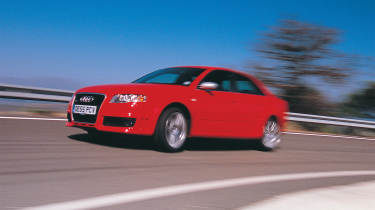
The old one: Audi RS4 (B7)
Audi turning out a genuine driver’s car isn’t much of a surprise today. In 2006 though, the RS4 suddenly becoming an M3 challenger was more of a shock. At the time we were aware of the Audi R8’s existence but it hadn’t gone on sale, and when presented with a 414bhp saloon with broadly the same 4.2-litre naturally-aspirated V8 as the supercar (there are a few technical differences), and driving through a manual gearbox, our hopes were sky high. Then we drove it, and discovered the new RS4 wasn’t just grippy and capable, per the Audi norm, but engaging, balanced, and urgent too. Few Audis have matched it since.
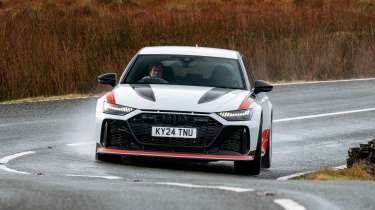
The modern classic: Audi RS6 Avant GT (C8)
The graphics might be a little much to some, an IMSA homage that still works best on the original Audi 90 Quattro racer. In the RS6 Avant GT’s defense, it’s only around 100bhp shy of the '80s monster, and a lot easier to take to the shops. The ultimate take on the already brawny RS6 Avant touts a £177k price tag with firmer (and adjustable) suspension, a carbon bonnet, 22-inch alloys that make it look like a Hot Wheels car, and is packed with character and ability. And involvement and entertainment, which aren’t always a given with fast Audis. Outrageous grip, clever diffs and four-wheel steering really take the edge off the size, too.
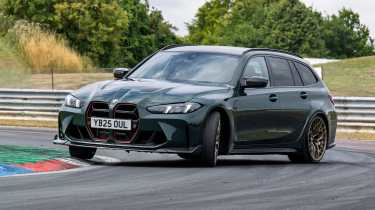
The new one: BMW M3 CS Touring (G81)
As per the M4 coupe and the M3 saloon, the G-series M3 Touring has been given the CS treatment – and it’s probably the pick of the bunch. More satisfying than even the M4 CS, strangely, though the extra practicality combined with the focus of the CS tweaks is undoubtedly part of its appeal. Nobody really needs an estate with Cup 2s, carbon seats, and 543bhp, but we’re glad it exists, and it’s significantly more appealing, and more satisfying to drive, than BMW’s own M5 Touring. The power, chassis, and brakes all easily cope with the 1850kg mass (on road or track); it feels more like a honed sports coupe than an estate.
| Five-star estate cars |
| Audi RS4 (B7) |
| Audi RS6 Avant GT (C8) |
| BMW M3 Competition Touring xDrive (G81) |
| BMW M3 CS Touring (G81) |
Convertibles and roadsters
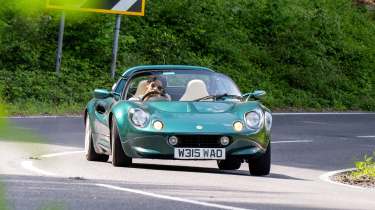
The old one: Lotus Elise (S1)
‘One of the truly great driving experiences’ neatly sums up the original Lotus Elise. The Elise was a vital car for Lotus on its arrival in 1996, and its persistence over three generations until 2021 shows how right the basic formula was. There’s still something particularly special about those earliest cars however. They did a lot with only a 118bhp Rover K-Series, mostly thanks to a 731kg kerb weight, enabled by a revolutionary bonded aluminium structure and a near-religious attitude to minimalism. Nothing short of a Caterham is as involving to drive, and to be honest, not many cars have come close since; especially to the Elise’s gloriously talkative steering, and the uncanny way it deals with poor road surfaces.
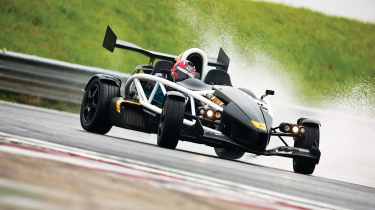
The modern classic: Ariel Atom 3.5R
A year after Ariel introduced the Atom 3.5 came the 3.5R. The regular car was brisk with 310bhp, and the R took that output to 350bhp – chipping only a tenth from the 3.5’s 0-60mph time, but with 636bhp per-ton (the 3.5R weighed just 550kg), perhaps the more striking stat was the six-second 0-100mph time. A healthy options list included the likes of a Sadev sequential gearbox and a carbon aero package incorporating front and rear wings, making this an Atom aimed even more at track driving – something backed up by trick Ohlins dampers. Naturally, it’s a complete riot to drive, and amazingly considering the performance on offer, confidence-inspiring too.
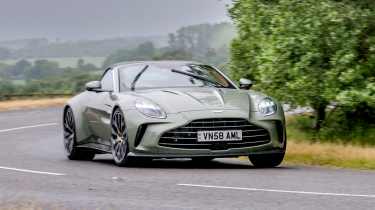
The new one: Aston Martin Vantage Roadster
It took a little while for Aston Martin to perfect the Vantage, but the Vantage Roadster we drove in 2025 was deservedly a five-star car, with ‘a dynamic repertoire with no excuses’. Some soft tops force a compromise over the equivalent coupe in terms of their abilities, but that’s not the case here – it helps that the Vantage is more GT than hardcore sports car to begin with, but you don’t notice any difference in rigidity. It’s just as alert as the hard-top, and it’s a little more compliant too. Naturally, there’s a lot of joy in the 656bhp 4-litre AMG-sourced V8 – and being able to drop the roof makes it even more enjoyable when you’re just cruising.
| Five-star convertibles and roadsters | ||
| Ariel Atom 4 | Caterham Seven Superlight R300 | Mazda MX-5 1.8i (Mk2/NB) |
| Ariel Atom 4R | Caterham Seven Superlight R500 | Mazda MX-5 1.6 (Mk1/NA) |
| Ariel Atom 3.5 Supercharged | Caterham Seven R500 | Porsche 718 Boxster GTS 4.0 |
| Ariel Atom 3.5R | Lotus Elise Club Racer (S3) | Porsche 718 Spyder |
| Ariel Nomad 2 | Lotus Elise Sport 220 (S3) | Porsche 718 Spyder RS |
| Ariel Nomad | Lotus Elise Sport 240 Final Edition (S3) | Porsche Boxster S (981) |
| Aston Martin Vantage Roadster | Lotus Elise Cup 250 (S3) | Porsche Boxster GTS (981) |
| Aston Martin Vanquish Volante | Lotus Elise Cup 260 (S3) | Porsche Boxster Spyder (981) |
| BAC Mono 2.5 | Lotus Elise S (S2) | Porsche Boxster S (987) |
| BAC Mono R | Lotus Elise 111S (S2) | Porsche Boxster Spyder (987) |
| Caterham Seven 360S | Lotus Elise (S1) | Porsche Boxster S (986) |
| Caterham Seven 420S | Lotus 3-Eleven | Vauxhall VX220 Turbo |
| Caterham Seven 420 Cup | Lotus 2-Eleven Supercharged | |
| Caterham Seven 620S | Lotus 340R | |
| Caterham Seven 620R | Mazda MX-5 2.0 (Mk4/ND3) | |
| Caterham Seven Supersport | Mazda MX-5 RF 2.0 (Mk4/ND3) | |
Sports cars
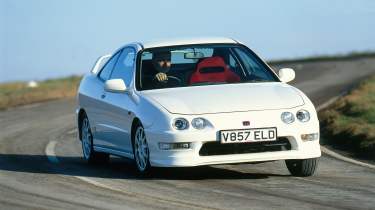
The old one: Honda Integra Type R (DC2)
The DC2 Integra Type R is the only front-wheel drive car in this category, and high-revving proof that a genuine sports car need not power its rear wheels alone. Driving an Integra R fast is as absorbing and exciting as almost anything here and a testament to what Honda engineers were able to achieve in the '90s with merely a mildly sporty coupe as their starting point. Selling points like a seam-welded shell and hand-built engine illustrate just how much went into the Type R, and that 1.8-litre B18C5 engine makes over 100bhp/litre, for 187bhp at a scorching 8000rpm and one of the most spine-tingling VTEC changeovers of any Honda engine. It needs commitment to come alive, but when you commit, it’s the equal of almost any car evo has tested.
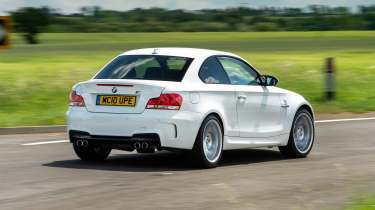
The modern classic: BMW 1-series M Coupé
The 1-series M Coupe wasn’t the first turbocharged M car - that accolade rested with the dubious X5 and X6 M – but it still made enthusiasts a little nervous, not least because it didn’t use a ‘proper’ S-designated M engine. Instead, its N54 3-litre turbocharged straight six was a tuned version of that used in the 135i, though with 335bhp it wasn’t short of urge. Ultimately, we shouldn’t have worried: the pumped up bodywork and wider tracks hit the right visual notes, while brawny performance and the ever-present option to steer on the throttle ensured it drove like a proper M car.
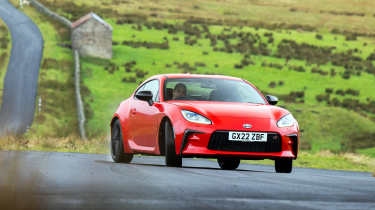
The new one: Toyota GR86
The Toyota GR86 lived only a short time in the UK due to emissions and safety legislation, but we’re glad Toyota made the effort to follow up the zippy little GT86. The GR model was a development of that car, with a little more where it mattered – notably, power and torque. The 231bhp flat-four offered much more punch than its predecessor, while the handling was improved by the fitment of proper performance tyres; the GT86’s balance was still there, but extra grip counter-intuitively meant exploiting the car’s handling became more intuitive. We liked it enough that it finished second in eCoty 2022 to the Maserati MC20.
| Five-star sports cars | ||
| Alpine A110 | BMW M3 CSL (E46) | Porsche 718 Cayman GT4 |
| Alpine A110 GT | BMW M3 (E30, AK05) | Porsche 718 Cayman GT4 RS |
| Alpine A110 R | Ferrari Roma | Porsche Cayman S (981) |
| Alpine A110 R Ultime | Ford Mustang GTD | Porsche Cayman GTS (981) |
| Aston Martin Vantage | Honda Integra Type R (DC2) | Porsche Cayman GT4 (981) |
| Aston Martin V8 Vantage N430 | Jaguar F-type R (RWD) | Porsche Cayman R (987) |
| Aston Martin Vantage GT8 | Lotus Exige S (V6) | Porsche 911 Carrera T (992.2) |
| Aston Martin V12 Vantage | Lotus Exige Sport 410 | Porsche 911 Carrera GTS (992.1) |
| Aston Martin V12 Vantage S | Lotus Exige Cup 430 | Porsche 911 Carrera GTS (991.2) |
| Aston Martin Vantage GT12 | Lotus Exige S (S2) | Porsche 911 Carrera S (997.1) |
| BMW M2 CS (F87) | Lotus Exige (S1) | Porsche 911 Carrera (996.1) |
| BMW 1-series M Coupé | Lotus Evora | Toyota MR2 (Mk1) |
| BMW M4 GTS (F82) | Lotus Evora S | Toyota GR86 |
| BMW M3 (E92) | Nissan GT-R (2008MY) | |
| BMW M3 GTS (E92) | Nissan Skyline GT-R (R34) | |
| BMW M3 (E46) | Nissan Skyline GT-R (R33) | |
| BMW M3 CS (E46) | Noble M400 | |
Supercars
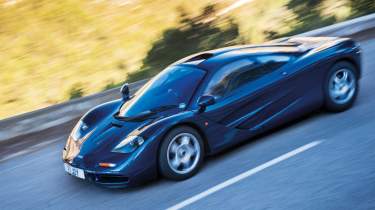
The old one: McLaren F1
Smaller than a first-generation Porsche Cayman and barely heavier than an MX-5, but propelled by a 7500rpm, 627bhp, BMW-developed V12, the F1 was designed to be the ultimate tactile driving experience but ended up becoming a speed record breaker and a Le Mans winner too. evo has driven the F1 on several occasions, both on its own and in concert with the later McLaren P1, and more recently the GMA T.50, but whatever you put the F1 against, it never gets any less special. The V12 still has searing response and enormous pull even from low revs, the steering is packed with feedback, and the central driving position remains unmatched for visibility. It doesn’t have the measure of the newer T.50 for crank speed, but the F1 has it beaten for richness of sound.
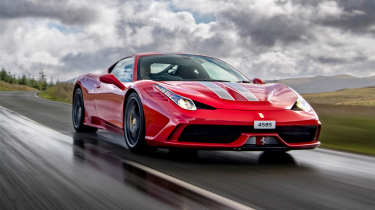
The modern classic: Ferrari 458 Speciale
You know the drill by now with hardcore versions of Ferrari’s V8 supercars. Or maybe you don’t, because the 458 Speciale was on another level again – one of only two cars ever to take unanimous victory at evo Car of the year, and one of our all-time favourite cars outright. Credit must go in part to the brilliance of the standard 458, because Ferrari was hardly turning a sow’s ear into a silk purse, but the extra intensity, communication and ability were all intoxicating. Ferrari squeezed 597bhp from the F136 V8, a barmy 133bhp/litre, and the first flat-out run is a shocking experience. Even better is that the chassis is still on top of it at all times, and copes with poor road surfaces too. It might just be peak Ferrari.
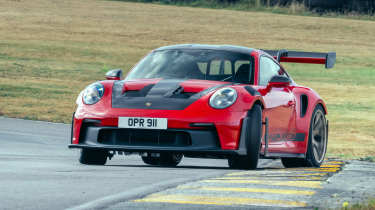
The new one: Porsche 911 GT3, GT3 RS and S/T
The 992-generation Porsche 911 hasn’t quite taken the triple eCoty crown, but wins in 2023 and 2024 for the RS and S/T, combined with 2021’s third-place for the GT3 Touring, demonstrate how broadly talented and thrilling the best versions have been. It helps that there’s nothing on the market quite like a manual, naturally-aspirated 911 these days. The 992 can feel quite large – it no longer has the pleasing compactness of earlier cars – but the 4-litre engines will do 9000rpm all day, passing 503bhp along the way, and Porsche has done a pretty good job extracting real steering feedback from electric power assistance too, making these cars as involving as they are capable. The S/T’s shorter gearing dials up the intensity even further.
| Five-star supercars | ||
| Alfa Romeo 33 Stradale | Honda NSX-R (NA2) | Porsche 911 GT3 (992.2) |
| Audi R8 V10 quattro | Honda NSX (NA1) | Porsche 911 GT3 (992.1) |
| Audi R8 V8 (Mk1) | Lamborghini Huracán Evo RWD | Porsche 911 GT3 RS (992.1) |
| Ferrari 296 GTB | Lamborghini Huracán Performante | Porsche 911 S/T (992.1) |
| Ferrari 296 GTS | Lamborghini Huracán Tecnica | Porsche 911 GT3 (991.2) |
| Ferrari 296 Speciale | Lamborghini Huracán STO | Porsche 911 GT3 RS (991.2) |
| Ferrari F8 Tributo | Lamborghini Huracán Sterrato | Porsche 911 GT2 RS (991.2) |
| Ferrari 488 GTB | McLaren Senna | Porsche 911 GT3 (991.1) |
| Ferrari 458 Italia | Lamborghini Murciélago LP640 | Porsche 911 GT3 RS (991.1) |
| Ferrari 458 Speciale | Lamborghini Murciélago LP670-4 SV | Porsche 911 R (991.1) |
| Ferrari F430 | Lexus LFA/LFA Nürburgring | Porsche 911 GT3 (997.2) |
| Ferrari 430 Scuderia | McLaren 600LT | Porsche 911 GT3 RS (3.8, 997.2) |
| Ferrari 360 Challenge Stradale | McLaren Artura | Porsche 911 GT3 RS 4.0 (997.2) |
| Ferrari F355 Berlinetta | McLaren Artura Spider | Porsche 911 GT2 RS (997.2) |
| Ferrari 348 GT Competizione | McLaren 750S | Porsche 911 GT3 (997.1) |
| Ferrari 812 Superfast | McLaren 720S | Porsche 911 GT3 RS (997.1) |
| Ferrari 812 Competizione | McLaren 765LT | Porsche 911 GT3 (996.2) |
| Ferrari F12 Berlinetta | McLaren 765LT Spider | Porsche 911 GT3 RS (996.2) |
| Ferrari 599 GTB Fiorano | McLaren 650S | Porsche 911 GT2 (996.2) |
| Ferrari 599 GTO | McLaren 675LT | Porsche 911 GT3 (996.1) |
| Ferrari 575M Fiorano Handling Pack | Mercedes-AMG GT R | Porsche 911 Turbo S (991.2) |
| Ferrari 550 Maranello | Mercedes-AMG GT Black Series | Porsche 911 Turbo (997.2) |
| Ferrari SF90 XX Stradale | Mercedes-Benz SLS AMG | Porsche 911 Turbo (996) |
| Ford GT | Mercedes-Benz SLS AMG Black Series | Porsche 911 Turbo (993) |
| Honda NSX (NC1) | Noble M600 | |
Hypercars
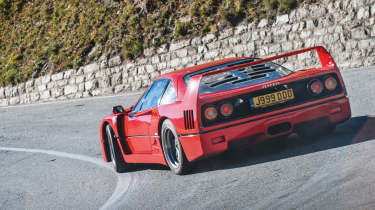
The old one: Ferrari F40
We suspect the Ferrari F40 is the supercar for a lot of enthusiasts. It remains one of Ferrari’s most distinctive and purposeful shapes, from its shovel-like nose to the tip of its square-edged rear wing. There’s even more menace in the power delivery of the 2.9-litre twin-turbo V8, with one of the most profound, eye-widening onsets of full boost you’re likely to experience. It still feels explosively fast today, helped by the quoted 478bhp having to push along just 1100kg (plus fluids), and the sensations coming through the unassisted steering. Driving an F40 quickly isn’t for the faint of heart, but it’s enormously rewarding all the same. Definitely meet your heroes, with this one.
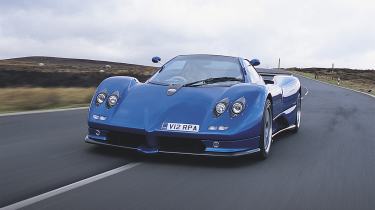
The modern classic: Pagani Zonda S (7.3)
The Pagani Zonda S is a special car to evo: co-founder Harry Metcalfe owned one for a time, making it surely the best long-term test car that any journalist from any magazine has ever written about in print. The Zonda S is and remains incredibly special to behold, while the Mercedes-derived 7.3-litre V12 sounded spectacular. If good looks and a soulful engine were all the Zonda had on its side that would’ve been enough for some, but it had sharp steering and supple suspension too, while the fighter-jet-style cockpit enabled a view out over those prominent front wings that made placing it a doddle compared to most supercars.
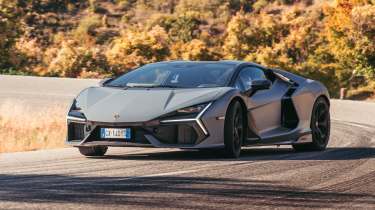
The new one: Lamborghini Revuelto
In days gone by, V12 Lamborghinis were considered supercars, but with an output of 1001bhp, the follow-up to the Aventador probably now deserves the hypercar tag. The thing is, names are almost irrelevant with the Revuelto, because the big news here is that it’s simply the best supercar, hypercar, whatever, you can currently buy. It has an evo Car of the year win in 2025 to its name (with unanimous results from the judges), and while it’s adopted the near-inevitable use of hybrid technology, in this case it really does augment the performance of the screaming 6.5-litre V12 it’s attached to. The Revuelto has all the drama of previous Lambo supercars, but there’s even more driver engagement, and it’s also confidence-inspiring, exploitable, and easy to use when you’re not driving like your trousers are on fire.
| Five-star hypercars | |
| Aston Martin One-77 | Hennessey Venom F5 Evolution |
| Bugatti Mistral | Koenigsegg One:1 |
| Bugatti Chiron | Koenigsegg Agera R |
| Bugatti Chiron Super Sport | Lamborghini Revuelto |
| Bugatti Veyron 16.4 | McLaren P1 |
| Bugatti Veyron 16.4 Super Sport | McLaren F1 |
| Ferrari F80 | Pagani Utopia |
| Ferrari LaFerrari | Pagani Huayra |
| Ferrari Enzo | Pagani Zonda S (7.3) |
| Ferrari F50 | Pagani Zonda F |
| Ferrari F40 | Porsche 918 Spyder |
| GMA T.50 | Porsche Carrera GT |
| Hennessey Venom F5 | Rimac Nevera |