Zenos E10 returns but it's Porsche 911 money
Zenos is coming back, now with help from Lotus to deliver a refreshed 380bhp lightweight sports car. But it’s expensive
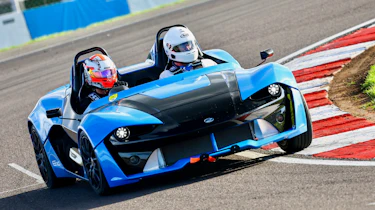
Zenos’s comeback is ongoing, with the E10 R2 joining the E10 RZ, the renewed sports car now shown in production form. Zenos first announced it was coming back in September 2025, though the RZ-spec car shown was unfinished. Zenos was then announced as a partner with Lotus’s new Hethel Performance Hub, that will allow outside manufacturers to use Lotus’s design, prototyping, testing and manufacturing resource. Now we can see the finished refreshed sports car and know the price. Spoiler alert: it’s a whole lot more than a Caterham 7.
It’s still an outwardly similar-looking car to the E10 of a decade ago, albeit with a revised face, a new front bumper and updated integrated lighting giving it a refreshed look. New ducting improves airflow to the front brakes, while there are updated heat exchangers with radiators separate from the intercooler. There are also revised side skirts and new winglets aft the front wheels and ahead of the rear wheels. The body now uses carbonfibre panels in a selection of finishes, including visible weave.
Central to the updates is a new 2-litre four-cylinder turbocharged engine with an output of 380bhp at 6000rpm and 376lb ft at 3000-4500rpm in RZ trim. That's up from 250bhp a decade ago when evo first tested the E10S, and a step over the old 350bhp E10 R. The claimed 790kg kerb weight is a little heavier than the 725kg of old, but with such a bump up in power, the E10 RZ is now a 480bhp/ton car, and one capable of 0-62mph in 3.2 seconds and 150mph flat out.

New for 2027 is the addition of the R2, with a 2.3-litre engine producing 300bhp at 6000rpm and 313lb ft at 3500rpm and therefore, 380bhp/ton. Both engines include CAN bus control and new induction and chargecooler packages.
Construction is as before, with a central aluminium spine, over which a carbonfibre tub is draped, but Zenos has taken care to centralise mass, noting that most of the car’s weight, including the engine and six-speed manual gearbox – with a revised shift linkage – are between the axles.
Track has increased too for greater stability, and once again the E10 RZ uses inboard pushrod-mounted dampers at the front, and coilover suspension at the rear, mounted to the subframe that holds the engine and gearbox. A limited-slip differential will be standard – probably wise, given the power increase.
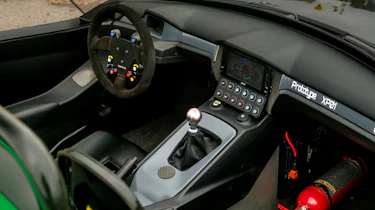
Meanwhile the combination of 16-inch wheels up front and 17 inches at the rear shows the benefit of a small and light platform like this – when you finally burn through a set of tyres on track, the 195/50 R16 and 225/45 R17 rubber shouldn’t cost an arm and a leg to replace. Driver information tech has also come on a bit so there are new interior displays, weatherproof controls and bespoke carbon bucket seats.
Make sure you’re sitting down for the price, as there’s been a bit of inflation over the past decade. That’s not unusual given the need for small sports car companies to actually make money, but when the original E10 S arrived at £29,995 and the E10 R a year later at £39,995, the quoted £115,900 on-the-road for the E10 RZ is still a bit of a surprise and moreso, the £129,900 figure for the E10 R2.