New Volkswagen T-Roc review – no thriller but not a snooze-fest either
VW’s new T-Roc injects a bit of intrigue and competency into the homogeneity of the family crossover/SUV segment
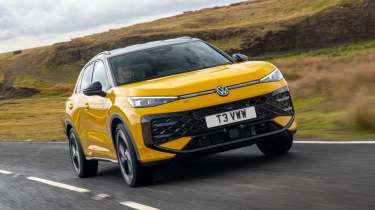
It’s easy to forget, but the Volkswagen T-Roc when it first arrived in 2017 was actually a left-field replacement for the Scirocco. It relatively successfully converted the old coupe-hatch’s visual attitude into small SUV form in the pursuit of sales. It proved a commercially savvy move, in spite of the dynamic drawbacks of raising ride height, given VW has sold more than two million of the things worldwide since its introduction. That makes the T-Roc Wolfsburg’s second best-selling SUV model behind the Tiguan. No pressure on this second-generation version then, which enters a market more saturated than ever.
Its cap comes feathered, VW claims, with improved practicality and an updated but still distinctive design. Powertrains, performance, dynamics and tech are aligned to market expectations.
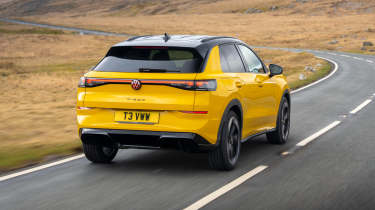
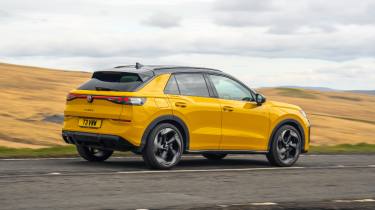
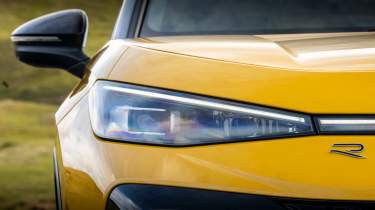
To my eyes, the new T-Roc is still more of a looker, and less generic and anonymous than others of its ilk. There's the pronounced arches, that distinctive black roof over a fang of a C-pillar, an attitude-laden (in R-Line form) if not unfriendly face and a more coupé-like rear. The job of creating a small crossover of distinction is never easy and rarely completed successfully. It's harder still when the car in question is lumbered with a design seemingly created to provoke a crestfallen sigh. The new T-Roc doesn’t fall at that first hurdle.
Engine, gearbox and performance
- 1.5 MHEVs will be joined by a full hybrid later this year
- 148bhp and 184lb ft feels spritely enough
- T-Roc R to be revealed next year, not confirmed for the UK yet
More reviews
The T-Roc range for the moment is made up of a 1.5-litre mild hybrid in two states of tune – 115bhp with 162lb ft and 148bhp with 184lb ft. Full hybrid models will join later in the year, with a full-fat T-Roc R set to be added to the lineup in 2027, though that’s unconfirmed as yet for the UK market.
It’s the 148bhp MHEV that we’ve been driving on the road in the UK, in R-Line form. That power is sent to the front wheels alone via Volkswagen’s seven-speed dual-clutch DSG transmission, making T-Rocs so-equipped good for 0-62mph in 8.9sec on the way to a 132mph top speed.
Less than 150bhp and 200lb ft may not sound like much, but the T-Roc feels spritely enough with this powertrain – responsive and willing at low speeds, that maximum torque figure available from as early as 1500rpm, up to 3500rpm. That’s thanks in part to the TSI engine’s quick-spooling variable geometry turbocharger and in part to the jolt of instant torque provided by the well-integrated mild-hybrid system.
It’s not an engine that relishes revs and it sounds a tad laboured, if not overly loud, when you ask for them. All told, though, the performance feels sufficient, even if the seven-speed DSG can occasionally feel outwitted by sudden throttle applications.
Efficiency is a mixed bag. Ask too much of the powertrain and you’ll see low 30s and even into the 20s for mpg – that’s what I saw when scrolling through the averages established before I’d gotten going. A more relaxed, less hurried drive should yield over 45mpg, the 48-volt mild-hybrid system allowing the engine to cut and the T-Roc to coast off-throttle, or slip into ‘two cylinder mode’ under low load. Both happen so seamlessly and the 1.5 is so smooth that you only realise because of the notification that comes up on the digital driver’s display.
Ride and handling
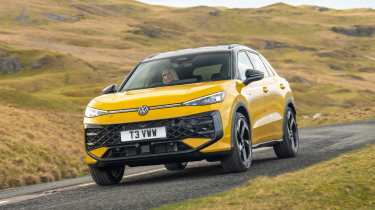
- Extra roll typical of a higher ride, but it’s well-controlled
- Ride can be punchy on the passive suspension, especially on bigger wheels
- Balance is fundamentally good, steering a tad too light and languid
Relatively affordable family crossovers don’t come with hydraulically cross-linked suspension systems to compensate for their higher ride heights. Why would they, when costing a quarter of the price of a Range Rover Sport SV? As a result, we always attack that first corner with low expectations in such cars. The T-Roc happily surprises with its competence, benefitting in terms of stability from the 28mm increase in wheelbase thanks to this MQB Evo-based platform.
Up the pace in the T-Roc and there's a certain amount of roll to a point, but once you know the point at which it settles, you can lean into it. It's not the last word in precision or response, but it is fundamentally neutral in balance. It needs abuse no owner will ever give it to make it feel unruly, or collapse into understeer. For the most part, it feels composed, well-resolved and mature but stops short of being totally dull.
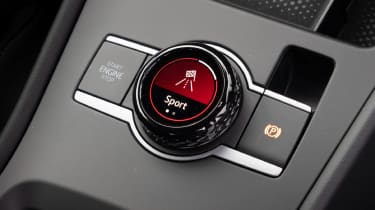
The steering never quite weights up in the nicest, most communicative way, even in the nominally stickier Sport setting found via the prominent Driving Experience Controller. It’s accurate enough from the straight-ahead without feeling nervous, but seems like it could do with a touch less ratio further into the rack for a properly Golf-like, nimble feel.
There’s a bit of hesitance right at the top of the brake pedal that you detect most in traffic, rather than at speed. Otherwise, the brakes are inoffensive, up to job that’s asked of them. Such is the T-Roc’s neutrality that you can use them to cultivate neutral cornering stances too.
The ride on the passive dampers, with 15mm lower R-Line sport springs is a bit busy at speed, even without the largest 20-inch wheel you can get, though insulation from sudden thunks is decent. Life and Style specification cars ought to ride better with their extra ride height and smaller wheels. If going for the R-Line, Volkswagen’s Adaptive Chassis Control package, which includes the multi-way adjustable DCC dampers, is an option box potentially worth ticking for £745. Wind noise is appreciably reduced, thanks to a drop in drag of 10 per cent compared to the previous T-Roc, with an overall c/d of 0.29.
Interior and tech
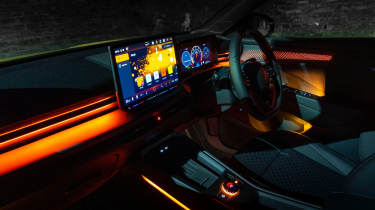
- 12.9-inch infotainment and backlit sliders for climate and volume
- Steering wheel with proper buttons
- Material quality a mix of great and so-so
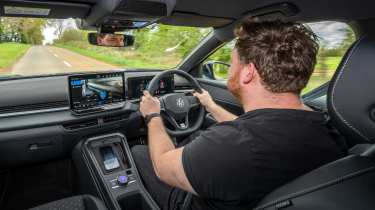
The interior is a lot of what you expect and are used to and some of what you’re not – the steering wheel is mercifully button-festooned, without the haptic nightmare we still endure on the Golf R. Likewise the 12.9-inch infotainment display carries over from the Golf, with backlit touch sliders – far from ideal but at least now usable at night.
The software is, as ever, a bit menu-heavy but navigable once you know what you’re doing. Shortcut buttons on the homepage take you to most of the places you need to go most regularly.
Material and quality wise, it’s a mixed bag. Close your eyes, paw your way around and you’ll feel one of two things: squishy, plush-feeling soft surfaces (mostly high up), or tinny, raw plastics (low down and to the centre of the car). The T-Roc’s cabin is passable as premium, though a dearth of luxuries like electric adjustment for the seats and steering wheel in the top-billed R-Line feels a little austere, even with a heated steering wheel, seats and wireless phone charger.
The tech pack brings with it reversing cameras and a head-up display for £950. The seats themselves are nice enough, with a fabric and faux Alcantara (called R-Line fabric) mix, and can be set lower than you expect.
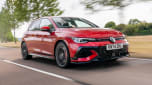
The new T-Roc is 122mm longer overall, with 28mm extra in the wheelbase. It’s also a hair (9mm) taller. The result is a roomier (with 30 litres more boot space), airier feel inside, with improvements in leg and headroom. The rear seats still aren’t somewhere to put full-sized adults for long stints but the T-Roc will support a young family easily enough.
Is the T-Roc’s interior interesting enough, or a little derivative? If the car looks distinctive on the outside, the amount of componentry it borrows inside means it doesn't stand apart as much as you might hope. Perhaps some trim colour options to rival the loud paint options on the outside wouldn’t go amiss. The Driving Experience Controller can at least be used to pick between ‘atmospheres’ that adjust the colour themes for the mood lighting and displays.
Price and rivals
The T-Roc is keenly priced with a low bar of entry at £31,635. This is however for the lowest-spec ‘Life’ with the 115bhp engine, smaller eight-inch driver’s display and 17-inch wheels. ‘Style’ adds the 10-inch digital display, plus 18-inch wheels, three-zone climate control, ambient lighting, multiple drive modes, 3D rear lights and more. The added gear takes it up to £36,255. Bump the engine up to the 148bhp version and the prices rise to £33,700 in life spec and £38,320 in Style spec.
R-Line gets the sportier suspension, seats and styling and is also only available in 148bhp form – really, the minimum requirement for making progress. It’s £38,935 and is appreciably cooler looking than the Style to warrant the extra £715.
A Style on the 18-inch wheels, potentially with DCC, would be the pick for comfort. We’d option DCC every time, with the smallest 19-inch ‘York Aero’ wheel on the R-Line. We specced up an R-Line with DCC, the tech pack, Harman Kardon sound system and IQ Light matrix LED lights to £42,330 – a full-bodied £10,700 more than a basic ‘Life’.
The T-Roc has more visual and driver appeal than most of its closest rivals, including the Nissan Qashqai from £30,655, Hyundai Kona from £27,290 and Toyota CH-R from £31,695. For similar money across the T-Roc range, you could also have the more practical, quirkier, comfier Citroën C5 Aircross from £30,510. A bit more money buys the T-Roc's spanish cousin, the Cupra Formentor, from £35,315, or its German cousin, the Audi Q3, from £38,350.
If you want moderate driver and visual appeal to match the T-Roc? Ford’s Puma from £27,145 is a cut above the models mentioned above – no Fiesta replacement on talent but still what you’d expect of a Ford.