Citroën C5 Aircross review – quirky, honest SUV offering Range Rover comfort on a budget
When is a generic family crossover not the dullest thing on Earth? When it’s a comfy Citroën glazed in weirdness

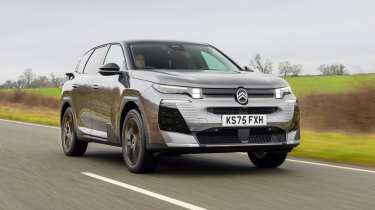
It’s easy to look out at the grey sprawl of generic, soulless crossovers and SUVs that is the current mainstream new car market and wonder if there’s anything left to be enthusiastic about. And yes, ‘normal’ cars used to be interesting. Some were even great to drive – RIP to the Ford Focus – and Citroën's C5 Aircross is a quirky, comfortable, interesting lighthouse in this dullest of storms.
It’s Citroën's take on that most boring, uninspiring Nissan Qashqai-shaped and sized family SUV and it shares its STLA Medium platform – the hardpoints and mechanicals – with fellow Stellantis family members, the Peugeot 3008, Vauxhall Grandland and Jeep Compass. So injecting that wonderful weirdness for which Citroën is beloved is surely no easy task.
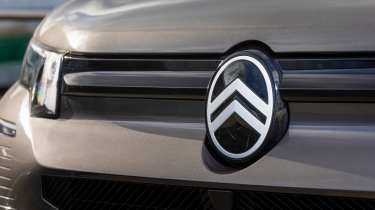
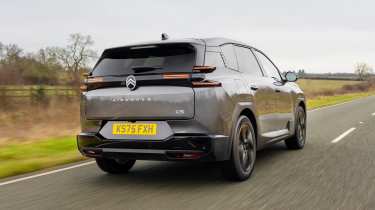
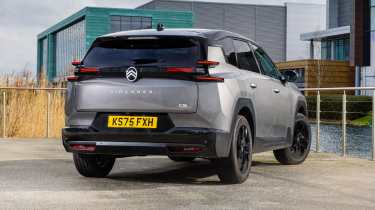
Citroën's design flare, however, means it’s a very distinctive thing to look at, and a faithful reproduction of the Oli concept that previewed it, with its floating triple tail lights, boxy arches, accent lines and the new-old Citroën chevron badge. It's a more attractive, more confident car than its blobby predecessor, that cricks the necks of curious bystanders like some sports cars. The cabin’s far from boring to behold either.
Engine, gearbox and technical highlights
- MHEV (142bhp) and PHEV (193bhp) and EV (210bhp) options
- ‘Advanced Comfort’ hydraulic bump and rebound control
- Weighs between 1479kg and over 2100kg
More reviews
The powertrain and drivetrain lineup is shared and admittedly, cannily varied, with mild-hybrid, plug-in hybrid and all-electric versions. The mild-hybrid uses a 1.2-litre three-cylinder turbocharged engine, boosted by a 48-volt electric motor, making it good for 143bhp and 170lb ft, up from 128bhp in its predecessor. The plug-in hybrid pairs a 1.6-litre petrol engine with an electric motor that’s fed by a 21kWh battery, producing 192bhp and 221lb ft – more potent than the old combustion-only 1.6, albeit heavier, thanks to the battery.
There is no longer a diesel option, though there is now an EV, that generates 210bhp, 254lb ft and us good for a (claimed) 319 miles of range with the basic 73kWh battery, or over 400 miles and 226bhp with the long range 97kWh battery – the latter the effective flagship in the place of the old 225 PHEV. The C5 is automatic-only, with a six-speed dual-clutch in the MHEV and a seven-speed in the PHEV.
What the Citroën does differently to its platform-mates is in the suspension, with what it calls the ‘Advanced Comfort’ set-up. This involves hydraulic cushions in place of traditional rubber bump stops, with one for compression and one for rebound installed at each corner of the car, to better isolate you from bigger shocks such as potholes while maintaining some body control.
Driving the Citroën C5 Aircross
- 1.2 MHEV really isn’t enough
- As sophisticatedly comfortable as you’d hope of a Citroën…
- … if not the last word in absolute dynamic control. And that’s fine.
We made the conscious decision to testthe basic MHEV 1.2-litre 142bhp C5 Aircross. Our logic being that it is 200kg lighter than the PHEV and over 600kg less than the EV – surely this should be the most pleasant of the Aircross variants to drive? The trade-off is that it’s the only C5 Aircross variant to take over ten seconds to get to 62mph – a full-bodied 11.2sec in fact, slower than the old 1.2.
The C5 MHEV’s performance is noticeably anaemic. There’s a hint of punch and response low-down at urban speeds thanks to the small electric motor. But the rest of the time, say, over 20mph, the C5 is labouring along the road, the three-cylinder engine thrumming in pain as you plumb it for all it has. Doing so feels cruel. Best to take things easily, never find yourself in a rush and let the pace build slowly.
Do so and the C5 starts to make sense, even in this under-engined form. The reduced weight starts to pay dividends as you glide along, appreciating the balance of comfort and control even once you get up to a brisk pace, the lower weight making it feel relatively light on its feet. Lean on it too hard and it’ll quickly let you know that this is not what it was made for.
It’s not too uncouth though, even with its beam rear axle (the EV is the only C5 that gets independent rear suspension). There is a sophisticated feel to it most of the time, far from under-engineered, it’s just been calibrated for plushness and compliance as you would entirely expect of a car with a suspension system called ‘Advanced Comfort’.
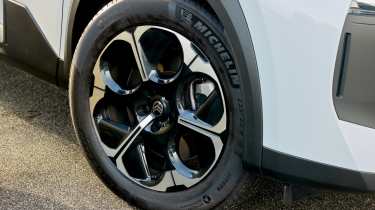
Does it deliver the ‘magic carpet’ ride? It certainly feels like a Citroën, more comfortable, more considered than most other cars of its type, with an almost Range Rover-esque serenity to its cruising gait. The hydraulic cushions shield you from big thuds nicely and you only sometimes notice the typical beam axle left-right shimmy. You glide through potholes and over speed humps, though short, sharp jolts do occasionally make their way through the strut towers and into the car.
The deliberate softness is not just in the ride but in all of the controls. The car’s comfort zone and sense of purpose is very clearly communicated and you’ll quickly learn how hard it does and doesn’t want to be driven and appreciate it for its strengths, rather than lament its weaknesses. There’s an honesty to it, in an era when many others try to make their car good at everything and the result is usually mediocre. I just wish the Stellantis toybox had a more stout, c200bhp mild-hybrid combustion engine to partner it.
> Citroën C4 WRC drive – behind the wheel of a rally icon
Manoeuvrability is good around town for its size and the view out is okay, though the bluff snout can make distance judgements difficult in tight situations. The only bug we experienced was that the cruise control wouldn’t work: ‘conditions not met’ it’d say, the car advising to check all the sensors for dirt or grime, which of course were all clean. Efficiency was fine, with 40mpg on average over a brisk cruise, more under than over when in a bit of a hurry. Claimed efficiency for the 1.2 is a WLTP-tested 42-43.6mpg.
Interior and tech
- ‘Advanced comfort’ seats a must for the full Citroën experience
- Quirky cabin design and materials are enjoyable
- Quirky ergonomics and UI take some learning
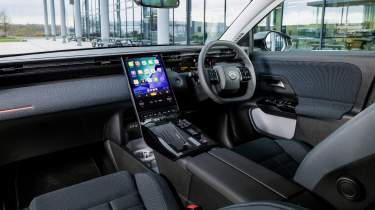
The C5’s cabin is the opposite of the flat, featureless dystopia you get in the likes of the Tesla Model Y and is appreciably more upmarket than its predecessor’s. Yes there’s a fairly generic driver’s display and a screen dominating the core of the car, but it’s a vertical ‘waterfall’ display, curves upwards from a distinctive semi-floating centre-console and floats in front of the curved dash – it’s part of the design, not a clumsy integration.
The central screen UI is relatively intuitive, with physical hotkeys to bring up wider, lamentably touch-operated climate controls. You’ll need to go searching for the climate and massage seat controls too. The central area can be customised with your chosen functions using widgets too, though most will run Android Auto or Apple CarPlay smartphone mirroring in its place. Chat GPT is integrated into the voice recognition system, which proves entertaining for bored passengers on long journeys and nominally irritating for the driver.
The cabin is a sea of interesting materials – some nice, some a bit tinny – with sustainability a focus. The clear plastic door bins are made with 20 per cent vine shoots from Burgundy vineyards – very French. The steering wheel’s a bit odd, with individual buttons replaced by panels rocking across multiple clickers. The driver’s display is a bit fussy too.
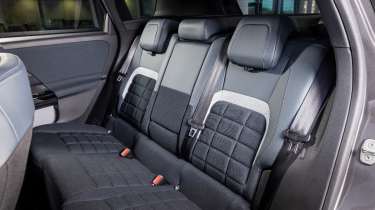
The ‘advanced comfort’ seats are nicely bolstered and are padded with foam pockets – o-so Citroën – but come only on higher-spec models. That also extends to the rear seats, which can also be reclined between 21- and 33-degrees. The cabin is roomy with good leg and headroom in all seats, and a good view out.
> The day Kris Meeke scared us in a Citroën Dispatch van
Overall though it’s just remarkable to not feel the light leave one’s eyes when climbing aboard such a car. Well over and above the bare minimum, with a good dollop of imagination and distinction are what we should ask of all cars that eschew absolute bargain basement status.
Price and rivals
In an era of SUV homogeny, platform sharing, tight margins, tighter budgets and fierce competition in the fight for the attention of a slimmer pool of buyers than the new car market has become used to, the C5 Aircross is distinctive and weirdly endearing. It's refreshingly honest dynamically – very good at what it sets out to be good at – and appealingly quirky in terms of its design and interior appointment. Yes it’s a parts and platform-share car, but you get the sense the people at Citroën genuinely cared about dressing this box of bits, and adding their own engineering where appropriate, to create something authentic to the brand. Nevermind that Jaecoo, this is the ‘not Range Rover’ that’s worth your attention.
The C5 Aircross on top of being refreshingly pleasant to drive and be in, is keenly priced. The entry level 1.2-litre MHEV ‘You!’ spec starts from £30,510, while Plus (which gets you the posh seats among other things) and Max specs start from £33,150 and £35,790 respectively. The PHEV is only available in Max spec at £38,860 and the electric model adds around £3500 compared to the 1.2, spec for spec.
Many of its core rivals come from within of course, the Peugeot 3008 is probably as quirky but sportier and more upmarket both inside, and while it is £5,000 more expensive spec for spec, it does offer the more powerful 222bhp PHEV option. The Vauxhall Grandland is also similarly pricier, though it does offer the 222bhp PHEV lower down the range. The Jeep Compass is more traditional and utilitarian, at least in appearance but still starts at £4000 more than the basic C5.
Nissan’s Qashqai is priced more competitively with the Citroën at £30,655 starting, but lacks any kind of visual distinction both inside and out. Renault’s Austral shares the Nissan’s platform and parts and is a nicer object, but is £5000 pricier as a result. Hyundai’s £30,985 Tucson and Kia’s £31,395 Sportage are also a closer match on price, as is Skoda's £30,960 Karoq.