Toyota GR Yaris Aero Performance review – one of the best hot hatches just got better
The winged GR Yaris Aero Performance has arrived, with more aggressive looks and incremental mechanical upgrades making it the best version yet
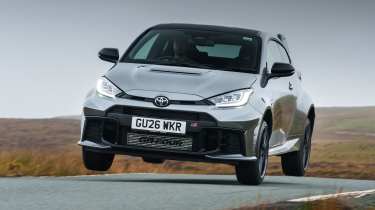
The Toyota GR Yaris Aero Performance is exactly as described: a GR Yaris with an aero package to increase its performance on both road and track. It’s not a special limited edition, but rather a second continuous production variant offered alongside the regular GR Yaris that we know and love.
In the UK, Toyota can only make a small batch of GR Yaris cars available each year. The vast majority of the 2026 allocation are Aero Performance versions, other than the few remaining 'standard' car orders from last year. All cars have already been allocated.

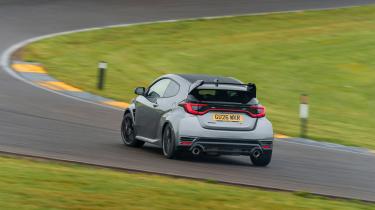
The upgraded aero comprises six new modifications. The most obvious is the generously portioned rear wing, which is manually adjustable in three stages from near-flat through mid to its steepest angle, with five degrees of difference between each. The aluminium bonnet has grown a reshaped power bulge with an integrated grille, to help get heat out of the engine bay during sustained hard driving. A more subtle tweak to the front lip spoiler helps reduce front-end lift, and outlet ducts on the trailing edge of the GR Yaris’s distinctive flared front wheelarches help reduce pressure in the wheel wells.
Slats in the rear bumper provide an extra exit point for air flowing under the car, reducing the drag coefficient. Out of sight, and also tidying up airflow at the rear, is a flat floor covering beneath the fuel tank area. Hiroyuki Yamada, engineer and project general manager for the GR Yaris, told evo that each of the aero upgrades has come from motorsport and hands-on track testing.
More reviews
Group tests
In-depth reviews
Long term tests
Reviews
The bonnet duct, for example, was developed on cars competing in the Japanese rally championship and the underfloor surfacing in circuit racing. Each part has a specific task; for example, the pressure-reducing ducts in the front arches are designed to help steering feel under braking and stability on corner entry, while the rear spoiler is all about high-speed handling and braking stability.
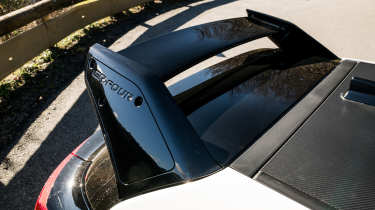
From a visual point of view, though, they all lend the GR Yaris a good dollop of attitude. The normal GR Yaris is too close in appearance to a standard Yaris, you could argue, but the aero kit fixes that: the rear wing and GR-Four script on the endplates calls to mind the old Celica GT Four, and it looks every inch a rally special. Despite the big wing, Toyota quotes the same 143mph top speed as for the regular GR Yaris – however, Yamada-san mentions that the Aero Edition does use a little more fuel, based on driving test cars on his own commute.
Inside, you immediately notice one major change versus the regular car’s cabin: the rehomed handbrake. It’s attached to the centre console next to the gearlever in a rally-esque near-vertical position, less than a handspan away from the steering wheel in this left-hand-drive car. In Yaris rally cars, it’s positioned here for easier handbrake turns but there’s a secondary benefit too: the empty space in the transmission tunnel moulding where the handbrake used to sit is now a slim cubby hole slot. It’s a bit rudamental, made with what looks like a repurposed handbrake gaiter, but the perfect size to stash a smartphone.
The move has meant re-routing the handbrake linkage. Nonetheless, the feel is perfect – minimal effort to pull, with your arm in a straight line rather than an awkward twist of the shoulder. Despite its appearance, it’s not a hydraulic handbrake but a conventional system, complete with push-button top to latch and unlatch. It’s not a big stretch of the imagination to picture some owners fitting an aftermarket cap, to turn the lever into a fly-off handbrake.
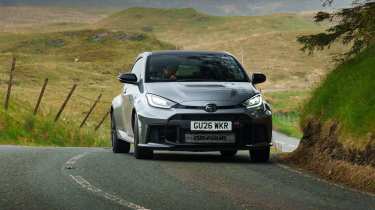
A change you can’t see is that the electric power steering software has been retuned for improved feel and response. And on the road the Aero Performance feels immediately sharper in handling and clearer in feedback than the regular GR Yaris. We can say this in confidence having run a standard Gen 2 car on our long term fleet at the same time of this test, and having driven them back-to-back on the same roads.
The standard car feels a little more numb, a little lazier changing direction; the Aero feels more eager, more precise, and more consistent in its responses. It’s a car you quickly feel at ease with. The difference isn’t night-and-day compared with the regular car but the Aero Performance is definitely more nimble and enjoyable, and has a more polished ride quality too. This means that as well as being incredibly effective on a twisting, undulating road, no matter the conditions, the Aero engages you that bit more, responding in higher fidelity than the standard car. Forget other hot hatches, it’s hard to think of any performance car that immediately instills so much confidence, and allows you to drive to the limit so comfortably.
> Best Japanese cars – performance icons from the land of the rising sun
Yamada-san says he believes the aerodynamic benefits can be felt from as little as 30mph. That may be a stretch but such is the Aero’s stability and surefootedness at speed that they clearly have real benefits. Supporting this is a stiffer body structure. Compared to early Gen 2s, structural rigidity has been greatly improved in post-2025 GR Yaris’s, particularly at the front due to a greater number of welding points. This stiffer structure no doubt plays a big part in the more immediate and consistent steering response, and that’s something that the regular ’25-spec car benefits from just as much as the Aero Performance.
The 1.6-litre three-cylinder turbo engine is gruff at low revs but sounds, and feels, enjoyably brawny once it’s in its sweet spot. Torque has fallen from the 2024 car’s 288lb ft to 254lb ft owing to emissions regulations measures, but power remains the same at 276bhp. Like the original Circuit Pack car, and all UK Gen 2 models, the Aero has Torsen limited-slip diffs front and rear. There’s no change to the switchable modes for the 4WD system, which vary the amount of torque divided front to rear, sending more rearward under acceleration in Track mode.
The regular GR is still available with a choice of manual or eight-speed auto but the Aero is three pedal-only in the UK for now, and that’s for the better. Driving a manual GR Yaris is as joyful as ever, the six-speed H-pattern shift a tactile, baulk-free delight. The auto rev-matching system works a treat on downshifts, and can be disabled instantly with a touch of a button rather than a dig through a screen menu. Given the undramatic way the Yaris deploys its performance the extra interaction of the manual is welcome, keeping you busy and engaged with the car at all speeds.
GR Yaris’s have never been natural track cars in standard trim. The resolute stability that makes them so effective on the road results in a balance that tends to understeer at track speeds, and limits your commitment around a lap. The Aero Performance has the same fundamental traits – it’s not as sharp and keyed-in as a Honda Civic Type R – but the balance has improved, bringing it closer to neutral. That means you can lean harder on the front end before it starts to push, and out of slow corners, you can occasionally feel the rear edging wide under power, keeping you on a tight line. The lap time it generates is quite impressive. On our Anglesey Circuit leaderboard, the Aero Performance matched the previous-generation BMW M4 with a time of 1:19.28.
Price and rivals
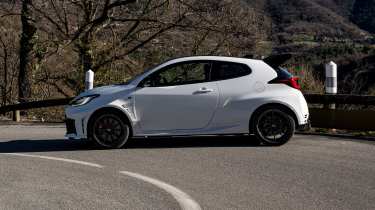
The GR Yaris Aero Performance is pricey at £49,145, but such is the popularity (and short supply) of the hot Yaris in the UK that Toyota has no trouble selling them. Drive the Aero Performance and you’ll see why; there's nothing else out there quite like it, and it’s the best version of the GR we’ve driven. No factory options are available for the Aero Performance: spec is as per the standard GR Yaris, albeit without heated seats. Paint colours are the same as the standard car too: Pure White, pearlescent white, black, red and grey.
In terms of rivals, Mercedes-AMG's A45 S is an altogether different sort of hyper hatch and considerably more expensive, at over £60k. Likewise Audi's RS3. The only hatch that matches the Aero Performance’s sense of purpose and involvement is the Honda Civic Type R, which is even sharper, more engaging and more capable on track, but now off sale. Another c£50k hot hatch worth considering is Volkswagen’s Golf GTI Edition 50. It’s noticeably more focused and aggressive than any previous Mk8 Golf and supremely capable on track (it outpaced both the Aero Performance and Civic Type R in our hands), but doesn’t have the tactility and bespoke feel of the Toyota.
Specs
| Engine | In-line 3-cyl, 1618cc, turbocharged |
|---|---|
| Power | 276bhp @ 6500rpm |
| Torque | 254lb ft @ 3150-4600rpm |
| Weight | 1280kg (219bhp/ton) |
| Tyres | Michelin Pilot Alpin5 |
| 0-62mph | 5.2sec |
| Top speed | 143mph |
| Basic price | £49,145 |