Ariel Atom 4RR review – is the most powerful Atom ever worth McLaren 750S money?
Britain’s ultimate track car just got more extreme and more powerful. We drive it on road and track

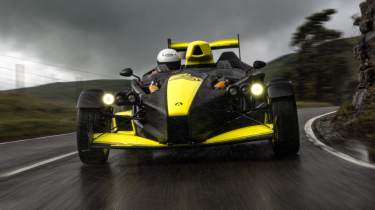
I think we can all agree that the 400bhp Ariel Atom 4R is no slouch: a power-to-weight ratio of 611bhp per ton – better than a Lamborghini Revuelto – and 0-62 in 2.7sec testify to its searing pace. So if I told you ‘Yeah, it’s quick, but it’s not all that’, you’d think I’d lost it, but let me explain.
You know when you’ve been on the motorway for so long that when you take a slip road and slow to 40mph, it feels like you’re at walking pace? That’s what it feels like when you’ve been lapping in the 525bhp Atom 4RR as hard as you dare and, out of curiosity, you turn the engine map back down to the one that gives ‘only’ 400bhp. Sure, it’s still punchy, but it doesn’t have the devastating impact of 525bhp.
Sounds crazy, doesn’t it? Trust me, it feels even crazier. The new 4RR gets to 62mph in just 2.4sec, which is startling, but more impressive is that it gets from zero to 100mph in just 5.1sec. Just as remarkably, it doesn’t seem to slow down much after that, which is a new sensation in a car that, even with front and rear wings, is about as aerodynamic as some fallen-over scaffolding. Ariel claims a top speed of 175mph and I have no reason to doubt it.
Booking Pembrey Circuit was definitely a good idea, though the five-hour drive to south Wales to meet the Ariel crew gives me plenty of time to ponder the wisdom of sticking my hand up to drive the 4RR. Vague misgivings become intrusive thoughts: ‘Nomex or not…? Will I regret not ordering that new full-face helmet…? I hope it doesn’t rain…’ The last of those is in the hands of the gods, of course, and they are in a devilish mood, for after almost a month of unbroken sunshine, the weather has properly broken. The forecast was decidedly iffy, so I packed my waterproofs and accepted that it would chuck it down.
More reviews
Group tests
- Ariel Atom 4R v Ariel Nomad 2 – is grip more fun than slip?
- Ariel Atom 4R v Caterham Seven ‘evo25’: power-to-weight heroes go head-to-head
- Ariel Atom 4 v Caterham Seven 310R v Lotus Elise Cup 250
Reviews
- Ariel Atom 4R review – how to make a Porsche 911 GT3 RS look tame
- Ariel Atom 4 2025 review – Britain's exoskeletal track toy just got torquier...
- Ariel Atom 1 (1999 - 2003) review, history and specs of the bare-bones sports car
- Ariel Atom 3.5 (2013 - 2018) review, history and specs
- Ariel Atom 3 (2007 - 2013) review, history and specs
On arrival, a stiff breeze is sending black clouds scudding across the sky, but it isn’t actually raining. Even so, as the Atom is pristine, we elect to grab static shots and details inside the scrutineering bay, which gives Ariel MD Henry Siebert-Saunders the chance to talk me around the 4RR.
He accepts that, to the casual observer, the 4RR looks just like the 4R. Yet while the 4R starts from £78k, the 4RR will cost £249k, an extraordinary amount. ‘It’s very much not the same car with more power,’ he says. ‘All Atoms so far have been road cars that are also great on track. This one is the other way around: a track car that’s also great on the road. We’ve worked on the chassis, we’ve worked on the suspension, we’ve given it bigger brakes. The exhaust has been worked on, the intake has been worked on, the aerofoils have been worked on… It’s all quite different.’
That includes the familiar ‘K20C’ Honda Civic Type R engine. Until now Ariel has used it like a ‘crate’ engine, adding its own intake and exhaust systems and ECU but not opening it up. The 4RR marks the first time the firm has physically uprated it, and that work has been entrusted to Corten-Miller Motorsport, Ariel’s approved service agent. The 100 hours of work that take it to 525bhp effectively make it a race engine: every significant internal and external component is replaced, upgraded or re-engineered to motorsport spec.
‘Corten-Miller have created tuned engines for customers, and the 4RR engine represents the culmination of that knowledge,’ says Siebert-Saunders. ‘Inside there’s a closed deck girdle, it’s got different pistons, different con rods, different crank, different cams, different porting, different injectors, different turbo, different fuel pump...’ It could make 650bhp, he says, but 525bhp strikes a good balance between performance and maintenance. ‘It’s plenty fast enough with 525bhp and you can go for a couple of years of driving around tracks at race speeds without having to do any major works to the engine.’
Building the rest of the car to match starts with the signature exposed chassis, which is bronze-welded in its entirety, rather than MIG-welded. ‘This makes it stronger because the joints are allowed to flex slightly more and it introduces less localised heating, which fatigues the metal less,’ says Siebert-Saunders.
The last Ariel with a fully bronze-welded chassis was the Atom 500 with its bike-derived, 3-litre V8 by Hartley Engineering, which offered 500bhp. The 4RR trumps that and, being turbocharged, absolutely slaughters it on torque. There’s a new intake, titanium exhaust, and a double-sized intercooler in the right-hand side-pod, which is made of carbonfibre, as are many other parts of the 4RR, as standard. ‘This is as much carbonfibre as we sell,’ says Siebert-Saunders.
Chassis-wise, there are Öhlins dampers, adjustable remotely, and 310mm front brake discs – the largest that will fit inside the forged wheels – which proved necessary once development got underway. ‘We went to Thruxton with the 4RR recently and we were seeing a peak of 162mph, whereas in a 4R you would be probably seeing 130 or 140.’
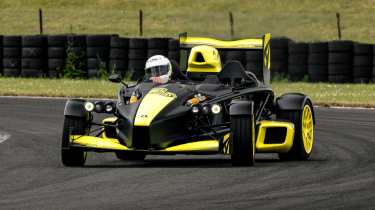
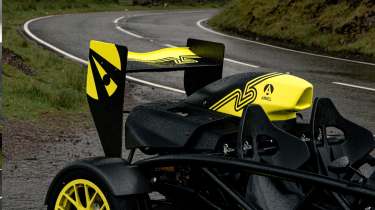
They’ve also fitted a stiffer front spring to hold the front end up under braking and added a brace to the front spoiler; it was starting to twist at the higher speeds the RR was making. At 100mph there’s 100kg of downforce front and rear, though this is more about calming the handling than offering a downforce experience, says Siebert-Saunders.

By the time we’ve rolled the car outside and I’ve strapped myself in and had a run through the controls, the circuit is almost completely dry, which I’m happy to see, not least because the Yokohama Advan A052s, 195/50 R16 up front and 255/40 R17 astern, look one step away from being a cut slick. Not ideal for today’s showery forecast, but here we are.
Nosing out onto the track, everything feels good. Really good. It’s a rare sensation, but in a few cars, almost from the moment the wheels start rolling, you can sense their settled, confident nature, and this Atom is one of them. Its steering is weighty but direct and precise, and even though this is a smooth racetrack, I already have the feeling that the damping is going to be just-so.
At least I know the track. I raced here back in the early ’90s in the first Rover K-series-engined Caterham Seven… which had 103bhp, not even a fifth of what this Atom has. Two laps in, I reckon I’ve broken my personal lap record and I haven’t used more than an inch of throttle yet. All credit to Corten-Miller. Describing an engine as motorsport-spec could be a strategy to excuse a lumpy idle or patchy low-speed throttle response, but stroking along as everything warms up, this engine feels as refined and tractable as the stock Honda unit.
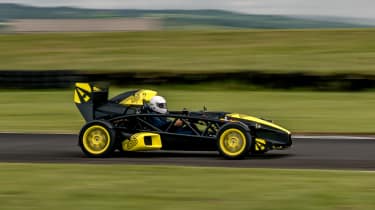
The disruptor is the shift of the Quaife sequential gearbox. We’ve met before, but the robust way it selects ratios, up or down, with a seemingly random quality is slightly baffling. Attempt to finesse it by backing off a bit to unload the drivetrain, and the shift quality is unaffected, sometimes being worse than if you’d simply tugged the paddleshift.
Into and through the corners at increasing speed, I feel confident in the dynamic balance and grip, which makes me a lot more relaxed about the moment I ask for everything the engine has got. To the right of the digital dash is a rotary switch that selects the engine map. It’s currently set to map 1, which delivers 400bhp and 280lb ft, and when the throttle hits the stop and stays there, the push in the back is strong and remarkably consistent, delivering the same intensity through the mid-range, all the way to the red shift-lights at over 8000rpm.
The car feels properly quick but comfortable with it, as do I. The first corner is a hairpin and the amount of traction the rear axle finds is incredible. I want to get a feel for what happens when the grip is used up, but try it here and the revs build so quickly that you’re into the limiter the moment you expect to be applying opposite lock. And the more laps that go under the 4RR wheels, the stickier its tyres seem to get.
Time for map number 2. This bumps power up to the headline 525bhp and torque to 332lb ft, and the difference is massive. Thinking about it later, it shouldn’t be a surprise because that’s 30 per cent more power. Still the grip out of the slowest corners is equal to the fast-building torque, but mid-lap there’s a third-gear right-hander, and here the combination of torque and high lateral load is enough to get the rear sliding.
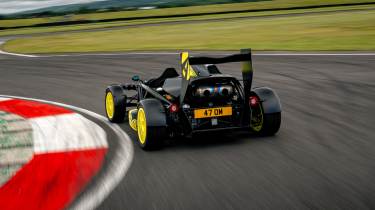
On a trackday you’d be feathering the throttle or upshifting early, but here there’s a photographer to please. A couple of times I think I’ve overcooked it, yet the chassis stays poised if you ease back the throttle, which is good to know. Map 3 shouldn’t make that much difference but, oh boy, does it ever. Power is the same but torque tops 400lb ft and throttle response is brutal. The now belligerent delivery perfectly matches the whip-crack pneumatic upshifts of the Quaife gearbox and the blistering acceleration is now almost seamless and utterly unrelenting.
The 4RR feels like a low-flying missile, yet still an easily guided missile. Extraordinarily, the Atom can still contain the force the engine delivers and convert it wholly into forward motion, even in the tighter corners with an early throttle. I know it’s mechanical traction, too, because I’ve wound down the traction control to one click from fully off.
I realise I’m concentrating so much on acceleration and traction that I’m miles off maximising braking performance, though curiosity soon sorts that out. I feel I could be a lot braver through the last sweep onto the start straight – the appropriately named Honda Curve. Thing is, there’s still a puddle right where you’d ideally run to the red-and-white kerbing, so I’ve been waiting to clear that before fully nailing it.
Even so, next lap I concentrate on getting on the gas as soon and as hard as I dare, and a couple of red-line shifts later I’m arriving in the braking area for the hairpin at an indicated 150mph. I hit the brakes and for the first time the momentum and mass are suddenly apparent and the brakes finally feel under pressure.
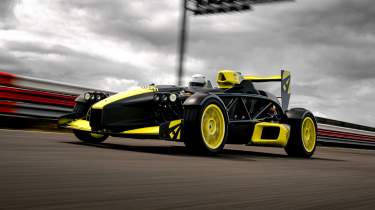
There’s clearly a chunk of time to be had in the braking areas, and a bit in the setup too; sensibly the RR is configured for a wet track and the rear is a bit soft in the fastest turns. That said, as remarkable as the power is, the chassis balance and feel are quite superb. It’s so transparent, such an easy car to read – you know how hard you’re pushing either end and so can feel how to drive it to be fast and tidy.
Huge credit here to Ariel’s development driver, pro racer Phil Keen, who has been fine-tuning Atoms for more than a decade now. ‘He’s the sort of driver that if you drop a pound out of a rear tyre he’d do two laps and come in and ask for a pound in that rear tyre,’ says Siebert-Saunders, who adds that Keen knows how to set the Atom up for fastest laps but also how to back it off to make it approachable for the less skilled. To that point, if you’re untidy, it gives you a remarkable amount of time to gather it up, hanging there on opposite lock and a part closed throttle while you tidy up your mess.
Additionally, although this is a low-volume specialist car from Somerset, you have all the aids you’d expect on a modern, high-performance GT, so you can be as brave or safe as you want. You choose which map – mad, madder or maddest – and how much slip you want via scalable traction control, and you’ve got ABS too.
Then there are those remotely adjustable Öhlins dampers, with thin tubes sprouting from their tops, connected to stepper motors. An app is currently in development that will allow you to adjust the bump and rebound via your phone so you don’t have to get out of the car. It will also offer semi-active damping; Ariel is working on setups for circuits that will tailor the damping for specific corners and braking areas, firming up the outer dampers, for instance, to maximise grip.
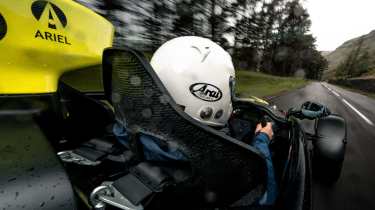
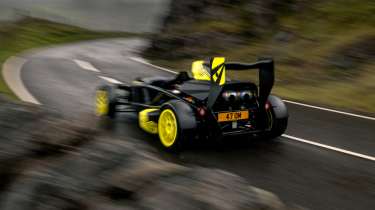
The 4RR is still a road car, though, so when the rain finally arrives we pack up and head for familiar routes in the hills above Treorchy. Even wearing the right gear, it’s not much fun wiping rain from the inside and outside of your helmet visor, yet the Atom is completely unfazed. The stupendous engine is completely without temperament, dawdling around happily at low revs and pulling cleanly with a snap open throttle; it’s just the lumpy shifts of the sequential ’box that grate a bit, though perhaps I just don’t know how to finesse them.
If there was standing water, the Yokohamas would struggle for sure, but on a simply wet road the 4RR feels planted. Intrigued, I lean increasingly hard on the grip through a long uphill corner with plenty of space and the Atom holds the line strongly. A generous squeeze of throttle doesn’t result in any slip from either end.
I’m on the 400bhp map, but still. Ten minutes later I’ve switched up to the full-on 525 map, I’ve wound the traction control almost off and I’m scaring myself with almost full-throttle acceleration between the trees. Grip is remarkable, traction simply astonishing. It feels like it’s on wets and has four-wheel drive. Apparently, the AO52s are always remarkably grippy in the wet after they’ve pounded around a circuit in the dry. Wow. I was not expecting that. What an incredible car the 4RR is.
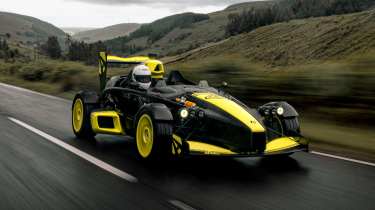
It has the pace to run with the big dogs at any trackday. ‘We went to Dunsfold and the next fastest thing was a Ferrari SF90,’ says Siebert-Saunders. ‘We’re back to playing in the big league again. Before all this hybrid stuff kicked off we were up amongst the McLarens, Ferraris and Lamborghinis. With the 4RR we’ve caught them up, with petrol power only.’
I was blown away by the 4RR on track but its ability on wet roads is mind-bending. It’s not just the pace, though, it’s the fact that it feels so controlled and exploitable and has all the chassis features of a modern supercar: anti-lock brakes, scalable traction control, paddleshifts and cockpit-adjustable electronic dampers. It even has a reversing camera!
It’s like a skeletal 911 GT3 RS, only much faster because it has more power and weighs about half as much. But it’s also more expensive. A quarter of a million pounds for an Atom is an extraordinary amount, but then the 4RR does extraordinary things. I reckon Ariel has missed a trick, though: it should be called the Atom 4SHC, for Somerset Hadron Collider, because an Atom has never gone faster.
| Engine | In-line 4-cyl, 1996cc, turbocharged |
|---|---|
| Power | 525bhp @ 8200rpm |
| Torque | 406lb ft @ 5200rpm |
| Weight | 669kg (797bhp/ton) |
| 0-62 mph | 2.4sec |
| Top speed | 175mph |
| Basic price | £249,600 |