New Audi Nuvolari review – why Lamborghini Temerario’s half brother isn’t twice the car
Audi's new Temerario-based Nuvolari does not absolve the sins of Lamborghini's new hybrid supercar, but it's not all bad news
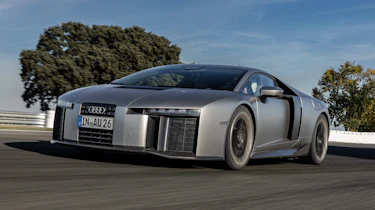
The Audi Nuvolari is poised to assume its place as the fastest and most expensive production car in Audi’s history. We’ve driven it, at full speed around the Jarama racetrack and, at a more sedate pace, on the open road.
Still in pre-production form but very close to sign-off spec, it’s the first opportunity to gauge how successful Audi has been in creating a new halo supercar flagship. And whether it has managed to extract more character and likeability from the Lamborghini Temerario upon which it is based.
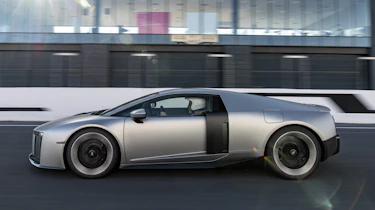
In terms of visual impact the Nuvolari is a big hit. The work of ex-JLR designer Massimo Frascella, it heralds a new direction for Audi, the aptly termed ‘Radical Next’. There are echoes of the original TT in its boldness and sense that it marks a real landmark moment for the brand, but where the small Coupe was defined by its soft, continuous Bauhaus-inspired arcs, the Nuvolari is angular and monolithic. Finished in satin silver it looks like it was milled from billet.
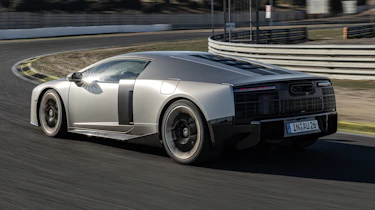
Unlike the Temerario the Nuvolari’s bodywork is made from carbon fibre, both to save weight, enable some of the surface shapes and – presumably – to help justify its half-a-million and upwards price tag. It’s unflinchingly precise, each shut line and panel gap wholly reliant on perfect alignment to sustain that machined-from-solid appearance. Critics might say it’s the Cybertruck’s hotter sister, but whatever your aesthetic preference, there’s no question the Nuvolari stands proud as a statement of functional purity and the torchbearer for a reinvigorated brand identity.

The interior is equally bold. It does a great job of disguising its shared bones with Temerario, clean lines and a smoothly integrated central screen creating a calm, precisely crafted ambience, with a simplicity verging on the austere, lifted by a palpable sense of elevated material and design quality. Think 80s Bang & Olufsen hi-fi and you’ll catch the vibe.
Arguably as controversial as the Nuvolari’s styling is its price and positioning. You’d think it would have been a no-brainer to continue the hugely successful collaboration with Lamborghini. Yet such was the radical ambition of Audi’s electrification plan that the 2nd Gen R8 went off-sale with no intention of building a combustion-engined or even a hybrid-powered successor. Instead, an all-electric supercar was planned, this time platform sharing not with Lamborghini but with Porsche.
We all know how that went, hence why the Nuvolari came as such a surprise when Audi announced it in June of this year, with a close-to-production prototype making its dynamic debut at the Monaco Grand Prix.

In hardware terms the Nuvolari is more of a cut-and-paste Temerario than the R8 was to the Gallardo or Huracán. The aluminium structure is unchanged. Likewise, the 10,000rpm 4.0-litre twin-turbocharged flat-plane combustion V8 and the tri-motor hybrid system, though the latter benefits from a significantly uprated 7.3 kWh battery, increased from the Temerario’s 3.8 kWh battery but packaged in the same space within the body structure.
While the V8’s output remains unchanged, the hybrid system contributes an additional 80bhp, lifting the Nuvolari’s combined peak power to 1001PS and 900Nm of torque, or 987bhp and 664lb ft in old money, elevating it above the already ballistic Lambo for raw power. Though principally a product of inevitable advances in battery technology since the Temerario went into production, it serves as both a performance and status booster for Audi’s flagship supercar. Not that more performance is what was needed...
The most contentious aspect of the Temerario, and consequently the most hotly debated aspect of the Nuvolari, is whether the high-revving but disappointingly low-fi V8 sounds any better in the Audi. Somewhat irritatingly on the evidence of this drive the straight answer is yes. And no.
The drive event was split between full-speed track sessions and a brief, sedate and less than revealing road drive. I drove a different car for the road and track sessions with each running a different level of silencing and sound manipulation; muted and subdued (both inside and out) in the road car, with the track car emitting more external volume and sounding significantly louder and more aggressive in the cockpit. According to Audi neither is representative of how the final production car will sound, but it’s reasonable to assume it will be somewhere in the middle.
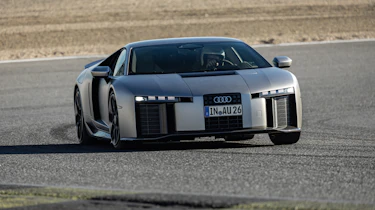
The track sessions were short but allowed for unaccompanied driving with no restrictions on speed, aside from the presence of a lead car in the form of a surprisingly rapid RS e-tron GT. Like all hybrid supercars the Nuvolari switches on like an appliance, with the combustion engine only kicking in when you select a performance mode. With no time to waste we select Track for maximum performance, with the ESC in Sport+ mode to allow a little slip under full-throttle.

Outside, the exhaust gives a subdued growl on start-up, then settles to an idle that rises in speed and volume when Track mode is selected. Inside, it’s surprisingly loud, even through a helmet - too loud, in fact. The raw, boomy tone recalls a rorty four-cylinder, which is unsurprising given the flat-plane V8’s firing order. There’s work to be done here, but like working with a ropey vocalist one suspects there’s only so much that can be done to extract a tune out of this industrial-sounding engine.
Upon leaving the pit lane first impressions are of light, free-feeling steering with a keen rate of response but typically filtered feel. The car feels flat and firm with encouraging initial front-end bite on turn-in, with a similarly promising sense of rotation making the Nuvolari feel like a grippy, energised apex hunter through Jarama’s early sequence of hairpins.
The suspension specification is a curious choice of passive multi-adjustable KW dampers. Audi has form where such hardware is concerned, especially with special run-out models such as the RS6 GT and RS3 Competition Limited. However, it’s an unexpected choice as not only does the Temerario run adaptive dampers but the Nuvolari debuts Audi’s all-new 6D fully integrated dynamics system, called Quattro Predictive Ride.
Like similar systems used by Ferrari and Aston Martin it employs a complex network of sensors that monitor pitch, roll, yaw, surge, sway and heave to read the car’s behaviour and ultimately use this to predict its next move and adjust itself accordingly.
Interestingly, while Aston Martin fitted adaptive dampers on the high-downforce Valhalla, Ferrari switched the 296 Speciale from the regular car’s adaptive units to passive Multimatic spool valve dampers to save weight and perform better on track. Like Ferrari, Audi has chosen to go with passive dampers, in this instance multi-adjustable KW units, again because Audi says they are more suited to track applications and better able to cope with vertical load variations that come with 400kg of downforce.
Though it was never explicitly mentioned by Audi representatives, the extremely short 405-day development window for the Nuvolari suggests these dampers were also chosen because they provided an expedient foundation from which to develop the new 6D system. They also make Quattro Predictive Ride seem like something of a misnomer given the one thing the 6D system has no control over is the damping.
The first flying lap reveals the Nuvolari to be bullet fast, just like the Temerario. You can really feel the added thump from the hybrid system, which thanks to that significant rise in battery capacity means you never run short of electric assistance across the lap. The combustion element is explosive, with a manic rush as its big turbos begin to blow. On and on it goes, revs rising through 6, 7, 8000rpm. By 9000 you’re wondering if you’ll ever need to change up, before finally the crazy ascent to 10k is completed and you pull for another gear.
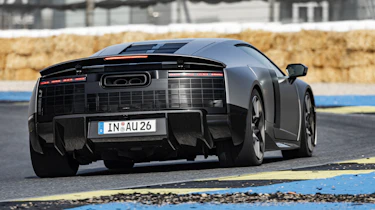
This race car-like focus on requiring peak rpm for peak performance has its moments, but even at Jarama you feel as though the endless reach of the intermediate gears is robbing you of the need to engage with the car. A few fewer rpms and the need for a few extra gear changes would make you feel like you’re doing more than simply pointing and firing the Nuvolari at the next corner.

Entering Jarama’s long downhill start-finish straight, judicious hanging back from the lead car is required to avoid having to come out of the throttle before the braking area, such is the ease with which it storms towards 190mph before eyeballing the tight second gear Turn one. Thankfully the huge 420mm front and 410mm rear CCM-R Plus brakes – which feature long-strand carbon fibre for better heat dissipation – are immensely powerful with a firm pedal and precise feel and modulation that allow you to brake deep into the apex. Few supercars stop like this.
Those tight hairpins allow for a little slip under power on the exit, but the ESC system nips this in the bud relatively soon, but with soft hands so as not to feel overly abrupt. Attack the quicker corners with more commitment and work the throttle with greater urgency and instead of raising its game the Nuvolari settles into a disappointingly steady pattern of encouraging turn-in that fades into a neutral-to-understeer balance by mid-corner and continues to corner exit.
Despite generating significant downforce and considerable tuning of the front axle torque vectoring specific to the Nuvolari, there isn’t a feeling of huge reserves of grip to lean into. So, whilst fast, the Nuvolari likes to lap in a prescriptive manner that’s stable but lacking in fun. It’s not necessarily at odds with what you expect the Nuvolari to be – the lack of obvious aerodynamic addenda and the restrained interior certainly don’t scream hardcore track-tuned set-up – but it does contradict the decision to fit motorsport-style manually adjustable passive dampers.
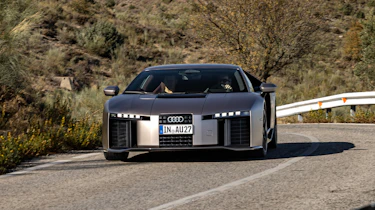
Frustratingly the road session was less than revealing. Accompanied by a stern engineer the brief drive was held on a mix of motorway and nondescript minor roads with a lead car dictating our very modest pace, it allowed for limited discovery beyond a predictable ability to set other motorists heads on swivels.
One thing which did make an impression were the brakes, which felt sharp and needed a conscious effort to apply smoothly at low speeds, especially in stop-start traffic. Transient inputs were also tricky to judge, the initially sharp tip-in response followed by a subsequent lack of feel or linear progression. It was possible to find ways of partially mitigating this, and they were extremely impressive on track, but the best brakes don’t need you to drive around their inconsistencies.
Audi contends that the Nuvolari offers a more advanced and sophisticated style of supercar performance and handling than the raw, exuberant Temerario. Yet not only does this description of a wild and flighty Lamborghini not tally with our experience of that car, but the Audi’s safe handling balance and lack of edge doesn’t square with the compromises which come with choosing passive, manually adjustable track-focussed dampers.
Such choices betray the development time crunch that came with racing to gain vital type-approval under the outgoing Euro 6 regulations. Missing that deadline wasn’t an option as stringent Euro 7 rules would have effectively scuppered the project before it turned a wheel. Would the car have featured adaptive dampers if Audi had the more usual three or more years to develop the car? We’ll never know.
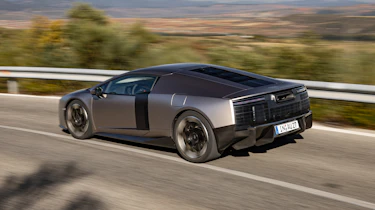
For this and other reasons the Nuvolari is a somewhat strange and enigmatic car. One with a split personality that's confused as to its ultimate objective. Immaculately styled, beautifully built and indecently fast, it is every inch the cultured, statement supercar to enjoy on weekend tours and park outside fancy hotels. But the aforementioned dampers and uncompromising S-duct aerodynamics that consume the front luggage compartment suggest a serious track focus.

To Audi’s credit they have succeeded in differentiating the Nuvolari’s dynamics from the Lamborghini with which it shares so much, but the results are different rather than emphatically better. Neither a grip monster nor a natural drifter, it doesn’t ask enough of you or give enough back, delivering its drama between the corners rather than through them. The Aston Martin Valhalla proves you can have genuine feel, colossal high-speed stability and a playful balance in the same heavily torque vectored 1000+bhp hybrid supercar. The Nuvolari could have done with some of that bandwidth and sparkle to make its mark, and set it sufficiently apart from the Temerario.
Unrestricted access and meaningful time on our favourite roads will give us the opportunity to fully interrogate the Nuvolari, something we hope to do in 2027. It deserves that chance to shine. Until then, it’s hard to shake the feeling that not only has it inherited the Temerario’s well-documented shortcomings, but such a curtailed development window left Audi with insufficient time to craft the car they would have preferred to deliver under less pressured circumstances.
Price and rivals
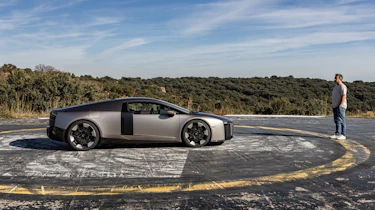
Limited to 499 units and priced at £526,990, it sits well above (if not beyond compare with) the car on which it is based and propels Audi into uncharted waters as the maker of low volume, high price collector-grade supercars. Just 25 are coming to the UK. All are left-hand drive and reportedly all are sold.
The same money would obviously get you into a well-specced Temerario, a Revuelto, a Ferrari 296 Speciale and a Ferrari 849 Testarossa, if not Aston Martin's Valhalla.