Hyundai Ioniq 6 N review – has Hyundai beaten BMW M at its own game?
The Ioniq 6 N might look odd, but it's a genuinely engaging electric car with performance to concern more expensive combustion-powered alternatives
Many had their reservations about the Hyundai Ioniq 5 N and its industry first ‘virtual gearbox’, but there’s no doubt it hit the spot. The hot crossover quickly became the go-to driver’s EV, eclipsing even Porsche’s efforts, with a multitude of manufacturers turning to the N as a benchmark for the development of much higher end offerings. Now, a decade since the N division was created, Hyundai’s launched the Ioniq 6 N as its second take on the EV performance formula, bringing it all to a lower saloon shape.
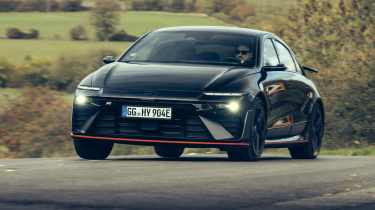
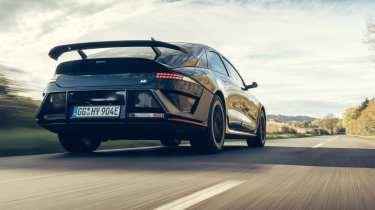
This car is lower, wider and more aggressive than the gawky banana-shaped saloon it’s based on, but it’s far from conventional. That low-drag teardrop shape gives the rear an element of Porsche 911, with the addition of a swan-necked wing sprinkling a dash of aggression to the package. Its looks won’t be for some, myself included, but there are some hints that this is a very serious performance car.
> Is Hyundai N about to create a petrol-powered Honda Civic Type R rival?
There’s a good level of negative camber on display should you catch the Ioniq 6 N from the right angle, and despite its awkward design, it holds itself in a way that only a performance car does out on the road. Open the boot (which is considerably smaller than the 5 N at just over 400 litres) and you’ll also spot an exposed strut brace, painted bright red to make itself known. It might look the part, then, but can it match its charming crossover counterpart on the road? We've already driven the 6 N on the roads in the UK, but now we have headed to Spain for more road miles and some laps of the Parcmotor Circuit to discover more.
Powertrain and technical highlights
Sharing a powertrain with the Ioniq 5 N means the 6 N generates 601bhp and 546lb ft in total (641bhp with the ten second boost active deployable via a button on the wheel) split across a motor on each axle, and with a rear bias. These are fed by an 84kWh battery mounted in the floor of the car which provides a WLTP range of just over 300 miles, something you’re very unlikely to see should drive it the way its engineers intend...
More reviews
Output might be the same between the two Ns, but the 6 is actually two tenths quicker to 62mph from a standstill than the 5 N thanks to a few new additions. New tyres and smaller wheels contribute, but tweaks to the construction of the motors themselves mean more power is available more of the time, with powertrain cooling also improved to prevent a loss in power under high load. The result is a car capable of what Hyundai calls the 20:20:20 rule, allowing for 20 minutes of charging, 20 minutes of flat-out driving, then 20 minutes of charging again, on the Nürburgring of all places. Leaning further into this, Hyundai has also completed the installation of a bank of four 400KW chargers in the Tourist car park at the ‘Ring, which are free to use for any Hyundai N driver.
The Ioniq 6 N is stiffer than the standard car thanks to additional spot welds and adhesive use in the structure, that new rear strut brace and stiffer underfloor. New adaptive ‘stroke sensing’ dampers from ZF and stiffer bushes are installed too, alongside revised geometry for a lower roll centre, but this isn’t any more focused than the Ioniq 5 N that came before it. Hyundai N boss Joon Park told evo that the Ioniq 6 N has been set up for even more accessibility in mind, giving it a softer, more approachable character than the 5 N.

Given its high tech underpinnings and clever powertrain, Hyundai gives you a multitude of ways to configure the Ioniq 6 N for the scenario you find yourself in. Power delivery, steering, suspension, e-LSD and stability control are all three-way configurable across normal, sport and sport+ settings, while you also have three choices of synthetic noises – ‘Ignition’ is closest to a conventional ICE car and sounds like anything from a G80 BMW M3 to a Porsche flat-six, depending on how hard you’re pushing. The sound is clearly still synthesised in isolation, but it’s much more convincing than in the 5 N, with the sound granular and capable of responding to minute changes in throttle position and traction loss, and ‘burbles’ actually felt through the seat.
The star of the show, and the reason the 6 N’s powertrain outshines everything else on the market, is ‘N E-shift’, giving you eight virtual ratios with ‘revs’ and a ‘power band’ just like the 5 N. This time though, Hyundai has shortened the ‘ratios’ to encourage drivers to use the gears, and it certainly does the trick. Foot flat in manual mode and you shift like you’re in a rally car, and thanks to the simulated torque curve, you’re rewarded for reaching for the redline too. Downshifting for simulated engine braking becomes second nature, and before long, you find yourself fully convinced you’re in a combustion-powered saloon.
Performance, ride and handling
The 6 N’s wheelbase is 15mm longer than its crossover counterpart. Combine that with a more compliant setup and a lower roll centre and you have yourself a car with a different character to the 5 N. There’s no doubt this still feels like an N product, but it’s more supple than its boxy alternative, with more refined damping allowing for use of almost any drive mode in almost any conditions. Speed bumps and potholes in even its most aggressive Sport+ setting rarely send shocks through the cabin, which isn’t a given for a car with this much performance.
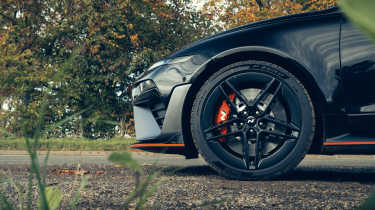
The 6 N’s Pirelli P Zero tyres are HN-branded, meaning they’ve been developed specifically for this car. Joon Park told evo this fifth-generation rubber has been developed to eradicate some of the drawbacks of the 5 N’s tyres, increasing grip while improving longevity. Given how soft these tyres feel to the touch and the torture they seem to be under on track though, we still can’t see them lasting long if you’re pushing on.
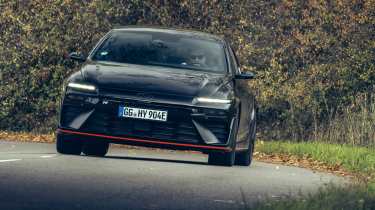
And you’re very likely to do just that, as just like the 5 N, there’s a feisty character to the 6 N, a fizz and a tautness identifiable through its controls that gets under your skin and puts your right foot on a hair trigger. It encourages you to push on just as the best performance cars do. Our experience on track did reveal a tendency to understeer at higher speeds, but at road pace there’s satisfying balance that allows for predictable, intuitive oversteer in even its standard modes that EVs rarely allow for – engage drift mode and that unlocks a new realm of oversteer, with initiation, wheelspin and angle all adjustable via three independent sliders. You’ll have to be brave to enable it on the road, but unlike some cars, the 6 N will happily allow you to bonfire the rears without any interference.
The performance is as ballistic as the numbers suggest (3.2sec to 62mph with the full 641bhp in N Launch mode), even filtered through the synthetic ‘power band’ and the close ‘gears’ – 62mph from rest requires you to reach third, no less. As the pace builds you can feel the 6 N get up on its toes and its mass starts to activate underneath you. And there’s a lot of it, 2201kg to be precise, but that is 50kg less than the 5 N.
You do learn the 6 N, learn to trust it. Once you do, you can back the car with neutrality, the car’s mass stroking back and forth on those new dampers with a sense of the available grip coming through your backside and via your internal gyroscope. There are moments when you really do actively enjoy feeling the car’s prodigious vertical control. There’s very little in the way of steering feel through the thin-rimmed wheel, but the response and weight of the rack is nicely judged. Positive response on initial turn-in gives you confidence in the front end and even on tight, twisty Spanish mountain roads, requests for sudden direction changes don’t induce the uncomfortable oscillations that similarly heavy rivals suffer with.
The four-piston (400mm front) brakes are by wire with the car’s brain consistently blending the efforts of the regenerative element and conventional friction elements, to positive effect. You lean on the brakes without paying any mind to their slightly complicated constitution, and they do the job well. Response is good from the top of the pedal, inspiring more confidence than in the 5 N.
Our previous drive in the 6 N in the UK did reveal that patchy wet-and-dry surfaces can make the 6 N quite inconsistent, gripping like a mollusc on dry stretches but slipping early on damp patches, the weight and momentum quickly snatching control. The vertical control is great but horizontally, especially in switchbacks, the sense of mass suddenly becomes very high-definition, as it would to be fair in any heavy car, whether electric, petrol or hybrid.
Indeed this and the Ioniq 6 N’s other flaws will come familiar to those who’ve spent time in its Ioniq 5 N sibling. Electric power simply isn’t as convenient as petrol if you’re looking at spending a few days dissecting the countryside, even with 350kW charging capability, good for 10 to 80 per cent battery charge in as little as 18 minutes. We saw an indicated 200 miles before we set off, with the number of miles lost ratcheting up much higher than the actual distance we’d traveled for most of our test; it’s claimed the Ioniq 6 N will deliver around 120 miles when driven flat-out on track. It’s also not ideal if you’re hoping for your performance car to retain some of its value, with some 5 N’s dropping a third of the value after just a year of average use.
Nonetheless, buried within and in spite of its weight and the impact on range its performance has should you choose to enjoy it, is a surprisingly engaging, enormously capable performance electric car that we’d challenge anyone to not enjoy time behind the wheel of. The BMW i4 M60, this car’s closest rival on-paper, doesn’t come close to the Ioniq 6 N in terms of driver engagement – it feels like it’s a generation behind in many ways, and so do many other cars in this segment.

Interior and tech
The cabin is familiar if you’ve spent any time in a recent Hyundai, with more space than you might expect (even in the back), and plenty of attention paid to useful storage compartments and real, physical buttons – rear headroom is limited, but unless you’re particularly tall you shouldn’t have much of an issue. You sit a bit higher than is ideal and it’s more noticeable in the saloon 6 N than in the 5 N, but its bucket seats provide a good amount of support for the huge lateral G this car can generate.
The cabin is a pleasant place to be overall, with tactile controls and the central infotainment sharp and snappy – the menu systems can be a little overwhelming given the sheer number of menus, but more time with the car would make this less of a problem. If you’re coming from a German equivalent like the BMW i4 you will notice the absence of materials associated with luxury-oriented products, but plenty of Alcantara gives it the sporty edge it deserves. You even get a standard-fit, hard-mounted panel in the roof liner for mounting an action camera…

Price and rivals
The Hyundai Ioniq 6 N is on sale now in the UK, with prices starting from £65,800, less than £1000 more than the 5 N crossover. The aforementioned BMW i4 M60 provides marginally less on-paper performance and significantly less real-world engagement for a higher £71,525 price tag, making the 6 N look excellent value. Look towards the combustion-powered M3 and you'll have to pay a £25,000 premium, with prices starting from £91,315 (although the five-figure discounts BMW dealers are often offering make the M3's price more palatable).
In reality, there are very few real rivals to the Hyundai Ioniq 6 N as it stands. No other manufacturer has come close to creating an electric car with this much driver appeal and while some are beginning to adopt some of the tech that makes it special, they’ll come at a much higher price point. Electric N buyers are a mixed bunch according to Hyundai – people from all sorts of backgrounds, with all sorts of performance car proclivities – but it is happy with the uptake so far. How the Ioniq 6 N will contribute to that, remains to be seen.
Hyundai Ioniq 6 N specs
| Powertrain | Dual-motor, all-wheel drive |
| Power | 641bhp |
| Torque | 568lb ft |
| 0-62mph | 3.2sec |
| Top speed | 160mph |
| Battery size | 84kWh |
| Range | 302 miles (WLTP) |
| Weight | 2201kg |
| Power-to-weight | 291bhp/ton |
| Price | £65,800 |