Renault Twingo E-Tech review – the EV to save the city car
Renault’s on a mission to save the city car and its electric Twingo might just manage it
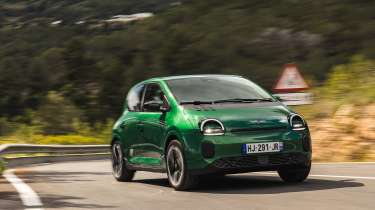
A battery-powered city car might not be the most obvious of evo cars but the Renault Twingo has become an unlikely cult hero car for enthusiasts. A lightweight, inventive, fit-for-purpose design, it’s a car to celebrate.
Particularly the original. The left-hand-drive Mk1 was never sold in the UK but many have been imported and DVLA records show 240 are in regular use on British roads.
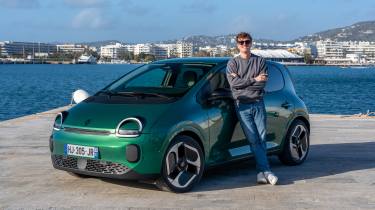
The new Twingo E-Tech Electric overtly references the original Mk1, not only in its endearing design cues, ‘monospace’ proportions and bright colours but also its modular interior layout.
Its two rear seats individually slide forwards and backwards by up to 17cm, so you can prioritise boot space or passenger knee room. Their backrests fold flat, as can that of the front passenger seat, enabling 2m long objects to be carried. A 50-litre well in the basement of the boot is a handy space to stash the charging cable, or valuables. The (slightly flimsy) boot floor above is split in two halves, making it easier to access the space beneath around other objects in the boot. And this time around the Twingo has five doors, rather than three. Renault describes it as an A-segment car with B-segment space. Despite being 3.79m long, it’s roomier inside than many larger hatchbacks.
Battery, range and platform
The Twingo E-Tech is based on the same RGEV platform (previously called the AmpR Small platform) as the Renault 4 and Renault 5. The latter in particular has been a success story, selling roughly 12,000 cars in the UK in approximately its first 12 months on sale, with the vast majority of buyers being new customers for Renault.
More reviews
Reviews
- Renault Sport Twingo 133 (2008 - 2013) review: big fun, small price
- New Renault Twingo GT review - has Renault Sport built a city car for drivers?
- Renault Twingo Dynamique TCe review and pictures
- Renault Twizy electric car review
- Renault Twizy electric car review
- Renault Twingo Bizu new car review
- Renaultsport Twingo Gordini 133 review
- Renault Twingo Gordini review
In the Twingo, a 65kg, 60kW motor powers the front wheels and a 27.5kWh usable-capacity battery pack is packaged mid-floorpan. Renault claims its Lithium Iron Phosphate (LFP) make-up uses materials in more abundant supply than other common automotive battery types, making it kinder to the planet and less costly to produce.
Official WLTP range is 163 miles. French-spec Twingos have a 6.6kW AC charging system, working on the proviso most owners will charge while parked at work or overnight at home and therefore don’t need excessive charging power. An 11kW AC and 50kW DC ‘advanced charge pack’ is an option and this will be fitted as standard to all UK cars, enabling a 10 to 80 per cent charge in 30 minutes at a DC fast charger (or 10 to 100 per cent in 2 hours 35 minutes at an AC wallbox).
It includes Vehicle to Load (V2L) and Vehicle to Grid (V2G) capability, so it’s possible to power other devices from the Twingo or feed energy back into the grid while the car’s plugged in.
Kerb weight in the lightest European spec is 1200kg, slight for an EV, with 212kg accounted for by the battery pack. Tested here is the top Techno spec, with 18-inch wheels, heated seats, multi-level regenerative braking, parking camera and other upgrades, meaning a few extra kilos. Entry-level Twingos in France have 16-inch wheels; at the time of writing, it’s not confirmed if UK cars will have a choice or be 18s only.
Interior: inside the Twingo E-Tech
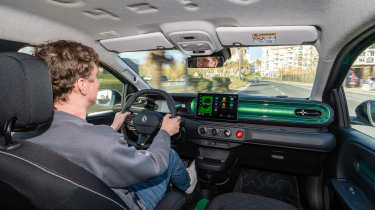
The interior is built down to a price but intelligently so – it feels cheap but not in a bad way. There are hard plastics throughout but a variety of textures and shapes ensures it doesn’t feel basic.
A large, Google-powered touchscreen takes care of infotainment but thankfully there are physical HVAC controls.
The sliding mechanism controls for the rear seats are easily accessible whether sat in the seat or from the boot. As well as folding the rear backrests flat to carry items, they can also put them in three different positions for passengers.
There are plenty of interior storage solutions, such as a storage box between the seats with a lid, or an armrest shaped like a cushion which doubles as a storage box. It’s also possible to spec versions of the clever ‘Youclip’ anchor mounts seen on Dacia models, with different attachments to hang handbags, attach charging cables and so forth.
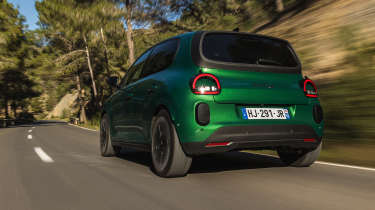
You sit behind a dramatically shallow-sloped windscreen, almost like that of a supercar, but with much better visibility. Its gentle slope is helpful for drag, as is the plastic shroud over the rear windscreen and mini shark fins over the rear lights, which work together to reduce turbulence around the Twingo’s tail.
Driving the electric Renault Twingo
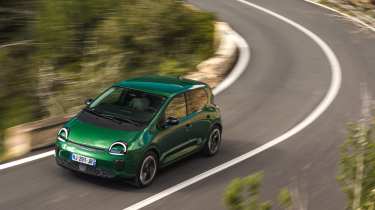
The big wheels pushed out to each corner with barely-there overhangs give the Twingo a perfect city car stance. Its international media launch is on the island of Ibiza, with a mix of urban streets, winding country roads and (some) A-roads. Tarmac is smooth for the most part, with the occasional gnarled, tree-root-ridden surface giving a good idea as to how the Twingo will feel on the UK’s rougher roads.
It’s very encouraging: ride quality is largely very smooth even on the larger wheels and you can feel the Twingo’s low centre of gravity and centralised mass in the way it changes direction with composure.
The wheelbase is less than 2.5m, shorter than that of the Renault 5 and it responds keenly without feeling twitchy. To keep the price affordable, whereas the R5 has multi-link rear suspension, the Twingo uses a torsion-beam set-up adapted from the Renault Captur. It can skip a little over mid-corner bumps but it’s largely very composed. Like all small cars, the Twingo sometimes climbs bumps rather than absorbing them but its overall pliancy is very good indeed, particularly at speed.
In urban streets, the Twingo is right at home. Despite being shorter than the Renault 5, it’s the same width but that’s narrow enough to squeeze into most spaces. Parking is very easy, helped by the tight turning circle (9.8m compared with 10.3m for the R5) and excellent all-round visibility, even over-shoulder past the C-pillar.
This car is fitted with the One Pedal regenerative braking function, which is likely to be standard equipment on the higher of the Twingo’s two trim levels in the UK at launch. You can adjust the level of regenerative braking using gearchange-style paddles on the back of the steering wheel. There are four levels, from the standard setting which decelerates very gently, a little like gentle engine braking in a high gear, to the most aggressive function which slows the car markedly and illuminates the brake lights. This setting is most useful in town and in traffic jams; it can spoil the flow a little on open roads.
Regardless of the regen setting, the brakes can be a little bit tricky to trail and modulate. Initial bite at top of the pedal is a slightly vague and so the first touch on the brakes, or the last bit of travel while blending off the pedal into a corner, can be slightly abrupt. This is nit-picking, however; the brakes’ performance and feedback is fine overall.

Steering is light, as you’d expect of a city car, and although it’s not full of feel its rate of response matches the Twingo’s movements nicely, and it loads up progressively in long corners. This is a genuinely enjoyable car in which to flow along a B-road.
What it is not is fast. Although the Twingo’s been tuned to sprint well from rest into traffic gaps in urban cut-and-thrust scenarios, there’s a cushioned edge to its torque delivery at higher speeds. Rather than some EVs’ instant-hit acceleration, it’s a gentler sensation, even if you push the accelerator beyond its kickdown-style stop for full power. After all, it’s a 1200kg+ car with no more than 81bhp and 129lb ft to call on.
The official 0-62mph time is 12.1sec and top speed is 81mph. That’s fine: this is a city car first and foremost. It’s also a comfortable and refined car for longer journeys, however. There’s a bit of wind noise above 60mph but overall refinement is very good.
Renault quotes efficiency of 12.2kWh/100 km based on the WLTP standard, and we saw an average of 12.9 on the trip computer during our test. Like many smaller-battery EVs, estimated range ticks down noticeably at speed and if we were somewhere bigger and colder than Ibiza, with a long journey ahead, my range anxiety nerves would be jangling a little. But as a commuter car for a driver with a predictable diary, that is capable of occasional longer journeys and with the ability to easily carry people and objects, it’s very much fit for purpose and there’s a virtuous circle of benefits to its lighter, ‘right-sized’ battery pack.
It would make an excellent second or third car in a theoretical evo garage, in fact.
Will there be a Renault Sport version?
Short answer, no: there is no Renault Sport nowadays, the department having merged with Alpine in 2021, and there’ll be no Alpine version of the Twingo. It’s on record that the only Alpine sharing a platform with a Renault model will remain the R5-based A290, and Alpine’s sights are set further upmarket. The longer answer, however, is maybe, just maybe: speaking at the launch in spring 2026, Renault’s product global leader for EVs Vittorio d’Arienzo says that shortly ‘there will be a discussion on how we manage the sport versions of Renault models – nothing is confirmed. But the potential is there’.
Verdict
The Renault Twingo E-Tech is an impressively well resolved machine and a standout example of industrial design. It’s built down to a price but doesn’t feel cheap, it’s full of clever design details and it makes a virtue of its electric architecture.
There has never been a dull Renault Twingo – but some have been better than others. The 2007 Mk2 was a little too grown-up for its own good, and 2014’s rear-engined Mk3 was brave but actually less practical and less dynamic to drive than more conventional city cars. But the Twingo E-Tech is a characterful, practical and affordable EV that makes the most of its platform. It’s a worthy successor to the original.
Price and rivals
From the outset, the Twingo E-Tech has been designed to have a starting price below €20,000, something Renault’s achieved by a variety of thoughtful design and logistics solutions, such as sourcing three quarters of suppliers from within a close radius of its Slovenia factory.
In the UK, there will be two trim levels initially. Renault says its target is to price the lower grade below £20,000 when British sales officially open later in 2026, excluding any government subsidies. (Although other markets will get the car sooner, UK deliveries won’t begin until early 2027.)
Natural competitors include the Fiat 500e, Hyundai Inster, Citroen eC3 and BYD Dolphin Surf. The Twingo is less powerful but features more luggage space than all of them. Its battery is a little larger in capacity than the Fiat’s but smaller than the others, however only the Hyundai has a greater on-paper range. The Renault is more expensive than the BYD but broadly competitive with the others.
Petrol-powered alternatives include the likes of the Kia Picanto, Hyundai i10 and Toyota Aygo X.
In some ways the longer-range Renault 5 is the Twingo’s rival from within. Or perhaps that should be the other way round: the slower but roomier Twingo makes a very strong case for itself.