Renault Clio RS (Mk4, 2013-2019) review – the downfall of Renault Sport?
For its fourth generation the Renault Sport Clio featured some controversial changes and made some crucial errors. It wasn’t all bad, though
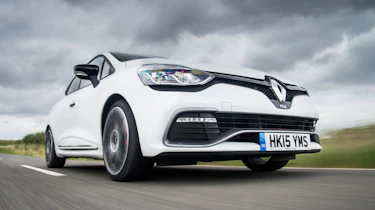
Renault Sport’s 2010s revolution for the Clio involved a number of significant changes for the model. It ditched the manual and went paddle-only, ditched natural aspiration for turbocharging and for the first time, didn’t just add a five-door option, but went five-door only.
Revealed in 2013, what was known at the time as the Clio 200 EDC was the opening gambit. The limited Clio 220 Trophy of 2015 arrived to redress some of our grievances before 220-spec became standard for the facelifted Renault Sport Clio in 2016.
Renault Sport Clio RS 200 and 220 in detail
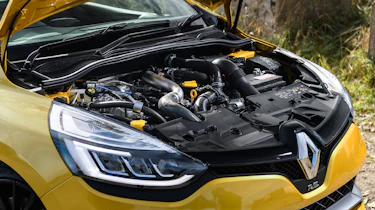
With 197bhp and 177lb ft of torque, the figures of the 200’s 1.6-litre turbo engine were not night and day different to the previous 2-litre naturally aspirated unit. But with both available much lower down in the rev range, both performance and economy were improved – 0-62mph dropped a few tenths to 6.7sec while the mpg figure jumped up a massive 30 per cent, from 34.5 to 44.8mpg.
The gearbox also contributes here; a six-speed twin-clutch 'EDC' transmission with steering column-mounted paddles allowing manual shifting. New for the Clio 4 RS was the ‘RS Drive’ button, which offered a choice of three distinct modes (Normal, Sport and Race) to tailor the car’s behaviour to the road you’re on and the mood you’re in.
More reviews
Renaultsport’s electronic ‘RS Diff’ worked to counter both understeer and wheelspin by micro-braking whichever front wheel threatened to lose grip while RS Drive offered three different driving modes (Normal, Sport and Race), each one tinkering with throttle response, gearshift speeds, steering weight and the strength of stability control. In Race, the latter is completely off. Hydraulic bump-stop technology was also added in the suspension – which can trace its roots to the Paris-Dakar rally – designed to smooth off ride quality with no impact on control.
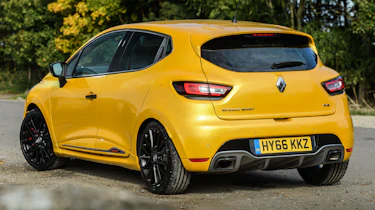
There was a standard or Cup chassis, the latter lowering and stiffens the suspension 3mm and 15 per cent respectively while introducing a quicker steering rack and 18in gloss black alloy wheels.
The 220 Trophy featured a bump in power, to 217bhp at 6050rpm and got the option of an Akrapovic exhaust. The revised gearbox featured shorter-throw paddles, 50 per cent faster shifts and earlier downchanges under braking hanks to a total software recalibration. The 0-62mph time dropped by 0.1sec to 6.6sec, which in spite of its supposedly high-tech drivetrain, was slower than its contemporary rivals, the Mk7 Ford Fiesta ST and Peugeot 208 GTi by Peugeot Sport.
In terms of handling and chassis, the 220 Trophy featured a 10% quicker steering rack, stiffer springs (by 40 per cent at the rear) and a lower ride height, 20mm at the front and 10mm at the rear. The Trophy’s dampers are also firmer.
What’s the Renault Clio RS 200 like to drive?
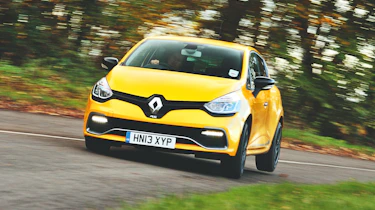
- Turbocharged engine much more potent in the mid-range than old NA cars
- Gearbox lacklustre and not responsive enough, however
- General competency and good balance remain, but it lost the lovable RS Clio edge
‘Developing 197bhp (200PS, hence the name) and 177lb ft of torque, the new car’s headline figures aren’t that different to the old model’s. That is until you compare where the power and torque arrive, at which point the new car’s increased tractability becomes blindingly obvious. In the 2-litre car you needed 7100rpm to find all 197bhp, whereas its successor delivers the same power 1100rpm earlier.
‘However, it’s the relative torque delivery that’s the killer: the old nat-asp motor needed 5400rpm to find 159lb ft, whereas the 1.6-litre forced-induction engine hits 177lb ft from 1750rpm, and stays there for another 3750rpm, only tailing off for the last 1000rpm run to the 6500rpm red line.’
‘This more generous spread of torque is immediately apparent. As you’d expect, the paddle-shift EDC (‘Efficient Dual Clutch’) transmission is simple to use: slot into ‘D’, squeeze the throttle and you’re away. There are progressively sharper modes to choose from (more of which later), but for now I’m keen to see how convincing the 200 Turbo is when it’s been asked nothing more than to shuffle gears for itself and cope with some low-speed lumps and bumps.
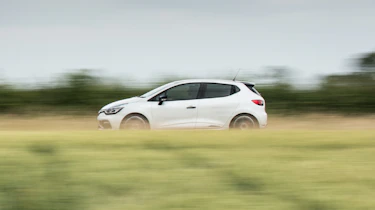
‘The answer is very, for not only is the gearbox smooth and the engine tractable, but the non-Cup suspension has decent pliancy that rounds off the sharpest edges of a poor road surface. It makes for a refined and grown-up experience, one that genuinely lifts this RS above previous generations in terms of day-to-day comfort.
‘Out in the sticks, with faster, more open roads spiced with knotted combinations of corners to challenge the Clio’s core ability, the essential differences between the previous model and the new car become clear. The engine response, gearshift speed, traction and stability control thresholds and steering assistance are all massaged accordingly via the ‘RS Drive’ button. Not that long ago, this was the preserve of high-end cars such as the Ferrari F430, so to have it filter down to a £19k hot hatch is an impressive demonstration of how such technology is changing the driving experience for everyone.
‘How you feel about it depends largely on whether you’re an old-school purist, techno-geek or a sucker for marketing. In truth I guess most of us are a little bit of all three, although I personally tend to prefer cars that try to do one thing very well, rather than promise to be several cars in one thanks to the voodoo of systems such as RS Drive. That said, the increased urgency you feel when switching from Normal to Sport is most welcome. The engine gains some edge, the gearshifts some snap and the steering some additional weight.
‘In terms of outright feedback and connection the Clio’s steering feels filtered, but the rate of response is natural and progressive, so you never feel as though you need to calm your inputs down. On tricky wet/dry roads you get plenty of information from the front tyres (here mounted on optional 18in rims) about available grip, so you can turn in with confidence and commitment, which is a sure sign the chassis is a good ’un.
‘There’s also a feeling of greater depth and control to the damping on poor surfaces, thanks to the incorporation of a secondary damper within the main damper unit. Called Hydraulic Compression Control, the system complements the solid polyurethane bump-stops to contain rebound and bring tighter, more linear control of wheel movements later in the stroke of the main damper. It’s a neat and effective solution.
‘That extra low-down and mid-range torque really helps pull you out of the corners, and the EDC gearbox maintains your forward momentum in a way you’d struggle to match with a manual. It also allows you to focus solely on picking the sweetest line through the corners, the effortless up- and downshifts enabling you to readily find your groove. There’s strong traction too, courtesy of Renaultsport’s electronic ‘RS Diff’, which monitors the difference in rotational speed of the front wheels and compares it to that of the undriven rears.
‘It works very well, to the point where you simply think you’re driving brilliantly, which is how all these systems should be. Of course there are occasions where you do get caught out and have to rely on the more aggressive intervention of ESC, but those moments are few and far between. Consequently the 200 Turbo is an extremely rapid and impressively capable car in point-to-point terms. It’s certainly a more flattering car to drive hard than its predecesor, and its performance is much easier to extract for sustained periods of time. Given Renaultsport’s objectives, you’d have to say it’s hit the spot, but it’s still impossible not to yearn for the previous model’s urgency and love of revs. It seems you always want a little of what you can’t have.
Clio 200 Cup track test
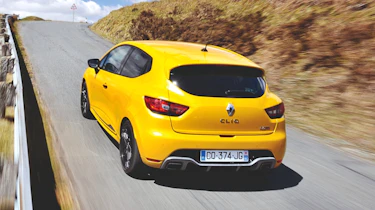
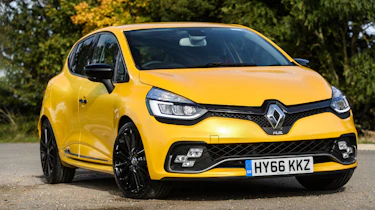
‘It’s frustrating that we don’t have the opportunity to drive the Cup car on the road, but it’s hard to complain too much when you have a Liquid Yellow Clio and the tricky twists and turns of Guadix at your disposal.
‘It’s hard to spot the 3mm reduction in ride height, but the 15 per cent increase in stiffness and quicker steering rack are easier to detect. It makes for a more energised feeling of alertness in the car, which is welcome, and you get a greater sense of bite from the front end.
‘With RS Drive switched to Race there’s no ESC safety net, which almost proves my undoing into Guadix’s deceptive downhill right-hander at Turn 2. Cold tyres, the wrong line and a closed throttle make for a rather extreme (nearly backwards!) corner entry and a heart racing off the limiter, but with the throttle pinned the front tyres somehow drag us straight and the gravel is avoided.
‘Such exuberant handling comes as a bit of a surprise, as on the road the Sport felt poised and light on its feet, but also neutral rather than being prone to big slides from the front or rear. With space to play with and a damp, slippery surface, the Cup is hilariously, brilliantly lively.
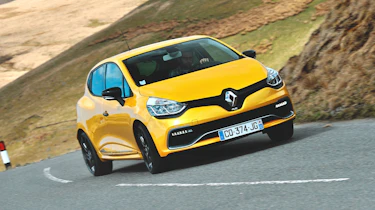
‘The brakes prove very strong as they did on the road, with progressive feel, terrific stopping power and impressive resistance to fade. Rather as expected, the engine is less compelling thanks to a modest 6500rpm red line (complete with infuriating warning buzzer) and a delivery that’s dominated by that big, fat plateau of torque. It thumps you out of the corners well, and it’s easy to see why this car would post a quicker lap time, but it doesn’t get your adrenalin flowing like the old rev-munching 2-litre. Likewise the gearbox is effective and quick (with sub-150ms shifts in Race), but it isn’t as satisfying as a snappy manual gearbox.
‘I’ll admit that prior to a night’s sleep and a track session that allowed my thoughts to percolate, I was pretty lukewarm about the car. Now, with more miles driven and more questions answered I’ve warmed to it a lot more. It’s definitely a Renaultsport car in spirit and chassis set-up, but with an added layer of sophistication to the ride that doesn’t seem to harm the dynamics.
‘But there is something missing: that final ten per cent of sensory connection and immersion you get from operating a machine that relies on the sweet co-ordination of hands, eyes and feet to make it sing. It’s an all-too familiar cry, and one that I’m getting increasingly self-conscious about making, but if you – as I – regard driving as a skill, then it’s not unreasonable to believe that cars that erode the need for such hard-won knowledge and ability feel somewhat two-dimensional as a result.’
What’s the Clio 220 Trophy like to drive?
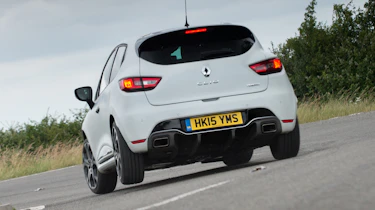
- Sharper responses from the gearbox and steering
- More power and a stiffer chassis
- Not much more in the way of entertainment or tactility
‘There’s some of the thrill you’d expect from such a heavily turbocharged engine, yet there’s plenty of the downsides. Throttle response is poor except when the revs are close to the red line, and below 5500rpm it feels remote and reluctant to perform.
‘The noise the engine emits through the optional Akrapovic exhaust is far fruitier than the previous model. The blast-furnace like rush from the exhaust has been replaced by more guttural rasp and sharp cracks at every gear change. The excitement doesn’t grow significantly as the revs rise and it's difficult to sense when you’re reaching the upper limit of the engine.
‘The gearbox in the Trophy is the same as in the 200, albeit recalibrated for faster shifts. As with the engine though, the gearbox lacks any sort of urgency. Although the shifts are quicker, they aren’t anywhere near as defined or as crisp as the best, or sportiest, double clutch ‘boxes. It also simply isn’t as engaging as a manual ‘box, so although much improved, the gearbox was still an obstacle that stopped the Trophy being a really satisfying car to drive.
‘The gear ratios of standard 200 almost as frustrating as the shift time. They aren’t any different in the Trophy, but with more power, and more grip, cornering speed has increased and 3rd often feels much more appropriate. The ratios still don’t suit the Trophy perfectly, 2nd is still too low, but it’s far less frustrating than in the standard 200.
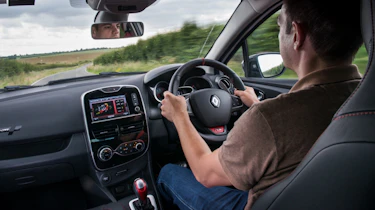
‘The Trophy certainly feels stiff initially, but over 50mph a real quality to the ride starts to shine through. It doesn’t glide over bumps, but it also doesn’t crash into them. It’s just firm enough to help communicate what the chassis is dealing with without being uncomfortable. There’s also a huge amount of body control; not once does the body fall out of sync with the road.
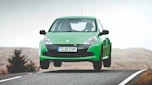
‘As you’d expect with such a stiff chassis there’s also very little roll. Combined with the quicker rack, this makes turn-in feel very direct. There are also vast reserves of grip at the front axle so you can carry a lot of speed into a corner.
‘The Trophy didn’t get a proper mechanical limited slip differential. Instead the front brakes interfere with the front wheels to increase traction. For the most part on the road, you aren't missing out. On track the lack of a proper diff is more noticeable. At turn-in, the effect of sudo-LSD is very helpful and the Trophy really darts into a corner. Once on the power though it can’t stop the inside front wheel from spinning.
‘The Trophy isn’t as lively as the previous generation, naturally aspirated Clio 200 Cup. It’s not as expressive and doesn’t want to rotate quite so easily. The Trophy’s wheelbase feels longer, like it simply doesn’t have the physical layout to ever be as fun as the old car. But the Trophy still possesses some of the qualities that have made Renault Sport cars so loveable.
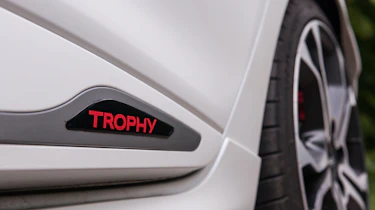
‘The chassis displays all the traits you’d expect from a well-sorted front-wheel drive hot hatch and trail-braking or a lift of the throttle helps bring the rear into play. The Trophy’s rear might not be as mobile as the old car, or need the same deliberate corrective inputs, but the Trophy’s chassis is effective, intuitive and, if you get the opportunity to witness its talents, it is satisfying to drive.
‘The quicker steering that has been fitted to the Trophy has not helped generate any more feedback. The rack is fairly lifeless and never communicates any meaningful information from the front tyres. The lack of feel isn’t a huge problem when trying to gauge grip levels because the chassis is so transparent. However, the lack of feedback just adds another layer you need to penetrate before you can start to enjoy the Trophy.
‘The chassis is undoubtedly talented, but the uninspiring engine, lifeless steering and less than engaging gearbox mean it’s difficult to tap into what’s great about the Trophy. The small glimmers of genius that it does show are often only fleeting and don’t last long enough to be really enjoyed.’ – Will Beaumont
Interior and tech
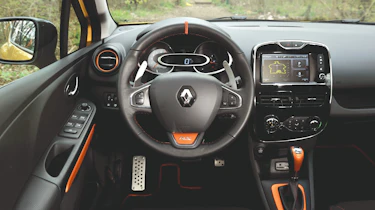
- Shift paddles are metal and column mounted and have a nice movement at least
- RS Monitor telemetry is high-tech compared to older Clios
- Mk4 cabin looks a bit more plush but quality still isn’t the best
It instantly feels like a bigger car than the Clio 3, but the technology level on the inside is almost beyond recognition compared to the relatively sparse 200 of old. Dominating the dash is a large touchscreen that comes to life with an impressive flourish. The satnav is excellent, my phone hooked up seamlessly and it all has the air of a car that would put the tech of quite a few large luxury saloons to shame.
But, this being a Renaultsport, there’s more. Delve into the RS Monitor section and you’ll find more graphs, charts and data than a Maths A-level lesson. It’s like a beautiful, graphically wrought version 2.0 of a Nissan GT-R’s system.
And like that Nissan system, it’s all utterly superfluous when you’re driving quickly and making the graphs do interesting things, because you don’t have time to even glance at it.
The shift paddles are made from metal with a lovely weight to the movement and they’re a pleasure to operate. Rather than mounted on the back of the wheel, they are actually on the column so don’t move when you turn the wheel. This, in itself, isn’t a problem and, even if you’re used to wheel mounted paddles, it’s easy to get used to. But, the paddles don’t extend down enough meaning your fingers find nothing to execute an up-shift when turning right, or to change down when turning left. This seems like an odd oversight to make, as both the paddles extend upwards and around the wheel, just not downwards.
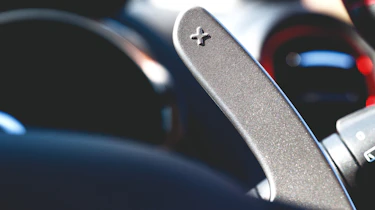
The lack of usable paddle means that you have to reach for the gear knob. None of the time and effort that went into creating satisfying feeling of the paddles went into creating a similar sensation for this bargain basement, plastic lever. In fact, we'd be surprised if any time went into the way it feels at all. Its position is too low and too far back, the materials feel incredibly cheap and the action is both too light and too springy. Thankfully though, you pull back on the stick to change up and push forward to change down. Give us a nasty lump of plastic where the change is correct over a tactile one where you push forward to change up every single day of the week…
The interior looks fancier than sporty Clios of old but fit and the feeling of quality aren’t the best. The Clio RS got a set of leather, heated seats. They’re not the prettiest items and the side bolstering is so significant it makes getting in and out of them slightly tricky.
What they lack in aesthetics or ease of ingress and egress, they make up for in support. You sit deep into them, with the seat hugging you from the waist right up, almost to your armpits. As a passenger they feel quite awkward, your arms get pushed forwards as they rest on the side bolsters. With your arms out in front of you when driving though, the support is incredible.
It’s not easy to find the perfect driving position in the Trophy. The seats, although supportive, are set a little too high and the wheel doesn’t allow much adjustment in regards to reach either.
Running costs, buying checkpoints and values
The official MPG figure for all Mk4 Clio RSs is 47.9. As you would expect from a turbocharged engine, driven hard and that figure plummets. evo's old long term Clio 200 would average 31-32mpg.
One way the Mk4 Clio RS seems to be better than its predecessors is in terms of maintenance and reliability. It doesn’t have the £1000 timing belt and water pump replacements that come every five years or 70,000 miles in the 2-litre cars. The more complex dual-clutch gearbox doesn’t seem to be the achilles heel of the car you might expect it to be in terms of reliability. Nor the 1.6-litre Nissan-based engine. Just be sure you go for a car that’s been serviced when it should by reputable specialists or main dealers, has had all the expected software updates and has good lift in its tyres and brakes. A solid MOT history goes without saying.
The earliest Mk4 Clio RSs are coming up for 15 years old and a few have done some serious miles. If you’re feeling brave, cars with well over 140,000 miles can be had for as little as £3000. A slightly later Cup with half those miles will cost you in the region of £7000, while the very nicest, newest facelift Trophy models are priced closer to £10,000.
Specs
| Clio RS 200 | Clio RS 220 | |
|---|---|---|
| Engine | In-line 4-cyl, 1618cc, turbo | In-line 4-cyl, 1618cc, turbo |
| Power | 197bhp @ 6000rpm | 217bhp @ 6050rpm |
| Torque | 177lb ft @ 1750-5500rpm | 206lb ft @ 2000rpm |
| Weight | 1204kg (166bhp/ton) | 1204kg (183bhp/ton) |
| 0-62mph | 6.7sec | 6.6sec |
| Top speed | 143mph | 146mph |
| Price new | £18,995 (2013) | £21,780 (2015) |
| Value now | From £3000 | From £8000 |