Porsche Taycan Turbo GT Manthey review – by far the most capable Taycan, but at what cost?
A 2.2-ton EV shouldn’t really be anywhere near a circuit, but that hasn’t stopped Manthey Racing turning the Taycan into a sub-7-minute Nürburgring weapon

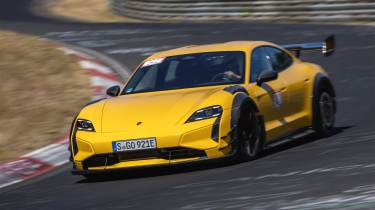
It’s hard not to look at the Porsche Taycan Turbo GT Manthey through a cynical lens. The Turbo GT already has narrow appeal – it’s a mighty technical achievement, but it’s hard to see why anyone would stump up £190k to buy one when the GTS and Turbo are already indecently rapid, and all the Taycan you could ever need. The Turbo GT Weissach Package is even harder to get your head around, ditching back seats in the pursuit of track performance, in a 2.2-ton electric saloon…
The Manthey kit takes this several steps further, with the Porsche-owned racing outfit comprehensively upgrading the Taycan’s chassis and aero to achieve the ultimate lap time, for – wait for it – €108,900 (circa £93k) on top of the price of a Turbo GT Weissach. Does anyone buy a Taycan to use on track? And if they do, would they pay the price of an Alpine A110 R to make it faster? The customer base must be vanishingly small – hence why the kit is only being offered for left-hand-drive Taycans.
Read between the lines and there’s another reason for the Turbo GT Manthey’s existence. Last year the ‘base’ Turbo GT Weissach had its four-door EV Nürburgring production-car record broken by the Xiaomi SU7 Ultra. Being beaten by a smartphone manufacturer probably didn’t go down well in Stuttgart (even if the Xiaomi needed around 500bhp more to do so), so consider the Manthey kit a response.
More reviews
In-depth reviews
Reviews
- Porsche Taycan Cross Turismo review – as appealing as jacked-up estates get
- Porsche Taycan E-Shift review – Hyundai-style fake gears here to up engagement in Porsche's electric saloon
- Porsche Taycan GTS Sport Turismo review – why this is the only everyday electric performance car you need
- Porsche Taycan RWD 2025 review – a good car at a good price, but mind that depreciation
- Porsche Taycan Turbo GT Weissach Package review: two seats, 1020bhp and £186,300
And respond it has, claiming the record with a 6:55.533 lap and beating the SU7 by over nine seconds. That’s also 12 seconds quicker than the Turbo GT Weissach on which it’s based. Where does that performance come from? Not just through raw power, although there have been small gains in the dual-motor powertrain. Power has gone up from 778bhp to 805bhp, with the Turbo GT’s Attack Mode function now dialling up 979bhp – 40bhp more than before. The maximum system output on overboost remains 1020bhp, but torque goes up from 915lb ft to 937.
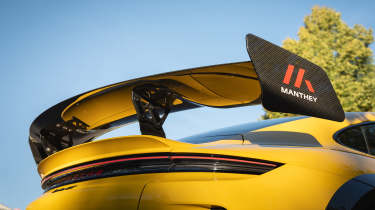
As ever with Manthey, the major changes are targeted at the chassis, brakes and aerodynamics. Most of these are instantly noticeable, the Manthey car gaining an enormous adjustable rear wing and sitting on wider, lighter 21-inch forged wheels that extend beyond the factory bodywork, necessitating carbon arch extensions. The sills, adjustable front splitter and rear diffuser are all more elaborate carbon items too, with canards and wheelarch louvres aiding downforce at the front. Other details include revised air guides to direct flow along the Taycan’s flat floor, plus Manthey’s trademark aero discs for the rear wheels.
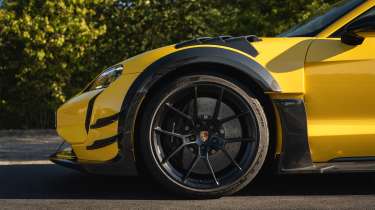
The result of these changes is a boost in downforce from 95kg to 310kg at 124mph, with a peak of 740kg generated at the 193mph top speed (up from 190mph). If there’s anywhere you need the confidence and security provided by the invisible hand of downforce, it’s the Nordschleife. That’s where we’re sampling the Manthey kit, and while you’d expect it to feel good here, the ‘ring is a tough test for any car – let alone a 1000bhp+ 2.2-ton EV.
Rolling onto the track and through the first complex, the effect of the Manthey upgrades is already stark. I know this because minutes earlier I was in a Turbo GT Weissach without the kit, which Porsche has laid on for comparison. All Taycans are good at disguising their mass, the Turbo GT Weissach in particular, feeling hunkered down, precise and surprisingly biddable. But the Manthey is another level entirely, feeling much more keyed in with more grip in reserve, less limited by understeer. As a test I dive in with extra speed and crank on lock through the left-hander of Sabine Schmitz Curve, and the Manthey doesn’t flinch. The nose dives for the apex with no hint of instability at the rear, goading me into committing harder next time.
The aero plays a part in this, but changes to the chassis are powerful too. Manthey has retuned the Taycan’s steering, rear-wheel steering and Active Ride suspension, and those new wheels wear stickier Pirelli P Zero Trofeo RS tyres – colossal 305-width fronts and 335 rears. You immediately sense that there’s more rubber on the ground, not only through extra grip but heavier steering, and a tendency for the car to twitch and tramline more when nudging against kerbs.
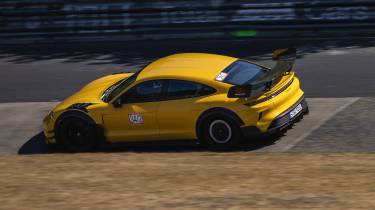
Given that most of the Nordschleife’s ‘straights’ aren’t exactly straight, deploying the full 1020bhp is alarming at first. There’s instant kick out of corners, big numbers flash by on the dash, and you need to place the car very carefully, planning way ahead to stay on the right parts of the circuit. Eventually the acceleration does start to tail off, but only at around 190mph on the Döttinger Höhe straight…
The E-Shift mode available on the latest Taycans, which simulates a burbling combustion engine and eight-speed gearbox, is a big help in giving you a constant reference for your speed. Bursting between corners in near silence can be disconcerting, but the V8-like tones of E-Shift put you more in tune with the car. You can use the paddles to short shift and modulate the flow of torque, or downshift for an engine-braking effect. You can even butt into the ‘rev limiter’ – marked beyond 7000rpm on the dash – which I found myself doing quite often, feeling like there should be more headroom. The effects don’t mimic a combustion engine as closely as in a Hyundai Ioniq 5 N, but they make the Taycan so much more intuitive and engaging, to the extent I never switched E-Shift off after turning it on.
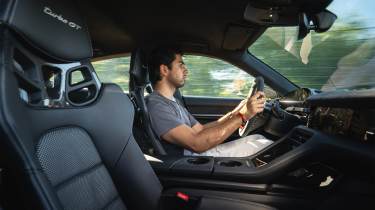
As much as the Manthey’s chassis feels like a big step on, power is still the Taycan’s biggest strength around the lap, and that dictates how you drive it. You brake late and deep into corners, rotating it quickly at the apex to straighten the car up, before powering out as early and hard as possible, often with just a small flick of oversteer. It’s a technique the Manthey car responds fantastically well to, giving you huge confidence to carry entry speed and be aggressive with the steering to get the nose in. Some track-focused cars feel nervous in the pursuit of faster lap times but the Manthey is the opposite, the gains coming through the confidence it gives you to attack.
This does mean the balance tends towards understeer when you find the limit, particularly towards the end of a stint when the tyres are crying enough (we saw front-left temperatures of 132 degrees C after a couple of laps). And despite the four-wheel steering and Active Ride system doing a great job of disguising the mass (and absorbing kerb strikes), at a certain point it becomes a limiting factor, the underbody grazing the ground through bumps at maximum load as the suspension runs out of support.
The weight makes itself known under braking too. Inconsistent brakes have been a weak point on all Taycans I’ve driven, and the Manthey is a big improvement – larger 440mm front and 410mm rear discs and upgraded pads providing a more solid bite at the top of the pedal. But there’s still inconsistency when fully leaning on them (perhaps due to the blend of friction brakes and regen), so modulating them perfectly through a braking zone is tricky. They do last longer than the standard brakes though, which go soft after a couple of laps.
There’s no question that the Manthey-equipped, E-Shift-enabled Taycan is the most capable and engaging yet. It’s a marked step up from standard and, bar hypercars, the best EV I’ve driven on track. While flicking through the ‘gears’, hopping over kerbs and fully immersed in the Taycan’s ability to attack the circuit, there were moments I felt I could be in some sort of track-focused petrol sports saloon. But the reality is that track driving is still a very narrow use case for a Taycan – or any electric car – unless there are fast chargers on site. Our advice? Buy a Taycan 4S and a GT3 for the same money as this niche within a niche.