Porsche Panamera tech
A closer look at the technical know-how which has gone into the Panemera
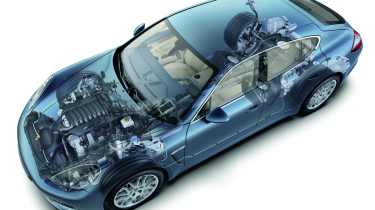
We've reported on how Porsche's Panamera über-saloon defies the forces of physics as it hurtles around the company's test track at Weissach, and how it combines luxurious waftability and convincingly sharp Porscheness in one split-personality package. But what lies beneath? And what is special about it? evo will be covering the final production Panamera in detail on the driving launch in June, but meanwhile here are some technical nuggets: •Stop-start. To begin with, Panameras will use 4.8-litre, dierct-injection V8s similar to Cayenne units, but, future versions will include a diesel V6 and a hybrid, again using technology developed for the Cayenne. For now, though, the Panamera V8s are unique in being the first cars to combine a stop-start system with a two-pedal transmission. And, with the engine not running, the Panamera doesn't try to creep when you're stationary. The engine restarts simply by pressing the accelerator pedal, the process electronically managed to ensure the engine revs and the operation of the PDK transmission's double clutches happens in a controlled way. The starting process uses a 'direct start' system in which a squirt of fuel and a spark occur even before the starter turns, making the engine start almost instantly. •Running hot. Instead of a normal coolant thermostat, the Panamera has an electronically-mapped coolant valve able to control temperature more accurately. This lets the engine warm up more quickly, and tailors the temperature to the needs at the time. For example, it allows the engine to run very hot – up to 105deg C – when safe to do so, which reduces friction to very low levels. This, the stop-start system and other economy measures keep CO2 emissions down to 253g/km in the Panamera S and 286g/km in the Turbo. •Transmission. A seven-speed PDK is standard in the 4S and the Turbo, an all-new unit apart from the double clutches which are shared with the 911, the Cayman and the Boxster. Standard fare in the two-wheel drive Panamera S is a six-speed manual, with the PDK optional. •Suspension. The base Panamera S has coil springs, but the air suspension fitted to grander models is available. All have active dampers with driver-selectable firmness ranges. The air springs normally have 2.2 litres of air volume in the front springs, 2.0 litres in the rear springs, but in Sport mode half of the volume is closed off and just the lower chambers are used. This results in a higher spring rate. The optional active anti-roll bars work by twisting the bars by means of an actuator positioned in the middle. •Structure. Porsche hasn't gone for an all-aluminium structure, because, say the engineers, you can use less steel for the same strength especially if it's high-strength steel, of which the Panamera has several grades. So the weight saving isn't dramatic. That said, the frontal structure is made from alumnium extrusions and castings, and is bonded and riveted to the steel bulkhead and floor much as BMW does with the 5-series. Three-quarters of the body-in-white, by weight, is steel, the rest is aluminium, magnesium or plastic. Result? A base Panamera weighs 1770kg, compared with 1990kg for a Maserati Quattroporte. And it's slightly lighter than a V8-engined, all-aluminium Audi A8. That's impressive. Next instalment: the drive in June.
Find used Porsche Panamera's for sale on the Classic and Performance Car site here.