Porsche 911 Carrera T review – the ultimate all-round sports car
One of a handful of manual sports cars that remain, the Carrera T is also the most 'affordable' way into a manual 911
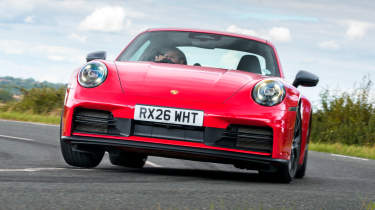
Porsche might be bringing back the manual for the 911 Carrera S in the USA but here in the UK and Europe, there are still just two 911s you can order with a stick and three pedals. One has a GT badge on the back, a screaming 9000rpm flat-six and a ride that’ll have you questioning your disdain for luxury SUVs.
The other is this, the Carrera T, an oft-overlooked variant that majors on minimalism, pairing the least potent 911 powertrain and a more compliant (but still punchy) chassis with a sublimely tactile six-speed transmission. At base, it represents a £40,000-plus saving over a GT3. Is it £40,000 less car? I covered over 600 miles in a Carrera T, across country roads, motorways and the urban sprawl, to discover whether it’s the perfect 911 compromise.
Engine, gearbox and performance
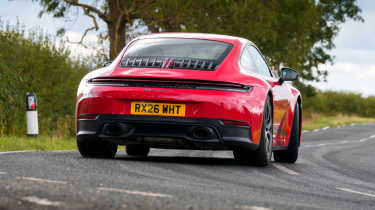
- Turbo is not taboo – this 3-litre unit is riddled with charisma
- It sounds great in the mid-range and pulls well throughout, so you don’t chase the redline by default
- The sublime manual ‘box is a glorious touchpoint with which to conduct the motor too
It’s based on the latest – and now PDK-only – Carrera, borrowing that car’s 3-litre twin-turbo flat-six. You get 389bhp and 332lb ft of torque, which sounds weak in the context of the big, bruising 500bhp-plus CS BMWs and especially when you take the £117,000 starting price into account (£11,800 more than the base Carrera). But underestimating the T would be a big mistake, because it has a fantastic spread of usable power that hits much harder than you’d expect from the figures.
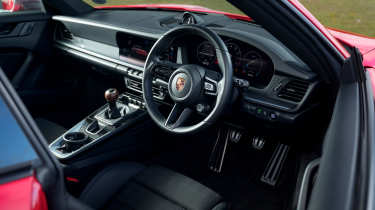
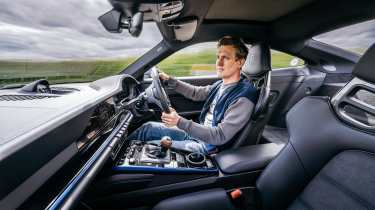
Before you’ve even climbed inside you’ll notice the Alibaba-special H-pattern decals on the quarter windows, and once you’ve slid behind the small-diameter, thin-rimmed steering wheel you’ll spot a laminated walnut gear knob sitting proudly between the seats, above an ‘MT’ badge on the centre console. There’s another H-pattern sticker on the dash in case, for some reason, you needed further confirmation that this is in fact a three-pedal 911.
More reviews
In-depth reviews
- Porsche 911 Carrera GTS review – why Porsche's T-Hybrid is also one of the best
- Porsche 911 Targa review – the opposite of a purists 911, but still superb
Long term tests
Reviews
- Gunther Werks Turbo review – part Porsche 911 Turbo, part hypercar
- Porsche 911 Turbo (1974 - 1989) review – why the 930 was the original 911 wild child
- Porsche 911 GT3 S/C review – does a convertible GT3 really make sense?
- Porsche 911 (992.2) GT3 Manthey Kit review – a road-legal race car with a warranty
From your initial nudge left and clunk forwards into first, you’ll be very pleased that Porsche has preserved the manual with the Carrera T. It has a lovely shift, heavily sprung across the gate, with a positive, mechanical thunk as the ratios engage, and a progressive clutch action.
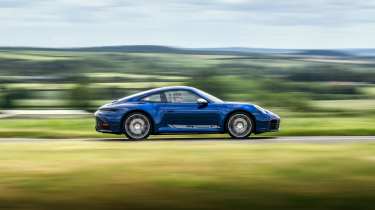
Straight away there’s more to think about and another element of your driving to finesse compared to a PDK-equipped 911 Carrera, and sweeter rewards as a result. In more technical sports cars – an AMG GT, for example – you sense that a manual would be at odds with their fundamental character, but in a 911, it just feels right.
The motor almost feels naturally aspirated in its response and linear delivery, but there’s still useful muscle in the mid-range that builds to a sweet rasp at the 7500rpm cut-off. It’s a cracking engine, and with a PTV (Porsche Torque Vectoring) diff fitted as standard, the T’s traction is such that you can deploy its maximum from way down low, time after time, with supreme confidence.
If you’ve just climbed out of an M4 you might miss the huge swell of turbocharged thrust, but you soon realise that the T is easily quick enough to be exciting on the road, and it probably wouldn’t suit a more boosty, barrel-chested engine. It’s more about nuance than outright power.
Having a manual brings out more of the flat-six’s character too, the revs quivering when you hit the throttle after an upshift and zipping up crisply with every downshift blip (either by your own footwork or the autoblip function). The ratios of the six-speeder are long in typical Porsche style – you can drive up to the national speed limit in second – but, strangely, this doesn’t really come to mind on a fast, flowing drive.
Perhaps because the engine has enough flexibility to cover for it allowing you to short-shift and still carry rapid pace. Plus there’s real aural joy to be had from flat-footing it in the mid-range, so you’re rarely chasing a novelty redline for the sake of it. Whatever the case, the manual dramatically changes how you drive the car, pulling you into the process where a PDK Carrera can feel clinical in how easy it is to pick your way along a road.
With a sports exhaust as standard the T sounds great too, with a slightly sharper edge to its note than a Carrera. That’s because the lightweighting programme includes thinner glass, reduced sound insulation and no rear seats. Along with the manual ’box, these measures take the T’s kerb weight down to 1490kg, which is 30kg lighter than the standard Carrera. Option the £4621 carbon bucket seats and you can trim that further still, to 1478kg – or 1kg lighter than a PDK-equipped GT3. The manual GT3 remains 16kg out of reach.
Driver’s note
‘The engine is a honey – inexplicably responsive for a Turbo lump, potent and deliciously vocal in the mid-range, so you’re never at a loss for joy when not ringing it out.’ – Ethan Jupp, evo web editor
Ride and handling
- More traditional 911 understeer than a GT3 can be rewarding to drive around and hone your skills
- Ride quality is right on the brink of being too punchy but tolerable if you spec the T correctly
- It might just be the best 911 for broad-spectrum road driving since the last 991 GT3
We’ve driven two second-generation Carrera Ts now, that differ in spec quite a bit. The first had the old 918 Spyder carbon bucket seats and no rear seats at all. The second was more ‘street’, with comfort seats and a rear bench for extra passengers. It might sound bizarre, especially from an evo perspective, but the latter heavier car might be the best choice in terms of getting the best from the T.
In fully stripped-out form, there’s just a bit too much road noise and resonance in the cabin, that both oversells it as a ‘budget GT3’ and undermines its true potential, which is to be the ultimate driver’s 911 on the road. With the normal seats and rear bench back in, the edge is just taken off such that you can use it every day.
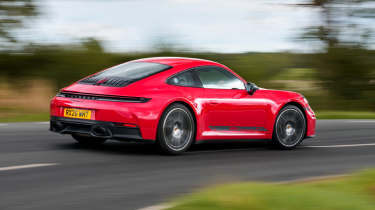
All Ts sit 10mm lower on PASM sport suspension with adaptive dampers, with retuned anti-roll bars and a larger, 20/21-inch staggered wheel set-up than a base Carrera. The busier and more connected feel suits the T’s brief to an extent but nudges it towards the more focused end of daily sports cars.
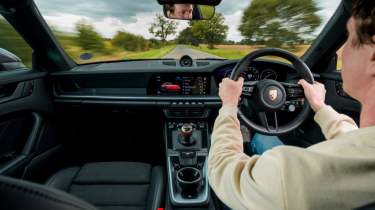
It’s a punchy ride, but the standard seats cushion you from it more. Then as you spend more time in the car, you learn its bandwidth and realise that, unless trundling around the city, hopping from speed hump to speed hump, it’s perfectly livable, especially once the dampers are warmed up and you’re up to speed.
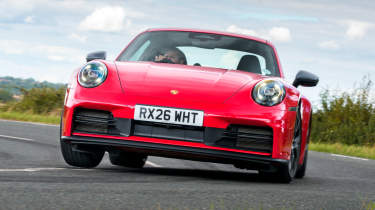
Pick up speed and the calmness of a standard Carrera comes back, the T staying flat, poised and controlled. Couple this with clean, accurate steering that builds reassuring weight (there’s a more direct steering ratio and specially tuned rear-axle steering as standard) and your confidence doesn’t fade as you sweep into fast corners and carry the momentum you’ve built. Grip is supreme and it can withstand massive commitment in the dry.
As in the base Carrera, sometimes you wish there was a bit more to manage, to feel like you’re making a difference, but having three pedals partly makes up for that, keeping your brain, hands and feet more engaged.
Compared to a GT3, you do have more to do, the McPherson Strut front lacking the double wishbone GT car’s near-immunity to understeer. It’s less a pitfall and more a dynamic identifier that this is still a 911, that you revel in improving your inputs to drive around. There’s reward in managing the imperfections.
At normal speeds you wonder why there’s a Sport damper setting, given how connected the chassis feels in Normal. But drive at pace on a really challenging surface and you occasionally find the limits of control, the weight shifting across the axles more than you might like over bumps under hard cornering loads. Sport tightens this up, and while there’s a firmer edge to the ride, you take this as a trade-off and just get on with it.
It may be less wild than an M4, but there’s still real joy to be had in working the T up to its limits and subtly manipulating it, in a way that the best 911s always allow you to do. The grip is such that the changes in attitude are subtle, but you can hold the brakes (which have great feel and power) on the way into corners to help turn-in, and then balance the car on the throttle all the way through.
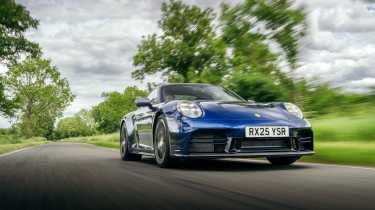
Too much power early in a corner pushes the nose gently wide. Be patient and the T slingshots onto the next straight without wasting a scrap of energy. A combination of aggressive turn-in and full power in the lower gears can pivot the car into a neat slide, the massive 305-width rears still finding fantastic forward drive and regaining grip smoothly. Combine this with the sweet delivery of the flat-six and added action of the manual ’box and you have the makings of a really absorbing 911.
The cabin is well built, the ergonomics are spot on and the 992.2’s infotainment system is easy to get along with (even if we miss the gorgeous analogue rev counter of the Gen 1, replaced by fully digital dials here).
Generally the T’s added rawness is well judged and gives it a genuine sports car feel where the 992 has sometimes been accused of being too grown up. It’s purer and more exploitable than an AMG GT, more communicative and finely tuned than an M4 CS. And it holds up well against its ancestry.
Driver's note
' When equipped with the carbon bucket seats and stripped-out interior, there are 911 S/T vibes, but also a fair bit of road noise on the move – a Porsche 992 weak spot generally, but especially in this spec.' – James Taylor, evo deputy editor.
Price and rivals
It seems like every 911 rival has either jumped up in price or changed tack in recent years. If you’re after a manual alternative to the £117,000 Carrera T, there’s less choice than ever.,
The Lotus Emira is another three-pedal, six-cylinder sports car that you could feasibly use every day, and undercuts the T by around £20k. Its downsized-supercar styling makes it much more distinctive than the 911, but there's something lacking in the driving experience. It's not as polished as you’d expect of a Lotus, lacking the 911's locked-on reassurance and precision. The Lotus's manual gearshift isn't as sweet, either.
For £10k less than the Carrera T, you can bag a Mercedes-AMG GT43, but with a four-cylinder engine and auto ‘box, it’s not as pure a driver’s car. Aston Martin’s Vantage, meanwhile, has moved up a category in its latest generation, costing from £170k. Offering an altogether different, thuggish character is BMW’s M2 CS, available for £25k less than the Carrera T.
Venture into the classifieds and £115k will buy you some very serious metal. Manual 991.2 GT3s are just about within reach, and if you’re not dead-set on having a stick, full-blown supercars (and eCoty winners) like the McLaren 720S and Maserati MC20 are available.