Porsche 911 GT3 S/C review – does a convertible GT3 really make sense?
Making a GT3 convertible was a bold move by Porsche, but one that makes total sense once you drive it
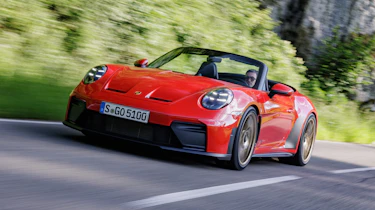
The premise of the new Porsche 911 GT3 S/C is quite simple: this is a fully convertible version of the 911 GT3. More precisely, it’s a GT3 that uses the bodyshell and roof structure of the 911 Cabriolet, together with some components from the limited-run 911 S/T coupe.
Is a cabrio at odds with Porsche GT models’ ethos as pure, hardcore driver’s cars? Based on this first experience in the S/C at its launch, the short answer is, no: with the rev-counter needle (or at least, a digital facsimile of one, on the brand-new instrument panel display) closing in on 9000rpm, and the flat-six’s unique shriek echoing off surrounding rockfaces and scenery, it feels every bit as intense and involving a driving experience as you’d hope of a 911 GT3.
Porsche 911 GT3 S/C in detail
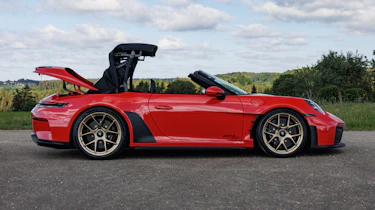
Thanks to various lighter components being made standard, kerbweight increase over the GT3 coupe has been kept as scant as possible (1497kg and 341bhp/ton for the S/C versus 1420kg and 360bhp/ton for the 992.2 GT3 coupe with lightweight options fitted). And while the overall structure is naturally not quite as rigid as that of the tin-top GT3, it’s far from floppy. This is not a case of the GT3 selling out. Literally as well as metaphorically, since the S/C is a new full-time production variant in the range rather than a low-volume limited edition.

S/C stands for Sport Cabriolet, as S/T stood for Sport Touring. The carbon bonnet and wings are the same as the S/T, as are the doors, with built-in aero channels (first designed for the GT3 RS). So too are the carbon rear anti-roll bar, drop-links and the shear plate (a structural panel beneath the rear of the chassis to join structural points and stiffen it against twisting forces). Inside, carbonfibre trim is standard and the lightweight door panels with carbon pull handles are also familiar from the 911 S/T.
More reviews
In-depth reviews
- Porsche 911 Carrera GTS review – why Porsche's T-Hybrid is also one of the best
- Porsche 911 Targa review – the opposite of a purists 911, but still superb
Long term tests
Reviews
- Porsche 911 Turbo (930, 1974 - 1989) review – when Germany took on Italy’s icons
- Porsche 911 Challenge review – this £200k racer might be the most fun 911
- Gunther Werks Turbo review – part Porsche 911 Turbo, part hypercar
- Porsche 911 (992.2) GT3 Manthey Kit review – a road-legal race car with a warranty
- Porsche 911 GT3 RS Manthey kit review – the ultimate Nürburgring toy tested to the limit
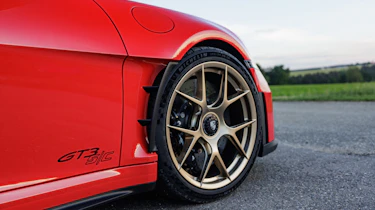
Many of the component choices have been made to keep weight down. Centre-lock magnesium wheels (also from the S/T) are standard fit, and so are carbon-ceramic brakes, saving more than 20kg against regular cast iron brakes. And there is only one gearbox choice. The S/C is manual only, saving 17kg versus PDK. (Observers might hypothesise that choice has also been made to assuage any doubts the S/C is not a ‘true’ driver’s car.)
This is not, technically, the first ever convertible 911 GT3. There’s been one before, albeit without a GT3 badge: the 911 Speedster of 2019, based on the 991-generation GT3. It was limited to a production run of 1948 cars, and cost more than £211,000 in the UK. To save weight, and to give the Speedster a clean look with a distinctive ‘double-bubble’ rear deck, its roof arrangement was part electric, part manually operated. The GT3 S/C however, adopts the fully motorised soft-top from other latest-generation 992 Cabriolet models.
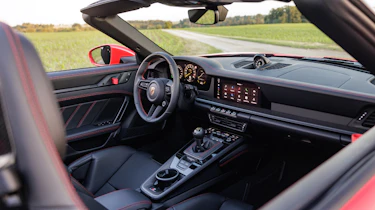
Introducing the S/C to us, Porsche’s director of GT models Andreas Preuninger explains why. ‘We had feedback from customers of the Speedster, who said: “Oh, I would gladly [sacrifice] another five or 10 kilos to be able to push a button to open the roof without having to pull over and fumble around. Then we had a closer look at the top that is used on the Turbo and Carrera Cabriolets, and it qualifies perfectly as a GT car part, because the panels underneath the cloth and all the linkages are made from magnesium.
The whole thing is very lightweight, and everybody in the team said, “okay, that's the way to go.” That doesn't mean there will be no Speedsters any more in the future,’ he adds, intriguingly. ‘But this is an addition to the range which makes complete sense. Especially when it's raining.’
Not least because the roof goes up or down in 12 seconds, and you can do so while driving at more than 30mph. The roof mechanism and all the special componentry fitted as standard throughout the car contribute to the uplift in price: £200,500 for the S/C versus £165,445 for the regular GT3.
The roof folds away above the same 4-litre, naturally aspirated flat-six engine in the tail as the GT3 coupe, with identical 503bhp/332lb ft outputs and 9000rpm redline. Unlike the S/T, Porsche has not fitted a lightweight single-mass flywheel and clutch, partly because it would make quite the racket at idle with the roof down, and partly because it made gearchanges tricky to pull off smoothly. In the S/T it was super-satisfying when you got it right, jerky and frustrating if you got it wrong.
Porsche 911 GT3 S/C performance, ride and handling
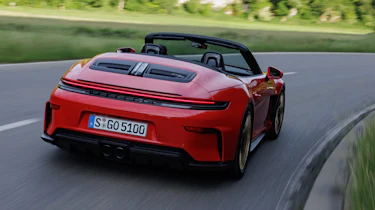
Pull-away in the dual-mass-equipped S/C is smooth and easy. The short-throw, six-speed gearshift is a joy and pedals are perfectly placed for heel and toeing, though there’s an excellent autoblip too, if you select Sport mode. Getting a perfectly smooth shift still demands concentration, as it should, but it’s a superbly enjoyable ’box to be in charge of. Like the S/T, the ratios are relatively short (though the S/C’s electronic limiter allows a higher top speed of 194mph). A few times on dual carriageways I absent-mindedly go to shift up before remembering I’m already in top gear.
Sport mode also opens the taps inside the stainless steel exhaust system and the resultant sound is as good as you’d imagine. It’s loud at high revs, certainly, but not uncomfortably so and being in the open air with the sound enveloping the cockpit and the airflow rising and falling in harmony adds to the intensity of the experience. Reaching the 9000rpm ceiling demands commitment as well as space but it’s a rush you find yourself chasing again and again. When you’re not using every last revolution per minute, the engine is still great company, smooth-revving and responsive.
It’s not intrusive at regular road speeds with the roof down, either. Overall roof-down refinement is impressive, even without raising the wind deflector behind the seats. Even with the windows down, you’re not particularly buffeted by the breeze. Roof up, things are good too with plenty of insulation up top and a heated glass screen behind. With the hood raised, you actually hear some extra mechanical noises the breeze takes away, for example a gentle whine from the limited-slip differential (a characteristic of the GT3 coupe too). But this is still a car you could easily take on cross-country trips without it wearing you out.
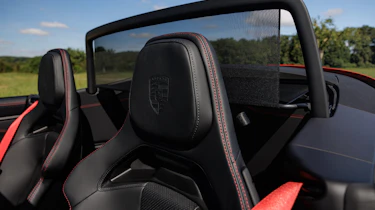
Four-way manual-adjust seats are standard, and electric seats an option, but our test car has the optional carbon bucket seats, which sit you that bit lower and put you more in tune with the chassis’ movements. There are no back seats: ‘We didn’t want to make a four-seater,’ Preuninger says: ‘I mean, try to sit in the back seat of a convertible, driving with the roof open – it makes no sense.’
That policy has allowed his team to come up with a handy optional storage solution, inspired by a Sonderwunsch option on 1980s 911 SC cars: an 80-litre storage box where the back seats would be in a regular 911 Cabrio. It has two hinged lids, positioned a bit like a top-load washing machine, which are lockable, so you can stash belongings inside and leave the car parked up with the roof down if you wish.
The new all-digital instrument panel mimics the classic five-dial 911 layout, and is easier to read than on previous 992s, with the outer gauges no longer obscured by the steering wheel. It’s part of a new infotainment system, introduced first on the S/C and to be rolled out to other 911 models shortly. A review of that will have to wait for another time; I’m sure you’ll understand if I admit I didn’t spend much time looking at the touchscreen and concentrated on driving.
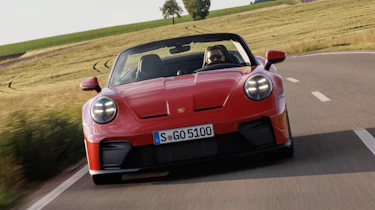
Like the regular GT3, the steering is relatively light but extremely precise, and doesn’t require much lock, even in tight corners, aided by standard four-wheel steering. Feel and feedback through the brake pedal is remarkable, even from cold – impressive for ceramics. It’s a far from cold day and the grip levels from the sticky Michelin Cup 2 tyres on the sunbaked tarmac are enormous. Handling balance is enjoyably positive and neutral.
We’re testing the S/C in a mountainous, rural area within a couple of hours from Stuttgart, a setting in which many other Porsche GT models have been developed and signed off. So perhaps it’s no surprise the car feels so at home here. Aside from being quiet and picturesque, the tarmac is also very smooth for the most part. It’s possible that on UK roads the S/C will feel more unsettled but here, body control is hard to fault, regardless of the adaptive dampers’ setting.
The 992 Cabriolet bodyshell is 25 per cent more torsionally rigid than the 991, and so no further work has had to be done to stiffen it – aided by the carbonfibre shear plate from the S/T doing a lot of bracing work on its own. Preuninger explains that his team made preparations for a bespoke suspension tuning purely for the S/C. In the end a prototype with identical settings to the GT3 Touring performed so well that they concluded there was no need to change it.
On these roads, it’s hard to disagree. I’m sure on a racetrack, or maybe if you were pushing harder than sensible on a really bumpy road, you could feel the difference in torsional rigidity versus the GT3 coupe but out here at a quick but safe pace, the difference really is negligible. The S/C is still a superb driver’s car. It’s not a car intended for the racetrack but you could absolutely book it on to a high-level trackday and find it would be more than up to the job.
It’s easy to see how some Porsche GT fans might feel a little cautious or sceptical about the notion of a GT3 Cabrio but, happily, the S/C proves itself a top-drawer driver’s car which hasn’t lost the GT magic. The winged 911 GT3 Coupe remains the core of the range and isn’t going anywhere.
The rest of the line-up, however, has diversified a little in recent years, from the active-aero 992 RS to the wingless GT3 Touring. The S/C expands the range further without diluting the GT3’s essence, and being in the open air and experiencing the engine’s aural repertoire all the more intensely gives it an appeal of its own. As it turns out, the question isn’t so much why Porsche has made a fully convertible GT3 as why it waited so long.
Price and rivals
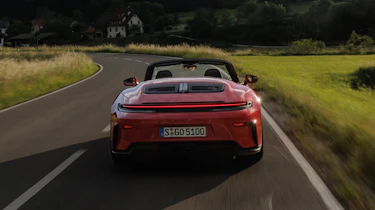
In addition to the Porsche 911 GT3 S/C’s £200,500 base price, there is the option of the £24,110 Street Style Package. It’s a bold spec that’s not for everyone, with eye-catching four-colour check-patterned braided leather seats and glovebox lining, bi-colour leather upholstery in Guards Red and Slate Grey and a dark plywood gearknob. On the exterior, there’s bright ‘PORSCHE’ lettering on the sides, stripes on the front wings, and further painted stripes on the inside of the wheel rims.
Direct rivals are few but McLaren’s Artura Spider offers even greater performance for a greater starting price of around £224,000. It’s a more digital, less analogue experience than the GT3, with a hybrid turbo V6 powertrain and paddleshift transmission. Aston Martin’s expressive and enjoyable twin-turbo V8-powered Vantage S Roadster undercuts the S/C on price, though it too can’t offer a manual gearbox. A car which could be considered to be a leftfield rival is the Corvette Z06, which features a two-piece motorised retractable hardtop and a naturally aspirated V8. Accounting for import costs in the UK, which are continually fluctuating, its price is likely to be in a similar ballpark to the Porsche.
Specs
| Engine | Flat-six, 3996cc |
|---|---|
| Power | 503bhp @ 8500rpm |
| Torque | 332lb ft @ 6250rpm |
| Weight | 1497kg (341bhp/ton) |
| 0-62mph | 3.9sec |
| Top speed | 194mph |
| Basic price | £200,500 |