Porsche 911 Turbo (993, 1995-1998) review – the Turbo’s turning point
The 993 Turbo is the last air-cooled, first 4WD Turbo. It's an all-time great and one of the most beloved of the breed
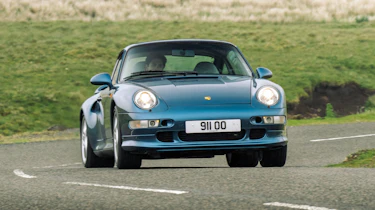
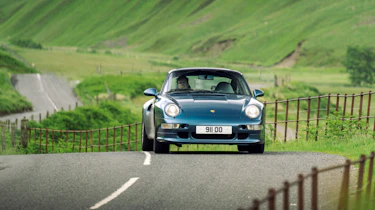
In summer 1995, Loaded magazine’s cover stars were Shaun Ryder, David Letterman and Kylie Minogue; the NME put Blur and Oasis head to head; Vogue made Kate Moss an international superstar; and for its May edition, evo’s forerunner, Performance Car, had a new cover star too. ‘King Turbo!’ the coverline proclaimed, bright yellow text contrasting with a Riviera Blue Porsche 911 Turbo.
The new 993-generation Turbo to be precise, and ‘Son of 959’ was the headline inside. Porsche had distilled some of the learning from its high-tech proto-hypercar and employed it here in the 911 to devastating effect.
Contemporary evo editor-at-large John Barker was the PC correspondent at the Turbo’s launch, and set the scene: ‘Traditionally the Turbo has been the fastest and most frightening of the 911 family, a car whose full potential only the most skilled could exploit... This, however, is a 911 Turbo like no other before.’
The 993 generation had marked a shift in the Turbo’s character. It was now an all-weather express, with searing point-to-point pace, suction-cup grip levels and lofty handling limits. Revisiting it today, it’s still a seriously quick car, and an effortlessly capable one, brimming with appeal.
Porsche 911 Turbo (993) in detail
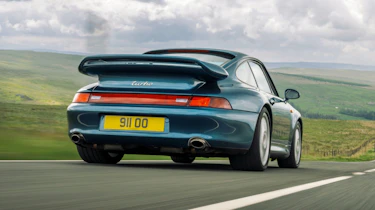
- Last air-cooled Turbo, first with twin turbochargers
- Launched in 1995, standard Turbo with 402bhp
- Turbos S version is rarer, with 422bhp
More reviews
In-depth reviews
Long term tests
Reviews
- Porsche 911 Turbo (930, 1974 - 1989) review – when Germany took on Italy’s icons
- Porsche 911 Challenge review – this £200k racer might be the most fun 911
- Gunther Werks Turbo review – part Porsche 911 Turbo, part hypercar
- Porsche 911 GT3 S/C review – does a convertible GT3 really make sense?
- Porsche 911 (992.2) GT3 Manthey Kit review – a road-legal race car with a warranty
- Porsche 911 GT3 RS Manthey kit review – the ultimate Nürburgring toy tested to the limit
Wendelin Wiedeking was at Porsche’s helm when the 993-generation 911 went into production in 1994. The final air-cooled 911 series, it introduced a new multi-link rear suspension set-up and rounded design cues crafted under the guidance of Harm Lagaay and Tony Hatter.
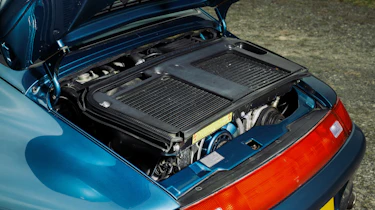
The Turbo made its debut in 1995. It was the first 911 Turbo to go four-wheel-drive, and the first to use two smaller turbochargers rather than a large single one, for better throttle response. It also benefited from twin air-to-air intercoolers, and a new six-speed gearbox. It had a wider body than the standard 911 Carrera. The Turbo’s broader shell was later also used for the Carrera 4S and Carrera S.
Based on the 3.6-litre Carrera, the flat-six gained new pistons with forged con-rods, a redesigned cylinder head and the latest Bosch engine management. Peak power at launch was 402bhp, with the later, rarer Turbo S variant packing 444bhp. The lovely 1996 Turbo tested here has the optional X50 power package, which gave an additional 22bhp, as per the Turbo S.
This is a special car in other ways, too, with various factory options including metallic turquoise paint and special to-order Porsche Exclusive extras such as carbonfibre interior trim (including the steering wheel) and a larger front air dam and decklid, per the S. Effectively, it’s as close to a Turbo S as a 993 can be without being a Turbo S.
Driving the Porsche 911 Turbo (993)
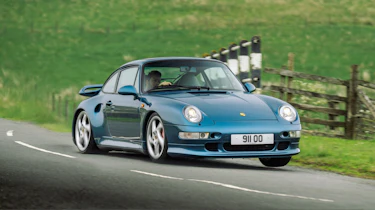
- First all-wheel-drive Turbo
- New six-speed gearbox
- Phenomenal all-weather pace
The 993 was a new kind of 911 Turbo but the doors close with the same reassuring thunk as earlier cars and the interior architecture is familiar, too. So is the lack of adjustment for the steering wheel, though it’s still easy to find a comfortable driving position in this car’s fantastically supportive seats (in ’90s grey with thick show-home-grey carpet to match). Also redolent of the times, the four-spoke wheel has a simply gigantic middle facia to house the airbag.
Handbrake and gearshift alike are remarkably light and easy (the gearbox had tougher double-cone synchros on first and second, and a lighter clutch than the Carrera 4). You could sit your driving test in this car, so remarkably friendly is it to drive at low speeds.
Should you decide to use more of its performance envelope, however, it’s truly, breathtakingly quick. Time hasn’t dimmed the space-shuttle-spec acceleration, nor how easy it is to carry speed through corners. The 930 Turbo from the ’80s felt rear-heavy in a traditional 911 way but you can sense the 993 working its tyres much more evenly.
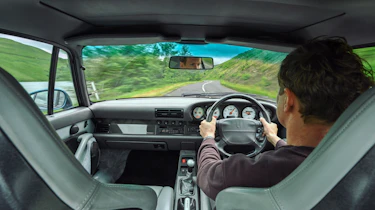
The steering is a little stiff and weights up markedly once you’re into a corner, which lends it an intermittently stodgy feel. But nonetheless the 993 can steamroller more or less any road you put in front of it, fast and smooth or twisty and bumpy.
The suspension is based on the contemporary Carrera Sport option, with stiffer springs and thicker anti-roll bars. It’s a big step on from earlier Turbos, where large bumps would ripple through the structure abruptly. The 993 does a much better job of smoothing out road surfaces and you never worry about it skimming over bumps, though it can still get a little disconcerted on compound surfaces if you’re really pressing on.
That’s something it’s effortlessly easy to do. As with earlier 911 Turbos, with the engine out behind you there’s not a lot of sound in the cabin, especially as the longer intake tracts mute the usual flat-six induction roar, while the air being marshalled through the intercoolers takes some of the traditional rumble away.
Put your foot down and there’s a faint whoosh followed swiftly by the sense that you’re being magically fast-forwarded down the road, like you’re in a toy car and an unseen hand has gripped the roof and propelled you forwards. There’s far less turbo-lag than its forebears.
Even today, the 993 Turbo feels like it could be comfortably quicker than the vast majority of performance cars, and although our test is in the dry, you sense that would be the case in all weathers. Its performance envelope is not only broad but apparently limitless. This was the moment the 911 Turbo became the ultimate all-weather all-rounder, an identity it’s kept ever since.
Back in May ’95, JB summed King Turbo up by advising that its ‘extraordinary performance’ required ‘a large degree of restraint on the part of the driver, and great foresight and planning. Same scary ride as ever, then. Just a different kind of scary.’ Now, as then, that’s emphatically true.
Driver’s note
‘It feels like a big leap in terms of refinement and sophistication over earlier Turbos. It’s a car you can just jump into and drive quite easily, without needing to recalibrate your senses. But I think that’s maybe at a cost of losing a little bit of that crazy rush, with less lag and more linearity, whereas the older 930S, for example, was like an explosion, and I think I found it more thrilling as a result.' – Yousuf Ashraf, senior staff writer
Values and buying checkpoints
The 993 Turbo ended production in mid-1998. Its heavier, faster 996 replacement introduced water-cooling (and was fitted with the now famous Mezger engine derivative). Whilst used 996 values decreased in later years, 993 values have remained more consistently strong and, as a virtuous circle, many have been well cared for as a result.
Although 993s were galvanised from new, they are of an age where corrosion is a potential and needs to be checked for thoroughly, including the rear chassis legs, for example, as well as the bodywork.
Broken door check-straps can be common on 993s, and more costly to fix than expected, as can faulty sunroofs. The vast majority of 993 Turbos in the UK and elsewhere were sold with a sunroof, and cars without them are a rarer find.
These days the 993 Turbo is emphatically a six-figure car. Rarer versions, such as the Turbo S or cars with the X50 power pack can command a premium, and may well exceed the quarter-million-pound mark and beyond. Strong history and paperwork can play as key a role in a car’s value as mileage.
Specs
| Engine | Flat-six, 3600cc, twin-turbo |
|---|---|
| Power | 424bhp @ 5750rpm |
| Torque | 398lb ft @ 4500rpm |
| Weight | 1500kg (272bhp/ton) |
| 0-62mph | 4.5sec |
| Top speed | 180mph |
| Price new | £91,950 in 1995 (£194,485 in today's money) |
| Value now | £250,000-plus |