Is the Nürburgring really the ultimate driving challenge? We sent a Nordschleife novice to find out
They say you can never truly learn the Nürburgring Nordschleife, regardless of how many laps you do. evo’s deputy editor puts that theory to the test with possibly the ultimate training school
They say six laps is the danger zone at the Nürburgring Nordschleife. Because after six laps, you think you know the track. Guess how many I’ve done up until now? Yep. Mind you, my six laps were spread over two years, and the most recent of them was in 2018. That’s about to change.
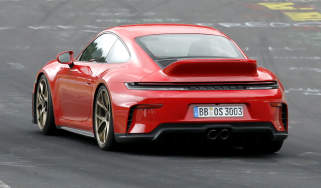
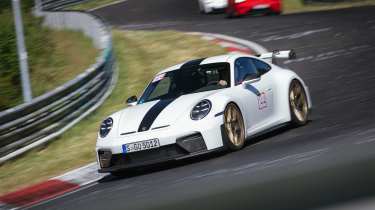
It’s before 8am on a Tuesday morning and I’m standing on the Nordschleife’s Döttinger Höhe back straight, the mile-and-a-half-long stretch between the infamous ‘bridge’ and ‘gantry’ landmarks. My much-needed cup of coffee is sitting on the rear wing of a Porsche 911 GT3 and I’m listening to a briefing from an instructor whose Ring lap-count is in the thousands. Shortly I’ll be following his wheeltracks in the GT3, to try to learn this most unlearnable of circuits in as much depth as possible. Ahead and behind us are nearly 200 other drivers receiving separate briefings from separate instructors, about to do the same. The event is called Perfektionstraining, and it’s all a bit surreal. Not least because by tomorrow afternoon I’ll have increased my lap-count by about 500 per cent. Fingers crossed.

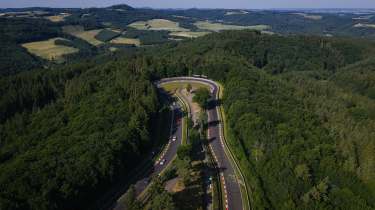
‘They’ say a lot of things about the Nordschleife, the Nürburgring’s mountainous 13-mile northern loop constructed in the 1920s. Is there a stretch of tarmac in the world spoken about with more reverence, or more heated opinion? Given the depth of folklore and mythology about the place, it can feel at once like a must-visit mecca and a place so intimidating it’s best avoided. It’s easy to understand both viewpoints. The consequences of getting it wrong at the Nordschleife are as heavy as it gets, and of late there have been an eye-opening number of high-profile accidents and, tragically, fatalities at public Tourist Drive days. I feel caught between both camps: drawn to the Nordschleife’s flame and all too aware of its dangers. If, like me, you’re a relative newbie to the place, perhaps you feel the same.
Received knowledge says you need at least 50 laps to learn the Ring properly, and if the bug bites you could spend many years (and many thousands of pounds) on that journey. Perfektionstraining, an annual programme organised in conjunction with German magazine Sport Auto, is one way to get a leg up on that steepest of (banked) learning curves, in a far safer environment than a public Tourist session. For two full days the organisers reserve exclusive use of the Ring, the 200 or so customers divided into groups of no more than five or six cars. Each group is assigned an instructor, many of whom are experienced racing drivers and industry test drivers who know the circuit backwards.
Rather than sitting alongside customers in the passenger seat, the instructors drive a pace car and lead their group in a ‘ducks and drakes’ formation, keeping in touch with each member of the group by radio. Each lap the increasingly speedy convoy learns the lines, braking points and gear choices vital to a clean lap and it’s all gradually hardwired into the drivers’ memories. At the end of each lap, the car at the front of the queue swaps to the back, giving plenty of opportunities to follow directly behind the instructor.
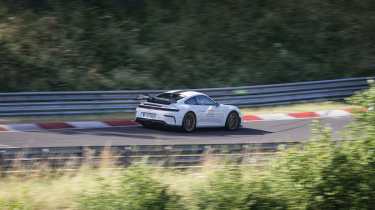
On the second afternoon, the formation flying ends and customers can lap the circuit freely to put it all into practice. Perfektionstraining has been running since the 1990s and provides marshals and safety officials, medical support, food and drink, and access to tyre technicians. A place costs around 3000 euros and is open to anyone, provided they bring (or rent) their own car (ideally something fairly quick). A good working knowledge of German is helpful, too, since that’s the language of much of the opening briefing at the pre-event dinner.
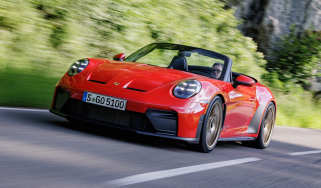
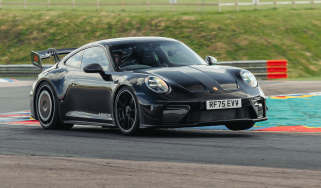
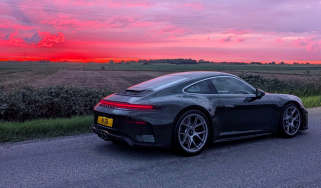
I’m lucky to have willing volunteers to translate for me, and doubly lucky not to be using my own car: Porsche is a regular Perfektionstraining participant and each year invites a group of journalists and guests to take part, which is how I’ve found myself here, and behind the wheel of a current 992.2-gen Porsche 911 GT3. I collected it from Cologne airport the day before the event, drove straight to the Ring, and I’ll drive it straight back. It’s an ultimate test of the GT3 in its natural road/track habitat.
It’s in good company. Of the couple of hundred cars here, about 70 per cent are Porsches, and many of them are 911 GT3 and GT3 RS models. I’ve never seen so many in one place at one time. There are M cars and AMGs too, GR Yaris, RS Mégane and Mini GP hot hatches, and some mid-engined sports and supercars including a McLaren and a couple of Lotuses – but this is a strongly Porsche-flavoured mix. (The other five cars in Porsche’s own group are 992.2 GT3s too, plus a Taycan Turbo GT.)
Our instructor is Porsche test driver Timo Kluck. Born in Adenau, one of the many towns the circuit passes by, Timo was a teenager when he drove on the Nordschleife for the first time. In the years since, he’s raced successfully in single-seaters and GT cars, and has competed in numerous Nürburgring 24 Hours. Nowadays in his testing role at Porsche he specialises in tyre development for road cars, including the Michelin Cup 2s fitted to ‘my’ GT3. Timo is a jovial character with a sharp sense of humour but becomes deadly serious when he introduces a mantra he’ll repeat several times over the next two days: ‘Respect the track.’
Kluck’s pace car is a Manthey-kitted Cayman GT4 RS and our laps begin at respectfully slow pace. A luxury in itself, because how often do you get the chance to drive slowly on the Nürburgring? Or, at least, slowly without being a hazard. The organisers ensure there’s a big gap between each group setting off, so in these introductory laps there’s less need to worry about keeping out of the way of faster drivers. The reduced speed gives a different perspective on sight lines, reference points and the 1000 feet of elevation changes as the circuit spears through the thickly forested Eifel mountains.
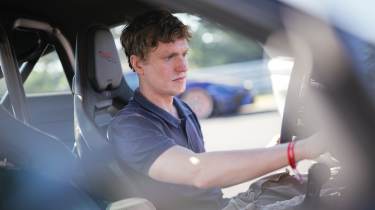
My previous two experiences of the Ring were also following pace cars but at a relatively swift pace: four laps on the first drive of the Volkswagen Golf Clubsport S in 2016, following racing driver Benny Leuchter in the car in which he’d recently set a front-wheel-drive production car lap record; and two laps in 2017, in a camouflaged BMW 3-series prototype, following a speedy BMW engineer in an M2. Given the time elapsed since, I feel like I’m more or less starting from scratch.
Timo’s messages over the radio are simple: ‘left’, ‘right’, ‘brake’, ‘third gear’, ‘stay right’ and so on. I was expecting more detail, but I quickly realise that with a train of six cars it simply wouldn’t be practical to impart a stream of real-time information. And there’s already a lot to take in. With each lap the pace gradually increases until, almost without realising, we’re really motoring. A bit like Mr Miyagi’s ‘wax on, wax off’ instructions in The Karate Kid, as the speed builds, all those seemingly innocuous instructions suddenly click perfectly into place. You’re always on the right line, always in the right gear; you know where to keep to one side over a blind crest, where to take care over the jump at Pflanzgarten – and, most importantly, you know where the circuit goes. Mostly. The later sections, where corners, crests and cambers come at you thick and fast, are a real challenge to memorise. I’ve driven plenty of laps on a PlayStation and it helps in terms of learning what comes next, but the screen flattens out the elevation changes and somehow a blind crest isn’t quite the same on a sim.
The rollercoaster-like drops and cambers are a big part of the circuit’s physicality. First time into the famous banked Karussell, it’s a real thrill to feel the sensation of the car dropping into the compression and the bumps working its suspension. The mini-Karussell towards the end of the lap is a greater challenge – higher speed, harder to find the right turn-in point, and even more exciting and rewarding.
When I take my turns at the front of the queue behind Timo, the subtleties of his lines become clearer: tighter entries than I’d expected in some corners, and unconventional angles to avoid the worst of the cambers in places. We’ve now done six laps – the magic number – and still in convoy we peel off the Döttinger Höhe, through the car park next to the diner and out onto the road to make the first of many refuelling stops at the local petrol station. It’s a strange sensation to be driving so quickly on a circuit and then, seamlessly, be on the road in the same car a moment later. It feels almost illicit.
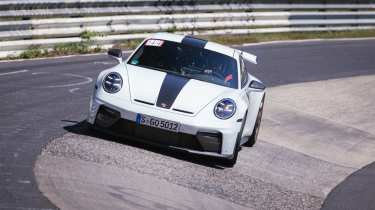
The GT3 feels perfectly at home in this dual track/road role. Setting off from the airport less than 24 hours previously, it felt pretty hardcore: stiff and noisy like a racing car. But after just a few miles it all felt entirely natural. It’s as easy to drive as most saloon cars, and a lot more involving. The fact that the same car that can cruise on the motorway with a podcast on the stereo, cope with speedbumps without needing to reach for the nose-lift switch, and is a doddle to park, can also lap the Nordschleife like a purpose-built racer is seriously impressive.
Its wing and other less obvious aero surfaces keep the GT3 nicely planted over crests and in high-speed sections, but it’s far from a downforce monster. It has a tactile, mechanical feel and always keeps you in touch with what the tyres are doing. Under Timo’s advice, we haven’t even needed to change their pressures for the track.
This car has the optional £19,500 Weissach Package (including lighter body panels and suspension components and a half roll-cage made of carbon) and the £9000 ceramic-composite brake option. Both might be options you’d question on the road but they come into their own here, particularly the brakes, which are tireless. This car has the standard PDK gearbox rather than the optional manual, so I can keep both hands on the wheel. One less thing to think about. The bucket seat’s headrest cushion pops out via a quick-release clip, so it doesn’t bump annoyingly against the back of your crash helmet as in most road cars. It’s all been thought through. Almost as if the car were developed to do this.
Back out on the track, the GT3’s precision makes learning much less daunting. Because the car is so capable, I can concentrate purely on the track. I’m certain that if I were in, for example, a BMW M4, I’d be working harder to keep the car on the right line and using more mental capacity. And the quicker we go, the more of it I need. How many corners there are at the Nordschleife depends on who you ask. There are 73 official ones but some reckon there are more than 100. What I’m discovering is the faster you go, the more corners there are. By Day Two, we’re in fifth gear in places where we were in third on the morning of Day One. What was a gentle, barely-notice-it curve before is a real corner now. The car is loaded differently. And if you’re not on the right line, you will go off.
We stop periodically for a breather and debrief. When Timo asks how we’re getting on, everyone’s full of adrenaline and enthusiasm. He becomes serious once more: ‘Never forget, respect the track.’ By now, our pace is night/day different from when we started. When the cones are removed from the back straight and the circuit is continuously open, he says: ‘Now we’ll do something very important: go and get a coffee.’ He explains the track will now be as busy as it gets and there’s a chance some drivers may get a little giddy out there.
After the break we head out again, no longer as a six-car train but just two of us, following Timo closely. He ups the pace another couple of notches and the laps that follow are among the best driving experiences of my life. Knowing Kluck is always on the right line and won’t do anything unpredictable gives me absolute confidence. There are big loads going through the GT3’s tyres and chassis, squirming and moving subtly as the tyres get hot, but never doing anything untoward. What could be a frantic, white-knuckle experience is a zen, calm one. Without the luxury of building up, bit by bit, I doubt I’d otherwise have been lapping at this pace after just a day and a half. From six laps, my total count is now closer to 40. But there’s one more sting in the tail. Beginning the final lap, going off-line to pass a slower car on the Döttinger Höhe, there’s a sharp crack: a piece of debris has flicked up from a distant car ahead and an ugly crack now scars the windscreen. Respect the track.
Respect, too, to the GT3. By the time I return it to Cologne airport, covered in bug splatter and rubber like an endurance racer, it’s covered around 600 miles in two and a half days. It’s a shock when I realise that around 400 of them have been on the Nordschleife. It’s been an ultimate test of the GT3, and one it’s passed with flying colours.
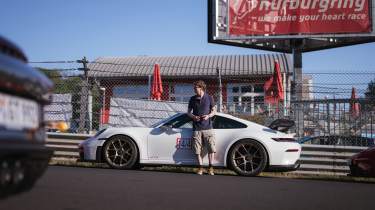
And do I ‘know’ the Nordschleife now? Superficially, yes; in reality, far from it. To really understand its intricacies would take yet more laps, more repetition, for them to truly sink in. But I know it infinitely better than I did before. Perfektionstraining has enabled progress that might otherwise have taken years, and in an infinitely safer environment than a public Tourist Day.
Plus, without Timo as a pathfinder I have a horrible feeling I’d have found myself on the wrong line at a crucial moment at least once. And without him constantly repeating the ‘respect the track’ mantra it would be so easy to hit a jump at the wrong angle and unsettle the car; run a little bit wide and touch the grass or one of the steep kerbs; or brake just a little too late at a point where the track falls away… So you must respect the track. But if you do – and experience it in the right setting – the Green Hell really can be driving heaven.