Porsche 911 GT2 RS (991.2, 2017-2019) review – raw, wild and exhilarating
With a chassis that mixed a 911 Cup car with GT3 RS with a 911 Turbo engine, the GT2 RS remains one of the wildest 911s ever made.
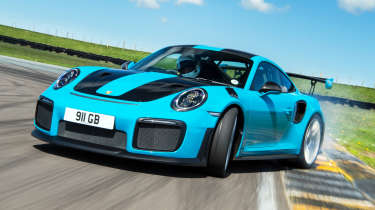
Over-powered, under-available; yet another ‘Ring lap bragard. You name it, the narrative for the 991 Porsche 911 GT2 RS was in danger of writing itself. Perhaps we’d simply overindulged on GT department Porsches.
Don’t get me wrong, we loved every one dearly - who wouldn’t, and they’ve won more evo Car of the year gongs than we can remember (spoiler alert, the GT2 RS didn’t in 2018, losing out to the McLaren 600LT). But the relentless output of hardcore 911s (the GT3 and GT3 RS had launched all within a spectacularly short time), each one ever-so-slightly faster, minutely lighter and more appealing to the speculator market than the last, had left us a little jaded.
Richard Porter brilliantly lampooned the situation in his column at the time: “The next turn off is the media coverage it’ll garner. The helmswright writers, who will imply it can heal the sick, feed the poor, and allow frustrated racing drivers to achieve some sort of climax”. Hmmm. Awkward.
Then I arrived in southern Portugal for the car’s international media launch, standing next to a small line up of GT2 RSs in all the available hues. Andreas Preuninger was here, as was Walter Rohrl and Mark Webber. But the schedule was a disaster so evo’s photographer Aston Parrott and I did the only thing we could do: grab the keys to a Weissach Pack-equipped white GT2 RS and head independently for the hills and a truly spectacular road; one that writhes, rises and falls over the mountains near Faro. Too heavy? Unusably fast for the road? This drive would settle that score once and for all.
More reviews
In-depth reviews
- Porsche 911 Carrera GTS review – why Porsche's T-Hybrid is also one of the best
- Porsche 911 Targa review – the opposite of a purists 911, but still superb
Long term tests
Reviews
- Gunther Werks Turbo review – part Porsche 911 Turbo, part hypercar
- Porsche 911 Turbo (1974 - 1989) review – why the 930 was the original 911 wild child
- Porsche 911 GT3 S/C review – does a convertible GT3 really make sense?
- Porsche 911 (992.2) GT3 Manthey Kit review – a road-legal race car with a warranty
When Lars Kern began his development driving programme with the RS, it was with a GT3 RS hack that had a Turbo S engine squeezed into the tail. He described it over dinner during the event as a real handful, and coming from a man of his iron-clad constitution that’s saying something. So what’s changed in the intervening time to make it the monster capable of 6:47 around the Green Hell?
What engine and gearbox does the 911 GT2 RS have?
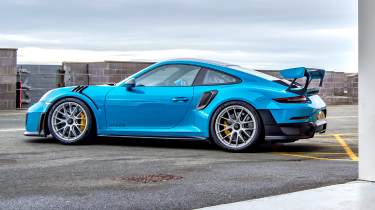
That familiar new-gen engine of the GT2 RS may still have displaced 3.8-litres, but it was fed air via a completely new ‘expansion’ induction system (with twin inlets at the base of the rear window) and a pair of larger turbochargers (9mm larger compressor wheels and 7mm larger turbine wheels compared to those in the Turbo S of the time). Larger intercoolers with a 27% greater throughput capacity nestled lower in the rear haunches and were located by exquisitely designed carbon brackets.
> Best Porsches – from Boxster to Carrera GT, there's a Porsche for everyone
Cooled via the gaping intakes in the rear arches (these weren’t for induction as there were on the GT3 RS of the time), a further reduction in temperature was achieved by a water-spray system that was fed via a 5-litre carbon tank in the front luggage area. Quenching the intercoolers in this manner lowers their temperatures by around 20 degrees, critical in combating the heat buildup from a high boost turbo engine (1.55 bar maximum) and ensuring, for example, that there was no drop off in power over a long, arduous lap such as on the Nürburgring Nordschleife.
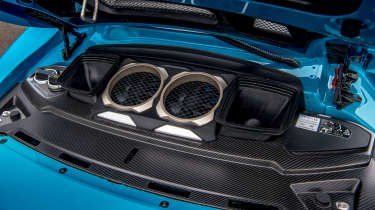
The lump itself had a reduced compression ratio via special pistons, yet could still rev to 7,200rpm. It resulted in an engine that churned out 553lb ft of torque from just 2,500rpm, yet once that peak is passed at 4,500rpm it’s the power curve that takes over, climbing like Bonington on benzedrine until it peaks just shy of the redline with 691bhp at 7,000rpm.
Those very hot spent gases - they glow red hot in fact - are disposed of via a titanium exhaust system, some 7kg lighter than the one fitted to the 991 911 Turbo S, with the shortest route to the atmosphere possible. It’s valved, so when the button is pressed, or the throttle generously open, it bypasses the silencer and effectively goes straight through. Hold onto that thought.
Hooked up to a PDK transmission, the only choice of gearbox and understandably so unless driving one-handed appeals. It’s effectively the gearbox Porsche used in the 918 Spyder, and the only real driving mode offered is a ‘PDK Sport’ button on the centre console that quickens the shifts in auto mode.
What suspension did Porsche fit to the 911 GT2 RS?
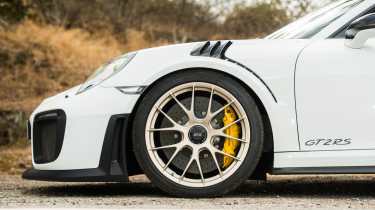
From there, the GT2 RS really did enjoy the very best of the GT Department’s toy cupboard. The rear diff is an electronically controlled PTV+ item and there’s rear-wheel steering and the familiar dynamic engine mounts. The actual chassis is close to that of a Cup car of the time: in fact, for the first time every joint in the suspension is of the steel uniball type.
There are adaptive PASM dampers with helper springs on both the McPherson strut front and multilink rear axles, with twice the spring rate as a GT3 RS on the front axle and rates similar to that of a Cup car running on the ‘Ring at the rear. Conversely, the anti-roll bar rates are lower than a GT3 RS. The forged wheels Porsche fitted were more than a little generous in the tyres they accommodated: at the front are 265/35 ZR20s and at the rear 325/30 ZR21s. Within those wheels Porsche fitted its finest carbon ceramic brakes.
Porsche 911 GT2 RS aero and downforce
You won’t have missed the GT2 RS’s extreme aero package even by today’s standards, which can produce 340kg at the maximum (limited) velocity of 211mph, or 450kg if the rear wing’s angle of attack is increased. There’s a carbon bonnet, magnesium roof and CFRP parts just about everywhere, including the front wings.
The rear window and rear side glazing is lighter than normal, while every GT2 RS is a ‘Clubsport’, hence half cage, driver’s six-point belts and the usual racing prep. Even so, the final kerbweight of 1,470kg is hardly what you’d call a true ‘lightweight’. Owners could knock nearly a further 30kg of that figure by specifying the Weissach Package for, gulp, £21,042, which brought magnesium wheels (saving 11kg), and carbon fibre for the anti-roll bars (a first at the time), roof, steering wheel trim and shifting paddles. The roll cage is then made from titanium, although this doesn’t have FIA certification.
What’s the Porsche 911 GT2 RS like to drive?
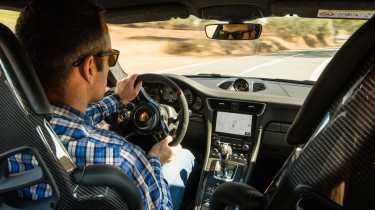
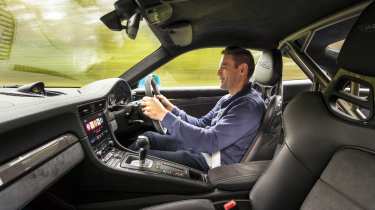
Clambering down into the carbon bucket seat and the GT2 RS’s interior will look very familiar - and possibly slightly underwhelming - to anyone who’s driven a 991, particularly given this particular car does without a ‘cage (it’s US spec) and has a leather dash with PCM in the middle of it. I twist the standard Porsche key and for just a moment there’s a cough and a boorish boom of immense depth that quickly vanishes for a quieter, busy idle.
Press the little button with the exhaust symbol and the boom returns: somehow ugly but wonderfully appealing; layered, rich and thick enough in the air that it feels like you could slice it like a homemade Victoria Sponge. It’s the kind of noise that burrows deep into your head, makes objects rattle around and fizz; it’s the sound of raw, malevolent turbo power through an unsilenced exhaust, and momentarily, it’s quite shocking. We haven’t even moved off yet and already the GT2 RS has me mentally on the ropes. I grip the steering wheel a little harder, and brace myself for the challenge ahead.
The over-the-shoulder boom box is too much at low revs. Ambling along in Faro traffic both Aston and I wince simultaneously then gasp when the engine revs fall below 2,500rpm and the resonance makes our heads start to vibrate. In other respects the GT2 RS is easy enough. The ride quality, while firm, is eerily good at dealing with the worst the suburban roads can place in the car’s path.
Finally, after what seems an interminable wait we find the road we’re looking for and suddenly there’s not a soul to be seen. And so the rhythm builds, and the GT2 RS starts to reveal itself, and the full magnitude with what we’re dealing with here comes crisply, and astonishingly rapidly, into focus. That first lingering foot on the throttle is the exact moment the addiction begins, and what a moment it is.
You’ll know when a GT2 RS is coming within range. That boom is nothing more than a blunt warning, for roused the RS snaps forward with hilarious force, really punching you in the small of the back. It’s manageable only in the hot seat because there’s the steerwheel to hold onto and every required input to get just right, but by the grunts, sighs and giggles coming from the passenger seat I can tell the GT2 RS’s utter fury as the engine goes truly mental between 5,000-7,000rpm is pretty wild.
The light has gone, so we hot foot it back to the hotel and reflect on a job still largely left to do. As my eyes finally close the final thought of the day is whether the expected thunderstorms will have arrived by the morning. No thank you, please.
With our request to get ‘our’ car back early granted, it’s before dawn when I catch my reflection in the lobby doing a bizarre hybrid of an excitable sprint and tip-toe creep in the direction of the hotel’s car park. By the time I’ve coaxed the big Porsche up the exit ramp Aston is waiting outside the front doors with his pile of photographic equipment, and in mere seconds we’re loaded up and gone, heading rapidly back in the direction of that amazing road as the first shafts of southern Europe sunlight start to peer over the rocky horizon.
I am beginning to get used to the power, as inevitably you do. Not taking it for granted, but learning to meter it out exactly where and when I want to deploy it. Two things are now readily apparent beyond its obvious ferocity (this is a rear-wheel drive car that manages 0-60mph in just 2.7-seconds). Firstly, despite its considerable nod to the great turbocharged flat-sixes of the past it is remarkably free from turbo lag. There just doesn’t seem to be any, at all. Secondly, the throttle calibration is extraordinarily good. You can keep the car in a perfect state of balance with exactly the right amount of throttle, but at the same time, when you squeeze the pedal more there always seems to be another layer of acceleration available, and then another one after that.
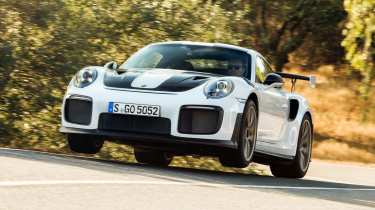
Yet there’s so much more to the GT2 RS than its raw firepower. If it feels within itself during normal driving, then its poise at higher workloads is breathtaking. I never question the steering from the first mile. Its accuracy is absolute, and if it doesn’t drip with feedback like an early 911, it tells you everything that’s important. In the GT2 RS you can brake incredibly late into a corner, feeling the ABS cutting in over undulations in the braking zone, then bleeding off the pressure as you trail it into the corner.
From that point on not once do the 265-section fronts ever suggest they might begin to push wide, instead the front end feels nailed to the asphalt, the car already having rotated around part of the turn but without even the suggestion of rear end nervousness. Now a brush of throttle energises the car, settles it, the first two millimetres of travel just the perfect amount for the task. Every time you summon it thus, something aft cracks and bangs naturally, repeating itself if you lift, so that it almost sounds like an anti-lag system.
Open the steering wheel a bit. Once you can see the exit you can get back on the throttle, and due to the GT2 RS’s immense traction this can be earlier than in almost any other car and much earlier than you’d expect. Get a little greedy and there’s the delicious sensation of torque beginning to ever-so-slightly overwhelm the grip the rears have on the tarmac, teasing those giant rubber bands away from the surface. Learning that sensation is important, for once you know what that feels like, you may feel inclined to push your luck a little further…
Switching PSM off in the GT2 RS feels like removing the muzzle on a military-spec Alsatian. But from talking to Kern, it’s obvious that the extraordinary lap time wasn’t due to the GT2 RS being a wild animal: it was because he felt confident in the car, dialled into it, able to adjust it at slower speeds but reassured by a window of understeer in high speed curves. After all, the final two second improvement at the Nürburgring came from taking the left kink after the public entrance flat out at 192mph. That’s not a car on the edge: that’s a car breeding confidence in the most extreme scenario.
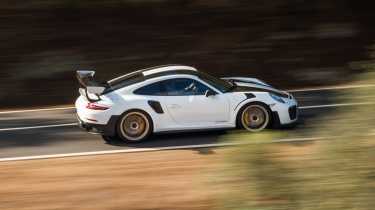
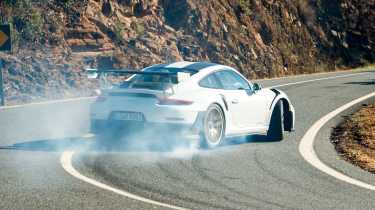
And you get to feel just a little bit of that on a road such as this. When the rear does brake traction, as it will do easily in a number of forward gears, it is more manageable than you might imagine. Sure, it demands precise inputs at all times, but it’s a long way from being frightening.
After a while it’s this unflappability that comes to define the GT2 RS. When it takes off it flies straight and level and lands four-square. Not once does that deep front splitter kiss the tarmac, regardless of this road’s uneven surface or the car’s velocity. It seems impervious to everything, but not lifeless; there’s still a faint nose bob over undulating surfaces, reminding you of the fundamental weight distribution. It’s still a 911.
After our time with the car expired and we head for the airport, the GT 2 RS retreats back inside its shell as though I’ve just pulled the plug out. This is the height of engineering cleverness, I do get that. But perhaps the GT2’s greatest failing is that it’s no more taxing, but crucially, no more dramatic, than a regular Carrera in the sort of driving it’ll inevitably spend the majority of the time doing.
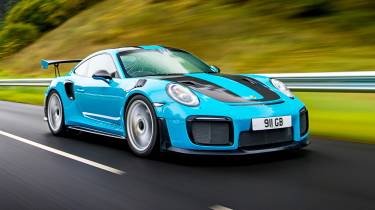
In fact, you could give the GT2 RS to anyone in your family with a driving license and they’d drive it to the shops without so much as a raised eyebrow. Should it be thus? I commented at the time that if a new 911 has the performance and soundtrack of a Kremer 935 K3, I want it to command and blow my mind from the moment I open the driver’s door, not obediently get me to the office in comfort.
Moreover, I yearn for Clubsport to really mean Clubsport, like back in the days of the original GT2, the 993-based car. It shouldn’t still have suit hooks in it: it should have bare metal floors, a simplified dash, carbon door cards. It should be like a 991 Cup car inside, nothing less. That would make it so much more of an event even just popping out for some milk just like a Ferrari F40. You know what? I wish the shift paddles were three times the size. They’re too small.
I also worried that the GT2 RS was far too fast for congested British roads, and with that exhaust, it won’t be appearing on any British track days, either; I worried that you won’t be able to buy one unless you’ve bought more Porsches than most of us have bought takeaways in our lifetime, and that those that do will leave them in their delivery plastic and simply sit back and watch its monetary value climb.
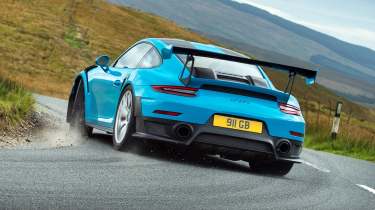
Finally, I wondered if it had 300bhp less but weighed 200kg less, would that make a better road car: maybe this is the last of the dinosaurs before a new dawn.
All of these things worried me greatly about the GT2 RS, yet despite those reservations, it was simply magic, an unforgettable car. Moreover, it felt like nothing less than the rebirth of the real Porsche Turbo. The angry Turbo, a match for anything, like the early days. It might not have had the homologation cred of the 993 GT2, but it felt like the direct descendant of that car, and its extraordinary Nürburging time wasn’t a bad motorsport substitute.
At last, the GT2 had emerged from the shadow cast by its smaller, naturally aspirated GT3 RS brother. It was a beautiful monster. It still is today. It’s just a monster that will cost your half a million pounds to buy.
How quick is the 911 GT2 RS on track?
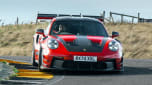
evo’s founding editor, Richard Meaden, headed to Anglesey circuit to see just how quick the Porsche 911 991.2 GT2 RS was against the clock.
Much has been written about this most extreme of all Porsche Motorsport department 911s, but not until you strap yourself in to the 911.2 GT2 RS does the reality of a 690bhp 911 on road-legal rubber truly hit home. This is the first time I’ve driven this generation of GT2 RS. Quite the introduction, and a good explanation for why my tongue is currently showing a propensity to stick to the roof of my mouth.
The driving environment is familiar territory for anyone who has sat in a GT 911 before: functional but comfortable, fuss-free but full of occasion. Twist the ignition key and the first major difference becomes apparent. The big-boost flat-six is an absolute dragon of a motor, breathing heavily from the tailpipes and filling the cockpit with a menacing pulse.
Should there be a manual GT2 RS? There’ll always be someone who wants one, especially if you get your kicks on the road, but I understand why a car so focused on track performance should only come with PDK. There’s certainly nothing to complain about with the way this dual-clutch gearbox goes about its business. The shifts are synaptic whether you’re working up or down the ’box, the latter changes complete with ultra-precise rev matching. I love stirring a gearlever, but when you’re driving against the clock the GT2 RS’s transmission is manna from heaven.
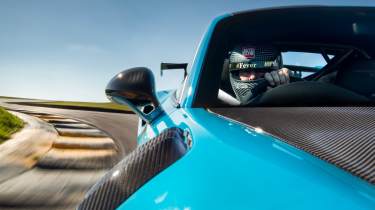
The steering is a bit lighter than you expect, but there’s plenty of feel and the front end is perfectly tied-down, so the car changes direction brilliantly, helped by the rear-wheel steering. You don’t have to cajole or agitate the GT2 RS into corners as you do older 911s, and this is a big step on in dynamics, as it allows you to concentrate on getting out of the corner rather than on how to get into it.
The GT2 RS isn’t quite as laser-guided as the naturally aspirated 991.2 GT3 RS. Some of that is down to the engine, which can’t match the throttle response of the sensational 4-litre naturally aspirated GT3 RS motor. It’s also because taming all that torque requires more measured throttle inputs. Fundamentally, it’s because the thing gains so much speed from the exit of one corner to the braking zone for the next that it forces a different driving style.
The brakes are stupendously capable, and crucially allow you to change direction while on the limit. Likewise, the ESC electronics permit just enough slip under power without letting things go too far, allowing you to ride out of the corner with a hint of oversteer, driven wheels rotating slightly faster than the fronts.
There are occasions where you unmask the GT2 RS’s well-hidden malevolence. If you’re too hurried with your steering inputs the front end has the grip to turn faster than the tail wants to move (even with rear-wheel steer) or has the lateral grip to support, but it’s a fleeting moment of instability that’s soon contained.
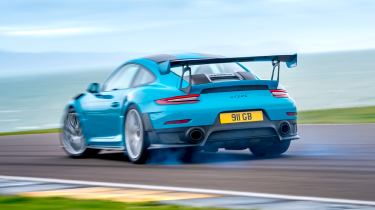
Logic suggests a rear-wheel-drive 911 with this much power and torque should be almost uncontrollable in anything other than a racing driver’s hands, but the reality is that, while it demands respect, the GT2 RS is incredibly precise and magnificently exploitable if you show it the requisite skill and confidence.
There’s always pressure to nail a clean lap within the first two flyers, simply because although the Michelins remain admirably consistent over prolonged stints, they have a few laps where they are at their absolute best. With ESC and TC on, it sets a 1:12.1 on Anglesey’s coastal circuit, while with ESC off I go a couple of tenths slower.
It’s an emphatic display. Just as impressive – at least to me – is the fact that this utter beast of a 911 has such precision and control to go with the immense power and torque. You need your wits about you, and it’s not a car for faint hearts or inexperienced hands, but we wouldn’t want a GT2 RS any other way, right?
evo Car of the Year 2018 result – Jethro Bovingdon
‘It seems odd to find the 911 GT2 RS in third position. As we are constantly reminded, ‘Porsches always win’. Of course, that’s not true, and although 911s have dominated eCoty over the years, we stand by the results. Their combination of tactile feedback, endlessly challenging and rewarding dynamics and the toughness they exude nearly always creates a truly special driving experience.
‘And you know what? On a different day, with the wind blowing in the other direction, maybe the GT2 RS could have won. It is an astonishing experience. A car that brings hypercar levels of performance to the 911, a car that decimated the Ford GT on track in our Anglesey group test. And yet despite its immense performance potential the GT2 RS is exploitable, puts its power down beautifully and above all gives the driver huge confidence.
‘So why third? It came down to a number of factors. Firstly, the GT2 RS is no longer the supercar bargain. At £207,000 it’s almost twice the price of a 991 GT3. Which leads us on to the next point... How fast do you need to go? Put simply, the extreme character that makes the GT2 RS so compelling is also its downfall. It nearly always feels reined-in on the road, like you’re just scratching the surface. Of course, you could argue the same for every supercar, but because the beauty of the 911 has always been its accessibility, it feels all the more painful here. We adore the GT2 RS, which says a lot about the cars that finished ahead of it...' – Jethro Bovingdon, eCotY 2018.
Verdict and values
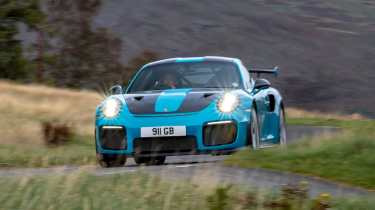
The 911 GT2 RS was the embodiment of the hardcore, track-honed road car of the time and still is today. Blisteringly quick and brimming with attitude, it is blessed with a depth of character and breadth of ability that shames the Ford and makes it as engaging on the road as it is extraordinary on track.
It excels as a track car and sits at the extreme end of the road-legal driving experience and truly defines the breed. Ballsy, boosty and breathtaking in every respect, it was one of Weissach’s modern masterpieces and still is today.
The GT2 RS was priced from £207,506 when it was new from 2017 to 2019 (not much more than what you’ll pay for a new GT3 SC today). Porsche originally planned to make 1000 examples but in the end, over 1200 were made for North America alone. In the UK, it’s believed in the region of 130 cars were ordered. Being a car that only comes along once a generation, as opposed to being a near-constant in the range like GT3s and GT3 RSs, GT2 RS values are still over double what they were new. You won’t pay less than £400,000 for almost any example today, with highly desirable specs and low-mile cars worth up to and over £800,000.
Specs
| Engine | Flat-six, 3800cc, twin-turbo |
|---|---|
| Power | 690bhp @ 7000rpm |
| Torque | 553lb ft @ 2500-4500rpm |
| Weight | 1470kg (477bhp/ton) |
| 0-62mph | 2.8sec |
| Top speed | 211mph |
| Price new | £207,506 |
| Value now | £400,000-plus |