Peugeot 208 GTI (2012-2018) review – Ford Fiesta ST fighter is now a hot hatch bargain
It took some time to warm to the 208 GTI but in Peugeot Sport form it became an evo favourite
In 2026, Peugeot launched a new 208 GTI… powered by electricity. It’s pretty good, though it’s been a long time coming, with an eight year separation between driving the latest car, and the old and much admired 208 GTI going off sale in 2018.
For the most part, Peugeot’s last hot hatch was a hit here at evo, thanks to a punchy engine and a hyper-agile chassis that could give the best hot hatches of its day, including the Ford Fiesta ST, a real run for their money. In fact, depending on the road, the top versions of the Peugeot could actually eclipse even the Ford for fun.
They’re strangely overlooked today but are abundant on the used market, and as the hot hatch landscape changes, they’re sure to become a bit of a cult choice. While the 208 GTI by Peugeot Sport didn’t fare very well at the ultra-competitive 2015 evo Car of the Year competition, finishing last (you can read our sum-up verdict below), when put against its direct rivals the result was always much closer.
Engine, gearbox and performance
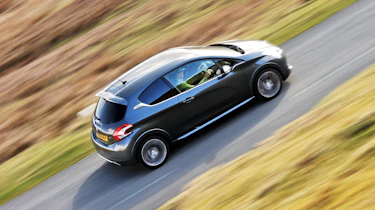
- 1.6-litre turbo engine has plenty of punch in regular and Peugeot Sport forms
- Gearchange feels a little baggy but the shift is quick
- Anniversary/Peugeot Sport desirable for its LSD and shorter gearing
More reviews
Group tests
- Peugeot 208 GTi by Peugeot Sport vs Renaultsport Clio 200 Cup
- BBR Mazda MX-5 Turbo vs PUG1OFF Peugeot 205 GTI 195 review
Long term tests
Reviews
All 208 GTIs use a variation of Peugeot’s ubiquitous 1.6-litre ‘THP’ turbocharged inline four. This unit went in everything, from other Peugeots, to pseudo-premium models from the DS Automobiles sister brand, and even the second-generation MINI Cooper S, while more highly-tuned variants found their way into cars like the Peugeot RCZ-R and the later 308 GTI by Peugeot Sport.
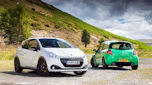
The 208 was never offered with the all-singing, all-dancing 266bhp engine that found its way into the latter pair, but it still got 197bhp and 203lb ft at launch, and in later 30th Anniversary and Peugeot Sport (PS) form, was bumped up to 205bhp and 221lb ft – all competitive figures for an engine of this size and for the era. A six-speed manual gearbox was the only transmission available, while regular GTIs got an open diff, and Anniversary/PS cars got slightly closer gear ratios and a Torsen limited-slip differential.
The upshot was 0-62mph in 6.8 seconds (both officially, and on evo’s timing gear), while Peugeot claimed 6.5 seconds for the Peugeot Sport variant. Top speed was 143mph regardless of quoted output. They’re not lacking performance then, nor drama, as the 1.6 delivered its power in an intoxicating and slightly boosty rush. It was a more dramatic delivery than you’d find in a Fiesta ST, though Peugeot’s hatch didn’t sound as good – the exhaust note was always a little bland.
Ride and handling
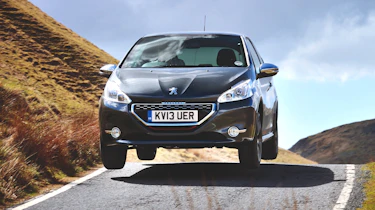
- Just as agile as its closest contemporary rival, the Ford Fiesta ST
- Small steering wheel gives it a responsive feel
- Not as much feedback as the true greats, but still engaging
If the engine is potent but a little bland, the same cannot be said of the chassis, at least with the Anniversary and Peugeot Sport cars. Peugeot hot hatches have always had a bit of an edge, and with the GTI by PS, it feels like engineers made the most of having the safety net of ESP for drivers to fall back upon. Nudge that small-diameter steering wheel even slightly offline and the 208 hungrily follows your input, and continues following as you wind more and more steering lock on.
It’s impressively resistant to understeer and, yes, that means it’ll first pop an inside rear wheel off the deck, and then if you lift off, begin to swing around from the back – then either held back by the ESP’s reins, or if you’ve switched everything off, to be quickly caught by a turn of opposite lock.
The effect is much more pronounced in Anniversary and PS models, in proportion to their higher power outputs. Opt for a standard 208 GTI and you may initially wonder what the fuss is about, though the tradeoff with these less focused versions is it’s easier to find a natural flow. What none of them do is really feed back much information to your fingertips, and some of the other controls are a bit awkward too, from the slightly spongy (but mightily powerful) brakes, to the clunky gearshift. Ability over tactility would be a good way to describe it, though next to the very latest hatches, it already feels a little old-school.
Peugeot 208 GTI updates – 30th Anniversary and Peugeot Sport
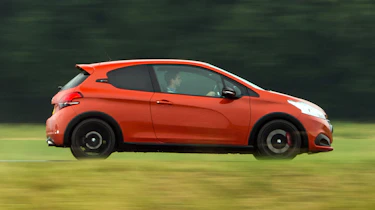
The first significant changes to the 208 GTI came with the 30th Anniversary model in 2014, which celebrated 30 years since the 205 GTI had first hit the roads. Bit of a risk drawing attention to this fact given Peugeot’s patchy recent history for hot hatches, but the 208 was already a better effort than the 206 and 207 GTIs had been, and with Peugeot Sport calling the shots – who’d recently turned out the brilliant RCZ-R – there was little to worry about.
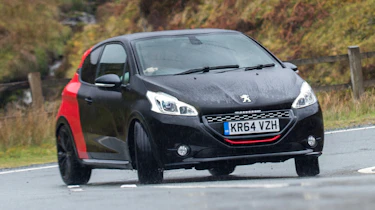
Power climbed to 205bhp but the biggest changes were the new Torsen limited-slip differential and shorter gearing. The track was also 22mm wider at the front and 16mm wider at the rear, while the car sat 10mm lower on stiffer springs and firmer dampers – rear springs were 80 per cent stiffer than standard. There was a thinner front anti-roll bar to improve traction, the toe and camber were tweaked, and Michelin Pilot Super Sports were standard. Anniversary models came in a two-tone black and red colour scheme called Coupe Franche, with wheel arch extensions covering the wider track, and black-painted 18-inch alloy wheels.
In 2016, Peugeot adopted the Anniversary model’s changes into a mainline model, wearing the longwinded official title, 208 GTI by Peugeot Sport. We tend to abbreviate it as 208 PS, which conveniently is also the car’s metric power output…
Peugeot 208 GTI PS track test
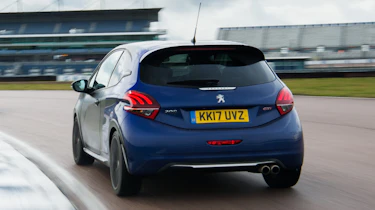
Heading onto the track, the GTI feels like a serious bit of kit from the outset. There’s a tautness to its ride and the 205bhp 1.6 delivers its urge in an intoxicating rush of turbocharged energy. In damp conditions the 208’s front wheels find turn-in grip effectively, particularly in tighter sections. On the exit of corners, though, the Peugeot’s tendency to dump all its torque in one go as the turbo spools up means traction is easily broken and the nose can slide wide. That said, in the dry the Torsen limited-slip diff does a staggering job of keeping you locked onto your chosen line even when the throttle is being squeezed into the carpet.
As you’d expect from a hot Peugeot, the 208 is fairly throttle-adjustable, allowing you to fine-tune your approach mid-corner – although you need to be wary that you don’t get too committed with your trail-braking, as with the stability control switched off the GTI can whip its tail around rather quickly. Yet the Peugeot’s biggest problem is its transformation in character from dry to wet conditions. In the former there are huge reserves of grip from its Michelin Pilot Super Sport tyres, allowing you to load up the chassis and feel the levels ebbing and flowing, egging you on to try harder. However, when the heavens open, the 208 turns mute as its firm suspension struggles to generate grip, which means the chassis can’t communicate, leading car and driver to spiral into mutual distrust.
‘The balance can be played with by lifting off, but the transition from grip to slip and back to grip again is abrupt,’ notes Richard Meaden. ‘It just feels like different people have signed off different elements of the car.’
John Barker is more damning in his verdict, saying: ‘If these were the conditions and this was the car I had, I’d go to the canteen, get a cuppa, and stand trackside watching other people have more fun.’ It’s a shame, because while this dual character still afflicts the Peugeot on the road, the differences aren’t as amplified as they are on track. It’s still a cracking hatch, but you’d be advised to check the weather forecast before setting off for a trackday.
What’s the interior like and is the tech any good?
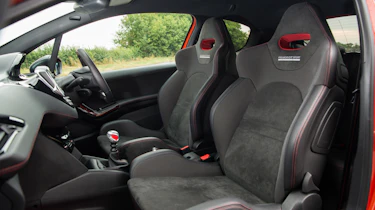
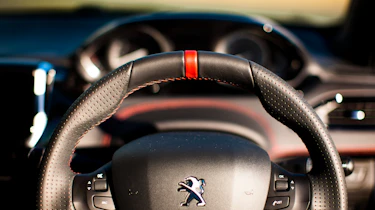
What’s the interior like? That’s a loaded question with a 2010s-and-onward Peugeot. The 208 debuted Peugeot’s ‘i-Cockpit’ dashboard layout, a fancy way of saying they’d put the instruments high on the dash, and put a small-diameter steering wheel below them, the aim being you look at the dials over the top of the steering wheel rim.

A Peugeot interior designer once told us you’re supposed to put the bottom of the wheel where the bottom of a normal wheel would be, therefore giving you a good view of the instruments, but if you like to sit low and have the wheel set high, like a touring car driver, then you’ll probably find the top of the wheel partially or completely obscures the gauge cluster.
This alone will turn some people off the 208 GTI, but for others it’s not a problem. The seat does go nice and low, and the gearlever is in the right place, though the pedal layout was never ideal, as the arc of each pedal seems to go downward as much as it does inward. Ankles can begin to ache after a while, as if you need another joint mid-shin to operate them correctly. The brushed metal finish can also be pretty slippery.
Quality was good when new, and you’ll find nicer materials than in a Fiesta ST. The touchscreen feels a bit small and slow by modern standards and there’s no CarPlay, but you can still plug a phone in to listen to your tunes, and thankfully, the air conditioning controls were still physical buttons at this point.
Peugeot 208 GTI MPG and running costs
Around the time of the 208 GTI’s launch, car manufacturers seemed to make fairly meaningful strides not just in performance but also economy, and Peugeot claimed a fairly remarkable-sounding 52.3mpg from the GTI, a number unchanged for the Anniversary and PS. That was around 5mpg more than the already impressive Fiesta ST’s economy figure, and resulted in a 125g/km CO2 figure.
Even if it’d rarely hit that on the open road, well over 40mpg was possible on a motorway cruise, so even today the GTI promises fairly low day-to-day running costs. The CO2 figure is also beneficial, especially for cars registered before April 2017, which attract a modest VED bill of £170 a year. Cars registered after this date fall into the current system, with a flat rate of £200 a year (at the time of writing).
In terms of tyres, a set of Michelin Pilot Sport 5s for a standard GTI (in 205/45 R17) are currently around £140 a corner, while the Anniversary/PS 205/40 R18 tyres are more like £180 a corner for Pilot Sport 4S or Pilot Sport 5 – though you’ll need to look to other brands for an equivalent to the Super Sports that Peugeot originally fitted.
evo Car of the Year 2015 result - Stuart Gallagher
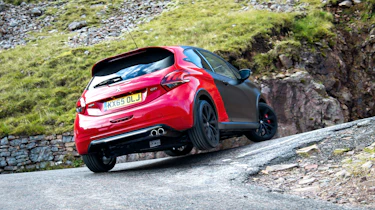
‘Something has to start the countdown and this year it’s the Peugeot 208 GTI by Peugeot Sport. Adam Towler sums it up best: “It doesn’t feel special enough… it’s about depth of ability. The engine is all but inaudible, the gearshift quick but sloppy. It’s well on the way to being a great hot hatch but just falls a bit short.” The best hot hatch Peugeot has built for a generation is left wanting in this company, then.’
evo Car of the Year 2017 result – Adam Towler
‘Not once do I yearn for a single extra horsepower guiding the GTI down one of the great themepark ride roads in the Yorkshire Dales: the Peugeot pulls with real gusto from very low revs but has the top-end energy that’s so vital in a small hot hatch. Its diminutive size is a real boon – a confirmation that, actually, a great hot hatch is not all about genuine downforce, Ring lap times and having 300bhp-plus. The 208 scythes between the low stone walls with plenty of room to spare either side of it, allowing the driver to choose their own cornering line, rather than being a mere prisoner between an unyielding barrier of hard rock and a painted white line.
‘There is tremendous cornering grip, to the point where I make a mental note to check if the tyres haven’t been swapped for a set of Cup 2s. The diff is a work of wonder, allowing the chassis to resist understeer and cutting engine output wastage to zero. But even more than that, it’s the willingness of the 208’s rear axle to play an active part in cornering, and the sheer agility of the car, that makes this supermini a special driving experience. For every mile on the M1 that you might curse the insistent rebound rates of the dampers, your faith is repaid three times over when the road gets interesting.
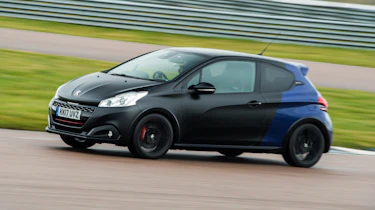
‘Having said all of the above, the 208 isn’t perfect. The engine is all but inaudible at times, and together with its occasionally soft throttle response makes attempting a heel-and-toe downchange particularly vexing. An odd driving position only exacerbates the problem, as Will concurs: ‘The pedals are too close and you almost push down on them rather than flex your heel, while the steering wheel is too far away and almost totally obscures the dials – for me at least.’
> New Peugeot 208 GTi review – can it take the fight to the Alpine A290?
‘A day later, a different road and different weather, and the 208 begins to struggle. Blasting across the moors in driving rain, it feels too stiff, the steering a bit nervous, the finesse from working the controls smoothly hard to come by. It’s still a very rapid little device, but it requires a firm hand to stop it going wayward. Yet overall this is a terrifically desirable hot hatch: small but practical, relatively frugal, and most of all a car created by people with an obvious passion for enthusiastic driving. Forthcoming contenders will need to work hard to dethrone our favourite supermini.’
Long-term test – 11,972 miles in the Peugeot 208 GTI PS
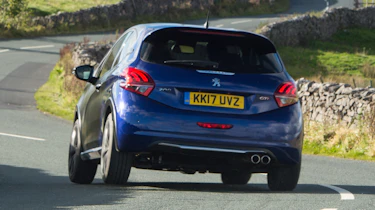
‘I don’t feel I had enough time in the 208. Not because I didn’t understand it, not because I couldn’t read it intimately, not because it couldn’t be enjoyed unless the environment was perfect. Far from it. It’s because I hadn’t tired of it, at all. Every time I got behind the wheel something exciting or memorable happened, because I almost always failed to drive it in a calm or relaxed manner. The car’s attitude was so energetic – it didn’t want to cruise along, it wanted to force its short snout through the air, sniffing out any interesting stretches of tarmac. You’d experience one, if not all of its party tricks in any drive.
‘The interior could have felt more solid, but beyond the brittle plastics and slightly tinny sounds, the chassis felt robust and durable. You didn’t hesitate to commit down bumpy, craggy roads, because although the firm set-up would throw you and the car around somewhat, when the tyres were in contact with the ground you could feel them vehemently clawing away at the asphalt.
‘I didn’t just love the way this car drove either; it was a joy to live with too. Just basic cruise control, none of that radar-guided nonsense, was perfect for reining in the eager, 205bhp engine when meandering through towns and villages. Meanwhile the infotainment system, once you’d got to grips with the steering-wheel buttons, made switching between the navigation and entertainment, or skipping songs or changing radio stations, incredibly easy.
‘More complicated tasks were a little trickier, though, and they weren’t made any better by a slow touchscreen and a non-QWERTY keyboard for your inputs. Also, the Bluetooth connection developed a little quirk during our last month with the car, cutting out for a moment every couple of seconds. After 15 minutes or so, when things had warmed up, the problem stopped – much to the relief of passengers, who seemed to prefer listening to songs in their original form rather than with my rendition filling in the missing snippets.
‘The 208 fitted into my life perfectly. It didn’t need to be bigger, faster or more economical, and I can’t imagine it being any more exciting. I even learned to love the Coupe Franche paintjob: it made it clear to everyone that this was no ordinary 208 GTI. I am going to really miss it.’ – Will Beaumont.
Peugeot 208 GTI prices and buying checkpoints
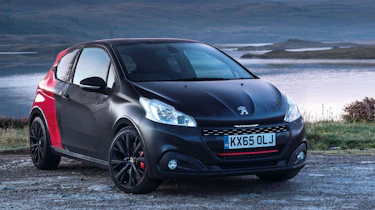
With the earliest examples now more than a decade old, the 208 GTI has well and truly fallen into the pit of depreciation. It’s possible to find early cars for under £2000, around a grand cheaper than the cheapest Fiesta STs. Expect high mileage at this point – one we found was on 158,000 miles, though that’s actually quite reassuring for the car’s longevity – and you’ll need to check very carefully for evidence of crash damage, while paperwork might be patchy at this level.
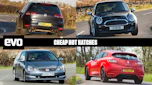
Double that budget and things begin to look quite tidy, and for six or seven grand you should be able to find a very nice car in a desirable spec with relatively low miles – around 50,000. This is also the price point at which you’ll begin to find Anniversary and Peugeot Sport versions, though they’re quite thin on the ground.
In MINI circles, cars with the 208’s 1.6-litre turbocharged engine have a pretty lousy reputation, but the engine seems much less troublesome in its Peugeot application. Nevertheless, these cars aren’t entirely free of issues: turbocharged wastegate actuators, timing chain rattles, gearbox synchro wear, and touchscreen faults are commonly reported. By now, some cars will be starting to feel a little rattly too, and damp boot floors (water gets in through degrading rear light seals) aren’t uncommon either.
Specs
| Peugeot 208 GTI (2012) | Peugeot 208 GTI PS (2015-2018) | |
|---|---|---|
| Engine | In-line 4-cyl, 1598cc, turbocharged | In-line 4-cyl, 1598cc, turbocharged |
| Power | 197bhp @ 5800rpm | 205bhp @ 5800rpm |
| Torque | 203lb ft @ 1700rpm | 221lb ft @ 1700rpm |
| Weight | 1160kg (173bhp/ton) | 1160kg (180bhp/ton) |
| 0-62mph | 6.8sec | 6.5sec |
| Top speed | 143mph | 143mph |
| Price new | £18,895 | £23,550 |
| Value now | From £3000 | From £4500 |