Ford’s Le Mans return – behind the scenes at Ferrari-fighting Hypercar’s test
A 5.4-litre V8 derived from the heart of the Mustang will power Ford’s hopes of taking to the top step
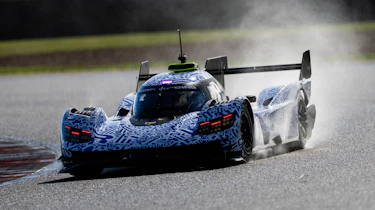
Truly, a golden age of endurance racing is underway, with Ford gearing up to join a packed grid of Le Mans Hypercars for 2027’s World Endurance Championship (WEC). Last time Ford fielded a full factory effort in the WEC it was from 2016 to 2019 with the modern-era Ford GT in the LM GTE class. It took a class win at Le Mans in 2016 (aptly, after a battle with Ferrari), and plenty of further class podiums and wins elsewhere. This time it will be competing in the top class for overall honours – for the first time since the GT40 in the 1960s. The new car doesn’t yet have a name, or at least, not an officially announced one; but it feels a safe bet it’s likely to include the letters ‘G’ and ‘T.’
We joined the nascent Ford team at Silverstone as a fly on the wall for the new Hypercar’s third test, following earlier runs at Paul Ricard and Portimao. As we arrive in the morning, a transporter is unloading the three Ford GT40s that finished first, second and third at Le Mans in 1966. They’re not replicas; they’re the real thing. Rarely seen in public in the same place at the same time, it’s a thrill in itself to be within touching distance of them. They’ll be running later too, for a photo opportunity with their new descendant.
Since the modern Hypercar era of regulations hit its stride in the early 2020s, a bumper crop of big-name manufacturers have mounted official factory efforts for the Le Mans 24 Hours and overall WEC. Past winners Peugeot, BMW and Ferrari have returned, after 50 years away from the top class in the latter’s case. Aston Martin’s wailing V12 Valkyries joined the party last year, too. Ford coming back to face up to Ferrari at Le Mans in 2027 is the icing on the cake.
Ford’s Hypercar: the technical overview
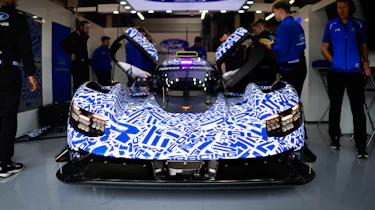
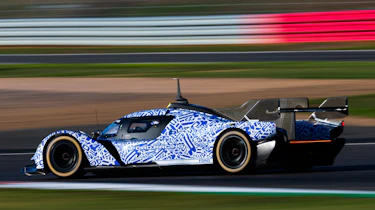
Out on the damp track, the new Hypercar can already be heard in action. It’s the classic iron-thunder sound of a naturally aspirated V8. Although the new car is a hybrid as is mandated by the regulations, Ford has chosen a turbo-free, 5.4-litre race version of the Coyote V8 found in the Mustang Dark Horse, to power it.
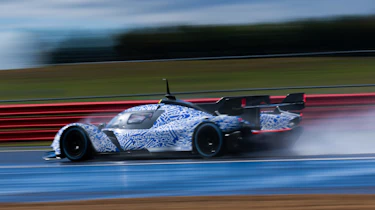
The new prototype comes into the pits, hits its marks and falls silent. It’s wrapped in graphic camouflage for now, its final livery yet to be confirmed. Its headlight graphics echo those of recent Ford road cars while the overall shape is similar to that of other current Hypercars. Final bodywork homogolation will be signed off at the end of December, at which point the shape will be frozen, with various physical and wintunnel tests between now and then to finalise it.
The Hypercar class is divided into two sub-categories: LMH, for Le Mans Hypercar, and LMDh, for Le Mans Daytona hybrid. Ford has chosen to build its car to LMDh regs. Although LMH (as used by Ferrari, Toyota and Peugeot) allows much more technical freedom, it can be more expensive and time-consuming to create a car for; LMDh (chosen by BMW, Cadillac and Genesis) is more restrictive as it requires entrants to use a ‘spec’ chassis from a third-party supplier (French constructor Oreca, in Ford’s case) and a standardised hybrid system (with free choice for engine). But it enables a more rapid turnaround – ideal for Ford, since the new Hypercar programme has been set up at top speed, as Ford Racing global director Mark Rushbrook explains.
‘It’s been less than two years since we’ve had formal approval,’ Rushbrook tells evo, explaining that initial discussions began in 2024. ‘To be able to have the car here and running has been a massive challenge for both Oreca and us. To do the engine entirely in-house – the design and build, and both the engine and driveline dynos, all that in Dearborn – has been a tremendous project as well. To have it all together, in the car, running, it’s pretty special to hear it.’ He pauses for a moment to savour the sound of the V8 hammering past the pits at full chat. ‘There’s still a lot of work to do before we're ready to race, but we've got a great team, a great group of people, a great partner with Oreca and we love what the engine's doing so far.’
The engine, developed in-house by Ford, as Rushbrook explains, is broadly based on the Coyote road car V8 engine family. The decision to avoid turbocharging is partly because it means less cooling, less bulky packaging for aerodynamics – and less potential for things to go wrong. It also fits well with Ford’s identity, and gives an aural and technical link to some of its road cars and history. Balance of Performance regulations – which ensure LMH and LMDh cars have parity to compete equally on pace – mean it’s running around 670 horsepower.
‘I’m a simple person,’ smiles Ford Hypercar programme manager Dan Sayers, ‘and for an endurance car, the simpler the better – you lose the intercoolers, you lose the turbos.’ Sayers has transitioned to lead the Hypercar project directly from Ford’s Red Bull F1 powertrain, where he was programme director, and it’s been possible to translate crucial know-how onto the Hypercar programme, particularly from a software point of view. ‘There were some Ford Racing engineers embedded at Red Bull doing a lot of software, and they have assisted in the software and control systems [on the Hypercar],’ Sayers explains. ‘That’s been a great help.’
‘It would have been possible to do this [project] without Red Bull but it would've been harder because the engineers that we had on-site [at Red Bull] in Milton Keynes learned a ton from that,’ Rushbrook concurs. ‘We also learned a lot on our [Mustang] GT3 racing programme, even though it's not a hybrid, with torque control with the torque sensors. A lot of the engineers here today were on that GT3 programme as well. Part of our mission is sharing not just across the racing programmes, but also back to production programmes as well.’
The Hypercar is a true global effort, with engineers split between multiple locations including Ford’s motorsport centres in Dearborn, Michigan, and Charlotte, North Carolina, plus at Venture Engineering, the team’s technical and operational partner, in Oxfordshire in the UK. ‘We’ve actually got cover for 18, 20 hours of the day,’ Venture’s Andy Williamson explains. ‘If we're finding things on this side, we can hand it across [to the USA], work can be done [overnight] and then pushed back again, which is fantastic.’ Access to Ford Racing’s simulators, rolling-road wind tunnels and beyond in the USA is a valuable tool, too. The team has recruited personnel from diverse backgrounds including Formula E, Formula One, IMSA, and WEC.
While some Le Mans Hypercars such as those of Ferrari, Peugeot and Toyota have electrified front axles, since it is an LMDh car the Ford Hypercar must be purely rear-wheel-drive. Its mandated ‘off-the-shelf’ hybrid system acts on the rear axle only, including a Bosch motor and power electronics, Williams battery and Xtrac seven-speed gearbox. LDMh cars are also eligible to run in the IMSA racing series in North America but for now, Ford is concentrating purely on the WEC.
Ford’s Le Mans return: the background
The new Hypercar programme is yet another strand of Ford’s new multi-tier attack on world motorsport. It’s also officially rejoining the top class as a full factory team in the World Rally Championship from 2028, the Ford Mustang GT3 and GT4 cars are competing in GT championships around the world (including WEC, in the GT3’s case) and it’s in Formula 1 too, as powertrain technical partner for the Red Bull Racing team. It also remains a fixture in the Dakar rally with the Raptor rally raid vehicle, and in NASCAR with Mustang- and F150-themed cars. Only perhaps Toyota – another rival for WEC Hypercar honours – can claim to have as many fingers in as many motorsport pies.
How did the decision to compete at Le Mans in the top Hypercar class come about? ‘In 2024 when we went back to Le Mans with the Mustang [in the LMGT3 class], it was incredible to be able to race that iconic car at that race, [however] it was pretty clear we needed to be there also competing for the overall win,’ Rushbrook tells evo.
‘Of our 125 years of Ford racing, the Le Mans era from ’66 through ’69 is very meaningful, so while sports car racing is on a high, with so many manufacturers involved, it’s a race that we want to be at to compete for the overall win.’
Ford’s Mustang programme in the LMGT3 class will also continue alongside the Hypercar.
Ford’s Hypercar driver line-up
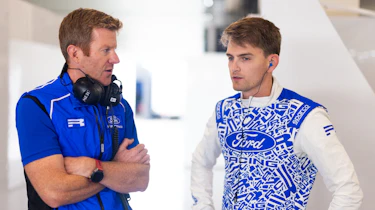
Ford has gone for a mixture of experience and youth in its driver line-up for its two-car team. Former Le Mans winner for Audi, Mike Rockenfeller, is joined by British drivers Nick Yelloly and Sebastian Priaulx. Former Porsche factory driver Matt Campbell is joined by British-Swedish driver Tom Blomqvist and former Williams F1 driver Logan Sargeant.
How good is the line-up? A former Le Mans winner from another, German, marque recently told evo: ‘I think Ford has one of the best driver line-ups. It’s very strong.’

Priaulx, 25, has a direct link to Ford at Le Mans as his father, Andy, was factory driver in the Ford’s GT LME squad. Has he given him any tips? ‘I don’t need any,’ Sebastian jokes. ‘No, for sure he’s got things he can tell me and I’m still able to pick his brains a bit for stuff.’
Today is Sebastian’s first ever run in the new Ford, having been racing both LMP2 and GT cars this year: after his first laps, how does the Hypercar compare? ‘It definitely feels heavier [than the LMP2]. It feels faster but in low-speed corners it’s a little bit more like a GT car: more dive and pitch and weight transfer, which I don’t mind. Engine-wise, the base is great: power delivery and driveability are good. Of course, testing on your own is one thing and then testing with other cars, then you know where your true speed's at,’ he adds. ‘I think we've got a mountain to climb still but we're optimistic. I think we’ve got a good base.’
What will be realistic for the car’s first season? ‘I think to get a podium would be great in our first year. Just to be up there would be very good. I think winning is going to be tough, especially the first year. Second year, I think we can fully go for it.’
Logan Sargeant will take over driving duties tomorrow for the test’s second day, having previously tested the car at Paul Ricard. ‘It was fantastic to drive it for the first time,’ he tells us. ‘It was extremely smooth from a power delivery point of view. Of course, there's plenty to work through, but I felt like for a first test, we hit the ground in a decent place.’ Does it feel different being in a car that’s a clean-sheet design and being part of the development story from the get-go? ‘One-hundred per cent. It's extremely different because there are so many different kinks to work out, and it's cool to be part of that, to work those out and to be part of the direction the car heads in.’
How different does it feel to an F1 car? ‘You have to be quite gentle on the brakes for the most part. You definitely can't overload them. Particularly at the first test, I found it was the trickiest part of the car to drive but I think as we continue to develop the system, it'll become more in the norm.’ And how does endurance racing in general differ from F1? ‘It’s a bit of a different mindset. Sometimes you have to make compromises, in set-up, seat fits, everything. So it's very different in that aspect, but a bit more of a laid-back atmosphere compared to single seaters for sure, while still being very competitive.’
Looking at the trio of GT40s sharing garage space with the Hypercar team, is he angling to get himself into one of them for a few laps. ‘I don't know if I deserve to! Man, they're absolutely beautiful. I couldn't imagine driving that at Le Mans for 24 hours, two drivers. They were different animals back then. A lot of respect.’
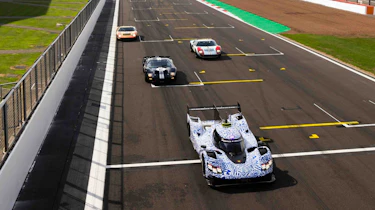
A few minutes later, the GT40s rumble onto the track in formation with the new Hypercar for the cameras. Priaulx is behind the wheel of the new car: ‘That's a dream come true, sitting in a Hypercar,’ he tells us afterwards. ‘Those cars won outright at Le Mans and I've got the opportunity to do the same in this car. It’s a “dream as a kid accomplished” sort of thing.’
The test programme so far
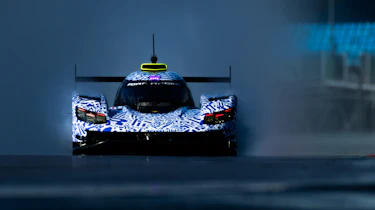
The Hypercar’s testing began with shakedowns in August at Ford’s own driving centre and on an airfield, to ensure all the basic systems were operating properly, before heading to Paul Ricard in France for its first proper test. ‘We know we're on a condensed schedule, so we have to maximise every single minute we get the track,’ Dan Sayers explains. Since Ricard, it’s undergone a four-day test at Portimao in Portugal. It covered more than a thousand kilometres at both those circuits, and Silverstone is its third test. The focus here is on traction control, braking and control systems.
‘We’re hitting all of the test milestones we’ve planned for,’ Sayers says. ‘Would we like more time? Of course we would.’ Any loss of track time would be very costly, so it’s extra pressure on the drivers not to have any mishaps on the damp circuit and damage anything – there isn’t a rack of spares as there would be for an established car. Nor, in fact, is there a spare car: at the time of the Silverstone test, the car is the car.
This is the first chassis, with the second Hypercar almost ready and logging time in the windtunnel in the USA at the time of writing, and Chassis Number Three a few weeks off completion too. As you read this, the team will have completed a two-car test at Monza in Italy. Next step beyond that is a 30-hour endurance test at Aragon in Spain, with COTA and Sebring in the USA to follow.
‘There’s been a lot of learning so far and a lot more learning to do but we're in a good place,’ Rushbrook tells evo. ‘The foundations are there.’
Who are the rivals Ford must beat? And what are its chances?
Ford isn’t the only big-name former Le Mans winner returning for 2027 after decades away from the frontline: 1995 winner McLaren will also be back with its own new Hypercar, also built to LMDh regulations.
Of the established teams, Ferrari has won three Le Mans 24 Hour races in a row from 2023 to 2025 but Toyota has been one of the most successful teams all round, winning three of the last four WEC titles and Le Mans in 2026. Cadillac and BMW have been highly competitive and while Peugeot has endured a tough time, it is renewing its efforts to fight at the front. Aston Martin is preparing an update to its Valkyrie Hypercar and Genesis will be entering its second season after a promising debut.
The first race for Ford will be the opening WEC round at Qatar in March 2027, although at the time of writing there is some doubt as to whether the event will be rescheduled or relocated, which sprinkles a little extra uncertainty into the team’s preparations.
Ford Racing global director Mark Rushbrook is realistic about the team’s chances in its first season:
‘The goal anywhere we race is always to win races and championships [but] we know practically we can't win every race and the massive challenge that this programme is. It’s a massive technical challenge to take on, to have an engine performing at this level, to have the complexity of this hybrid system and to truly optimise it. But we're also coming in against competitors that have a four-year head start, and a lot of great OEMs and great teams.’
Did Ferrari’s return also play a part in Ford’s decision, for the added publicity of ‘Ford versus Ferrari’ headlines?
‘Not Ferrari by itself, of course,’ Rushbrook replies. ‘There's so many great manufacturers there. Yes, it's Ford versus Ferrari, but it's Ford versus a lot of other good manufacturers as well. We know it's formidable competition, but our commitment is to keep working until we win.’