Mercedes GLC Electric review – big on space and tech, if not driver appeal
The Mercedes GLC Electric rolls out a load of clever EV technology and uses it to soothe, rather than entertain, its driver

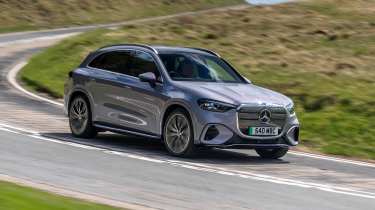
If you have £60,000 to spare and the need of a new car, there are more inspiring choices than a mid-size, premium electric SUV. It is nonetheless a fiercly fought sector underpinned by massive investments in platform and battery tech, with the latest inductee Mercedes-Benz's new GLC Electric.
It's here to face off against the likes of the BMW iX3, the Volvo EX60, Audi’s Q6 e-tron, Porsche’s Macan Electric and the Alpine A390. If you had to sum-up the Mercedes plan to help the GLC Electric come out on top in one word, it would be technology.
Mercedes sells a petrol and hybrid-powered car called the GLC but the GLC Electric has very little to do with that. It rides on a dedicated EV platform called MB.EA that it shares with the new C-class Electric and has a raft of standout tech plumbed-in from the MB.OS computer system that’s said to integrate all of the car’s functions into one ‘superbrain’, to the ‘One-Box’ brake-by-wire tech, the two-speed gearbox, intelligent air suspension and the rear-wheel steering. We’ve seen the comically massive Mercedes Hyperscreen infotainment interface before and if it's not your thing, the GLC may not be fore you.
The question for us, is whether all the wizardry translates into a car that can put a smile on your face when you drive it – a hurdle most electric SUVs fail to clear.
Motors and performance
- More performance than it really needs
- Strong refinement
- Range is only average
More reviews
There is one powertrain available for now. The GLC 400 4Matic Electric has a dual-motor, all-wheel-drive set-up with 94kWh battery. It offers a 482bhp maximum and 590lb ft of torque but weighs in at 2,655kg in entry-level form. We’ve seen some silly power and torque numbers from middling EVs in the past but this is still up with the more potent offerings in the class, with 0-62mph taking just 4.3sec on the way to a 130mph top speed.
The specifics of the drivetrain are unorthodox in that there’s a two-speed gearbox on the rear axle - like in Porsche’s Taycan. It has a short first ratio for stepping promptly off the line, then second gear is engaged at a time of the software’s choosing, depending on the driving mode selected, driving style and other parameters. It’s designed to maintain the GLC’s power delivery and efficiency at higher speeds and helps it achieve an impressive (for an EV) 2.6-tonne towing capacity.
In practice, the GLC Electric doesn’t have that over-eager throttle response that seems so out of place in some powerful electric family cars. It’s simple to modulate the pedal to extract a gentle cruise or a progressive surge of power as needed. Conversely, you have to administer a real stomp to get the violent lunge at the horizon you’ll probably only try once.
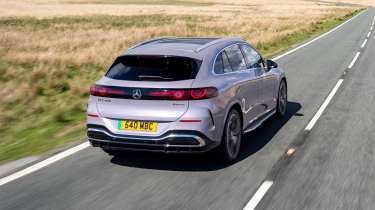
Sport mode sharpens this up a lot but generally the GLC has a layer of cushioning around its formidable performance that makes it a very easy-going car to get about in – a feel that’s mirrored in other aspects of the drive. There were no issues at all deploying the power on the test route in the Surrey hills with its dry but patchy and uneven B-road surfaces. The gearbox’s work is virtually undetectable except in the elongated band of power that sees the car react eagerly and with no obvious tail-off in performance at higher speeds, unlike many EVs.
The motors are virtually silent while doing their work. There’s noise from the suspension soaking up bumps, then above 50mph the road and wind noise start to build. Nonetheless relatively little noise finds its way into the cabin.
Depending on spec, the GLC records official WLTP range figures of around 400 miles. This looks a little underwhelming next to the 500 miles managed by the BMW iX3 but that car is aided by a giant 112kWh battery. In cars that were being peddled around the countryside, we saw indicated ranges equivalent to only 250 miles. It feels like 300 miles would be easily possible with a circumspect approach, and more than that with careful driving and your electricity bill in mind.
Ride and handling
- Capable and easy to drive
- Lacks handling sharpness
- Rear-wheel steering is worth getting
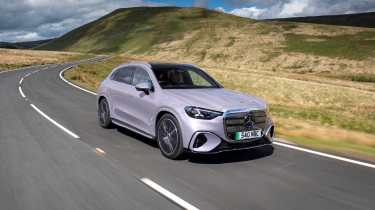
All GLC Electric models get coil springs as standard but there’s the option of a Refinement Pack that costs £2,500 and adds both Airmatic air suspension and rear-wheel steering. The ride comfort in all versions is impressive. In fact, the coil springs are almost good enough to make you question the need for the optional adaptive system.
The standard set-up often feels more planted and composed over undulations and odd cambers than the air springs do in comfort mode. When riding on air, the rounding out of bumps goes to another level but it’s also floaty at times, less dialled into the surface. Stick the air suspension in Sport and things get a lot firmer but there’s still that soft edge always present. For an electric SUV aimed at families and company car users, it's well judged.
This is probably where the GLC Electric is going to disappoint those looking for a rewarding drive the most. There’s a lot of body roll and even in the tautest Sport setting, the reactions feel like they’ve been dulled in the quest for comfort.
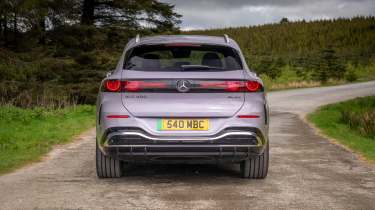
The electric power steering is well weighted but could sharpen up another few notches in the Sport setting. There’s a lot of dead movement around the straight ahead taking the edge off the turn-in to corners and little feel. BMW’s iX3 is less comfortable but significantly better in these respects.
It may be debatable whether the GLC’s air suspension is worth the extra outlay but the rear-wheel steering packaged together with it swings the balance. It can apply 4.5 degrees of lock to the rear wheels making low speed cornering in this big car a breeze. The turning circle actually decreases by almost a whole metre to 11.2m. Then, at higher speeds you get some added stability as the back wheels follow the fronts.
The brakes will also impress anyone who’s become frustrated by the erratic behaviour of electric cars when the time comes to stop. Mercedes has developed a system it calls One-Box that integrates the friction brakes (370mm front and 360mm rear) with the regenerative braking to try and deliver a more consistent feel.
There’s no physical connection to the pedal, a single module combines all the previously separate braking functions and sensors to deliver what is still powerful and predictable braking but with none of the clunky transitions between the two systems. Brake settings are controlled via the steering wheel paddles and most drivers will end up sticking with the D Auto mode that automatically selects the best level of regenerative braking for the driving conditions.
Interior and tech
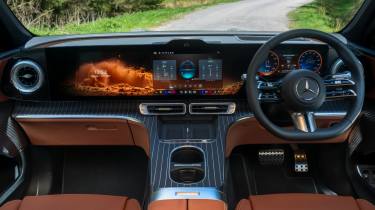
- Giant screens dominate everything
- User experience is at least reasonably intuitive
- Excellent practicality
The screens are monstrous in every version of the GLC Electric. They look very similar but there are actually three separate versions, two with a merged array of three different screens across the dash in lower spec models and the one-piece Hyperscreen in the flagship cars. Whatever you think of it, you can’t ignore it, but the underlying user experience is pretty good. Simple menus, fixed positions for key controls and a smattering of supporting physical buttons means it’s not as daunting as first impressions might lead you to expect.

The driving position isn’t bad. There’s a lot of movement in the seat so you can sit relatively low for an SUV and get your legs out in front of you. There just might not be enough reach adjustment in the steering column for taller drivers.
The steering wheel on AMG Line cars and above has a lot more space where the vertical spokes meet the rim, so it can be held comfortably without your hands covering (or accidentally pressing) the buttons on the spokes. For that reason, and the sports seats with better lateral support, the base cars are probably best avoided. Just to complicate matters, however, those entry-level ‘Sport’ cars are the only ones with proper door handles. It’s silly pop-out ones higher up the range.
Another advantage of the Mercedes GLC Electric being on a specialist electric car platform is that it’s got loads of space in the cabin. At 4,845mm long and 1,913mm wide it’s bigger than the previous generation GLE from the class above and you can really feel this if you have cause to sit in the back. The boot’s 570-litres is 50 litres up on the BMW iX3 and there’s a 128-litre frunk in the nose as well.
Price and rivals
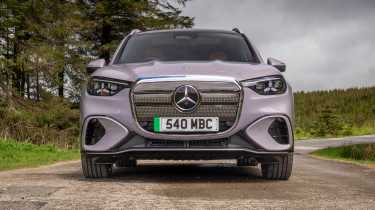
The Mercedes GLC Electric squeezes under the £60,000 mark in entry-level Sport trim. Then you have the AMG-Line for £3,000 more, AMG Line Premium for another £5,000 and AMG Line Premium Plus at a further £2,500 on top. The flagship model is the £72,000 Premier Edition and on every model except the Sport you can pay an extra £2,500 to get the Refinement.
There are better driver’s cars in this class, the BMW iX3, Porsche Macan Electric and Audi Q6 being the obvious choices. There's also the Alpine A390 and Polestar 3 if you're looking a little left-field.The space and practicality of the GLC Electric give it a clear edge over the Porsche and Alpine while its ride comfort is near class-leading.
On price, the iX3 is slightly cheaper if you compare the 4x4 versions and it beats the Mercedes with its outstanding 500-mile electric range. Both cheaper single-motor and high performance tri-motor AMG-badged versions of the GLC Electric are expected to follow.
Specs
| Mercedes GLC Electric 400 4Matic Sport | |
|---|---|
| Motors | Dual motor, all-wheel drive |
| Power | 482bhp |
| Torque | 590lb ft |
| Weight | 2655kg |
| Range | 406 miles |
| 0-62mph | 4.3sec |
| Top speed | 130mph |
| Basic price | £59,450 |