Mercedes-AMG C63 (W205, 2015 - 2023) review – the hot-rod V8 that took on BMW’s M3
While Audi and BMW downsized to six-cylinder engines, Mercedes-AMG stuck with a new V8 to create the ultimate hot-rod
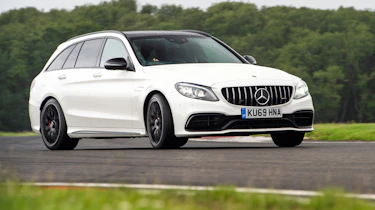
While Audi and BMW mixed and matched the body styles of its high performance A4 and 3-series models, Mercedes-AMG went all in with C-class to offer a 4-litre, twin-turbocharged V8 in any body style you wanted: coupe, cabriolet, saloon and of course, an estate. With 469bhp and circa 4sec 0-62mph times across all offerings and very little discernible difference in how they drove (even if the Cabriolet would be our fourth choice), the W205 generation C63 was AMG at its best, and you can own one from below £20,000.
We rather like the W205 Mercedes-AMG C63. Despite 2015 marking the end of the glorious M156 naturally aspirated 6.2-litre V8, its turbocharged replacement still delivered the model’s hard-as-nails character with its steely eyed focus on performance remaining intact. This focus and approach crystallised the W205-generation model as the last rear-drive AMG muscle car and at the time we perhaps didn’t fully appreciate what we had until it was replaced with the woeful four-cylinder hybrid C63.
> Mercedes C63 AMG (W204, 2008 - 2014): absurd in the best possible way
Affalterbach got a lot right with the W205, built between 2015 and 2023. What its new turbocharged engine lacked in vocal character it more than made up for in terms of drivability, poise, balance and, of course, stonking levels of performance.
More reviews
It was - and remains - a huge amount of fun to drive, too. It was sharper and more stable than the previous generation C63, highlighting the detailed level of involvement that was lacking in its predecessor, the W205 was more than a shock and awe machine, there is genuine fidelity in how it flows along a road. The downside to this higher level of engagement is a firm ride that those coming from an Audi RS4 or BMW M3 or 4 will struggle to get on side with. Those that do will enjoy the benefits.
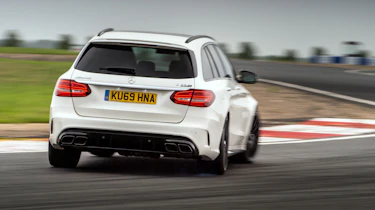
A new V8 and two choices of gearbox
Replacing the old naturally aspirated 6.2-litre V8 was never going to be an easy task, but the wet-sump M177 four-litre twin-turbocharged V8 that had originated in the original AMG GT was no poor substitute. A thoroughbred AMG motor, it proved that turbocharging didn’t need to result in an engine lacking in character, something BMW has always struggled with its eight-cylinder M engines. With power starting at 469bhp for the C63 and increasing to 503bhp in the C63 S, this rear-drive only AMG wanted for little in the performance stakes.
One of the biggest improvements the W205 had over its predecessor was its gearbox. It's the same seven-speed MCT Speedshift auto as was fitted to the W204, but its shift times and how quickly it reacts to driver inputs were greatly improved resulting in smoother, more finessed shifts. It might not be able to rival the best dual-clutch units but this transmission really suits the C63. The nine-speed fitted to the post 2019 models was better still, with cleaner, crisper shifts and ratios that got the best from the engine's 516lb ft torque output.
Throughout its production run the C63 could never escape comparisons to BMW’s F8X-generation M3 and M4 models and to a lesser extent Audi’s RS4 Avant, RS5 coupe and Sportback. But this car gave Munich's offerings more to worry about than ever before. The BMW’s straight six simply couldn’t match the AMG’s roaring V8 for character, mid-range thump and top-end frenzy. What’s more, the AMG was available as a Coupé, Saloon, Cabriolet and Estate, offering an even more practical alternative over the saloon-only M3 and the coupe and Cabriolet M4 models.
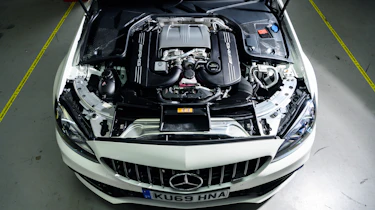
The C63's performance remains utterly captivating; its surging swell of forced induction power and torque catapulting you to the vanishing point at a blistering rate. Its claimed 0-62mph times are certainly believable. The standard C63 Coupé reaches 62mph in 4sec, the saloon in 4.1sec and the cabriolet and estate in 4.2sec. All were limited to 155mph unless you opted for the optional AMG Driver’s Pack, which lifted the top speed to 174 -180mph depending on the body style.
As well as a 34bhp hike in power and 37lb ft of torque, to give it a total of 503bhp 516lb ft, the C63 S also has an electronically controlled Drexler LSD and an extra driving mode called Race, which includes access to Launch Control. The engine’s extra performance, improved traction from the diff and the launch control meant that, no matter what the body style, the C63 S is 0.1sec faster to 62mph than the standard car.
> Mercedes-AMG GT 4-door coupe review – the Porsche Taycan has competition
Whichever driving mode you are in, the C63 wants for little in terms of performance. Wind the S’s engine setting all the way round to Race and the throttle response is scintillating, the big saloon charging down the road with wonderful unseemly haste at the merest sniff of right foot provocation. Even in Sport+, the standard C63 doesn’t feel quite as sharp and, as you’d expect, can’t quite match the S’s outright thump. Nonetheless it is still a mighty experience in full flow.
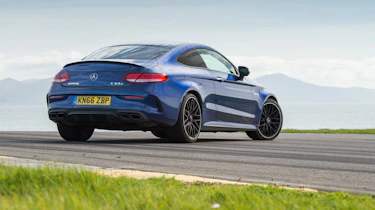
Turbocharging can rob an engine of much of its aural character, significantly reducing the exhaust note and completely muting the induction noise. By combining the exhaust ports of both banks of cylinders into each turbo, a hot-V configuration removes the typically lumpy off-beat noise that a cross-plane crank V8 is known for. But Mercedes has compensated for all of this with a rambunctious exhaust, that despite the odds, has a definite V8 burble at idle and a raucous blare at full throttle. Pleasingly, anyone who has heard the old naturally aspirated 6.2 V8 will certainly recognise some of its character in the soundtrack of the new car.
It’s a little more subdued in Comfort mode where there is a bit of gas rush (think Megane R26 R) complementing with the woofle. But once the valves in the pipes open in Sport and Sport+ mode (or when you press the exhaust button) the noise is back to being appropriately bold for an AMG. The noise is then also complemented with an angry rasp on upshifts.
What we said at the time
'The engine is a truly mighty thing. Aurally exuberant and explosively potent, it makes the car heart-poundingly rapid when you pull the pin and merely imperious when you simply wish to make progress. - Richard Meaden, Contributing Editor (evo 211)
A firm ride but a rewarding chassis
Things were equally as serious as the engine underneath the C63’s body. Most obvious are the wider wheels and tyres (255 section fronts, 285 rears), but there’s significant structural reinforcement to better contain the lateral and longitudinal forces generated during maximum cornering, braking and acceleration. AMG also went to town on the suspension, most notably the rear, which features an all-new multi-link axle, which combines a wider track for greater wheel control and increased camber change.
The ride was firm on the original models but from the 2019 model year springs rates were softened by 10 percent to help manage the slightly fidgety ride and manage larger wheel movements. Nicely weighted but numb steering during the initial input stage left it in the shadow of BMW’s M cars of the time, but you never felt not plugged in to what the C63 is doing with the car delivering a constant flow of detail through the car to you.
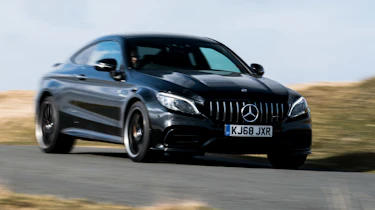
However, on challenging roads the C63’s chassis can struggle. With the dampers in their most comfortable setting it feels tense, never relaxing to allow the car to react intuitively to the road, with the body locked-in throughout the process. A firmer damper setting increases that sense of tautness, yet the ride doesn’t deteriorate to a similar extent. The stiffest damper setting simply doesn’t gel with the road, both transmitting more shocks through the chassis and unsettling the body. It’s a setting best used on track. The active dampers on early cars were also prone to ‘locking’ in their hardest setting, requiring a dealer reset.
There is a certain amount of weight and push to overcome on turn-in to tighter corners; the Coupé’s front-end is sharper than the Saloon and Estate, but it still requires patience. At the exit, when you’re able to get on the throttle as early as you dare, all your attention switches to the rear of the car. The later C63 S’s electronically controlled diff made the transition of the OEM fitment Michelin SuperSports through grip and into slip pleasingly smooth and easy to control with the angle dictated by your right foot and the speed of your hands. Although the transition from grip to slip is rather more abrupt in model’s fitted with the purely mechanical LSD, requiring sharper initial steering correction to catch any slide that arrives with less warning, too. Once the car is balanced, however, the feeling of security, control and connection you get with the mechanically locked diff is arguably greater.
Perhaps surprisingly, oversteer isn't an any-gear-affair, with more grip on offer than you might expect. However, once you get into a rhythm and keep the revs in the meat of the torque curve it’s easy enough to bring the rear axle into play to manipulate the C63 through a corner.
With identical wheelbase and front and rear tracks, the Estate’s handling is also all but a carbon copy of the Saloon’s. If anything, we think the mild absurdity of a more lucid and playful estate is more appealing. It looks better, too.
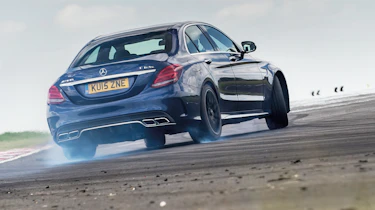
As for the Coupé, it's clear that it’s a hugely desirable car and the most popular of body styles, despite some thinking that it missed leg day at the gym with its oddly proportioned and pinched rear end. The C63’s all-new rear axle delivered more precision and the wider track improved the steering response and a sense that there’s more outright grip to lean on and the Coupe’s made the most of these changes. Although each body style had their own distinct damper settings, the Coupe rode very much like the Saloon, with the same resolutely tied-down body control.
While perceived wisdom suggests that the Cabriolet will be a heavy, wobbly mess by comparison, while it’s heavier by 200kg the prodigious performance means it only dulls the performance slightly. The drop-top C63 S is only 0.2sec slower from 0-62mph than the Coupé with a time of 4.1sec, and that’s hardly noticeable from behind the wheel.
Sadly, the extra bracing that makes up the bulk of the added weight hasn’t completely compensated for the lack of roof. You can feel the steering wheel move laterally in your hands, and if you select one of the firmer damper settings the motion is exaggerated further still. When the roof is up, there’s also the occasional squeak and rattle where it meets the top of the windscreen. In lesser C-class Cabriolets with smaller engines, such as the C43 and C220, the body copes much better and they don’t exhibit either of the C63’s structural shortcomings. But the retractable roof isn’t all bad as it allows you much better access to the exceptional noise the C63 emits from its exhaust pipes.
One time the mass of the C63 is evident is after sustained braking. Although the actual retardation remains consistent, the pedal can soften and complain disconcertingly. The S actually has bigger brakes than the standard car but still feels the heat under sustained heavy braking nonetheless. Carbon-ceramic brakes were an expensive option when new, but if you’re looking to extract the C63’s performance more of the time, an upgraded set of aftermarket brakes will be a better option.
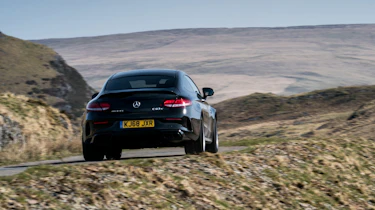
By turning to turbocharging the W205 C63 is significantly less profligate than the W204 that came before it. Where the naturally aspirated car guzzled fossil fuels at the rate of one gallon every 23.5 miles, the latest car will take you a whole 11 miles further, according to Mercedes.
Its carbon dioxide emissions have dropped accordingly, too, down to 192g/km which won’t placate the greens but it’s still a significant improvement on the 280g/km exhaled by the previous car. The estate records figures of 33.6mpg and 196g/km, while all body styles in the group J VED band.
Does the C63 feel and look like an AMG inside?
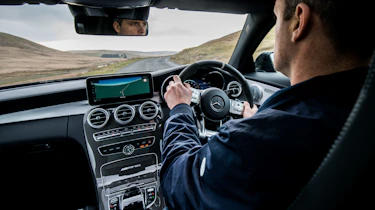
First impressions are of a very solid car with an interior that’s more interesting than anything BMW or Audi could muster at the time but it was also the start of Mercedes’s fixation with sticking an iPad style screen to the dash, although this predates touchscreens so you’ll need to remember how to use the rotary wheel on the transmission tunnel to control what you see. 2019 facelifted models got a larger screen but it was still controlled by the rotary dial or touchpad. Mercedes also over-ordered on the hateful piano black plastic, which cheapens the interior, but a carbon fibre trim alternative (sadly lacquered to within an inch of its life) was also available.
The steering-column mounted gear selector is also an acquired taste, but it does leave the broad transmission tunnel attractively uncluttered with the individual controls for the dampers and exhaust joined by the volume controls.
There’s plenty of brightwork and detailing to lift it above the equivalent M car and the optional sports seats many customers specified added some attitude - and support – but they aren’t very soft and highlight the car’s firm ride.
It drives like an AMG, does the C63 look like one?
The Saloon’s exterior styling doesn't match the Estate's kerbside appeal, and for some will be too understated and therefore perfect for others. 2019 models were fitted with the later Panamericana front grilles.
The small boot spoiler fitted to the saloon is more of a gurney flap and the way it fluidly rises up at the edges is beautifully sculptural. The alternative to the Saloon conundrum presented itself in the form of the Estate. For an extra £1200 in 2015 you could not only have an additional 55 litres of luggage space (1075 litres extra with the rear seats folded) but a much more handsome machine to boot (if you’ll pardon the pun).
As for the Coupé, it certainly looks ready to rumble as only the roof, doors and boot lid of the AMG are borrowed from the standard C-class Coupé. Its extravagantly flared wheel arches (64mm wider at the front, 66mm at the rear) transform its stance and presence from that of a rather svelte and elegant small coupe into a real thug. A few years ago AMG could have stuck a Black Series badge on the tail, it’s that pumped and aggressive.
The Mercedes-AMG C63 S went head-to-head with the Audi RS5 and BMW M4 Competition Pack in a Supertest in evo 240. Read the online version of that Supertest here and subscribe to evo for all the evo Supertests in full.
Here's what we thought of the Mercedes-AMG C63 S against its rivals.
In the company of BMW’s F82 M4 and Audi’s B8.5 RS5 that both use blown 3.0-litre six-cylinder engines Mercedes-AMG’s C63 S bruiser seems a little old hat with its V8, but that power plant is certainly the most aurally stimulating of the trio. It produces the most power but is comfortably the heaviest and might struggle against the M4 and RS5.
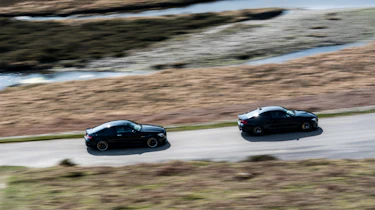
The AMG is undoubtedly rapid but its suspension struggles to keep the power harnessed and it can serve up heart-in-the-mouth oversteer moments if you turn the traction control off.
With more power than both the M4 and the RS5 one might have expected the AMG to be the quickest in a straight line but despite the fruity V8 bellowing its approval the Merc’s 1847kg weight (50kg heavier than the RS5 and 200kg more than the M4) counts against it and it’s only a tenth quicker to 60mph than the M4 and 0.7sec behind the RS5. The AMG’s hard to get off the line cleanly too, like the M4 it scrabbles for traction.
Once it’s hooked up though the AMG’s V8 really delivers the goods and in the 0-150mph test it equals the lissom M4 Comp Pack for pace.
As any track regular will tell you the biggest enemy on track is weight so it shouldn’t come as a surprise that the AMG was the slowest around Bedford Autodrome’s West Circuit. In the final analysis the C63 S was 1.6sec slower than the RS5 and 2.2 adrift of the M4.
The AMG’s main issue was putting the power down – with the traction control in its half way setting the system was reining the car in too much, with it off it’s hard to extract the maximum from the car without lurid oversteer rearing its ugly head in the quicker corners. You have to be quick to catch it, too.
I did 10,000 miles in six-months in a C63 S Coupe, this is what I thought
“It was fitting that my last drive in evo’s long term test AMG C63 S Coupe was one of the best: a one-day round-trip to Anglesey Circuit to drive the new Porsche 911 GT3. It was a long day in the saddle; one that started with a 4.30am alarm and finished with me arriving back home just before 9pm. In between was the best part of 500 miles of motorways, majestic A-roads and nadgety B-roads, all dispatched in effortless, engaging style.
As I’ve discovered over the last six months and nearly 10,000 miles, that’s the nub of the C63 experience. I’d never run a Mercedes before, let alone an AMG model. I suppose deep down I never considered myself a Merc person. This car has made me revise that belief. It did everything so well, and with such big-hearted enthusiasm that even if the journey was a stinker I always found plenty to savour about the car.
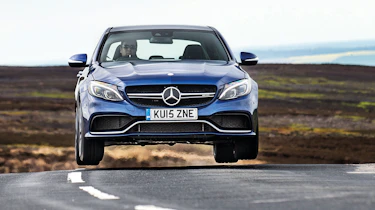
Star of the show is the 4-litre biturbo V8. In ‘S’ spec it’s an absolute powerhouse, feeling good for every last one of its 503bhp and 516lb ft. It’s smooth and refined, with a ton of endlessly elastic low- and mid-range thrust, so in most situations you just dip into its vast reserves of performance. Yet when you do extend it, there’s proper fire at the top end. It’s a thoroughbred powerplant, no question. And fuel economy? I’m pleasantly surprised to report that over six-months the average was 22.9mpg. Yes, I saw sub-15mpg on a particularly enthusiastic commute to the evo offices, but the car countered that with a hugely impressive 29mpg on an epic 700-mile Cambridgeshire-Ayrshire-Cambridgeshire day-trip. Merc’s muscle cars aren’t the dipsomaniacs they used to be.
Being an AMG, there were plenty of modes to choose for the engine, gearbox, chassis and exhaust, from Comfort through Sport, Sport+ and Race. Comfort and Sport were my preferred and most-selected modes. They just seemed to offer the best blend of response, fuss-free pace and comfort for most trips. However, when I did elect to blitz a few A- and B-roads, Sport+ was hugely effective and great fun. The seven-ratio Speedshift automatic transmission could really up its game and was uncannily prescient with downshifts. Unless I was in a particularly committed frame of mind, Race mode was a bit full-on, but even that had its moments.
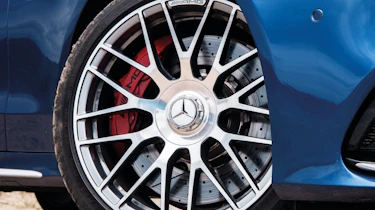
KN66 ZPB was very generously equipped, with options including carbon-ceramic brakes (£4285), lightweight forged alloys (£1735) and the AMG Driver’s Package (£765), which elevates the speed-limiter to 180mph. All in, the price shot up from £68,710 to £82,875 (in 2017 when the car was delivered new): a lot of money for a BMW M4 rival. That said, the car’s fit, finish and looks backed up the big ticket. Sleek and compact, with a purposeful stance and a muscled physique, the C63 S had plenty of presence without showing off. The leather, Alcantara and carbon interior was a delight, with the glass roof and Burmester hi-fi (part of the £2595 Premium Package) adding to the feel-good factor.
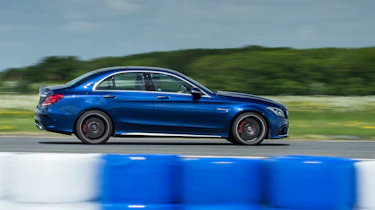
We often criticise cars for a lack of connection, and I was worried the C63 S might be a bit numb. Those concerns weren’t entirely unfounded, as it quickly became clear the Merc’s feedback was muted and finely filtered. The steering feel was hardly sparkling, but you could build a picture of what the front end was doing, and its rate of response was well judged. Just as importantly, the rear end’s communication skills were good enough that you always knew when traction was at a premium. I knew where I was with the car, in dry or wet conditions. It helped that the stability-control system was on the ball, and could be relaxed enough to let you have fun yet still remain effective when run in Sport mode.
The ceramic brakes had great feel and made light work of stopping the 1725kg coupe, even when we had a quick hoon down the runway at the Bruntingthorpe Proving Ground. The Michelin Pilot Sport 4S tyres worked well through the winter and generated plenty of grip. And there was still a useful amount of meat left on them when the car went back. Must try harder next time.
Traction? Well, that was at the mercy of my right foot and/or the electronics, but I was surprised how much performance the software enabled you to deploy in the wet. In the dry, the car easily nailed 0-100mph in nine seconds, and I was amused to find it would hit 60mph in seven seconds while performing an epic rolling burnout.
Dislikes? Well, I quickly switched off most of the semi-autonomous driver-assist widgets (lane-assist and the like). The coasting mode, which disengages drive when you’re cruising off the throttle to save fuel, was annoying too, so I frequently switched that off as well.
I tend to miss long-term test cars when they go, but this one really got under my skin. It was special in ways that transcend objectivity, and I can honestly say I enjoyed every one of those 9955 miles. You can’t ask for more than that.’ Dickie Meaden, evo Editor at Large
Where did the C63 S coupe finish in evo Car of the Year 2016?
In a group that consisted of 12 great new cars launched in 2026 the Mercedes-AMG C63 S Coupe finished a lowly 11th place, just ahead of BMW’s original M2 and behind Ford’s Mk3 Focus RS. This is what we had to say about it.
‘Many of us expected more of the Mercedes after it had beaten Audi’s RS5 and BMW’s new M4 in a group test prior to eCoty. David Vivian and Colin Goodwin both rank it last – the latter reckoned it ‘just isn’t special enough to score well on evo Car of the Year’ – but certain other judges found a great deal to enjoy about the AMG. ‘I really like the chassis,’ said Adam Towler, ‘specifically the way it seems to be permanently on the cusp of oversteer, as if it’s just beginning to smear the road surface with two black lines, but never actually falling into a wasteful slide.’
Where can I buy a used W205 C63 from and how much will it cost?
Values start from around £25,000 for a first-gen Coupe, with Saloons and Estates commanding a £45,000 premium on top of that. If you’re looking to buy a W205 C63 visit Carwow’s used stock to find the latest in-market cars, and if you have a car to sell we can help you do that, too.