Lotus Exige V6 (S3, 2011-2021) review – a mini supercar for Golf GTI money
For the S3 generation the Lotus Exige got a lot brawnier, trading the four-cylinder engines it had hitherto utilised for a supercharged Toyota V6
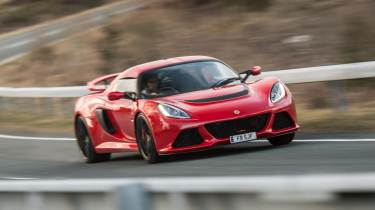
The S3 Exige was arguably the most dramatic evolution of the Elise/Exige family. Lotus’s light and lithe little track star turned into little short of a miniature supercar. It was every bit the foil for Porsche’s Cayman and later even 911s - on power and performance, if not refinement. Quite the opposite to spoiling the formula, Lotus created a car worthy of a joint evo Car of the Year win in 2012 alongside the Pagani Huayra…
On sale between 2011 and 2021, the Exige V6, as it became known to some, evolved through special editions, more focused versions and increasing power outputs, peaking with the Cup 430. The S3 was also the Exige with the broadest range of skills and goals, with multi-stage traction control and a Boxster-rivalling Exige S Roadster.
Engines, gearbox and performance
- All Exige S3s are almost supercar-fast
- Brawny V6 isn’t as musical as a flat-six, but more characterful than past four-pots
- Sport 350 and onward required for the best manual gearbox experience
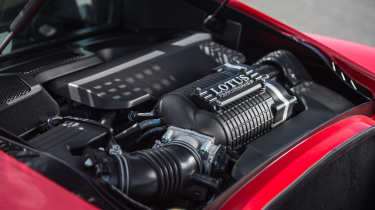
For the third-generation Exige, Lotus swapped out Toyota’s supercharged twin-cam 2ZZ-GE four-cylinder engine, for its 2GR-FE 3.5-litre V6 with an Eaton supercharger sat on top. The result was a significant bump in output to 345bhp at 7000rpm and 295lb ft of torque at 4500rpm.

Weighing 1176kg, the Exige S was by far the heaviest Exige yet (240kg more than the last S2 Exige), though still being 200kg lighter than an Evora meant it had a better power-to-weight ratio than a 911 Turbo of the era.
More reviews
Group tests
In-depth reviews
Reviews
- Lotus Exige Sport 410 review – first drive of latest mid-engined sports car
- Lotus Exige 380 Cup review – leaner, faster and harder than ever before
- Lotus Exige Sport 350 Review - less weight, sharper focus for former eCoty winner
- Lotus Exige S review, price and specs
- Lotus Exige 260 Cup
- Lotus Exige Cup 260
As a result, even with the use of a manual gearbox, the car could catapult itself from standstill to 60mph in 3.8sec and on to 100mph in just 8.5sec. The Sport 350, in spite of not getting any extra power, dropped the 0-62mph time to 3.7sec. In the end the Cup 430 of 2017 was the fastest and lightest of the Exige S3s, managing the 0-62mph sprint to 3.2-sec.
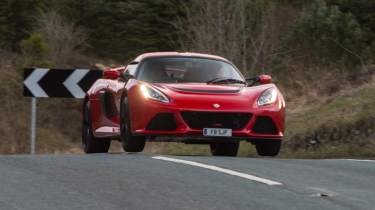
Over the years Lotus introduced Sport 350 (345bhp) and Cup versions, 360s (354bhp), 380s (375bhp), 410s (410bhp) and 430s (430bhp). Power increases came courtesy of tweaks to the ECU, revised exhausts and eventually in the Cup 430, an upgrade to an Edelbrock supercharger with a charge cooler, for 430bhp. Cooling was improved by an additional front radiator and oil cooler. That same engine was then detuned for use in the run-out 410.
Standard was a six-speed manual transmission (with an automatic option) and it was a point of focus for upgrades during the S3 Exige’s life. The manual gear shift mechanism was overhauled for the Sport 350, the lacklustre shift quality of early cars addressed with 1.5kg-lighter cast aluminium components. That mechanism was also on show within the centre console.

‘The Exige S feels stunningly quick, to the point where the claimed 0-62mph time of 3.8sec seems almost conservative. It might not have the most charismatic V6, but it has an addictively rich seam of punchy torque thanks to that supercharger. It has ride quality and steering that leave you in no doubt about the road surface you’re travelling over.'
‘The supercharged V6 makes a world of difference to the character of the car. It’s a stunningly strong engine and throttle response is scintillating, no matter where you are in the rev range. Even in sixth gear on the motorway the Exige will leap forwards eagerly at the slightest prod and on an A- or B-road it is as fast as you could realistically want. The V6 sounds great – there’s something of the historic racecar about its rich growl and there’s no overpowering supercharger whine either.’ – Dan Prosser, who tested the Lotus Exige S.
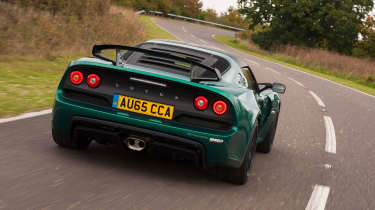
‘It’s not the engine’s performance that grabs you, it’s that first gearshift. Whoever you worship thank them, because Lotus has a gearshift it can be proud of and you can use. It’s not only tight around the gate, but precise and intuitive and within three or four shifts your left hand drops instinctively to go up and down the ratios, no longer do you need to make a conscious effort to change gear and be prepared to wrestle it home. If this was the only upgrade Lotus had made to the Sport 350 we’d be very happy.’ – Stuart Gallagher, evo editor-in-chief, who tested the Exige Sport 350.

‘Initially, any in-depth dynamic observations are clouded in my struggling brain by the rabid acceleration and the deafening exhaust note of the V6, exhaling here through the optional titanium exhaust (saving another 10kg). This blue-tinged, centrally mounted organ emits a kind of sonic warfare that turns heads on the roadside 500 yards in advance. Make no mistake, wrung out to the red line, the Exige Cup 380 is absolutely brutal.’ – Adam Towler, who tested the Exige 380 Cup
‘Below 3000rpm the V6 pushes you around at hot-hatch pace, but as soon as you extend the revs, reaching beyond 4000rpm and opening the exhaust’s valve, the Exige lays down its supercar credentials. A combination of the single-mass flywheel and the shove of the supercharger turns the Exige from a thoroughbred sports car to a supercar-baiting flyweight. The rate at which it piles on speed in the top three gears would require a 911 to be a Turbo rather than a Carrera turbo to get away from you.’ – Stuart Gallagher, evo editor-in-chief, who tested the Exige 410 Sport.
Ride and handling
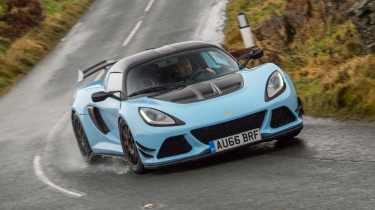
- All S3 Exiges have unassisted steering – heavy at low speeds, delicious feel when up and running
- Nitro damper upgrade afforded Cup and later Sport models increased adjustability
- Sport 350’s ugpraded chassis makes it worthwhile over an earlier Exige S
Underneath there was still the familiar, bonded aluminium tub containing the suspension that had largely been carried over from the Evora. The S3 Exige was longer and wider than any Exiges before it, befitting the increased performance provided by its supercharged V6 engine. Other changes were present in the form of a quicker steering ratio and the addition of a new rear anti-roll bar.

Also included in the package was the switchable Lotus ESP system - Dynamic Performance Management. This contained no limited-slip differential but did come with both touring and sport modes. If you specified the Race pack (a £2000 option), you also got a Race mode that optimised the handling for track driving, as well as firmer suspension and track-biased P Zero Trofeos in place of the standard Corsa tyres. No Exige S3s bar race-spec cars have proper mechanical limited-slip differentials.
The Sport 350 focused on weight loss, revising key componentry and upping quality. Camber, toe and bump-steer were all changed, the toe angle to allow a degree of pre-load in the tyres (a Pirelli P Zero Corsa, or Trofeo R if you’re track focused) to eliminate the nervousness the Exige suffered on less than perfect surfaces. The steering rack was also repositioned and the rear wheel width increased half an inch to 10 inches. There was a lightweight forged wheel offered that saves 5kg of unsprung weight. Overall weight savings, across tighter bodywork, the shift mechanism, upgraded HVAC and wheels totalled 51kg, for a 1125kg kerb weight (down from 1176kg).
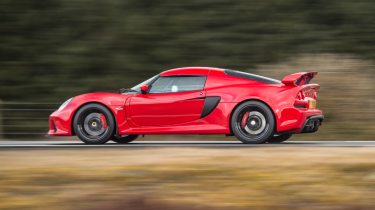
A key upgrade made as the S3 Exige got more hardcore was to its suspension, with Bilstein dampers swapped for adjustable (16-way compression, 20-way rebound) Nitrons with a broader scope of capability, in addition to the fitment of adjustable Eibach anti-roll bars. More aggressive bodywork, from louvres to cannards, that splitter and large rear wing, meant the 380 Cup had up to 200kg of downforce at 175mph. Greater use of carbonfibre, inside and out, helped reduce kerb weight to 1105kg.

The 410 was perhaps the S3 Exige’s most prominent ‘facelift’, with a more curvaceous front fascia. Though not as extreme as the 380 Cup in terms of downforce, with 150kg at 180mph, it did feature its own upgraded Nitron dampers with revised spring rates to suit the different aerodynamics. Lightweight options including a titanium exhaust, carbon bodywork, and an airbagless steering wheel meant kerb weight could be as little as 1108kg.
‘With the extended wheelbase and wider build, the Exige looks low and exotic with a kind of Noble vibe to it. It has grown up. And like all grown-up supercars in 2012, it’s highly configurable. So try to resist blipping that coarse, edgy V6 and concentrate on Lotus’s version of Ferrari’s manettino…
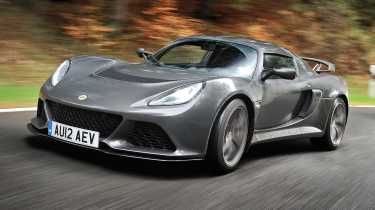
‘Touring is for sensible driving; Sport opens up a valve in the exhaust for even more noise and introduces a fair degree of slip so you can really experience the Exige’s limits with a reassuring sense of security. Race “learns” the road surface as you drive and constantly adapts to provide maximum cornering speed and acceleration. Sounds spooky. Feels almost entirely intuitive.’ – Jethro Bovingdon, who tested the Exige S.
‘The chassis work has resulted in an even more precise machine. There’s no longer a small delay when you first apply an amount of lock before the front axle reacts, instead it’s instant but crucially it’s not too quick nor edgy, but linear and precise and installs immediate confidence.'
‘Combine the steering changes with the other chassis upgrades on the road – a more compliant ride despite stiffer Exige Cup dampers, improved body control, increased grip levels and the more relaxed nature and settled movements on poor road surfaces – and the Sport 350 draws you in. It encourages you to push harder, brake later and deeper into the corner (the optional lightweight discs fitted to our test car were some of the best we’ve tried: progressive pedal travel, easy to modulate and as strong at slowing the car as the supercharged motor is at accelerating it) and lean on the outer tyres’ grip, and play with that brilliant chassis beneath you.’ – Stuart Gallagher, evo editor-in-chief, who tested the Exige Sport 350.
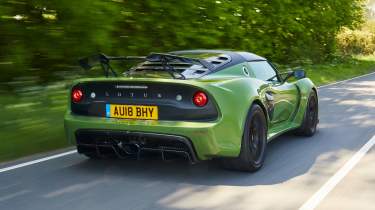
‘Dynamically, the Cup operates on a plane some way above what can be fully experienced on the public road. However, so engrossed are you in the driving experience that this Lotus provides more sheer enjoyment than most modern supercars combined. Most corners require no more than the thought of turning the wheel and a slight squeeze of pressure in the right direction. It’s a firm-riding car, and over poor surfaces the dampers are obviously working hard and the steering tugs this way and that. The trick with the latter is to know when to release your grip and let the Cup get on with it, and when to grip harder to keep it pointing straight.’ – Adam Towler, who tested the Exige Cup 380.
‘Add speed and it’s delightful. Delicate and delicious from turn to turn, flowing with an uncorrupted clarity and such a clear channel of communication that you steer with your instincts as much as you do with actions. The three-spoke steering wheel moves in your hands a great deal on the road as it reports everything the front wheels are absorbing, but the car is never thrown off line and with the lightest of grips you can edge it to where you want it to go, the front end faithfully obeying every input.
‘On track the 410 feels connected to your eye sockets, turning with your eyeballs as they focus on the corner entry, apex and exit. So natural is the steering’s motion that you don’t register your wrists’ fluid movements as they roll from turn to turn. As with the steering, the chassis is in constant dialogue with you, too. There’s more movement than in any of today’s sports cars as the dampers and springs register, digest and react to every roll and hole in the tarmac.’ – Stuart Gallagher, evo editor-in-chief, who tested the Exige 410 Sport.
evo Car of the Year 2012 win – Henry Catchpole
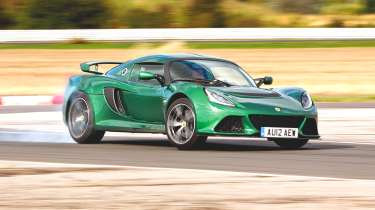
‘Meaden was particularly smitten with the Exige: ‘I adore its looks, its presence. It’s like a little shrunk-down, condensed, distilled supercar. And I love the fact that when you’re on the road and going for it, it just takes off.’
'Trott echoed this: ‘You feel like you’re getting a bargain exotic in the Exige. And Lotus undoubtedly owns certain areas of dynamic involvement – it is simply wonderful to drive.’
'Metcalfe loved the little Lotus with the big engine too: ‘It’s just super-smooth and I love the noise – a supercharged V6 shouldn’t sound that good. It reminds me of the rally raiders of the past.’’
Interior and tech
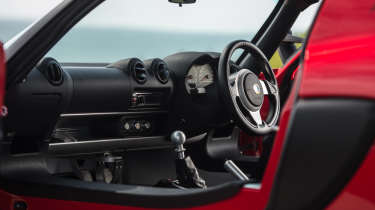
The interior of the S3 Exige is perhaps the most familiar thing about it, given it didn’t really change by comparison to the S2 Exige in many ways. It’s still extraordinarily minimal, prohibitively cramped for some and marred by old Vauxhall switchgear (plus those wingmirrors).
Colour coding of trim, a liberal use of Alcantara and carbonfibre and some delectable details like exposed shift linkages did aid in elevating the boutique feel of the cabin somewhat. Cup specification makes the Exige experience even more Spartan, with even more of the aluminium structure exposed and no radio (in earlier cars).
Ultimately, no Exige offers anything like the premium or plush cabin you’ll find in a Porsche, or even to an extent, an Alpine A110, Renault parts bin included. Apple CarPlay or Android Auto? Your best bet is to get a phone mount…
Values and buying guide
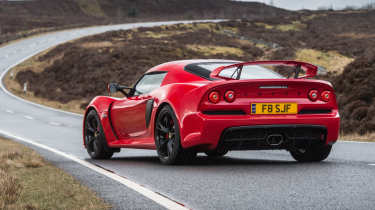
The Lotus Exige never sold in enormous numbers and so, with the experience it offered not replicated in anything you can buy today, prices are steady.
The earliest pre-Sport 350 Exige S models, both coupes and roadsters have been between £35,000 and £40,000 almost for the last ten years. Move into a Sport 350 or a Cup and it’s £45,000 at the minimum up to beyond £60,000. Likewise 380s, 410s, 420s and 430s. The high prices of these Exiges were derided when new, but save for inflation, they’ve not really moved at all.
As with all cars, the overall condition of it is as good a guide as anything when it comes to assessing the type of life that the car has led and establishing whether it has been abused during its time. Therefore, it is key to check the nose of the car for chips and grazes. Also the front splitter and the underside of the sills are worth checking for any signs of kerbing damage.
It's hardly surprising given the Toyota-sourced engine that the motors are known to be strong. These cars are driven hard and as such, it’s worth only taking cars with a diligent history of servicing and consumables replacement seriously.
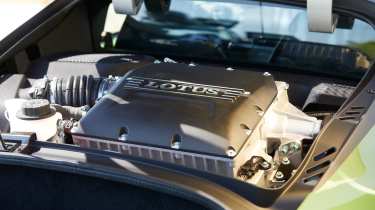
A full service every 9,000 miles or annually (depending on which comes first) is key. As the V6 has a timing chain, there is no belt to worry about. Where issues can arise is that the cooling fan bearings can sometimes go. This can create a racket when the fans cut in, but fortunately most have been replaced with upgraded ones under warranty.
There’s a slightly lighter flywheel for faster pick-up and response but the gearbox is the same as in the Evora and so far there have been no common issues. Being a car that is likely to have been driven hard on road and/or track, it is well worth checking the clutch operation fastidiously for any slipping, juddering or smell as any of these could indicate that it's on the way out.
Unfortunately it’s a major job to replace with costs well over £2k when parts and labour have been factored in. Despite there being no diagnostic for clutch life, an engine download can reveal how many launches the car has done giving an indication of its treatment.
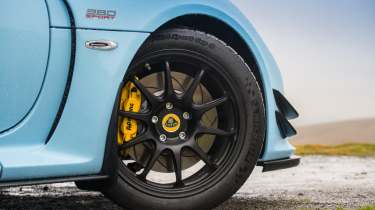
The Trofeo tyres originally fitted to some cars are sadly no longer road legal. However the Pirelli P Zero Corsa is good on the road and adequate for occasional track use. What are worth checking, though, are the inside edges of the tyres as there is a tendency for these to wear faster than any other area of the tyre.
The Exige S standard brakes possessed AP four-pot callipers that will more than do the job for the majority of owners. An upgrade to drilled discs was available to those looking to do more track use and if track performance is key to you, then these are highly recommended. Because of the Exige’s lightweight construction, both sets of brakes and suspension components tend to last well, as loaded stress is never too much of an issue.
Specs
| Lotus Exige S | Lotus Exige 380 | Lotus Exige 410 | Lotus Exige 430 | |
|---|---|---|---|---|
| Engine | V6, 3456cc, supercharger | V6, 3456cc, supercharger | V6, 3456cc, supercharger | V6, 3456cc, supercharger |
| Power | 345bhp @ 7000rpm | 375bhp @ 6700rpm | 410bhp @ 7000rpm | 430bhp @ 7000rpm |
| Torque | 295lb ft @ 3500rpm | 302lb ft @ 3500rpm | 310lb ft @ 3500rpm | 325lb ft @ 4000rpm |
| Weight | 1176kg | 1110kg - 1108kg | 1108kg | 1056kg |
| 0-62mph | 3.8sec (claimed | 3.6sec (claimed) | 3.4sec (claimed) | 3.2sec (claimed) |
| Top speed | 170mph | 175mph | 180mph (claimed) | 180mph (claimed) |