Lexus IS F (2008 - 2014) review – Japanese V8 is charismatic but not BMW M3-sharp
Lexus’s first foray into proper performance cars was great for an opening gambit, but lacked that last bit of edge to topple the Germans
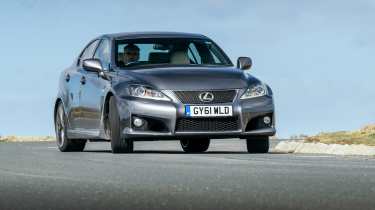
The Lexus IS F is among that rarified breed of car in being the product of a small ‘skunkworks’ team within the ranks of its maker. It was the car to launch Lexus’s ‘F’ brand ahead of the LFA's introduction, F standing for Fuji with a logo inspired by the circuit’s 27R corner. Lexus was bold with the IS F. It was bigger and brawnier than any super saloons or coupes in its class that had come before. Remember, its January 2007 reveal pre-dated the debuts of both the E90 BMW M3 and W204 Mercedes-AMG C63. On reflection, Lexus’s prescience was impressive, as was how well it fared against these rivals for a first go at such a car.
Reacquaintance among others in this ‘class of 2008’ V8 cohort didn’t however reveal a car that was unfairly judged as the slightly underachieving upstart. Now as then, it’s brilliant in many ways, but lacking that extra tenth of finesse and fidelity. All the same, it’s still a fabulous super saloon from an unrepeatable era of charismatic naturally aspirated engines. Its reliability, brawny-yet-subtle good looks, stonking engine and outlier underdog status (plus a love for it rooted in my childhood) were convincing enough for me to buy one.
Engine, gearbox and performance
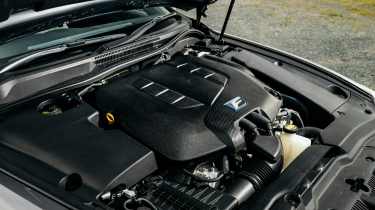
- 417bhp 5-litre V8 features Yamaha-tuned cylinder heads
- Eight-speed automatic transmission was the first of its kind
- Splits the difference between the peaky E90 M3 and torque monster C63
More reviews
The heart of any super saloon of this era is the engine and in this arena, the IS F fares well. Its 2UR-GSE V8 was a heavily developed version of the V8 found across a number of Toyota and Lexus models at the time. It featured direct, port injection and Yamaha-tuned DOHC cylinder heads with titanium inlet valves, a forged crank as well as a dual-stage intake and an oil system with scavenge pump, to aid sustained flow during high-load cornering. The engine increased in output to over 470bhp for the later RC F and GS F, thanks to revised inlets and exhaust manifolds, with rev limits raised to over 7000rpm.
The transmission was Lexus’ own Sport Direct Shift eight-speed automatic, with the ability to lock the torque converter. This allowed faster gear change responses – as quick as 100ms upshifts when in manual mode – via the IS F’s steering wheel-mounted paddles.
The V8 bursts into life with a woofle but settles to a smooth idle. Throttle response is improved with a press of the sport button, while sliding from D into M sharpens the gearbox’s responses considerably. The engine properly wakes up at 3700rpm, at which point the variable intake switches and an induction bark accompanies the building torque that peaks at 372lb ft at 5200rpm.
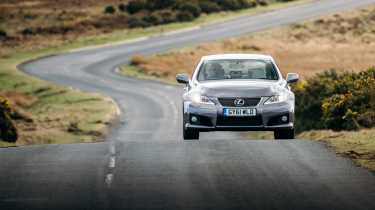
The engine then revs and roars enthusiastically up to its (staid compared to the banshee 8800rpm E90 M3) 6800rpm redline, having hit its 417bhp maximum output at 6600rpm. All the while, the IS F surges convincingly towards the horizon. It still feels like a quick car, quicker than its 5.2sec 0-62mph time might suggest.
In the higher revs in manual mode, the gearbox is snappier than you’d expect for its age and the fact it’s a torque converter, splitting the difference between a standard Ferrari F430 F1 (150ms) and the 430 Scuderia (60ms) by the numbers. The V8 blips with an excited and responsive bark during high-rev downshifts, in a way that betrays your understanding of traditional automatic transmissions. Torque converter was a dirty word before this ‘box came along. Now even BMW M uses them in place of a dual-clutch.
Driver’s note
‘Foot down, there’s a step change in the V8’s vocals at about 3500rpm as the engine switches to a snortier, sportier intake mode, though the red line seems to come quite soon after, with an annoying warning beep too.’ – John Barker, evo editor-at-large
Ride and handling
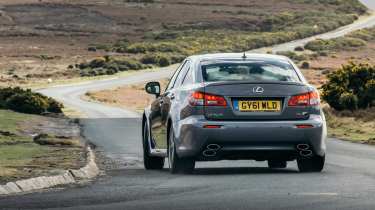
- Early EPAS feel and damping were weak points, but improved with updates
- Strong brakes – six-piston at the front – had the M3 of the time licked
- Diff-effect by braking was eventually replaced by a torsen limited-slip diff
The IS F featured double-wishbone front and multi-link rear suspension with bespoke wishbones and aluminium hub carriers at the front. Heavier duty springs with higher rates pair with passive dampers. The IS F uses an early electronic power assisted steering system, with variable weighting that increases in sport mode.
Initially the IS F used a system to brake the inside wheel during cornering to mimic the effect of a proper limited-slip diff. This was eventually replaced by a proper torque-sensing differential from 2010, which was claimed to take two seconds off the IS F’s Fuji lap time. Lexus also continuously refined calibration of the steering and dampers, as these are key areas of criticism.
Happily, the six-piston front brake calipers clamping 14.2-inch discs were sizable and strong from the off, good for hauling the IS F down from speed convincingly and consistently, with solid pedal feel, even next to the M3, which remained frustratingly under-braked as standard.
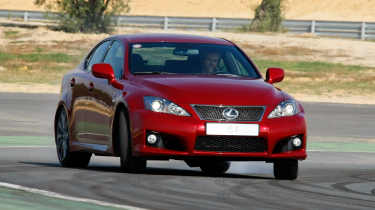
The IS F’s flaws remain though. It’s responsive and accurate enough but there’s a dearth of feel to the steering, with artificial added weight when in Sport mode. The damping is too busy and unsophisticated in feel at low speeds. You reap the rewards of what is a sturdy set-up at higher speeds, where the IS F tightens up and has a good sense of control.
Nonetheless, composure and control were never quite nailed in the IS F by Lexus’ F team and moreso, the feel of the steering. Being under-tyred at the front (225-section isn’t a lot for a heavy nose), you have to adjust your inputs and driving style to account for a nose that’s a bit too happy to wash wide. Wider wheels and tyres are an unsurprisingly popular modification, as are aftermarket springs and dampers and even full coilover kits and limited-slip differentials. By all accounts (including my own), a car that’s flawed as standard has potential that can be tapped with choice changes and expert set-up tweaks.
Driver’s note
‘Rolling away, the steering is surprisingly heavy, betraying a lack of speed-variable assistance, and the ride is firm too, but with some speed both feel right, and at a cruise refinement of road and wind noise is to a luxury car standard. Unfortunately, to a degree, so are the dynamics. On an enticing bit of road the calm of the smooth ride is occasionally interrupted by single-wheel bumps thumping through, while tacking into turns the car feels willing enough but there’s not much steering feel adding detail to the picture.’ – John Barker, evo editor-at-large.
Interior and tech
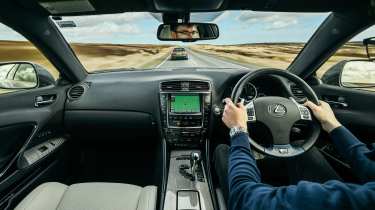
- An early taste of the scourge of touch screen climate controls
- Cabin is well put-together if a bit bland
- Seating position a little high in this pre-bucket era
It’s a well-known story with Lexus’s of this era. To look at the interior is a borderline snooze fest. Only fake carbon trim, alloy gearshift ears behind the steering wheel, a few F badges and some slightly meatier bolstering on the seats are clues to its performance positioning.
For whatever reason, the louder colour and trim options of later cars offered in the US and Japan were never offered in the UK. So here, most are a sea of black leather, gold fake carbon stickers and black plastic inside, or cream in later cars, which isn’t much better.
It was well-equipped for the day though, which might go some way to justifying its premium compared to an M3 at the time. Very early radar cruise, a reversing camera and even some of the very earliest self parking tech (I’ve never tried it on mine. Too scared) are present. Later cars got a DAB radio, Bluetooth connectivity and cooling in addition to heating in the seats. Infuriatingly, fan direction and strength is controlled via the touch screen. We should have decried it more back then, in the vain hope of staving off what we now know was coming…
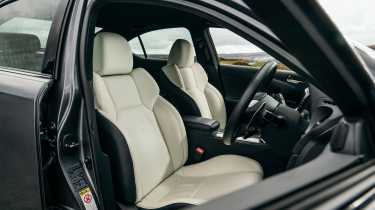
How to tell if you’re in a later car? Black rather than silvery gold plastics, a few splashes of chrome plastic trim and in much later IS Fs, an LFA-ish central dominant rev counter, in place of the two dials denoting speed and revs.
The leather is high quality and wears well, the dashboard plastics don’t and can be prone to cracking. The back seats of an IS F are not a comfy long-term place for adults either but the boot is usefully large. Large enough, I can attest from a recent road trip to the Nürburgring, for a load of Mazda MX-5 spare parts and some suitcases.
Driver’s note
‘The seats have decent support but in corners you slide on the slippery leather; the ride is unexpectedly robust at low speed, but at speed the damping is occasionally thuddingly wrong-footed.’ – John Barker, evo editor-at-large
Values and buying guide
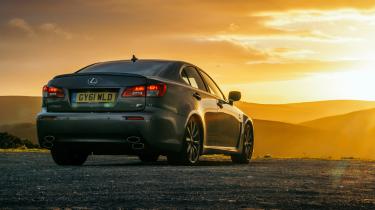
Oddly for an upstart in a segment so hotly contested by such storied names as BMW, Mercedes and Audi, values have held relatively well for IS Fs over the years, perhaps due to how rare they are. It’s thought that fewer than 300 were sold in the UK over its six years on sale.
They dipped to the mid-teens a few years ago and leggier cars can still be had in the £10,000-£15000 range. Cars with 90,000 miles or less and good history are upwards of £17,000. Later cars carry a premium on account of their being a bit better and obviously, newer. A low-miles 2012 or 2013 car is still a £20,000-plus concern. By comparison to the equivalent Germans, their values are in lockstep with the Merc and appreciably behind the BMW and Audi.
Compared to the E90 BMW M3, W204 Mercedes C63 AMG and B7 Audi RS4, these are relatively affordable to run and reliable. Nonetheless, there is an Achilles' heel. The coolant system. Water pumps were a known issue on early cars and all 2UR-GSE engines, whether in a 2008 IS F or a 2025 LC500, have the potential to spring a leak from the valley plate in the V of the engine, under the inlet manifold. It’s an expensive, 10-hour-plus job at a dealer but specialists are now well versed in the job.
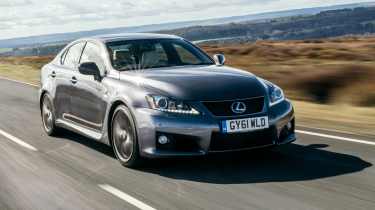
Expenses I’ve suffered with include a new crank pulley, new shims for the camshafts to remediate an annoying (but it turns out, not terminal) ticking and a few key batteries. Oh, and plenty of tyres, brake consumables and servicing.
Check the MOT history of your chosen car, the life in the tyres and brakes, that the gearbox is shifting as it should and that servicing has been diligent – every year or 5000 miles. These cars are surprisingly resilient to abuse on track but more oil changes for the engine and gearbox are a must if used as such regularly.
Specifications
| Engine | V8, 4969cc |
|---|---|
| Power | 417bhp @ 6600rpm |
| Torque | 371lb ft @ 5200rpm |
| Weight | 1714kg (247bhp/ton) |
| 0-62mph | 5.2sec |
| Top speed | 173mph |
| Price new | £55,995 (2010) |
| Value now | £17,000+ |