Hennessey Venom F5 Revolution review – how to make a Ferrari F80 look tame
Hennessey’s F5 Revolution has a full-bodied 1800bhp, but is no one-trick pony

We’re driving through Texas Hill Country in the Lone Star State’s very own hypercar, the Hennessey Venom F5 Revolution. A track-focused but very much road-legal version of the famously fast, needle-sleek F5 coupe.
Temptation comes in many forms, but few so seductive as this. After cresting a rise, the road unfurls ahead like a coarse, sun-bleached carpet. Two lanes wide, and straight for what must be a good three miles, it leads down onto a wide-open plateau like a shallow-angled alpine schuss. No traffic. No side turnings. Just wide-open country; a scene straight from every speed demon’s wildest dreams.
Hennessey Venom F5 Revolution in detail
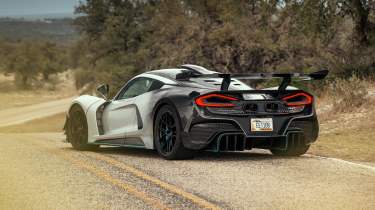
The Revolution’s prominent aero package comprises a larger front splitter, dive planes, full-width adjustable rear wing and extended diffuser signals a clear shift in priorities.
It’s not in the extreme aero league of a Valkyrie or Manthey-kitted 992 RS, but 363kg of downforce at 186mph is not to be sniffed at. Especially in a car weighing comfortably less than 1400kg. Somewhat hilariously, the Revolution is ‘limited’ to 250mph, at which speed downforce peaks at 635kg. Together with a more aggressive suspension geo setup for increased front-end bite, larger wheels and tyres for an increased contact patch and manually adjustable dampers for precise tuning, the Revolution is a uniquely formidable proposition.
More reviews
To prove the point, Hennessey took it to the Circuit of the Americas F1 circuit and set a new production car lap record, eclipsing the Czinger 21C (which rather stretches the notion of ‘production’) by 0.43sec and previous record-holder the McLaren P1 by almost 7sec. It also hit 193mph on COTA’s 1000-metre back straight. Gulp. There’s a suite of driving modes to deliver varying degrees of power and suit typical Revolution driving scenarios – Sport, Wet, Drag, Track and F5.
Believe it or not there’s an even more potent version, as Hennessey has taken the F5 platform a stage further since our visit, with a suite of changes including increased power and torque peaks of 2031bhp and 1445lb ft, adaptive TracTive dampers and, in Revolution spec, an upgraded aero kit with 40 per cent more downforce.
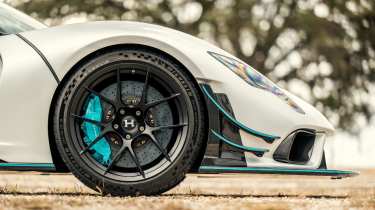
Indeed, we sampled the powertrain and suspension upgrades in development prototype form along NASA’s Shuttle Landing runway just under a year ago. That car was raw and very much a work in progress, fitted with myriad sensors and trialling different low-drag aerodynamic configurations compatible with breaching 300mph. The F5 Evolution package it spawned has now become the default spec for F5s and can be retro-fitted to earlier models for $285,000.
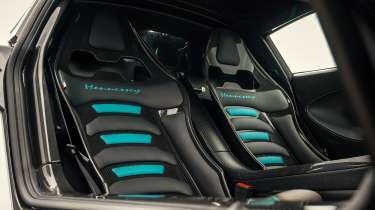
Push the release button and the lightweight scissor door accelerates upwards and outwards with a hiss of a gas strut. The cockpit is more than purely functional but some way short of plush. It’s as you’d expect of an all-carbon car with a focus on weight saving, the large areas of exposed, glossy weave proudly displaying the F5’s composite construction.
Soft furnishings are sparse, strategically positioned to stop you knocking your knees and elbows, and to absorb some road noise. The seats are an extension of this pared-back approach, hard, stiff carbon shells dressed with padded sections to locate you and offer some modest cushioning.
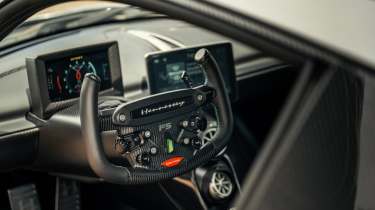
It’s a suitably Top Gun interior. There are no conventional gauges. Instead, a pair of small flat screens display vital info. The F5’s switchgear is designed with a mash-up of military and race-car function. Most of the buttons are positioned on the boss of the extreme yoke ‘wheel’, which hints at quick steering with a need for no more than half a turn of lock unless parking or attacking hairpins.
Additional switches are found in the centre stack, including D, N and R buttons (for Drive, Neutral and Reverse) controlling the seven-speed semi-automatic single-clutch transmission. Perforated metal shift paddles attached to the yoke give a satisfying click when pulled.
Your view out is something special thanks to an exceptionally low scuttle. It’s a dramatic reminder of the F5’s needle nose and a desire to present as little frontal area as possible. The front fenders rise sharp and pronounced like Willem Dafoe’s cheekbones, while the door mirrors sit on the ends of long arms that sprout from the base of the A-pillars to give you a view that clears the F5’s broad haunches. You really do feel like you’re sitting at the pointy end of an arrowhead.
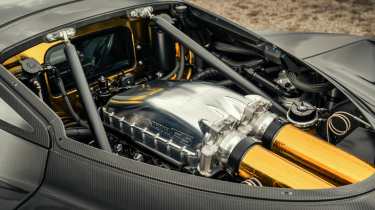
The lithe looks might be sharp as a dagger, but when you press the red ‘Ignition’ button and fire it up, the engine settles into a fat, dirty idle. Inside the car you hear lots of ancillary pumps and cooling fans whirring over the throb of the engine. From outside it sounds like a cross between a dragster and a bank of Japanese O-Daiko war drums. It pummels the air, the heavy cadence of its cross-plane firing order striking a delicious, lolloping beat, the sweet aroma of E85 fuel (which it requires to deliver its headline outputs) hanging in the air.

As if to signal their impatience, the big 76mm billet alloy wheels of the 1800bhp 6.6-litre ‘Fury’ engine’s twin turbos emit a soft whistle, their shrill tone adding nuance and intrigue to the seismic syncopated breakbeat. It all makes for a magnificent noise, richer and more menacing than one of Cosworth’s wailing V12s. The F5 sounds like it would snack on GMA T.50s like popcorn chicken and eat a medium-rare Valkyrie for its main.
The Revolution we’re driving here was made available to us by a generous and trusting owner, happy for us to discover just what it is to experience such a car on the public road. With a starting price of $2.7m, the responsibility weighs heavy. More so considering the extraordinary optional $250,000, 800-hour bespoke paint job, which begins as bright Bullet Silver at the front and fades to exposed gloss carbon at the tail, almost as if the paint has been ablated from the bodywork by pure speed. It’s an absolute masterpiece and suits the F5 to a tee.
Driving the Hennessey F5 Revolution
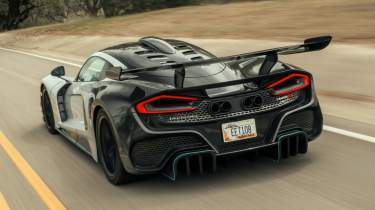
Driving almost any other car, Meaden mischief memory would have me changing down a few gears and flooring the throttle before conscious thought had a chance to stage an intervention. But the Venom F5 Revolution is not just any other car. In the space available, a concerted pull through the gears could have us travelling at its 250mph V‑max and back down to sane speeds with room to spare.

A lowly 200mph would be a breeze. Which is not meant to sound glib or sensationalist. These are the realities of driving a Hennessey Venom on the road. It’s the car equivalent of having the nuclear codes: you know what you can unleash, but you also know that, in all conscience, you can’t unleash it.
Rewind 13 years and I find myself in a similar situation behind the wheel of Hennessey’s OG hypercar, the Venom GT. You know it: one-part Lotus Elise, two-parts Marvel franchise cheese-dream with an absinthe chaser. Having pulled out of a side turning and found the road to be clear, I short-shift to second gear and then gas it through second, third and a brief lunge of fourth. To this day I haven’t felt quite such an intense surge of adrenaline or been left quite so speechless by what a car can do simply as a result of opening the throttle. It was foolish, but it was epic.
Just as I’m beginning to beat myself up for not taking the opportunity to be the fastest moving land-based vehicle on the continental USA, a police cruiser lopes into view at the other end of the straight. Whether its forward-facing speed radar could think quickly enough to assimilate an F5 comfortably on the wrong side of 200mph is thankfully academic.

Instead, we pass one another with contrasting expressions: me with my best butter-wouldn’t-melt glance, law enforcement officer with the amused look of a man who can read the minds of would-be felons a mile off. Especially those driving 1800bhp hypercars in the middle of nowhere.
Texas Hill Country is a curious region. Rising from the flat plains of East and West Texas and covering 31,000 square miles, this central plateau sits some 2500ft above the cattle ranches and oilfields that define the Lone Star State. Characterised by rocky terrain, natural springs and limestone canyons, it’s a fine place to drive a (very) fast car, with plenty of elevation change, wide open sweeps and sequences of testing transitional corners to punctuate the long straights.
It’s a stimulating change from the venues we’ve enjoyed on past Hennessey drives: NASA facilities and the flat cattle pastures surrounding Hennessey’s base in Sealy. If I hadn’t had previous experience of what Hennessey has achieved with the fabulous and criminally overlooked Venom GT, I might be more surprised by the way the F5 Revolution tackles these Hill Country roads.
It’s an ultra-precise machine, sharp and immediate with brilliantly direct steering that’s weighty enough to require a little effort but wieldy enough that you can steer from the forearms not the shoulders. It feels far more biddable than it has any right to. The way it turns in inspires tremendous confidence, and that response is matched by a reassuringly stable rear end.
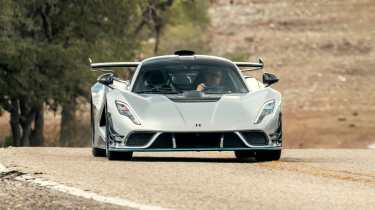
There’s unity in the way both ends of the car track through a corner, with no disconnect or mismatched rates of roll to shake your faith in the tail’s ability to live with the front end’s appetite for direction change. It really is laser-guided from the moment you turn the yoke, which is nicer to handle than you might expect.
Traction control and ESP systems are impressively effective, managing the fearsome task of balancing monstrous torque against available grip without feeling like they’re holding the F5 back. Likewise, the single-clutch semi-auto ’box copes extremely well, delivering generally smooth low-speed manners (it can get jerky if your throttle inputs are clumsy) and punchy up- and downshifts that have more of an edge to them than those of a typical DCT, but are significantly better than, say, Lamborghini’s Aventador.
Given the maximum loads and temperatures they have been developed to cope with, the F5’s brakes have sweet feel and progression. The ride is always firm and occasionally a little brittle, but this car is on passive dampers rather than the Evo’s adaptive units.
This agility-focused setup means the front wheels follow the road surface rather too faithfully at times, but it’s busy rather than distracted, so it’s more a case of becoming comfortable with it sniffing around and maintaining a slightly firmer hand rather than fighting it through a corner.
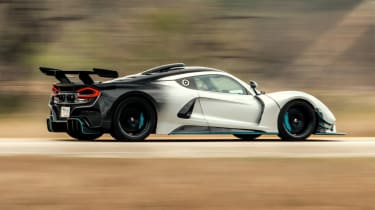
More than any Venom before it, the F5 Revolution’s reason for being far exceeds the headline-grabbing speeds for which Hennessey is famous. Still, I’d be lying if I said its ability to punch a hole in the horizon is anything less than wondrous.
Even now, having experienced three iterations of F5 and knowing what it feels like to hold down the throttle until you see either God or a highly inappropriate speed (or, most likely, both), the performance figures are completely gobsmacking. Seeing them listed as though it’s perfectly normal to quote a 0-400kph (249mph) time is illustrative of a car that exists in an entirely different dimension of speed. One that gets more ridiculous the faster it goes.
As you might imagine, attempting to put more than 1800bhp to the road through the rear axle alone is something of a challenge, hence the 0-62mph time of 2.6sec, but once hooked-up (a state it attains remarkably readily) the F5 is more in the business of matter transfer than mere mortal acceleration.

The jump from 62mph to 124 takes just 2.1sec. Keep it pinned and in another 3.7sec you’ll be doing 186mph. Another 7.1sec and you’ll be doing 249mph. According to Hennessey’s independently verified figures, that’s 0-249mph in 15.5sec.
The sensation of an exponential gain in speed is truly befuddling. As we’ve already established, no one in their right mind is going to do that on the open road. But, as you can doubtless imagine, when a car can take you from zero to 186mph in a little over 8sec, serious speeds are laughably easy to access.
Whether you choose to do so is another matter, but only if you’re fortunate enough to experience the ability these cars have to yo-yo between swift and interstellar speeds can you fully comprehend the level at which they operate.
So much of the F5’s mythology is built on its pursuit of raw speed that how it feels and performs on the road is largely lost in the slipstream. And yet the truth is, this missile is born for more than the laboratory environs of a NASA runway or even the limit-handling world of a racetrack. Granted, Texas Hill Country is not your average location.
It certainly doesn’t want for space to stretch the F5’s legs, but the topography, weather-beaten road surfacing and mix of endless shimmering straights and sinuous canyons places emphasis on the need to cope with whatever real-world road scenarios might throw up.
I imagined the Revolution would be forever leaning heavily into its electronics, but it delivers its performance with real finesse. It has true whole-car capability that belies its small production numbers and independent origins. Whether it’s the low-speed tractability (throttle response is uncannily linear on or off-boost), precisely metered and, for the most part, unfettered deployment of all that power and torque, or the precision with which you can send it along a truly challenging road, the F5 Revolution is something of a revelation.
Price and rivals

As you might expect, it’s very much its own machine. Where a Bugatti is defined by its bulkier build and deploys speed like a Shinkansen bullet train, the lighter Venom is more like a White Sands rocket sled. Intense and unrelenting, it can play nice but really wants to rough you up a bit with heavy doses of decibels and sustained, sense-scrambling longitudinal and lateral g.
Valkyrie? Aimed at extraordinary track performance but blessed with freakish active suspension, it achieves miraculous things in a very different way. Once you realise it weighs the same as the F5 but has a little over half(!) the power, you can perhaps imagine the fundamental character difference that separates them.
Koenigsegg has always seemed the closest to a Hennessey in spirit. Not least because it too relies on heavily boosted V8 powerplants. Christian von Koenigsegg’s love of eccentric in-house engineering innovations is in marked contrast to John Hennessey’s more pragmatic approach to outsourcing the manufacture of the F5’s Hennessey-designed tub and bodywork, but the Texan company has significantly bolstered its in-house capabilities in recent years and is rightly proud to be America’s only production hypercar builder.
By their very nature, hypercars of any and all denominations exist to entertain ultra-high-net-worth individuals. Whether these vehicles get used to a fraction of their hard-won and exhaustively developed capabilities is almost academic, but the $2.7million F5 Revolution proves that a truly mind-bending driving experience awaits those collectors prepared to use their cars as intended. Once driven, never forgotten.
| Engine | V8, 6555cc, twin-turbo |
|---|---|
| Power | 1817bhp @ 8000rpm |
| Torque | 1193lb ft @ 5000rpm |
| Weight | 1385kg (1333bhp/ton) |
| 0-62mph | 2.6sec |
| Top speed | 250mph |
| Price | £2million |