BMW M5 CS v Audi RS6 GT – the greatest supersaloon v the ultimate fast-estate
The two most thrilling fast German execs ever made finally meet. Is the BMW M5 CS still the dominant force or can Ingolstadt's steroidal estate topple it?
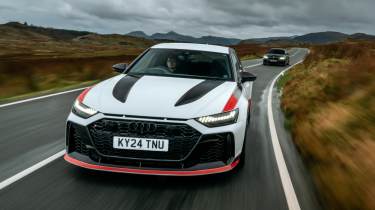
Perhaps there’s something in the water at Ingolstadt. In Mary Shelley’s original Frankenstein novel, it’s there that Victor creates his monster through a mysterious mixture of chemistry and alchemy. And it’s there that the Audi board signed off the monstrous RS6 GT. From evo’s very first test in 2024, it was clear that some kind of similar alchemy was at work. This was more than an RS6 with stickers: it was blessed with a colossal turn of pace but also remarkable precision. It was very much alive.
In his first drive of the GT (evo 327), Richard Meaden commented that there was something of the BMW M5 CS about it. Praise doesn’t come much higher in the corridors of evo Towers: the CS is still talked about in hushed tones round here. From its debut in 2021, the big BMW captivated all who drove it, edged out the Lamborghini Huracán STO and Porsche 911 GT3 to win eCoty 2021 (the only four-door car yet to win eCoty), and topped it all by proving itself an ultimate all-rounder in a five-month Fast Fleet long-term test. Like the RS6 GT, it was infused with agility at odds with its size. This was more than an M5 with a gold grille.
So we couldn’t resist getting the two together to compare, contrast and crown the ultimate German supersaloon/superwagon. Separated by three years, this pair share plenty of parallels. Both were developed by specialised divisions within major manufacturers, both last-of-the-line products squeezing the pips from their respective platforms. The CS was the final, ultimate form of the F90-generation M5 and the GT likewise for the C8-gen RS6, with motivated engineers given the resources to go out on a high and make them the best cars they could be.
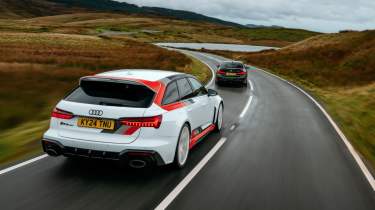
Both are powered by twin-turbo V8s with more than 620bhp and both boast a top speed around 190mph. Both feature special lightweight components (though are still heavy cars). Both were built in limited numbers: the RS6 GT was limited to a six-doors-down-from-the-beast 660 cars, with numbered plaques in each; around 1000 BMW M5 CSs were built during its single model-year production run. Both are future collector’s-item classics. And both feel a little like ‘end of days’ cars: the next RS6 will be a plug-in hybrid; the current M5 already is.

The GT wasn’t actually built at Audi’s main plant at Ingolstadt. Rather like the goings-on in Frankenstein’s lab, creating it was a specialised process, with production starting at Audi’s Neckarsulm facility before being moved to the nearby Böllinger Höfe plant for the car’s hand-fitted bodywork and suspension. (Similarly, the M5 CS was built at BMW’s Dingolfing plant before final specialised hand-assembly at M division’s Garching centre.)
Whereas Victor’s monster was an unsightly mass of mismatched body parts, both these cars are handsome creatures with dramatically muscular but balanced proportions. The M5 CS appeared borderline chintzy on reveal, with its bronze-gold details and yellow running lights; in 2025, it looks positively restrained. Though it doesn’t have bespoke arches like the Audi, the CS does have a carbon bonnet with extra cooling channels, plus redesigned front splitter, rear diffuser, mirrors, and bootlip spoiler, all in carbon.
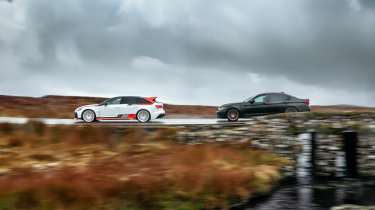
The RS6 GT is more extrovert. The regular RS6 isn’t short of presence but the GT’s bespoke widescreen arches and enormous 22‑inch wheels and XL tyres make it an estate with the aura of a supercar. It was inspired by the Audi 90 IMSA GTO race car, nicknamed the ‘UFO’ and a favourite muse of former Audi head of design Marc Lichte, who led the design of the RS6 GT and the preceding RS6 GTO concept car. The livery, inspired by classic Audi Sport motorsport graphics, makes an impression too. It was possible to buy the GT in Mythos Black and Nardo Grey too, with slightly less eye-catching decals, but in Arkona White with Colgate-coloured wheels to match, it has maximum impact.
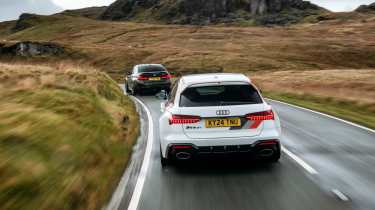
Especially so in the M5’s mirrors on our journey from evo HQ in Bedfordshire to north Wales, traditional home of mythical creatures (and good roads to test them on). I’m in the BMW, with senior staff writer Sam Jenkins following in the Audi, which looks incongruous in the best possible way on grey Midlands motorways. I can see other drivers’ reactions too in adjacent cars, double-taking as they clap eyes on the Audi.
Several spot the M5 CS too, even in its more under-the-radar Frozen Deep Green (one of only two hues available for the CS, along with Brands Hatch Grey), and offer approving headlamp flashes and thumbs-ups. Regular readers might remember YH21 FWW as evo’s former long-term test car in 2023. I was writing for another magazine back when evo first drove the CS but tested it concurrently on road and track, and was just as enthralled.
Slightly unexpectedly so: the CS recipe includes a bit less weight, some trivial-looking aero bits, suspension changes and lightweight seats. But they add up to more than the sum of their parts – more even than the £38k premium BMW charged over the regular M5. I remember deciding during that first test that my Lottery win garage would have an M5 CS in it.
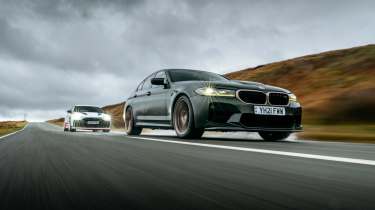
From the very first few roundabouts on this journey, I remember why. The CS feels taut and hunkered-down on its suspension (7mm lower than a contemporary M5 Competition), yet with just enough pliancy in the adaptive dampers (originally fitted to the M8 Competition, and recalibrated for the M5 CS). The steering is fast, super-responsive, but also full of detail; even through the BMW’s obese steering wheel rim you can feel what’s going on at the coalface between the Pirelli P Zero Corsas and the road. The Corsas were standard fit on the CS and seriously focused tyres for a saloon car. With rain on the horizon, that could prove interesting.
For now, in the dry, the M5 CS feels superb. You don’t need much lock to get its nose into a corner, and complementing the positive front axle is a rear end that follows just as keenly. Its limits are high so you need to be relatively brusque with your inputs to breach them but, when you do, the CS is balanced, progressive and transparent, helped by its long wheelbase and responsive steering. On a track, it can be to a driver as a paintbrush is to an artist, painting lines with its Pirellis wherever you wish to place them.
When the CS was new it was the most powerful production BMW yet (a mantle since passed to the XM and the new, hybrid M5). Its 4.4-litre twin-turbo V8 was tuned to 626bhp, 10bhp more than in the M5 Competition, while torque was unchanged from standard at 553lb ft. It’s enough. Applied to all four wheels via an eight-speed auto gearbox (as per the RS6 GT; neither of these cars uses a DCT), its official 0-62mph time was three seconds flat. We certainly wouldn’t get anywhere near that on this cold tarmac, getting colder and slimier by the minute as we cross the border into a dampening north Wales.
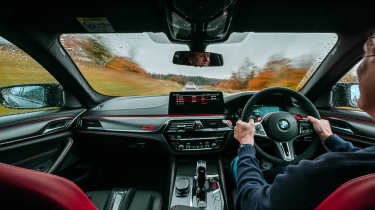
The F90 was the first M5 to go four-wheel drive – controversial at the time, now de rigueur – with the switchable ‘M xDrive’ system, which can be toggled from 4WD to the more rear-biased 4WD Sport and pure rear-wheel drive. Even in regular 4WD, it feels predominantly rear-driven. In normal driving scenarios, only an occasional flicker of wheelspin from the front wheels out of a slippery junction or slow corner reminds you that it does in fact drive both axles.
4WD Sport puts the M5 CS in its element: the stability control relaxes a little, allowing the big body to rotate nicely and ride out the power. You need to be in a particularly brave mood to put it into 2WD mode (particularly in this weather) but memories of time on track tell me it’s enormously friendly if you have some space to play with. As well as being enormous full-stop. This is a big car, but it doesn’t feel like it.
It’s happy to be overdriven but also rewarding when driven smoothly and neatly. Its overall poise and the consistent feedback through the chassis, seat and controls make it satisfying to drive at everyday speeds, too. Despite the bucket seats and near-trackday-spec tyres, this is still a comfortable, useable saloon car. Luxurious, even.
A gaudy one in places, perhaps – I’m not sure about the red accents and Nürburgring outline perforated into the headrests – but fit and finish are superb and ergonomically it’s spot-on. Including the older-generation iDrive, still a benchmark for intuitive infotainment systems. The carbonfibre-shell front seats, with the individual channels for your legs and a carbon divider between them, have become a modern M car hallmark.
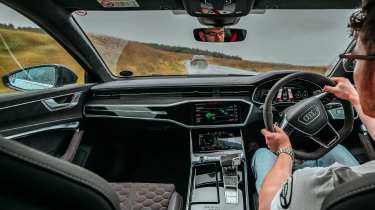
They’re so deep and aggressively bolstered in the M5 CS that if you’re not careful climbing in you can get a bruise from the carbon frame beneath the side bolsters, and I occasionally support myself on the sill when clambering out, like exiting a supercar. Once you’re in, they cradle upper and lower body beautifully, and it’s not until after a couple of hours’ motorway work that I start to ache – though it has to be said, the Audi’s less aggressive, still handsome carbon buckets are much comfier.
The BMW’s two rear seats are individual buckets, too. With Isofix! Kids brought up in them will have strong stomachs. With a flat torque curve from 1800rpm all the way to 5950rpm, the sense of acceleration is relentless. The CS’s engine is already a monster in Efficient mode, and there are Sport and Sport Plus settings to further sharpen its response. It’s not the most charismatic-sounding powerplant BMW has ever produced, but stiffer engine mounts than standard put you more in touch with it without overly compromising the CS’s road manners.

There are three levels of stiffness for the dampers, too. It’s pretty firm in Sport Plus, but in Comfort and even Sport there’s a useful amount of compliance. You feel the bumps but they don’t upset the car. Of the two steering settings, Comfort is quite light but there’s plenty of detail in there; Sport adds a dollop of weight and only becomes useful when you’re pressing on and working with big inputs. The only thing this CS is missing is the ten-stage traction control of later M cars, which would unlock more of its potential in conditions such as these.
As rain falls increasingly heavily, the CS feels decreasingly keyed in to the road. Now it’s the Audi’s time to shine. Sam is certainly beaming when we reach our destination. ‘Even before we got to these roads, I could tell it was something special. Despite its size, it inspires confidence down a tricky road. It deals with imperfections even in these conditions, never edgy or easily unsettled, but allows for rotation if that’s what you’re after. The damping is so sophisticated. Compared to a standard RS6 it feels really polished and not brittle as you might expect a hardcore special to be. Even with its crazy wheels and arches, in terms of its road manners this feels like the standard RS6 ought to feel – though obviously it would cost a lot more money…’
The RS6 GT was priced at £177,115, more than £60k extra over the regular RS6. The entire production run sold out, with 60 cars allocated to the UK. A quick search finds two for sale in the UK at the time of writing, priced between £175k and £195k (and one M5 CS, priced at £140k). Power and torque (621bhp and 627lb ft) were unchanged from the regular RS6 Performance, but an awful lot else was very different…
The enormous wheels are connected to passive coilover suspension with much stiffer anti-roll bars than standard. The suspension is adjustable via special tools housed in a case in the boot. The running gear is enveloped in special carbonfibre body panels, including the bonnet and wheelarches. Not all of the graphics are stickers; some of the black sections are exposed carbon. There are more extensive aero upgrades than with the M5 CS, including the sizeable roof-mounted wing and air vents behind the front wheelarches. And the GT has the mouth to match its ’80s shell suit trousers.
The RS6 GT didn’t win eCoty as the M5 CS did, but it impressed mightily in the 2024 edition, finishing fifth and beating, amongst others, the latest BMW M4 CS. I still remember clambering aboard for the first time, at the end of a day that had started long before sunrise. My tired eyes saw it simply as an estate car. I cued up a playlist for the Bang & Olufsen stereo, clicked the heated seat on and began to waft back to the hotel. It took only a couple of corners before I realised this was no ordinary estate car; a few more before I muted the stereo; and a couple more before I exclaimed out loud, ‘No way!’ No way could this 2075kg car be doing the things it was doing.
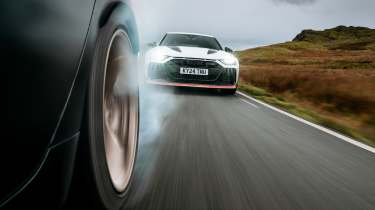
With cleverly calibrated rear-wheel steering, it tucks into hairpins like a sports car. As with the M5 CS, it feels smaller than it really is. While it can’t switch between all- and rear-wheel drive like the BMW, the Audi’s clever centre diff and GT-specific rear diff can themselves do remarkable things. A little like the CS’s active electronic rear diff, the RS6 GT can balance the rear axle’s torque left-to-right under acceleration and deceleration. It can also apportion more to the outside rear through a bend, helping the RS6 turn more keenly, or do the opposite during oversteer to help stabilise it. So both on- and off-throttle, it’s possible to tighten the GT’s line with real precision. Dynamic mode allows a little more yaw and the GT can be truly playful – albeit with enormous grip from its truck-sized tyres to overcome.
Braking performance, too, is remarkable. The M5 CS’s stoppers are enormous, with calipers that barely clear the wheels. But the RS6 GT’s are bigger still. Its front discs look like manhole covers. As with the BMW, they’re carbon-ceramics, helping to cut weight as well as boost braking performance. On that eCoty drive, I couldn’t get over how swiftly the GT stopped into downhill hairpins. Still can’t.
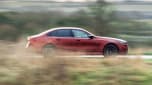
That experience made me a big fan of the RS6 GT even before this test had begun. But after the M5, it feels very different. It’s more obviously four-wheel drive than the BMW, with greater steering corruption: cambers in the road tug more readily at the wheel. There’s a numb spot at the top of the brake pedal’s travel and a strong initial spike of braking force thereafter, making it much trickier to modulate. Once you’ve clicked with it, however, it can steamroller a road, bend it to its will. With such reserves of grip, the pace it can carry into, through and out of corners is remarkable. Yet you’re still involved, engaged.
The Audi’s V8 has a more vocal, characterful rumble than the M5’s and similarly epic performance, though it’s also a great companion when you’re not going for it, wafting around on its buoyant wave of torque. Zero to 62mph in 3.3sec is good going for a 2.1-ton car but it’s the 0-124mph in 10.4sec stat that’s the more eye-opening, and the more indicative of the GT’s abilities. And as Sam points out, its ride quality is remarkable, considering its passively damped coilover suspension and gigantic wheels. That said, the M5’s ride-handling balance is just as impressive.
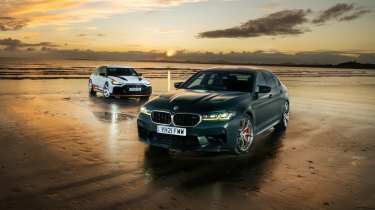
And while the Audi, with its bespoke, concept car-style bodywork, is the more special object to behold, the M5 is a truly special experience to drive. Just as the GT feels far removed from a normal RS6, the CS is a different being from a mortal M5. ‘There’s a sense of lightness to the BMW, not just in its lighter steering but in the whole car,’ Sam notes. ‘The Audi responds and rotates as if it’s way lighter than it is, but it’s in everything the M5 does.’ Not that it’s invincible. This test is Sam’s first experience of an M5 CS and he’s surprised by its sheer lack of grip in the wet. When he checks the tyre sidewalls, he notes that the P Zero Corsas were made in 2021, so are on the cusp of needing replacing.
Though the CS’s front end is as keen as ever, its tyres’ lack of bite in these conditions means you can no longer carry big speed into a corner as you can in the RS6 GT; you need to slow it down, feel it’s locked on at the front and then drive it round on the throttle. When you do, it’s still not spiky; there’s consistency and precision in its every movement.
Although the way they go about things is actually very different, this pair really do feel cut from the same cloth. The Audi is in many ways the ultimate expression of the Quattro philosophy, in style and in its dynamics, and it’s a truly special creation. But it’s the M5 CS that pushes my buttons hardest and is the more rewarding. Having driven every major car from M division since, I’d say the M5 CS is still its best of the decade so far. Both these cars are remarkable achievements but, like Frankenstein’s monster, both may stalk their creators for a while to come: they set a scarily high bar for future products to match up to. Let’s hope they don’t remain peaks never to be revisited.
Specs
| BMW M5 CS | Audi RS6 GT | |
|---|---|---|
| Engine | V8, 4395cc, twin-turbo | V8, 3996cc, twin-turbo |
| Power | 626bhp @ 6000rpm | 621bhp @ 6000rpm |
| Torque | 553lb ft @ 1800-5950rpm | 627lb ft @ 2300-4500rpm |
| Weight | 1825kg (349bhp/ton) | 2075kg (304bhp/ton) |
| 0-62mph | 3.0sec | 3.3sec |
| Top speed | 189mph (limited) | 190mph |
| Price new | £140,780 (2021) | £177,115 (2024-25) |
| Value now (2026) | £110,000+ | £170,000+ |