Honda’s JDM kei car icons do battle – car pictures of the week
Two tiny Japanese delights take on the rigours of an old British city, with typical kei car aplomb and cute style

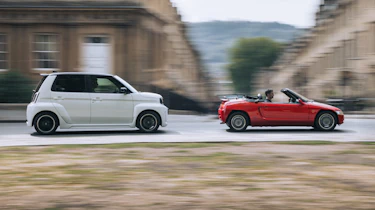
Never let it be said that we don’t love a bit of variety. Some time soon we will be driving Bugatti’s Tourbillon, an 8-litre V16 hybrid hypercar. In the current issue (351) of evo (in shops only for a few more days and available online from the evo shop), however, we compared two cars that only have three cylinders, one turbocharger and an electric motor between them for a cumulative 157bhp. It’s a battle between two generations of Honda kei car, the Honda Beat and new Super N, and these are our favourite shots from the test.
Now, the venue for such a test needs to differ from the usual Anglesey track battles and trans-Pennine face-offs we usually feature. In fact, even the B660 is a bit of a big pond for what are two tiny fish, so we ventured into the city of Bath.

Okay, strictly speaking the Super N isn’t a kei car. It uses kei car underpinnings but for the European market, features a widened track and a boost in power, up from the regulation 63bhp to a dizzying 93bhp. But the apple’s not fallen far from the tree. The Beat, meanwhile, is textbook kei car, from the late-1980s early-1990s peak of tiny Japanese icons.
They’re quite different, the N and the Beat, the former a boxy electric hatch, the latter a tiny mid-engined sports car. But the journey of discovering their differences and similarities was an interesting one. Here’s an excerpt from the test:
‘The urban environment is also where you can enjoy the advantages of a car that is, by modern standards, genuinely tiny. That is until you see the Super-N parked next to its distant relative, at which point it looks like an MPV because the Beat really is truly minute. I’ve owned mine for over a year and still sometimes I come back to it parked among normal cars and find myself startled by its weeness. I should add with some pride that when we stopped to take photos for this story outside Bath’s Royal Crescent, of the two it was the Beat that instantly attracted a crowd of tourists wanting to pose with it for photos.’ – Richard Porter, evo 351